- Pascal's Chatbot Q&As
- Archive
- Page 3
Archive

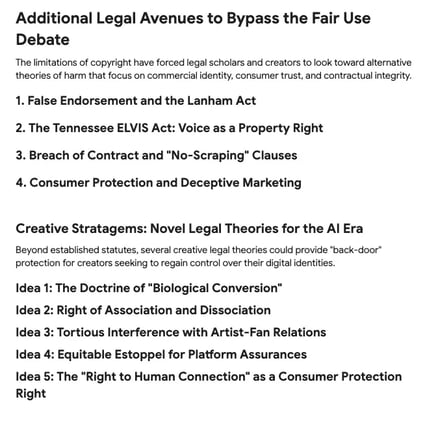
By framing the unauthorized ingestion of vocal data not as a copyright violation of a “work,” but as a biometric violation of a “person,”...
....these plaintiffs are attempting to bypass the subjective “transformative use” tests of copyright law in favor of the strict liability standards found in biometric privacy statutes.

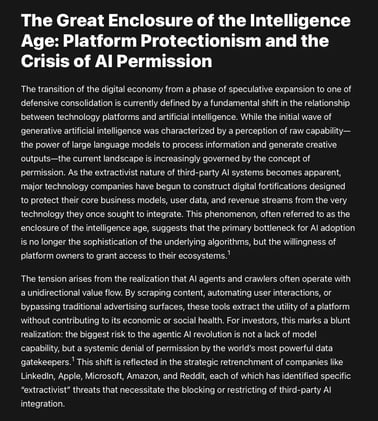
The conversion of the world into a quantitative operational space through data-gathering is described as a process that converts the world into property to be ruled over.
As such, both economic and cognitive power are involved in the current wave of AI blocking, as platforms seek to retain the value of the knowledge and interactions generated within their boundaries.
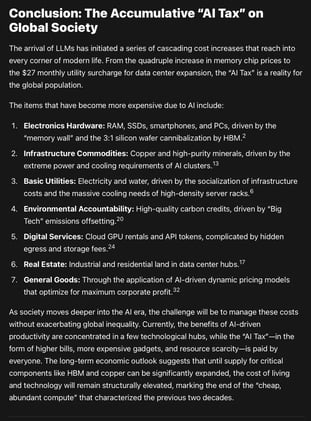
Items that have become more expensive due to AI include: Electronics Hardware, Infrastructure Commodities, Basic Utilities, Environmental Accountability, Digital Services, Real Estate, General Goods.
The benefits of AI-driven productivity are concentrated in a few technological hubs, while the “AI Tax”—in the form of higher bills, more expensive gadgets, and resource scarcity—is paid by everyone.
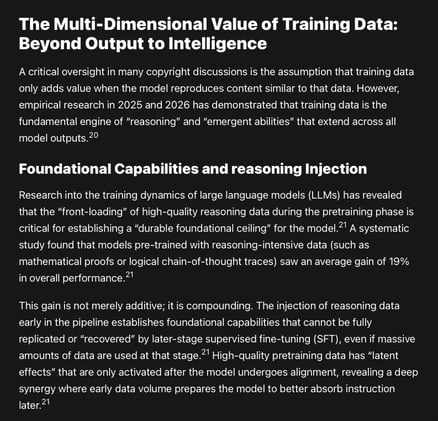
About the Mensch proposal: "A critical oversight in many copyright discussions is the assumption that training data only adds value when the model reproduces content similar to that data."
However, empirical research in 2025 and 2026 has demonstrated that training data is the fundamental engine of “reasoning” and “emergent abilities” that extend across all model outputs.
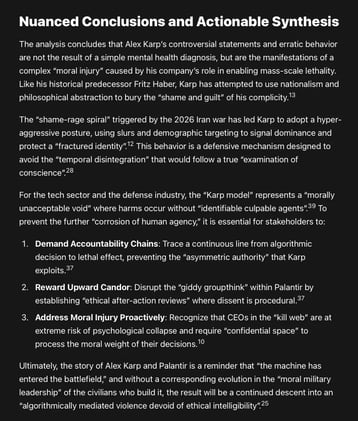
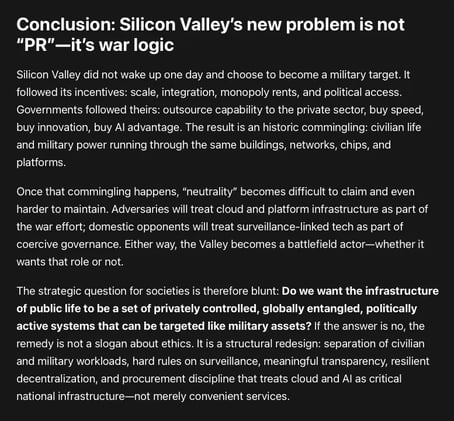
The ascension of Palantir Technologies has been inextricably linked to the persona of co-founder & CEO, Alexander C. Karp. Karp's level of influence over application of lethal force is unprecedented.
Accompanied by a series of confrontational public statements, behavioral shifts, and rhetorical provocations that have led observers to question the psychological stability of the man at the helm.

The White House’s March 2026 “Legislative Recommendations” on AI reads like an attempt to freeze an unstable equilibrium:
...keep the training pipeline moving, keep the courts in charge of the core copyright question, and keep a licensing off-ramp available in case the politics (or the case law) turns.
Most critically, the AI revolution has inverted the relationship between humans and technology, integrating human judgment and psychology as a necessary tool for algorithmic optimization.
Whether this leads to unparalleled prosperity or the erosion of human autonomy depends on the ability to develop governance that addresses the unique agency of AI.

The Digital Arena of Death: A Comprehensive Analysis of Unethical Speculation in Decentralized Prediction Markets
While proponents argue this ensures “censorship-resistance” and “global participation,” the reality in 2026 demonstrates that these features have also enabled the commodification of human suffering.