- Pascal's Chatbot Q&As
- Posts
- The Digital Arena of Death: A Comprehensive Analysis of Unethical Speculation in Decentralized Prediction Markets
The Digital Arena of Death: A Comprehensive Analysis of Unethical Speculation in Decentralized Prediction Markets
While proponents argue this ensures “censorship-resistance” and “global participation,” the reality in 2026 demonstrates that these features have also enabled the commodification of human suffering.

Pascal Hetzscholdt
March 20, 2026
The Digital Arena of Death: A Comprehensive Analysis of Unethical Speculation in Decentralized Prediction Markets
by Gemini 3.0, Deep Research. Warning, LLMs may hallucinate!
Introduction: The Convergence of Decentralization and Dark Speculation
The emergence of decentralized prediction markets has introduced a profound structural tension between the pursuit of information efficiency and the preservation of global security and human ethics. Historically, prediction markets—often categorized as “event contracts” or “information markets”—were conceived as tools for aggregating dispersed knowledge to forecast outcomes in politics, economics, and science.1 By requiring participants to place financial stakes on their beliefs, these platforms theoretically incentivize the disclosure of “hidden” information, producing signals that often outperform traditional polls and expert models.3 However, the migration of these markets to blockchain protocols such as Polymarket, Augur, and Gnosis has removed traditional regulatory gatekeepers, facilitating a rise in wagers that are increasingly described as “demented,” “grotesque,” and “dehumanizing”.3
The fundamental mechanism of these platforms relies on smart contracts—self-executing code residing on a blockchain—to lock user funds, determine event outcomes through decentralized oracles, and distribute payouts without human intervention.3 While proponents argue this ensures “censorship-resistance” and “global participation,” the reality in 2026 demonstrates that these features have also enabled the commodification of human suffering.6 The current landscape involves billions of dollars in volume flowing through contracts tied to the timing of military strikes, the ouster of sovereign leaders, and the deaths of public figures.10 As these platforms evolve from niche crypto-experiments into trillion-dollar valuation drivers, they pose systemic risks to national security, journalistic integrity, and societal health.13
Taxonomy and Ranking of Controversial Betting Contracts
To understand the ethical landscape of modern prediction markets, it is necessary to categorize and rank wagers based on their potential for real-world harm and the degree to which they violate established moral norms. The following ranking assesses bets on two primary axes: the severity of their unethical nature (the degree of moral transgression) and their real-world impact (the potential for causing physical harm, security breaches, or institutional collapse).
Ranking of Questionable Betting Contracts
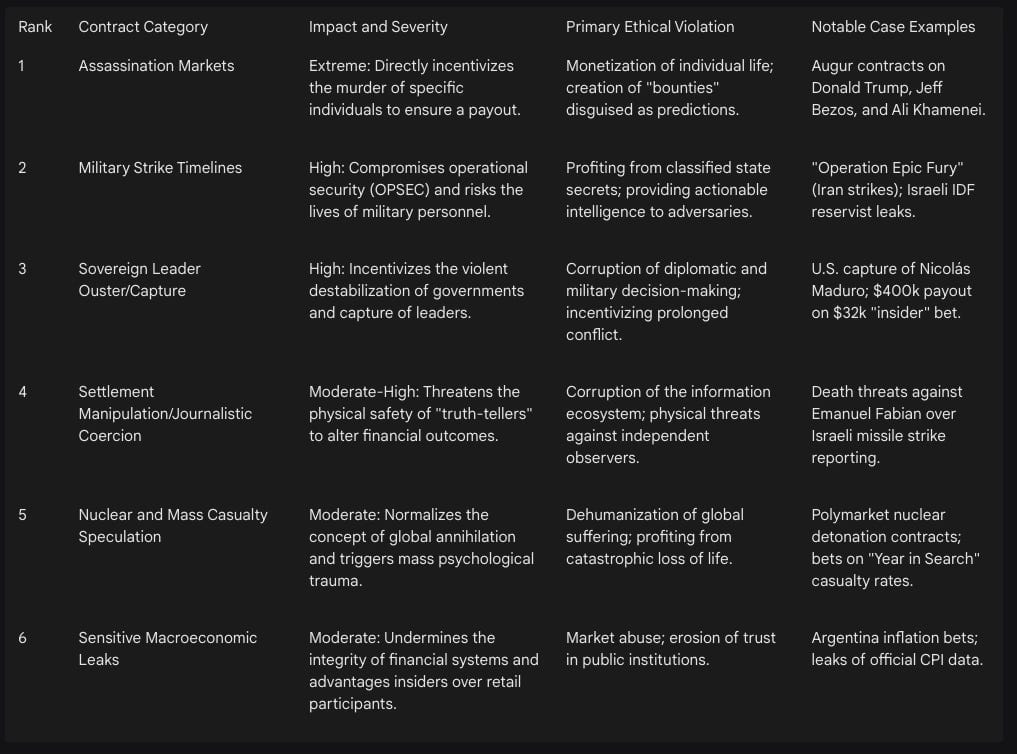
The ranking places assassination markets at the apex because they represent a “rigged game” where the boundary between prediction and commission is erased.6 A participant can ensure a “win” by actively killing the subject of the bet, making the platform a de facto crowdfunding tool for murder.6 Military strike timelines and sovereign ousters follow, as they fundamentally compromise the security of nations and the lives of those in active service.17
The Geopolitical Hazard: Information Leaks and Military Strategy
The most significant consequence of prediction markets in the realm of national security is their role as a “high-fidelity indicators and warnings (I&W) system” for adversaries.18 When markets are liquid and participants are anonymous, they become a magnet for individuals with access to classified information who seek to monetize their knowledge.11
The Commodification of Classified Intelligence
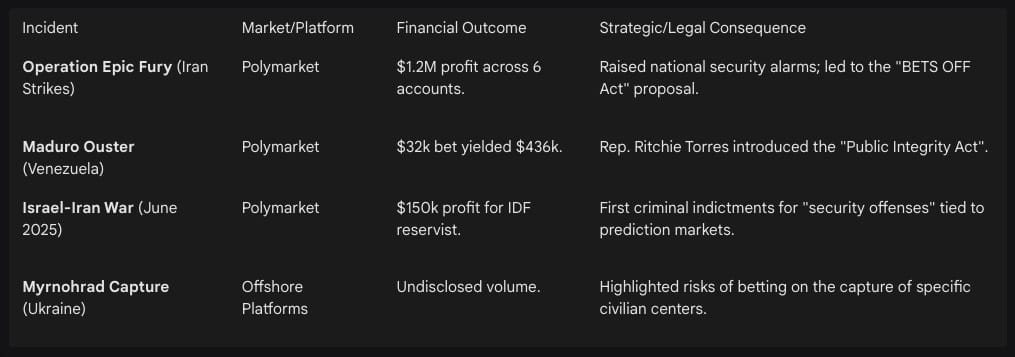
Military strategy relies on the element of surprise. Prediction markets effectively “liquidate” this surprise by reflecting non-public knowledge in the form of price movements.18 In early 2026, during the U.S. and Israel-led strikes on Iran (Operation Epic Fury), blockchain analysis identified a cluster of six wallets that earned over $1.2 million by betting “YES” on the timing of the strike just hours before it occurred.11 These accounts were funded specifically for this trade within 24 hours of the event, suggesting they were controlled by individuals with “inside knowledge” of President Trump’s military decisions.20
The consequences of such leaks are catastrophic. If an adversary observes a sharp rise in the “YES” price of a strike contract—moving, for example, from 10 cents to 90 cents—they can infer that an attack is imminent.11 This allows the adversary to move high-value assets, hide personnel, or launch a preemptive strike, directly resulting in mission failure and lost lives.13 The “unfiltered information” that proponents celebrate is, in a military context, a leak that compromises the safety of service members.12
Corrupting the Decision-Making Apparatus
Prediction markets create a “perverse incentive” for officials to push policies that serve their personal financial interests.9 A government advisor or military strategist who has placed a bet on a conflict breaking out is no longer a neutral arbiter of the public interest; they are a market participant who benefits from war.9 This “conflict of interest” transforms public service into a private enterprise, where the timing of a special operations raid can generate returns that dwarf an annual government salary.13
Case Studies in Strategic Compromise
Societal Consequences and the Human Cost of Gamified Conflict
Beyond the immediate security risks, the proliferation of unethical bets has deep-seated societal consequences, ranging from the erosion of communal empathy to the physical loss of life through gambling-induced despair. The “gamification of war” targets younger audiences, potentially normalizing violence as a speculative asset.12
Journalistic Integrity and the “Referee” Problem
One of the most concerning second-order consequences is the intimidation of journalists who serve as the “oracles” for these markets. In March 2026, military correspondent Emanuel Fabian reported that an Iranian missile had struck Israeli soil.10 Because the settlement of a $14 million Polymarket contract depended on whether the missile was “intercepted” or not, gamblers who stood to lose millions began sending Fabian death threats, pressuring him to change his reporting.10
This creates a world where every objective reporter is also a “referee” in a game with massive financial stakes.3 If the “truth” causes a loss for a violent or wealthy bettor, the reporter becomes a target.10 This dynamic threatens to corrupt the very information streams that the world relies on for an accurate understanding of global crises.14
Public Health, Addiction, and Mortality
The human cost of prediction markets is most visible in the data on gambling addiction. A landmark study from Oxford University published in Nature revealed that high levels of gambling are associated with a 37% increase in mortality.33 These platforms, often marketed as “event contracts” to evade regulation, capitalize on “sticky behavior” that can rapidly transition a user from social betting to high-level gambling.3
Statistical Overview of Gambling Harms
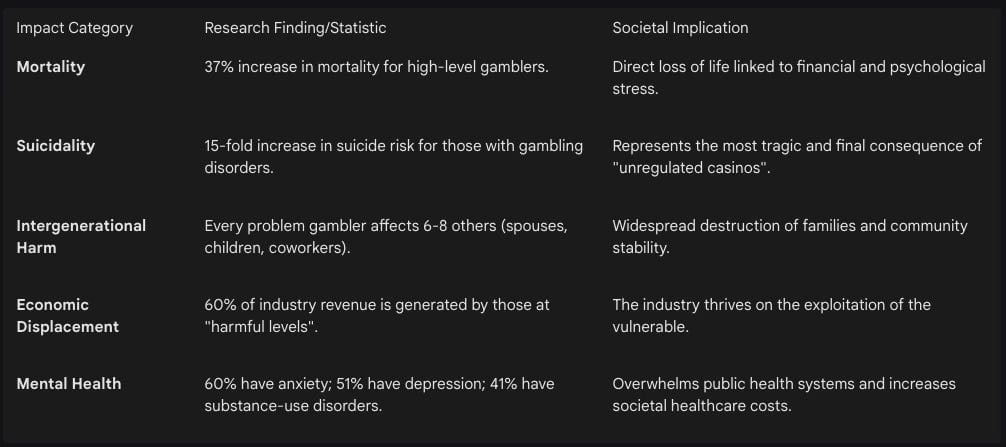
These statistics demonstrate that the “lost lives” associated with prediction markets are not merely a theoretical risk of assassination, but a documented reality of the mental health crisis exacerbated by these platforms.33 By “financializing everything,” platforms like Polymarket and Kalshi are accused of creating a “dystopian reality” where human suffering is a profit-center.9
Insider Trading and the Architecture of Corruption
The ethical critique of prediction markets often centers on the concept of “insider trading.” While traditional securities markets have clear prohibitions against trading on material non-public information (MNPI), prediction markets have operated in a “regulatory lacuna”.3
The Feature vs. Bug Debate
Proponents of decentralized platforms argue that insider trading is a “feature” because it forces the price to reflect the “truth” as quickly as possible.4 They claim that if a White House staffer knows a strike is coming and bets on it, the market price increases, thereby warning the public.4 However, this defense ignores the “perverse incentive” to create the very events being bet upon.6 As Rep. Ritchie Torres noted, if an official can personally profit from a policy outcome, they face an incentive to “push policies that line their pockets” rather than serve the public trust.21
Evidence of Market Manipulation
Blockchain analysis of the Iran strikes in 2026 provided empirical evidence of this corruption. Bubblemaps identified wallets that:
Were funded within 24 hours of the strikes.20
Exclusively bet on ultra-sensitive geopolitical events.28
Purchased “YES” shares exactly at the optimal moment for profit.28
Realized returns as high as 900% in a single day.20
This behavior reduces market liquidity and can cause prediction markets to “fail to provide useful information” because retail participants, sensing a “rigged game,” withdraw from the platform.21 The “wisdom of crowds” is thus replaced by the “theft of insiders”.21
Legislative Responses: The 2026 Regulatory Crackdown
As of March 2026, the “Wild West” era of prediction markets is facing a bicameral and international legislative onslaught. Lawmakers have identified that the current framework—where the CFTC must determine if a contract is “contrary to the public interest” on a case-by-case basis—is insufficient to handle the scale and speed of decentralized finance.27
Key Federal Legislation Introduced in 2026
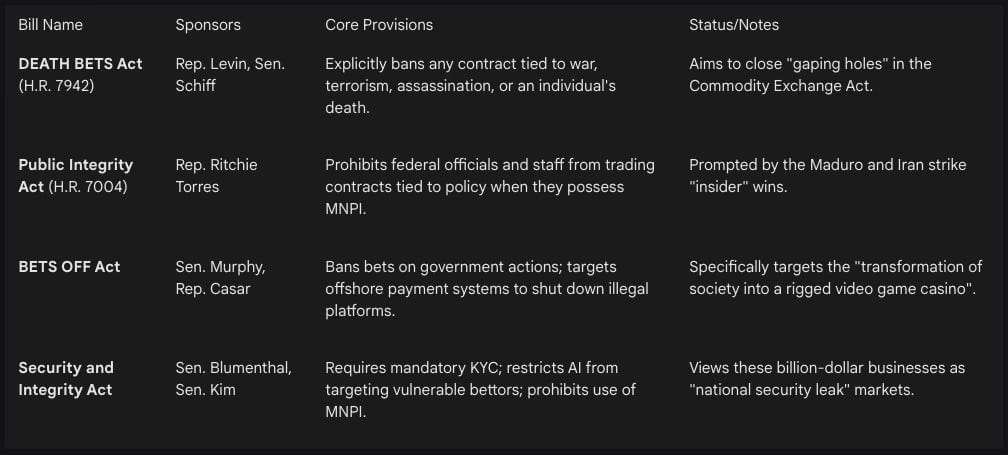
This legislative wave signals a shift from “regulatory clarity” to “prohibitive intervention”.40 Chairman Michael Selig of the CFTC has abandoned earlier “laissez-faire” proposals in favor of “clear rules” that uphold “investor protection and market integrity”.40
Recommendations: A Strategic Framework for Regulators
To effectively mitigate the risks posed by unethical betting markets, regulators must move beyond traditional financial oversight and adopt a multi-disciplinary approach that addresses national security, public health, and information integrity.
1. Statutory Prohibition of “Death Contracts”
Congress must pass the DEATH BETS Act to remove the discretion currently held by the CFTC.27 The standard of “public interest” is too subjective and slow-moving to counter decentralized protocols.27 A clear, statutory ban on any contract referencing the death of an individual or the outbreak of war would provide the “bright jurisdictional line” needed to shut down these markets.27
2. Mandatory Identity Verification (KYC) and Anti-Money Laundering (AML)
The anonymity of crypto-wallets is the primary shield for insiders.11 Regulators should mandate that any platform accessible to U.S. or EU residents must implement robust “know-your-customer” (KYC) procedures.31 For decentralized platforms that refuse to comply, authorities should use “BETS OFF” style measures to target the payment rails and “off-ramps” that convert crypto-winnings into fiat currency.9
3. Expansion of Insider Trading Definitions
Traditional securities laws must be updated to include “event contracts” as regulated financial instruments.23 This would allow the Department of Justice (DOJ) to prosecute individuals who use military or policy secrets to trade on Polymarket or Kalshi under traditional fraud and market abuse statutes.40 Corporate and government agencies should also integrate “prediction market surveillance” into their internal compliance programs.23
4. Protection of Information Oracles
To prevent the “Emanuel Fabian” scenario, legislation should include protections for journalists and data providers whose reporting settles high-stakes contracts.10 Platforms should be held strictly liable for any threats or coercion directed at their “oracles” and should be required to implement “dispute resolution” systems that are resistant to intimidation.1
5. Public Health Oversight and Advertising Bans
Prediction markets should be classified as a major public health concern similar to high-speed gambling.36 Regulators should ban the targeting of younger audiences and the “gamified” marketing of war.12 Platforms should be required to contribute to a “Gambling Harm Mitigation Fund” to address the 15-fold increase in suicide risk among their most frequent users.34
Conclusion: Reclaiming the Public Trust from the Speculative Abyss
The current state of decentralized prediction markets represents a “generational opportunity” to define the ethical boundaries of the “new frontier of finance”.40 While the ability to aggregate the “wisdom of the crowd” remains a powerful technological tool, it cannot come at the cost of human life or national security.1 The transition from “event contracts” to “assassination markets” and “war casinos” demonstrates that without firm regulatory guardrails, the most innovative technologies will inevitably be co-opted by the most predatory instincts.6
The legislative actions of 2026, if successful, will ensure that “the soul of America” is not “fundamentally corrupted” by the commodification of death.9 By treating prediction markets as the complex financial instruments they are—rather than simple “games”—regulators can preserve the informative value of these platforms while stripping away their capacity for harm.7 The era of profiting from the “next kinetic movement” must end, replaced by a system where information discovery serves the public good rather than the private pockets of the “inside trader”.18
Works cited
Augur stakes its reputation on the wisdom of the crowd | IBTimes UK, accessed March 19, 2026, https://www.ibtimes.co.uk/augur-stakes-its-reputation-wisdom-crowd-1515084
The Market Knows Best: Using Data From Prediction Markets to Assess National Security Threats - from MIPB, accessed March 19, 2026, https://mipb.ikn.army.mil/issues/jul-dec-2025/the-market-knows-best/
Prediction Markets: Thrills, Ethics, and Blockchain’s Double Edge, accessed March 19, 2026, https://www.chosun.com/english/opinion-en/2026/03/09/DFSBEXXNHNGBNDQYC2SQZZIFDM/
Prediction Markets and The Ethics of Betting on Bad News | The ..., accessed March 19, 2026, https://thedailyeconomy.org/article/the-ethics-of-betting-on-future-bad-news/
The Regulation and Value of Prediction Markets | Mercatus Center, accessed March 19, 2026, https://www.mercatus.org/research/working-papers/regulation-and-value-prediction-markets
The Rise Of An “Assassination Marketplace” Shows The Dark Side of Decentralized Networks - Futurism, accessed March 19, 2026, https://futurism.com/augur-assassination-marketplace-decentralized-blockchain
CFTC Issues Cease and Desist Order to Binary Options Operator Using Smart Contracts, accessed March 19, 2026, https://www.blockchainandthelaw.com/2022/01/cftc-issues-cease-and-desist-order-to-binary-options-operator-using-smart-contracts/
Crypto prediction market offers Trump assassination wagers - CoinGeek, accessed March 19, 2026, https://coingeek.com/crypto-prediction-market-offers-trump-assassination-wagers/
Amo, Murphy, Casar, Ansari Introduce Bicameral Bill To Ban ..., accessed March 19, 2026, https://amo.house.gov/press-release/amo-murphy-casar-ansari-introduce-bicameral-bill-to-ban-prediction-markets-from-enabling-officials-to-bet-on-and-profit-off-war
Polymarket bettors send death threats to reporter over missile report ..., accessed March 19, 2026, https://www.theblock.co/post/393790/polymarket-bettors-death-threats-reporter-missile-report-prediction-market
Polymarket under scrutiny as traders profit from Iran war predictions | Ctech, accessed March 19, 2026, https://www.calcalistech.com/ctechnews/article/syu2jf11tzx
Prediction Markets: Should People Be Allowed to Bet on War? | J&Y Law, accessed March 19, 2026, https://jnylaw.com/blog/prediction-markets-kalshi-betting-on-war/
Betting on War: Prediction Markets and the Corruption of National Security, accessed March 19, 2026, https://warontherocks.com/2026/01/betting-on-war-prediction-markets-and-the-corruption-of-national-security/
Polymarket bettors send death threats to reporter over missile report tied to $14 million prediction market pool | The Block, accessed March 19, 2026, https://www.theblock.co/post/393790/polymarket-bettors-death-threats-reporter-missile-report-prediction-market?utm_source=companies.xml&utm_medium=rss
More on making a killing from prediction markets | Statistical Modeling, Causal Inference, and Social Science, accessed March 19, 2026, https://statmodeling.stat.columbia.edu/2026/03/06/killing/
Assassination market - Wikipedia, accessed March 19, 2026, https://en.wikipedia.org/wiki/Assassination_market
Israel says Polymarket wagers used classified military information, files security charges - iGamingToday.com - News, insights and Slots review, accessed March 19, 2026, https://www.igamingtoday.com/israel-says-polymarket-wagers-used-classified-military-information-files-security-charges/
Precision-Guided Predictions: Intelligence Risk in Prediction Markets, accessed March 19, 2026, https://irregularwarfare.org/articles/intelligence-risk-prediction-markets/
Israel accuses two of using military secrets to place Polymarket bets, accessed March 19, 2026, https://www.btpm.org/2026-02-12/israel-accuses-two-of-using-military-secrets-to-place-polymarket-bets
Fresh accounts netted $1 million on Polymarket hours before US airstrikes on Iran: Bubblemaps | The Block, accessed March 19, 2026, https://www.theblock.co/post/391650/fresh-accounts-netted-1-million-on-polymarket-hours-before-us-airstrikes-on-iran-bubblemaps
In Response to Suspicious Polymarket Trade Preceding Maduro ..., accessed March 19, 2026, https://ritchietorres.house.gov/posts/in-response-to-suspicious-polymarket-trade-preceding-maduro-operation-rep-ritchie-torres-introduces-legislation-to-crack-down-on-insider-trading-on-prediction-markets
RELEASE: Prediction Market Bets Ahead of U.S. Military Actions Should Raise Corruption Alarm Bells in Congress - Center for American Progress, accessed March 19, 2026, https://www.americanprogress.org/press/release-prediction-market-bets-ahead-of-u-s-military-actions-should-raise-corruption-alarm-bells-in-congress/
Employee “Betting” in Prediction Markets: New Risks for Insider Trading and Proprietary Information Disclosure - The Compliance and Ethics Blog, accessed March 19, 2026, https://complianceandethics.org/employee-betting-in-prediction-markets-new-risks-for-insider-trading-and-proprietary-information-disclosure/
Buenos Aires Times: News from Argentina and beyond – in English, accessed March 19, 2026, https://www.batimes.com.ar/
United States: Eye on Enforcement - CFTC and Prediction Markets | Insight, accessed March 19, 2026, https://www.bakermckenzie.com/en/insight/publications/2026/02/united-states-eye-on-enforcement
The Current State of Prediction Markets - KPMG International, accessed March 19, 2026, https://kpmg.com/kpmg-us/content/dam/kpmg/pdf/2025/current-state-prediction-markets.pdf
Rep. Levin & Sen. Schiff Introduce New Bicameral Legislation to ..., accessed March 19, 2026, https://levin.house.gov/media/press-releases/rep-levin-and-sen-schiff-introduce-new-bicameral-legislation-to-explicitly-ban-death_war-prediction-contracts
Incredible story: Did bettors know in advance about the s | _Ram on Binance Square, accessed March 19, 2026, https://www.binance.com/en-IN/square/post/298366417027570
Trump Insiders Accused of ‘Profiting From War’ After Winning $1.2 Million via Bet on Iran Attack - YouTube, accessed March 19, 2026
Bill Introduced to Ban ‘Insider Trading’ by Federal Officials on Prediction Markets, accessed March 19, 2026, https://www.pymnts.com/cpi-posts/bill-introduced-to-ban-insider-trading-by-federal-officials-on-prediction-markets/
Sen. Blumenthal proposes bill establishing guardrails for prediction markets | Connecticut Public, accessed March 19, 2026, https://www.ctpublic.org/news/2026-03-11/prediction-markets-regulation-blumenthal-murphy
Murphy seeks ban on insider bets in prediction markets - Hartford Business Journal, accessed March 19, 2026, https://hartfordbusiness.com/article/murphy-seeks-ban-on-insider-bets-in-prediction-markets/
Oxford gambling study: The ‘fun’ can stop with financial problems, addiction, unemployment, ill-health and even death, accessed March 19, 2026, https://www.ox.ac.uk/news/2021-02-04-oxford-gambling-study-fun-can-stop-financial-problems-addiction-unemployment-ill
Gambling disorder, increased mortality, suicidality, and associated comorbidity: A longitudinal nationwide register study - PMC, accessed March 19, 2026, https://pmc.ncbi.nlm.nih.gov/articles/PMC6376387/
Gambling - World Health Organization (WHO), accessed March 19, 2026, https://www.who.int/news-room/fact-sheets/detail/gambling
Legalized gambling is exploding globally. What policies can limit its harms?, accessed March 19, 2026, https://www.hks.harvard.edu/faculty-research/policycast/legalized-gambling-exploding-globally-how-policy-can-limit
Hickenlooper, Murphy Introduce Bicameral Bill to Ban Prediction Markets On War, Government Actions, accessed March 19, 2026, https://www.hickenlooper.senate.gov/press_releases/hickenlooper-murphy-introduce-bicameral-bill-to-ban-prediction-markets-on-war-government-actions/
NEWS: Sen. Schiff Introduces Legislation to Explicitly Ban Death and War Prediction Contracts, accessed March 19, 2026, https://business.cch.com/srd/20260312-NEWS_SenSchiffIntroduces%C2%A0Legislation%C2%A0toExplicitlyBanDeathandWarPredictionContracts.pdf
Ritchie Torres Introduces the 2026 Financial Prediction Markets Public Integrity Act, accessed March 19, 2026, https://www.binance.com/en-IN/square/post/01-04-2026-ritchie-torres-2026-34610797052474
CFTC Chairman Outlines Regulatory Agenda for Prediction Markets and Cryptocurrency and SDNY Signals Focus on Prediction Markets Fraud | Paul, Weiss, accessed March 19, 2026, https://www.paulweiss.com/insights/client-memos/cftc-chairman-outlines-regulatory-agenda-for-prediction-markets-and-cryptocurrency-and-sdny-signals-focus-on-prediction-markets-fraud
Prediction Markets: The Emerging Regulatory Headache - Taylor Wessing, accessed March 19, 2026, https://www.taylorwessing.com/en/insights-and-events/insights/2026/03/prediction-markets-the-emerging-regulatory-headache