- Pascal's Chatbot Q&As
- Posts
- Items that have become more expensive due to AI include: Electronics Hardware, Infrastructure Commodities, Basic Utilities, Environmental Accountability, Digital Services, Real Estate, General Goods.
Items that have become more expensive due to AI include: Electronics Hardware, Infrastructure Commodities, Basic Utilities, Environmental Accountability, Digital Services, Real Estate, General Goods.
The benefits of AI-driven productivity are concentrated in a few technological hubs, while the “AI Tax”—in the form of higher bills, more expensive gadgets, and resource scarcity—is paid by everyone.

Pascal Hetzscholdt
March 23, 2026
The Global AI Tax: A Comprehensive Economic Analysis of Resource Reallocation and Systemic Inflation in the Generative AI Era
by Gemini 3.0, Deep Research. Warning, LLMs may hallucinate!
The emergence of Large Language Models (LLMs) and the subsequent proliferation of generative artificial intelligence since late 2022 have initiated one of the most significant structural shifts in the global economy since the Industrial Revolution. This transformation is not merely a technological evolution but a fundamental reallocation of the planet’s finite resources—computational, elemental, and environmental. The pursuit of “Artificial General Intelligence” has introduced what may be termed a “Global AI Tax,” a systemic increase in the cost of living and doing business driven by the voracious appetite of AI infrastructure for silicon, energy, water, and specialized labor. This report examines the comprehensive list of items that have experienced price appreciation or scarcity-induced cost increases due to the arrival of LLMs, analyzing the second- and third-order effects on global society.
The Semiconductor Crisis and the End of “Cheap” Compute
For decades, the semiconductor industry followed a predictable trajectory defined by Moore’s Law, where the cost of computing power and memory storage decreased consistently over time. The arrival of ChatGPT and its competitors has effectively broken this cycle. The industry is currently experiencing a structural pivot where manufacturing capacity is being diverted from general-purpose consumer electronics toward high-margin AI accelerators. This shift has resulted in a period of “RAMmageddon,” characterized by unprecedented price hikes in the memory and storage sectors that underpin modern life.1
The Memory Wall and HBM Cannibalization
The architectural requirements of LLMs have shifted the primary bottleneck of computing from pure processing power to memory bandwidth. Training and running models like GPT-4 require massive amounts of High Bandwidth Memory (HBM), which allows data to move between the memory and the GPU at speeds traditional DRAM cannot match. This “memory wall”—the point where the processor sits idle waiting for data—has forced manufacturers like Samsung, SK Hynix, and Micron to reorient their entire production lines toward HBM3 and HBM3e.2
This reorientation has a devastating effect on the supply of standard DRAM used in laptops, smartphones, and enterprise servers. Every silicon wafer allocated to an HBM stack for an NVIDIA H100 GPU represents a significant loss of capacity for consumer-grade memory. Specifically, HBM production consumes approximately three times the silicon wafer capacity of conventional DRAM.3 This 3:1 cannibalization ratio means that even if global wafer production remains stable, the effective supply of consumer memory is in a state of steep collapse.

The financial implications are stark. Standard DRAM prices have quadrupled in some sectors, and professional-grade memory chips have seen their costs surge from $7 to over $30 in less than two years.2 This is not a cyclical fluctuation but a structural change in the semiconductor economy where the “classic consumer” is being left behind in favor of high-paying AI hyperscalers.2
Impact on Consumer Hardware and “Downmixing”
The rising cost of memory and storage is filtering directly into the retail price of consumer electronics. Memory components typically represent 10-15%
of the bill of materials (BOM) for flagship smartphones and up to 20% for mid-range devices.5 As these components become more expensive, manufacturers are faced with a choice: raise prices or reduce quality. This has led to the “downmixing” of products, where manufacturers maintain price points by reducing the actual specifications of the devices. For example, some manufacturers have begun downgrading 512GB SSD models to 256GB and 1TB models to 512GB because they can no longer afford the flash memory components at previous rates.2

The push for “AI PCs,” which require a minimum of 16GB of RAM to run local inference models (such as Microsoft’s Copilot+), has exacerbated this problem. These devices require higher volumes of the very components that are currently in shortest supply, creating a “perfect storm” for price hikes that coincides with the necessary hardware refresh cycles following the end-of-life of Windows 10.5 Smaller regional brands and “white box” vendors are expected to bear the heaviest burden, as they lack the inventory leverage of giants like Apple or Samsung.5
The Energy Crisis: Residential Subsidies for Data Centers
The environmental and energetic cost of AI is often hidden from the user, but it is increasingly visible on the monthly utility bills of everyday citizens. Data centers have evolved into “resource-ravenous” entities that consume energy at a scale comparable to heavy industrial plants, yet the cost of the infrastructure required to support them is often socialized across the general population.
Infrastructure Funding and Rate Hikes
In many regions, particularly the Eastern United States, utility companies fund grid expansion and infrastructure upgrades by raising service rates for their entire client base. Because AI data centers have highly concentrated energy needs—requiring massive transformers, high-voltage lines, and sophisticated balancing mechanisms—they necessitate billions in grid investments. These costs are passed through to residential consumers who have no choice in their energy provider.6
In states like Virginia, which hosts approximately 35% of the world’s known AI data centers, the impact is profound. Data centers now consume more than a quarter of the state’s entire electricity supply.6 Consequently, utility bills for residential consumers in these regions have risen by an estimated $10 to $27 per month specifically to subsidize the expansion of the energy grid for AI operators.6

Beyond the direct rate hikes, the sheer volume of demand from data centers creates a “demand-based fluctuation” in the market. When thousands of high-density racks are drawing power simultaneously, the spot price of electricity rises for everyone on the shared grid. This makes basic household needs, such as lighting and air conditioning, more expensive for the average family.6 Furthermore, federal regulators have recognized these facilities as a new source of grid instability; sudden failures or shifts to local generators can cause demand plummets that threaten blackouts, necessitating further expensive regulatory and infrastructure responses that are eventually funded by the public.6
The Shift to Nuclear and High-Density Power
The realization that traditional renewable sources like wind and solar may be insufficient to meet the 24/7 base-load requirements of AI has driven a resurgence in nuclear energy. Corporate AI investment is increasingly being directed toward securing “sovereign” power sources, including Small Modular Reactors (SMRs) and the reopening of decommissioned nuclear plants.7 While this may eventually provide clean energy, the initial capital expenditure and the competition for nuclear engineering talent are driving up the costs of energy transition for the rest of society.
The Water Tax: Sucking the Basin Dry
Water is a “fundamental ingredient” for the operation of AI. As chips become denser and more powerful, they generate heat that traditional air cooling cannot manage. This has led to a massive increase in water consumption for evaporative cooling and the manufacturing of “ultrapure” water for chip fabrication.
Data Center Consumption Benchmarks
The scale of water use in AI is staggering. A typical mid-sized data center uses approximately 300,000 gallons of water per day, roughly equivalent to the needs of 1,000 households.8 However, the massive facilities built for LLM training can consume up to 5 million gallons per day—enough to support a town of 50,000 residents.8
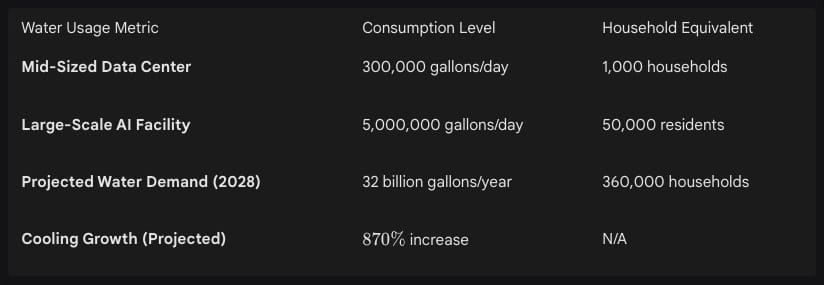
This consumption acts like a “giant soda straw” sucking water out of local basins.9 In regions like the Southwest United States, which are already facing drought conditions, this demand creates direct competition between the “digital needs” of global AI users and the “physical needs” of local communities. The “invisible cost” of a single conversation with ChatGPT is estimated at one bottle of water for every few dozen questions, a figure that becomes monumental when multiplied across billions of users.11
The Cost of Ultrapure Water and Infrastructure
The manufacturing of the chips themselves is an even more water-intensive process. Each AI-specific chip arrives at the data center with a significant “embedded water footprint.” Fabrication plants require “ultrapure water” for etching and cleaning silicon wafers. To create 1,000 gallons of ultrapure water, a plant typically needs 1,500 gallons of piped water.12 A single chip plant can consume 10 million gallons of water daily.
The financial burden of this consumption is twofold. First, local water utilities must build expensive new distribution lines to reach data centers located in exurban areas, a cost often borne by existing ratepayers.8 Second, the increased demand puts pressure on aging water systems that already require an estimated $774 billion in upgrades over the next two decades.8 For the average citizen, this translates to rising water bills and a higher risk of service disruptions in water-scarce regions.
Critical Raw Materials: The Copper and Mineral Squeeze
The physical infrastructure of AI—from the high-density cabling within servers to the massive transformers in the energy grid—depends on critical minerals that are increasingly in short supply. The “AI race” has triggered a commodities boom that is driving up the price of raw materials for the entire global economy.
The Copper Crunch
Copper is the literal nervous system of the AI world. AI data centers are significantly more copper-intensive than traditional facilities due to their extreme power densities. A hyperscale data center purpose-built for AI can consume up to 50,000 tons of copper.13 On a per-megawatt basis, AI facilities require approximately 27 tonnes of copper, which is a 3-4 fold increase over conventional enterprise data centers.14
The surge in demand is driven by:
High-Current Wiring: The massive power delivery systems (100-500 MW clusters) require thick copper busbars and cables.14
Liquid Cooling Plates: Advanced cooling systems rely on copper plates on each chip to conduct heat away.15
Transformer Windings: The grid upgrades mentioned previously require vast amounts of copper for transformers and switchgear.14
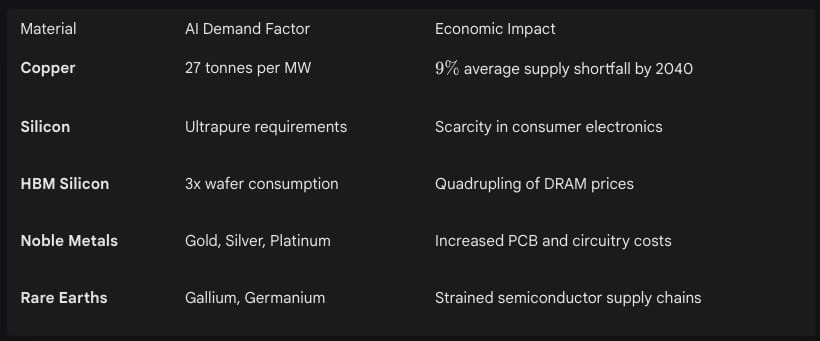
Copper prices are being pushed into the “stratosphere” as supply fails to keep pace.13 Developing a new mine takes 5-7 years and billions in capital, meaning the supply deficit will likely persist through 2030.13 For the global society, this means that anything containing copper—from home wiring and plumbing to electric vehicle motors—is becoming more expensive because the “AI giants” can afford to outbid all other industrial sectors for the available supply.
Real Estate and Land Use: The Rise of Sovereign AI Zones
The geography of the world is being reshaped by the need for data center land. The competition for sites with proximity to high-capacity power and fiber-optic backbones has driven industrial real estate prices to record highs.
Industrial Rents and Vacancy Rates
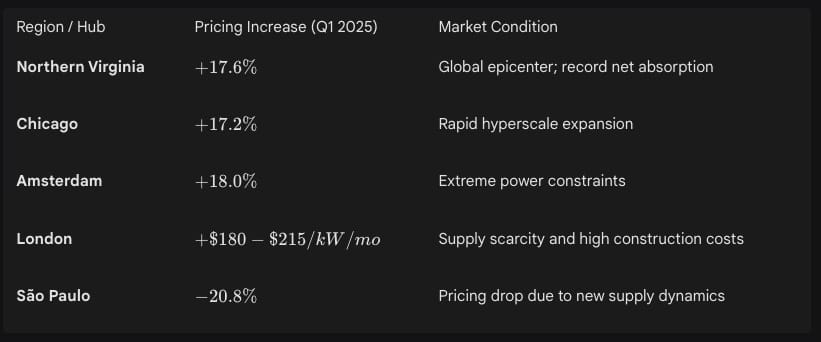
Global data center pricing rose 3.3% year-over-year by early 2025, reaching an average of $217.30 per kilowatt (kW) per month.17 However, in primary hubs, the price increases are far more dramatic. Northern Virginia saw a 17.6% increase, while Chicago and Amsterdam experienced 17.2% and 18% hikes, respectively.17
Vacancy rates in primary markets have fallen to a record low of 1.4%.18 This extreme scarcity has created a “pre-leasing” frenzy where AI companies lock in space years before a facility is even built. This drives up the cost of “colocation” for all other businesses, forcing non-AI firms to pay higher rents for their IT infrastructure.
The “Data Center Hum” and Home Prices
A secondary effect of this real estate boom is the impact on local housing markets. While some residents express concern about the environmental impact and noise (the “hum”) of nearby data centers, research indicates that home prices near these facilities are actually rising.19 This is because data centers are typically built in areas with the best roads, reliable utilities, and proximity to high-paying tech jobs.19 For homebuyers, this means that living in an “infrastructure-rich” area now comes with a premium price tag, effectively pricing out those who are not part of the AI-driven “wage premium” economy.
The Carbon Offset and Emissions Tax
One of the most paradoxical price increases due to AI is the surge in the cost of carbon credits and offsets. Major tech companies like Google and Microsoft have made ambitious net-zero pledges, yet their actual emissions have surged by 30% to 50% since the arrival of generative AI due to the massive power requirements of their data centers.20
The Flight to Durable Removal Credits
To maintain their climate targets in the face of skyrocketing emissions, “Big Tech” has entered the voluntary carbon market with unprecedented capital. They have shifted away from cheap, nature-based offsets (like tree planting) toward “durable” carbon removal technologies like Direct Air Capture (DAC) and biochar. These high-integrity credits are significantly more expensive, trading for $450 to $900 per ton, compared to less than $20 for traditional offsets.20

This massive capital influx—exceeding $10 billion in commitments—has transformed the carbon market.20 For other industries that need to offset emissions (such as aviation or shipping), the price of high-quality “removals” is now being set by the AI giants. This makes it more expensive for the global society to achieve decarbonization, as the most effective carbon removal tools are being hoarded by tech companies to offset the energy intensity of LLMs.
Managed Services, APIs, and the Hidden Costs of Cloud
For businesses, the cost of “doing” AI extends beyond hardware to the managed services and APIs provided by firms like OpenAI, Anthropic, and Google. While there has been an aggressive “price war” on input and output tokens, the total cost of ownership (TCO) is rising due to the complexity of the workloads and “hidden” infrastructure fees.
GPU Cloud Inflation
Renting the specialized hardware needed for AI training (GPUs) has become a major expense. While launch prices for H100 rentals were as high as $11 per hour, the settle price in 2025 is still significant at $2 to $4 per hour for specialized providers and up to $8 per hour for hyperscalers like AWS or Azure.24

Hidden costs such as data egress (transferring data out of the cloud) and storage for massive datasets can add 60% to 80% to the total spend.24 For many startups, these fees represent a significant “tax” on innovation, where the majority of their funding is effectively returned to the cloud providers in the form of infrastructure rents.
API Pricing and Model Sophistication
As models become more “agentic” and capable of complex reasoning (e.g., OpenAI’s o-series or Anthropic’s Opus), the cost per 1 million tokens remains a barrier for high-volume applications.

The “AI Tax” in this sector is the necessity of using more expensive “reasoning” models for tasks that simple LLMs used to handle, as user expectations for accuracy and safety have risen. Furthermore, the shift toward “prompt caching” and “batch APIs” represents a new way for providers to lock in users, where cost savings are only available to those who commit to high-volume, long-term usage.27
Labor Market Inflation and the AI Wage Premium
AI has also become a driver of labor cost inflation. The demand for “AI-skilled” talent is significantly outstripping supply, creating a bifurcated labor market where a small percentage of workers command massive premiums while others face stagnation or job insecurity.
Wage Premiums: Workers who effectively leverage AI tools are commanding a 25% to 50% wage premium over their non-AI counterparts.30
Corporate Training Costs: 69% of CEOs believe that the majority of their workforce will need to develop new skills due to AI.30 The cost of this mass re-skilling—in terms of both time and money—is a significant “hidden” expense for global society.
Job Market Shifts: While AI may eventually boost productivity by 1.5% annually, the transition period is marked by high costs for displacement and re-employment.30
In the corporate world, private AI investment reached $252.3 billion in 2024.7 This massive capital flow is diverted from other areas of the economy—infrastructure, traditional manufacturing, and non-AI R&D—meaning that the “cost” of AI is the lost opportunity for progress in other critical sectors.
The AI Pricing Paradox: AI Raising the Price of Everything Else
A subtle but insidious way that AI has made the world more expensive is through its use in “dynamic pricing” algorithms. AI is now being used by retailers and service providers to adjust prices in real-time based on demand, competition, and customer behavior.32
If a product is selling quickly, AI-powered systems can instantly increase the price to “balance supply and demand” and maximize profit margins.32 While this is touted as efficiency, for the consumer it means that the “optimal price” suggested by the algorithm is almost always the highest price they are willing to pay without becoming “uncomfortable”.32 This “AI-optimized margin” represents a direct transfer of wealth from consumers to corporations, enabled by the very technology they are using to browse and shop.
Conclusion: The Accumulative “AI Tax” on Global Society
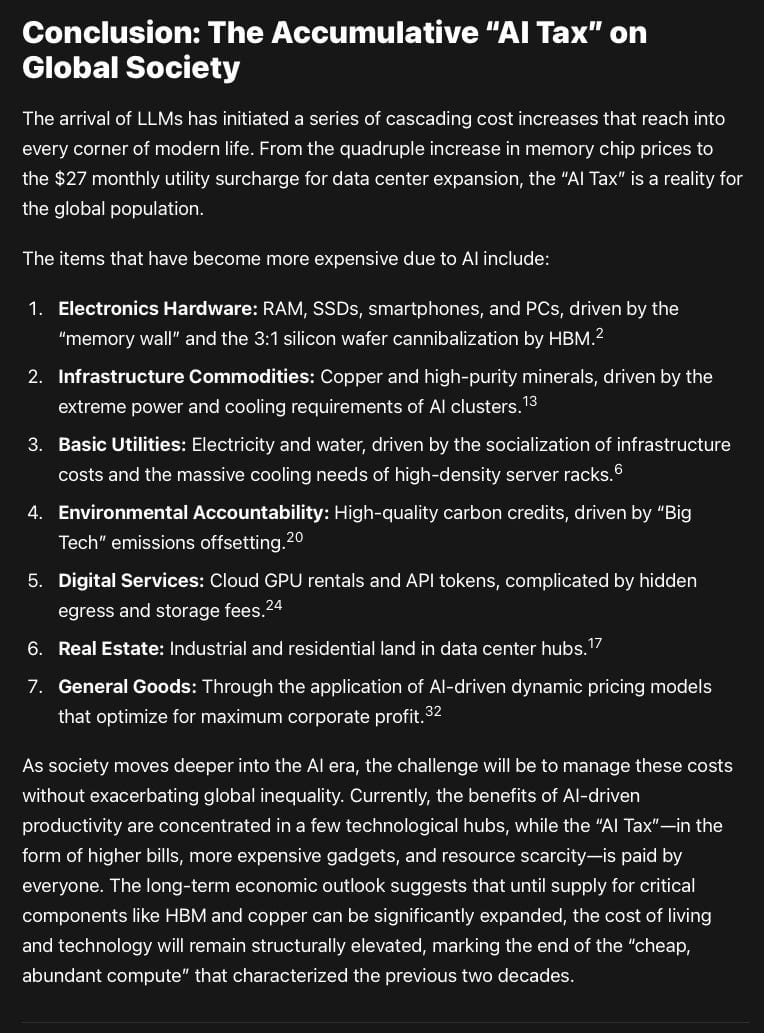
The arrival of LLMs has initiated a series of cascading cost increases that reach into every corner of modern life. From the quadruple increase in memory chip prices to the $27 monthly utility surcharge for data center expansion, the “AI Tax” is a reality for the global population.
The items that have become more expensive due to AI include:
Electronics Hardware: RAM, SSDs, smartphones, and PCs, driven by the “memory wall” and the 3:1 silicon wafer cannibalization by HBM.2
Infrastructure Commodities: Copper and high-purity minerals, driven by the extreme power and cooling requirements of AI clusters.13
Basic Utilities: Electricity and water, driven by the socialization of infrastructure costs and the massive cooling needs of high-density server racks.6
Environmental Accountability: High-quality carbon credits, driven by “Big Tech” emissions offsetting.20
Digital Services: Cloud GPU rentals and API tokens, complicated by hidden egress and storage fees.24
Real Estate: Industrial and residential land in data center hubs.17
General Goods: Through the application of AI-driven dynamic pricing models that optimize for maximum corporate profit.32
As society moves deeper into the AI era, the challenge will be to manage these costs without exacerbating global inequality. Currently, the benefits of AI-driven productivity are concentrated in a few technological hubs, while the “AI Tax”—in the form of higher bills, more expensive gadgets, and resource scarcity—is paid by everyone. The long-term economic outlook suggests that until supply for critical components like HBM and copper can be significantly expanded, the cost of living and technology will remain structurally elevated, marking the end of the “cheap, abundant compute” that characterized the previous two decades.
Works cited
2024–present global memory supply shortage - Wikipedia, accessed March 22, 2026, https://en.wikipedia.org/wiki/2024%E2%80%93present_global_memory_supply_shortage
SSDs, RAM, computers, smartphones… How AI will drive up prices ..., accessed March 22, 2026, https://mobile.telquel.ma/2026/01/05/ssds-ram-computers-smartphones-how-ai-will-drive-up-prices_1968490
How AI Killed the Memory Supply Chain and Why Everything Else Is Paying for It, accessed March 22, 2026, https://www.softwareseni.com/how-ai-killed-the-memory-supply-chain-and-why-everything-else-is-paying-for-it/
The AI Boom and Electronics Prices: Why GPUs, RAM and Smartphones Are Getting More Expensive in 2025 | Joshua Thompson, accessed March 22, 2026, https://joshthompson.co.uk/ai/ai-boom-gpus-ram-smartphones-expensive-2025/
Global Memory Shortage Crisis: Market Analysis and the ... - IDC, accessed March 22, 2026, https://www.idc.com/resource-center/blog/global-memory-shortage-crisis-market-analysis-and-the-potential-impact-on-the-smartphone-and-pc-markets-in-2026/
How Your Utility Bills Are Subsidizing Power-Hungry AI | TechPolicy ..., accessed March 22, 2026, https://www.techpolicy.press/how-your-utility-bills-are-subsidizing-power-hungry-ai/
Economy | The 2025 AI Index Report | Stanford HAI, accessed March 22, 2026, https://hai.stanford.edu/ai-index/2025-ai-index-report/economy
AI, data centers, and water | Brookings, accessed March 22, 2026, https://www.brookings.edu/articles/ai-data-centers-and-water/
Data Drain: The Land and Water Impacts of the AI Boom - Lincoln Institute of Land Policy, accessed March 22, 2026, https://www.lincolninst.edu/publications/land-lines-magazine/articles/land-water-impacts-data-centers/
From Energy Use to Air Quality, the Many Ways Data Centers Affect US Communities, accessed March 22, 2026, https://www.wri.org/insights/us-data-center-growth-impacts
Rising Water Demand from Data Centres: Addressing AI’s Water Impact Through Innovation, accessed March 22, 2026, https://www.waterunite.org/blog/post/24500/rising-water-demand-from-data-centres-addressing-ais-water-impact-through-innovation/
How AI Growth Is Intensifying Data Center Water Consumption - Net Zero Insights, accessed March 22, 2026, https://netzeroinsights.com/resources/how-ai-intensifying-data-center-water-consumption/
AI copper demand + memory chip shortage | Sourceability, accessed March 22, 2026, https://sourceability.com/post/ai-copper-demand-and-fluctuating-chip-market
Copper Demand Surge in AI Data Centres: Mining Investment Opportunities, accessed March 22, 2026, https://discoveryalert.com.au/copper-demand-ai-data-centres-2026/
How AI and data center growth drive copper demand in the US - Fastmarkets, accessed March 22, 2026, https://www.fastmarkets.com/insights/copper-demand-data-centers-future-trends/
Copper Crunch: Data Centres, AI & Supply Squeeze | CIBC Asset Management, accessed March 22, 2026, https://www.cibc.com/en/asset-management/insights/investment-research/copper-crunch-data-centres-ai.html
Global Data Center Trends 2025 | CBRE, accessed March 22, 2026, https://www.cbre.com/insights/reports/global-data-center-trends-2025
North America Data Center Trends H2 2025 - CBRE, accessed March 22, 2026, https://www.cbre.com/insights/books/north-america-data-center-trends-h2-2025
Study: Home Prices Are Higher When the House Is Near a Data Center, accessed March 22, 2026, https://schar.gmu.edu/news/2025-11/study-home-prices-are-higher-when-house-near-data-center
Big Tech’s Rising AI Emissions Push Durable Carbon Removal ..., accessed March 22, 2026, https://esgnews.com/big-techs-rising-ai-emissions-push-durable-carbon-removal-prices-to-new-highs/
S&P Global’s Top 10 Sustainability Trends to Watch in 2026, accessed March 22, 2026, https://www.spglobal.com/sustainable1/en/insights/2026-sustainability-trends
Carbon Offset Pricing Trends: What Buyers Should Budget for in 2026 - Sylvera, accessed March 22, 2026, https://www.sylvera.com/blog/carbon-offset-price
Carbon Credit Prices Today: Trends and Forecasts for 2026 - Regreener, accessed March 22, 2026, https://www.regreener.earth/blog/carbon-credit-prices-today-trends-and-forecasts-for-2026
Cloud GPU Pricing Comparison: Compare 32 Providers | ComputePrices.com, accessed March 22, 2026, https://computeprices.com/gpu
H100 Rental Prices: A Cloud Cost Comparison (Nov 2025) - IntuitionLabs, accessed March 22, 2026, https://intuitionlabs.ai/pdfs/h100-rental-prices-a-cloud-cost-comparison-nov-2025.pdf
H100 GPU Price Comparison Across Cloud Providers, accessed March 22, 2026, https://cyfuture.cloud/kb/gpu/h100-gpu-price-comparison-across-cloud-providers
LLM API Cost Comparison 2026: Complete Pricing Guide for Production AI, accessed March 22, 2026, https://zenvanriel.nl/ai-engineer-blog/llm-api-cost-comparison-2026/
LLM API Pricing 2026: OpenAI vs Anthropic vs Gemini | Live Comparison - Cloudidr, accessed March 22, 2026, https://www.cloudidr.com/llm-pricing
Anthropic vs OpenAI: Comparing Direct API Costs - Vantage, accessed March 22, 2026, https://www.vantage.sh/blog/anthropic-vs-openai-api-costs
From Hype to Reality: How AI is Reshaping Margins Across Industries - Henon, accessed March 22, 2026, https://www.henon.ai/commentary/from-hype-to-reality-how-ai-is-reshaping-margins-across-industries
How AI Industry Growth is Affecting Business in 2026 & Beyond - Insight Global, accessed March 22, 2026, https://insightglobal.com/blog/ai-industry-growth-impact/
AI Pricing Strategies in 2026 - Impact Analytics, accessed March 22, 2026, https://www.impactanalytics.ai/blog/ai-pricing