- Pascal's Chatbot Q&As
- Posts
- The ascension of Palantir Technologies has been inextricably linked to the persona of co-founder & CEO, Alexander C. Karp. Karp's level of influence over application of lethal force is unprecedented.
The ascension of Palantir Technologies has been inextricably linked to the persona of co-founder & CEO, Alexander C. Karp. Karp's level of influence over application of lethal force is unprecedented.
Accompanied by a series of confrontational public statements, behavioral shifts, and rhetorical provocations that have led observers to question the psychological stability of the man at the helm.

Pascal Hetzscholdt
March 21, 2026
The Algorithmic Sovereign: A Psychological and Geopolitical Analysis of Alex Karp, Palantir Technologies, and the Ethics of Targeted Lethality
by Gemini 3.0, Deep Research. Warning, LLMs may hallucinate!
The ascension of Palantir Technologies from a secretive startup funded by the Central Intelligence Agency’s venture arm to a $400 billion pillar of the global defense infrastructure has been inextricably linked to the persona of its co-founder and CEO, Alexander C. Karp.1 As of March 2026, Palantir’s proprietary systems, including Gotham, Foundry, and the Artificial Intelligence Platform (AIP), serve as the computational “backbone” for the United States’ and its allies’ military operations, most notably in the ongoing conflict in Iran.3 This systemic integration has conferred upon Karp a level of influence over the application of lethal force that is historically unprecedented for a private citizen. However, this power has been accompanied by a series of increasingly confrontational public statements, behavioral shifts, and rhetorical provocations that have led observers to question the psychological stability of the man at the helm.5
Central to this inquiry is whether Karp’s erratic behavior—ranging from the use of derogatory slurs to the callous dismissal of civilian casualties—represents a cognitive defense mechanism against the immense guilt and shame associated with enabling mass-scale lethality.8 By examining the record of Karp’s controversial declarations, the operational reality of Palantir’s role in the 2026 Iran war, and the psychological frameworks of “moral injury” and “shame-rage spirals,” a portrait emerges of a leader struggling to reconcile a humanist academic background with the brutal demands of algorithmic warfare.10 Furthermore, the historical precedents of industrial facilitators of state violence, such as Fritz Haber and the executives of IG Farben, provide a chilling template for understanding how individuals double down on aggression to suppress the consciousness of their complicity.13
The Rhetoric of Algorithmic Warfare: Chronological Analysis of Controversial Statements
The trajectory of Alex Karp’s public discourse between 2024 and 2026 reveals a marked departure from the guarded language of early Silicon Valley executives toward a style characterized by “jingoistic” defiance and polarizing social commentary.8 His rhetoric has increasingly framed Palantir not merely as a software provider but as a moral arbiter of Western civilization, often at the expense of specific demographic groups and international legal norms.
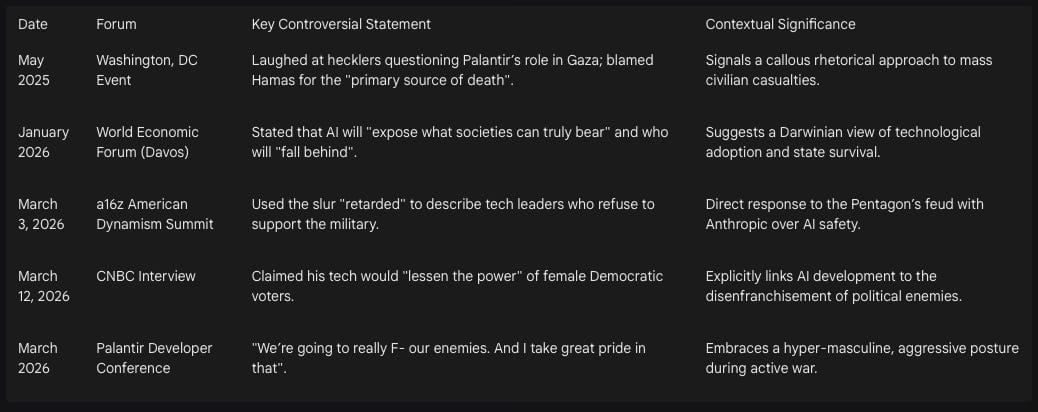
In early March 2026, Karp’s public statements began to target domestic political demographics with a specificity that suggested a strategic attempt to weaponize technological disruption for partisan ends.15 During an interview with CNBC on March 12, 2026, Karp articulated a vision in which AI would serve as a tool for eroding the political and economic influence of “highly educated, often female voters, who vote mostly Democrat”.15 This admission was described by critics as a “shocking confession” that Palantir’s mission was not only to defeat foreign adversaries but to disrupt the internal “social fabric” of the United States.15
Karp’s framing of this disruption was binary: while the “humanities-trained” Democratic base would see their power diminished, “vocationally trained, working-class, often male” voters would see an increase in economic capital.15 Analysts noted that this alignment with Republican Party strategy and the “male-centered culture war” was a calculated move to secure Palantir’s standing within the Trump administration’s inner circle, which was simultaneously prosecuting a full-scale war in Iran.15
Nationalization and the “Retarded” Controversy
The most documented instance of Karp’s verbal aggression occurred at the a16z American Dynamism Summit on March 3, 2026. In the context of a worsening standoff between the U.S. Department of Defense and AI firms like Anthropic—which had restricted its “Claude” model from being used in autonomous weapons—Karp issued a blunt warning to the tech industry.9 He argued that if Silicon Valley continued to “screw the military” while simultaneously automating white-collar jobs, the government would inevitably nationalize their technology.9
The use of the slur “retarded” during this speech was widely condemned, yet Karp’s supporters in the “American Dynamism” movement viewed it as a sign of “strength and firmness of character”.9 This incident highlighted a deeper psychological trend in Karp’s leadership: the use of “forbidden” or offensive language to signal a total rejection of the “wokeism” he believes threatens meritocracy and Western deterrent capacity.6 By branding his critics and competitors as cognitively deficient, Karp effectively shuts down the moral conversation surrounding the use of AI in warfare, replacing ethical inquiry with a demand for patriotic compliance.9
The Crucible of Iran: Operation Epic Fury and the Reality of Enforced Lethality
The volatility of Karp’s rhetoric must be viewed against the backdrop of Palantir’s actual contributions to the 2026 Iran conflict. On February 28, 2026, the United States and Israel launched coordinated strikes against Iranian military and nuclear infrastructure, an operation that quickly escalated into a widespread air campaign.22 Palantir’s “Meta-Constellation” and “AIP” systems were reportedly used to integrate vast arrays of data to provide real-time targeting coordinates for Tomahawk cruise missiles and drone swarms.3
The Minab School Strike and the “Triple Tap” Phenomenon
The most egregious example of the human cost of this technology was the destruction of the Shajareh Tayyebeh girls’ elementary school in Minab on the first day of the war.22 Investigations by the New York Times and BBC Verify concluded that the United States was responsible for the strike, which killed 175 people, including 168 children.20 Satellite analysis verified that the school was “triple tapped”—hit by three distinct strikes in succession—a tactic that targets survivors and first responders.22
Witness testimony indicated that after the first missile hit, the school’s principal attempted to move surviving students to a prayer room, only for that room to be hit by a second missile.22 The precision and timing of these strikes suggested the involvement of advanced AI tagging systems, which Palantir provided to the military to maintain the “high tempo of the kill web”.20 Despite the mounting evidence, Karp maintained a posture of “pride” in his company’s role, stating at a conference shortly after the incident: “We are very proud to have our role in having American men and women come home safe. That sometimes means that people on the other side don’t go home”.8
The Dehumanization of the “Other Side”
This refusal to acknowledge the humanity of the “other side” is a critical component of the “algorithmic warfare” framework that Karp has championed.4 By characterizing rivals as “noncompetition” and civilians as people who simply “don’t go home,” Karp creates a linguistic buffer between his proprietary code and the “shattered infrastructure” and “devastating civilian casualties” it produces.8 This abstraction is mirrored in his dismissal of the Gaza genocide, where he laughed while claiming that Hamas, rather than the technology enabling the targeting, was the “primary source of death”.17 This behavior suggests a systematic attempt to distance himself from the “visceral reality on the ground” in favor of the “sterile precision” promised by his software.25
Psychological Profiling: Guilt, Shame, and the “Erratic” CEO
The query into Alex Karp’s mental health often centers on his “erratic behavior” and “bizarre speech patterns,” which have been documented by friends and biographers alike.5 However, a clinical assessment of his public persona suggests that these traits may not be indicative of a traditional mental illness, but rather the symptoms of “moral injury” and “identity fusion” in a position of ultimate authority.10
The Identity of the “Philosopher in the Valley”
Karp is a distinctive figure: a biracial technologist who is severely dyslexic, a trained philosopher with a doctorate in social theory, and a man who has never learned to drive.1 This background provides him with a “finely calibrated moral compass” that he must continually suppress to lead a company built for “battlefield advantage”.8 His 2002 dissertation, Aggression in der Lebenswelt (Aggression in the Life-World), reveals that he has long been fascinated by the role of aggression in “social integration”.11
In his academic work, Karp reinterpreted Theodor Adorno’s critique of “authenticity jargon” to argue that strategic aggressive positions are necessary for the functioning of society.11 This reinterpretation provides him with a sophisticated philosophical justification for Palantir’s most controversial contracts.11 However, the tension between his “far-left progressive roots” and his current role as a “staunch supporter” of aggressive military interventions creates a “knot of contradictions” that may manifest as the erraticism noted by observers.6
Moral Injury and the “Shame-Rage” Spiral
Psychological research on executive leadership identifies “moral injury” as the distress that occurs when an individual must make decisions that conflict with their personal values or cause harm to others.10 For a CEO like Karp, who is “deeply embedded in the Pentagon,” the cumulative weight of enabling strikes like the one in Minab can lead to a fracture in the “productive self”.15
When this moral injury is challenged by public scrutiny or “internal debate” among employees, the individual may enter a “shame-rage spiral”.12 This manifests as:
Narcissistic Rage: Explosive anger and the use of slurs (e.g., “retarded”) when his “grandiose self-image” or the company’s mission is threatened.9
Victim Mentality: Framing himself and Palantir as victims of “wokeism” or “craven” Silicon Valley competitors, despite his position of immense wealth and power.6
Doubling Down: Increasing the intensity of aggressive behavior rather than modifying it in response to evidence of harm.21
Karp’s statement that he “takes great pride” in Palantir’s ability to “F- our enemies” can be seen as a defensive “doubling down” to bury the feelings of guilt and shame that would otherwise be associated with the deaths of 168 children.8 By magnifying his power and going on the attack, he seeks to maintain his “standing in the group” and protect his self-respect.12
Historical Analogues: The Psychology of Facilitators and Industrialists
To understand the severity of Karp’s situation, it is instructive to look at historical figures who also played pivotal roles in enabling mass death through technological and industrial systems. These individuals often struggled with their roles, employing many of the same psychological defense mechanisms observed in Karp.
Fritz Haber and the Paradox of Nitrogen
Fritz Haber is perhaps the most direct historical analogue to the “Philosopher in the Valley”.13 Like Karp, Haber was an intellectual who was also a fervent nationalist, believing that his scientific genius belonged to his country during wartime.13 Haber’s work in nitrogen fixation saved billions from starvation through fertilizers, yet he also personally supervised the first large-scale chlorine gas attacks in World War I.13
Haber’s lack of distress about the “agonizing deaths” caused by his poison gas provoked a sense of “visceral horror” in his peers.13 He defended chemical weapons by stating that “death was death regardless of the means,” a rhetoric of abstraction identical to Karp’s claim that war simply means “people on the other side don’t go home”.8 However, Haber’s loyalty to the state did not save him; he was eventually rejected by the Nazis and died a “broken man,” having witnessed his own invention (Zyklon B) being repurposed for the Holocaust.13
The Nuremberg Industrialists and the Defense of Complicity
The trials of executives from Krupp and IG Farben provide a template for how corporate leaders justify their involvement in war crimes.33 Like Palantir, these companies were essential to the “Nazi war machine,” utilizing slave labor and producing the chemicals for mass murder.14 Their defenses were characterized by a “refusal to acknowledge complicity” and a reliance on the “duty to profit”.14

Franz Stangl and the Examination of Conscience
In her book Into That Darkness, Gitta Sereny explored the conscience of Franz Stangl, the commandant of the Treblinka extermination camp.35 Stangl maintained a “cold” demeanor throughout his tenure, justifying his role as an administrator of “cargo”.34 Only at the end of his life, during the interviews, did he admit that his crimes were the result of a “failure to perceive the humanity” of his victims.34
Karp’s rhetoric of “algorithmic warfare” and his laughter during discussions of the Gaza conflict suggest he is currently in the same state of “darkness” that Sereny described: a world where the system preserves its integrity by “compromising the integrity of the individuals within it”.36 His “doubling down” on aggression is an attempt to avoid the “shame-rage spiral” that would occur if he were to truly confront the “eyes that didn’t close” in the rubble of the Minab school.12
Additional Factors in Karp’s Erraticism: Isolation, Power, and “AI Mania”
Beyond the burden of enabling mass death, there are systemic and cognitive factors that contribute to Alex Karp’s increasingly detached and aggressive behavior.
As Palantir’s valuation has soared, Karp has become increasingly isolated within a “bubble” of like-minded military officers and tech sycophants.8 This “multilevel marketing event” atmosphere reinforces a “giddy groupthink” that discourages dissent or ethical reflection.8 Research on “identity dissolution” indicates that when a leader’s sense of self becomes entirely merged with their corporate role, they lose the ability to maintain healthy boundaries or process negative feedback.10
Karp’s requirement that employees work from his home and his disdain for “remote work” while he himself lives a nomadic, secretive life, points to a “problematic pattern” of control and hypocrisy often seen in narcissistic leadership.6 This isolation is compounded by his “out-of-bounds” cognitive style, where his dyslexia and philosophical training allow him to “display his inner world” without the traditional restrictions of corporate norms.38
The “AI Mania” and Cognitive Overload
The current cultural moment of “AI Mania” is characterized by “racing thoughts, erratic behavior, and an unusually high level of physical and mental activity”.7 Karp, who runs at a high tempo both literally and metaphorically, is at the center of this “sociotechnical phenomenon”.7 The pressure to maintain “strategic parity in an era of algorithmic arms races” leads to “decision fatigue,” particularly when those decisions involve “balancing multiple competing values” like shareholder profit and human life.10
Karp’s use of “game-time audibles” and his “chaotic” decision-making process suggest a mind struggling with the “incomprehensibly vast arrays of data” his own company is designed to manage.4 This “cognitive self-defense” against the complexity of the world often results in “sudden shifts” in policy and “blunt warnings” that appear erratic to the outside world.28
The Nationalization Threat: A Symptom of Institutional Fragility
Karp’s warning that tech companies must “cooperate with the government or face nationalization” is perhaps the most telling indicator of his current state of mind.9 While framed as a patriotic defense of the state, it reveals a “crisis of accountability”.39 By advocating for the absorption of private tech into the state, Karp is effectively arguing for the “dissolution of the link between moral agency and lethal outcomes”.39
If the company is the state, then Karp is no longer a private citizen responsible for 168 dead children; he is a “body to burn” for a system that “engineered the consequences elsewhere”.37 This “delegated exposure” allows him to internalize responsibility without the capacity to repair it, a state that leads directly to “temporal disintegration” and the “hollow feeling” of spending his life optimizing systems he may no longer believe in.28
Causal Relationships and Systematic Harms
The analysis of Karp’s rhetoric and behavior demonstrates several clear causal paths that connect his personal psychology to global events.
Philosophical Justification Lethal Implementation: Karp’s dissertation on “aggression” provided the ethical framework that allowed him to build “Iron Man suits for cognition” for the Pentagon.8
Mass Casualties (Minab Strike) Shame/Guilt Doubling Down: The horror of the 2026 Iran war necessitated a shift from “peaceful philosopher” to “aggressive nationalist” to preserve his identity.8
Institutional Isolation Cognitive Distortion: The “giddy groupthink” of Palantir events prevents Karp from receiving the “interpretive alignment” needed to correct his erratic behavior.8
Algorithmic Warfare Moral Deskilling: By automating targeting, Karp and his military partners have “decoupled lethal force from human moral agency,” creating a “responsibility gap” that Karp fills with aggressive rhetoric.39
Institutional Consequences and Future Trajectories
The long-term impact of Alex Karp’s leadership style on Palantir and the broader tech sector is likely to be one of “normative degradation”.39 As the 2026 Iran conflict continues, the “sterile precision” of generative AI will continue to clash with the “visceral reality” of the battlefield.25 This tension will force more leaders to confront the “psychic cost” of their work.37
Palantir’s notoriety, which Karp currently views as a “useful filter” for finding culturally aligned customers, may eventually become a “supply-chain risk” as it has for Anthropic.8 If the investigations into the Minab school strike prove that Palantir’s algorithms were responsible for the “triple tap” targeting, the company may face legal and moral challenges that cannot be buried by “doubling down”.22
Nuanced Conclusions and Actionable Synthesis
The analysis concludes that Alex Karp’s controversial statements and erratic behavior are not the result of a simple mental health diagnosis, but are the manifestations of a complex “moral injury” caused by his company’s role in enabling mass-scale lethality. Like his historical predecessor Fritz Haber, Karp has attempted to use nationalism and philosophical abstraction to bury the “shame and guilt” of his complicity.13
The “shame-rage spiral” triggered by the 2026 Iran war has led Karp to adopt a hyper-aggressive posture, using slurs and demographic targeting to signal dominance and protect a “fractured identity”.12 This behavior is a defensive mechanism designed to avoid the “temporal disintegration” that would follow a true “examination of conscience”.28
For the tech sector and the defense industry, the “Karp model” represents a “morally unacceptable void” where harms occur without “identifiable culpable agents”.39 To prevent the further “corrosion of human agency,” it is essential for stakeholders to:
Demand Accountability Chains: Trace a continuous line from algorithmic decision to lethal effect, preventing the “asymmetric authority” that Karp exploits.37
Reward Upward Candor: Disrupt the “giddy groupthink” within Palantir by establishing “ethical after-action reviews” where dissent is procedural.37
Address Moral Injury Proactively: Recognize that CEOs in the “kill web” are at extreme risk of psychological collapse and require “confidential space” to process the moral weight of their decisions.10
Ultimately, the story of Alex Karp and Palantir is a reminder that “the machine has entered the battlefield,” and without a corresponding evolution in the “moral military leadership” of the civilians who build it, the result will be a continued descent into an “algorithmically mediated violence devoid of ethical intelligibility”.25
Works cited
Recommendations | Sayville Library, accessed March 21, 2026, https://www.sayvillelibrary.org/recommendations
The Philosopher in the Valley - The Guardian Bookshop, accessed March 21, 2026, https://guardianbookshop.com/the-philosopher-in-the-valley-9781398522176/
Palantir CEO Alex Karp on Iran’s attack on three Amazon data centers: They are evil, they are not stupid, as … - The Times of India, accessed March 21, 2026, https://timesofindia.indiatimes.com/technology/tech-news/palantir-ceo-alex-karp-on-irans-attack-on-three-amazon-data-centers-they-are-evil-they-are-not-stupid-as-/articleshow/129557884.cms
Cyber Security in The Age of Artificial Intelligence and Autonomous | PDF - Scribd, accessed March 21, 2026, https://www.scribd.com/document/804272989/Cyber-Security-in-the-Age-of-Artificial-Intelligence-and-Autonomous
The Philosopher in the Valley: Alex Karp, Palantir and the Rise of ..., accessed March 21, 2026, https://www.goodreads.com/en/book/show/214666632-the-philosopher-in-the-valley
The Philosopher in the Valley: Alex Karp, Palantir and the Rise of the Surveillance State, accessed March 21, 2026, https://www.goodreads.com/book/show/214666632-the-philosopher-in-the-valley
AI Mania | UCHRI, accessed March 21, 2026, https://uchri.org/foundry/ai-mania/
At Palantir’s Developer Conference, AI Is Built to Win Wars | WIRED, accessed March 21, 2026
Palantir CEO Warns Tech Firms: Cooperate with Government or Face Nationalization, accessed March 21, 2026, https://nationaltoday.com/us/dc/washington/news/2026/03/03/palantir-ceo-warns-tech-firms-cooperate-with-government-or-face-nationalization/
Therapy for CEOs in California: Confidential Executive Psychotherapy - cerevity, accessed March 21, 2026, https://cerevity.com/therapy-for-ceos-california-executive-mental-health/
Moira Weigel — Palantir Goes to the Frankfurt School – b2o ..., accessed March 21, 2026, https://www.boundary2.org/2020/07/moira-weigel-palantir-goes-to-the-frankfurt-school/
Preventing a Heated Exchange When We Feel Ashamed at Work - Psychology Today, accessed March 21, 2026, https://www.psychologytoday.com/au/blog/leadership-learning-and-growth/202402/preventing-a-heated-exchange-when-we-feel-ashamed-at
Fritz Haber: The War Criminal Who Helped Prevent Global Hunger | Magazine | Davidson Institute of Science Education - מכון דוידסון, accessed March 21, 2026, https://davidson.org.il/read-experience/en/sciencehistory-en/fritz-haber-the-war-criminal-who-helped-prevent-global-hunger/
The Other Nuremberg Trials, Seventy-Five Years On - Boston Review, accessed March 21, 2026, https://www.bostonreview.net/articles/erica-x-eisen-nuremberg/
Palantir CEO Makes Shocking Confession on Disrupting Democratic Power, accessed March 21, 2026, https://newrepublic.com/post/207693/palantir-ceo-karp-disrupting-democratic-power
Trump’s Inner Circle Is Divided Over Iran War | The New Republic, accessed March 21, 2026, https://newrepublic.com/post/207740/donald-trump-inner-circle-iran-war
Al Jazeera – Breaking News, World News and Video from Al Jazeera, accessed March 21, 2026, https://www.aljazeera.com/sitemap.xml%3Fyyyy=2025/page/27208?utm_source=openai%3Fgb%3Dtrue&mm=03&dd=09%3Fgb%3Dtrue
Palantir CEO Karp Says AI Is Stress-Testing States, Militaries, and Markets | AI1G - YouTube, accessed March 21, 2026
Palantir CEO Alex Karp Issues Explosive Warning To Silicon Valley - Benzinga, accessed March 21, 2026, https://www.benzinga.com/markets/tech/26/03/51040405/palantir-ceo-alex-karp-issues-explosive-warning-to-silicon-valley
Senators Demand Accountability as Pentagon Admits U.S. Struck Iranian Girls’ School, accessed March 21, 2026, https://www.democracynow.org/2026/3/12/headlines/senators_demand_accountability_as_pentagon_admits_us_struck_iranian_girls_school
Shame and Aggression: A Dangerous Combination | Psychology Today United Kingdom, accessed March 21, 2026, https://www.psychologytoday.com/gb/blog/the-pathways-experience/202204/shame-and-aggression-dangerous-combination
2026 Minab school attack - Wikipedia, accessed March 21, 2026, https://en.wikipedia.org/wiki/2026_Minab_school_attack
Military - Freeman Spogli Institute for International Studies | FSI, accessed March 21, 2026, https://fsi.stanford.edu/taxonomy/term/161
Video Shows U.S. Missile Struck Iranian Girls’ School, Killing 175, Contradicting Trump’s Denials | Democracy Now!, accessed March 21, 2026, https://www.democracynow.org/2026/3/9/headlines/video_shows_us_missile_struck_iranian_girls_school_killing_175_contradicting_trumps_denials
The New Battlespace: How Geospatial AI Is Reshaping Military Intelligence, accessed March 21, 2026, https://projectgeospatial.org/geospatial-frontiers/the-new-battlespace-how-geospatial-ai-is-reshaping-military-intelligence
The Philosopher in the Valley: Alex Karp, Palantir, and the Rise of the Surveillance State - dokumen.pub, accessed March 21, 2026, https://dokumen.pub/download/the-philosopher-in-the-valley-alex-karp-palantir-and-the-rise-of-the-surveillance-state.html
Full article: Moral courage, injury, and leadership in military contexts: lessons from a thematic analysis of conversations among international experts and students, accessed March 21, 2026, https://www.tandfonline.com/doi/full/10.1080/13623699.2025.2463041
Beyond Burnout: Why You Feel Stuck & How to Break the “Functional Freeze”, accessed March 21, 2026, https://bigstorynetwork.com/content/beyond-burnout-why-you-feel-stuck-how-to-break-the-functional-freeze
Full article: Ideology and Cognitive Complexity in Terrorism: Insights from a Terrorist Rehabilitation Program - Taylor & Francis, accessed March 21, 2026, https://www.tandfonline.com/doi/full/10.1080/09546553.2025.2540364
What Narcissists Do When Backed into a Corner: Lessons from Celebrities Who Lost Control, accessed March 21, 2026, https://abbymedcalf.com/what-narcissists-do-when-backed-into-a-corner-lessons-from-celebrities-who-lost-control/
Fritz Haber | Science History Institute, accessed March 21, 2026, https://www.sciencehistory.org/education/scientific-biographies/fritz-haber/
Why did scientists boycott Fritz Haber but defended Oppenheimer? - Quora, accessed March 21, 2026, https://www.quora.com/Why-did-scientists-boycott-Fritz-Haber-but-defended-Oppenheimer
A History of the I.G. Farben Trial: Armament, Exploitation, Auschwitz | BERGHAHN BOOKS, accessed March 21, 2026, https://www.berghahnbooks.com/title/LindnerHistory
Emotional Responses (Part II) - Emotions and Mass Atrocity, accessed March 21, 2026, https://www.cambridge.org/core/books/emotions-and-mass-atrocity/emotional-responses/D6275B12FCFB87015FB754F584321FD2
Exploring the psychological effects of the Holocaust on the second generation : a phenomenological inquiry with children of Holo - SciSpace, accessed March 21, 2026, https://scispace.com/pdf/exploring-the-psychological-effects-of-the-holocaust-on-the-2w94pclsjb.pdf
Chris Hedges | The Act of Killing - Truthout, accessed March 21, 2026, https://truthout.org/articles/the-act-of-killing/
The Conservation of Responsibility | by Sean Punska - Medium, accessed March 21, 2026, https://medium.com/@sean.punska/the-conservation-of-responsibility-4f3aad453a36
Birth Chart Reading On Gavin Newsom - Governor of California, USA : r/Advancedastrology, accessed March 21, 2026, https://www.reddit.com/r/Advancedastrology/comments/1mtzpii/birth_chart_reading_on_gavin_newsom_governor_of/
Full article: The ethical legitimacy of autonomous Weapons systems: reconfiguring war accountability in the age of artificial Intelligence - Taylor & Francis, accessed March 21, 2026, https://www.tandfonline.com/doi/full/10.1080/16544951.2025.2540131
Earn Your Leisure - Omny Studio, accessed March 21, 2026, https://www.omnycontent.com/d/playlist/e73c998e-6e60-432f-8610-ae210140c5b1/8dbc4f54-a337-4481-9ef2-b355012b0a3d/eac4c628-29cb-469a-b5c8-b355012b0a48/podcast.rss
War and Moral Injury, accessed March 21, 2026, https://ngkok.co.za/vbo/diensplig/1.War%20and%20Moral%20Injury.digital.pdf
