- Pascal's Chatbot Q&As
- Archive
- Page -59
Archive

AI-assisted development remains lawful and commercially useful, but only when wrapped in provenance, licensing, human review, and accountability. The companies that treat vibe coding as magic...
...will accumulate invisible legal debt. The companies that treat it as a governed supply chain will move faster in the end, because their code will be easier to defend, license, sell, audit & insure.


RAND’s report shows that RAG, GraphRAG, and long-context AI systems can appear grounded in trusted documents while still misreading nuance, caveats, evidence strength, and partial truths.
The tested systems achieved only 48–54% accuracy on nuanced truthfulness classification, rising to 75–80% only when the task was simplified into binary true/false judgments.

OpenAI was born from a genuine fear of concentrated AI power, but almost immediately became a contest over exactly the same thing — concentrated AI power.
The people building OpenAI were not merely resisting Musk personally; they were resisting the idea that AGI, if created, should sit under the durable control of one dominant individual.

Contemporary data suggests a significant shift toward the obfuscation or outright removal of publication dates across various digital platforms.
Reason? Algorithmic pressures, psychological biases among information consumers, and the evolving economic imperatives of content marketing in an era increasingly dominated by generative AI.

Once a system is said to have rights, powerful actors will use that language strategically. AI companies may argue that agents need freedom to browse, learn, transact, train, remember, speak, and...
...resist interference. That would be unacceptable if it undermines human rights, copyright, privacy, competition law, consumer protection, or democratic oversight.
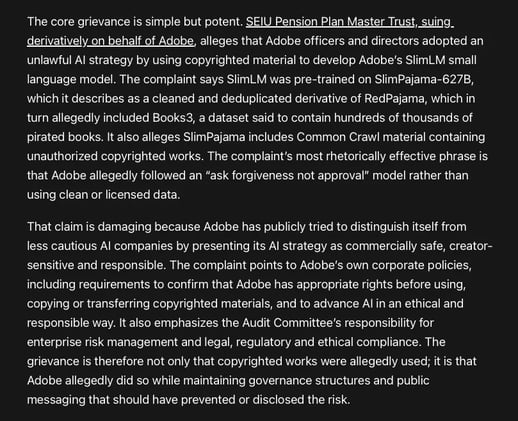
“Did the board and senior executives knowingly expose the company to infringement liability, reputational damage, securities risk and wasted corporate assets?”
The new Adobe shareholder derivative complaint reframes the same conduct as a corporate governance failure: not merely “did the company infringe?”

The administration’s public messaging has repeatedly leaned on phrases such as “worst of the worst,” violent criminals, public-safety threats, gangs, cartels, fentanyl, and national-security risks.
The budget does not support the idea that enforcement is narrowly limited to that category. It supports a broader model: non-criminal or non-priority removals are also a large part of the machine.

Research indicates that the resistance to AI is not merely a matter of technological skepticism but is rooted in the preservation of identity and the psychological need for cognitive consistency.
This avoidance is a rational defense against a perceived loss of human agency, a real “social evaluation penalty,” and the “ideological capture” of AI guardrails by corporate and political interests.


AI is becoming the new enterprise interface: shaping customer discovery, shopping, service, surveillance, and internal workflows, often through platforms companies do not fully control.
At the same time, the cheap-AI era is ending, meaning enterprises will face rising token costs, tighter limits, model lock-in risks, and the need for serious AI cost governance.


Ideas that would once have triggered corporate distancing, shareholder revolt, or reputational collapse are instead absorbed into the normal bloodstream of public discourse. Markets can become...
...laundering mechanisms for extremism when investors, customers, regulators & political actors decide that money, access, infrastructure, or technological dependency matter more than democratic norms