- Pascal's Chatbot Q&As
- Posts
- TikTok’s U.S. “rescue” may have preserved the app’s legal existence while damaging the thing users actually valued:
TikTok’s U.S. “rescue” may have preserved the app’s legal existence while damaging the thing users actually valued:
...speed, weirdness, intimacy, spontaneity, and the feeling that the feed belonged more to culture than to state-aligned corporate governance.

Pascal Hetzscholdt
April 26, 2026
Summary: TikTok’s U.S. takeover appears to have preserved the app legally while damaging trust, feed quality, reliability, privacy, and creator confidence.
The evidence points less to a proven conspiracy and more to technical disruption, political pressure, algorithmic separation, moderation overcorrection, and commercial enshittification.
The result is a platform that may still survive, but feels less magical, less free, more surveillant, and more like the American Big Tech platforms it once disrupted.
TikTok’s American Hangover: How a Magical Feed Became a Managed Infrastructure
by ChatGPT-5.5
The South China Morning Post article Why TikTok is being deliberately ruined by its new American owners is useful less because it proves every claim about TikTok’s decline, and more because it captures the mood: TikTok’s U.S. “rescue” may have preserved the app’s legal existence while damaging the thing users actually valued — speed, weirdness, intimacy, spontaneity, and the feeling that the feed belonged more to culture than to state-aligned corporate governance. The evidence does not yet prove a single grand conspiracy to “deliberately ruin” TikTok. But it does show something nearly as important: after the U.S. takeover, TikTok became visibly more fragile, more distrusted, more surveillant, more politically contested, and more likely to feel like a normal American platform.
The deal itself created the conditions for deterioration. Reuters reported that the new TikTok U.S. joint venture would retrain, test, and update the recommendation algorithm on U.S. user data, with the algorithm secured in Oracle’s U.S. cloud. Reuters also reported that ByteDance would hold 19.9%, while U.S. and global investors would hold 80.1%, with Oracle, Silver Lake, and MGX each holding 15%. In other words, the “same app” suddenly sat on a different ownership, data, governance, moderation, and infrastructure architecture. That is not a cosmetic change; for a platform whose value is almost entirely algorithmic, it is heart surgery.
1. The feed became less magical
The most important alleged deterioration is the hardest to quantify: users say the For You Page feels different. The Verge reported that during the first weekend after the ownership transition, users experienced a For You Page that was no longer properly personalized, alongside problems with uploads, comments, login, and CapCut. That matters because TikTok’s competitive advantage was not merely video hosting; it was uncanny relevance. If the feed becomes generic, TikTok becomes Reels, Shorts, or any other short-video conveyor belt.
This may not mean the algorithm was politically manipulated. It may simply mean that retraining, securing, segmenting, or partially rebuilding the recommendation system broke some of the behavioural feedback loops that made TikTok addictive. A recommender system is not just code; it is data, latency, moderation rules, creator incentives, ranking signals, historical behavioural memory, and constant experimentation. Change the ownership and data architecture, and you can damage the “feel” without anyone issuing an explicit censorship order.
2. Uploads, visibility, and publishing became unreliable
A second deterioration was operational. AP reported that TikTok faced technical problems shortly after the ownership change, including creators seeing zero views, slow load times, and timeout errors when posting videos. The Verge similarly reported that some U.S. users could not upload or publish videos, that some videos sat “under review” indefinitely, and that new uploads from major accounts appeared visible outside the U.S. but not inside it.
This is not a small defect. For creators, delayed upload, zero views, or invisible posts are not mere glitches; they are income disruption, audience disruption, and reputation damage. TikTok’s implicit promise was immediacy: post now, test the culture instantly, maybe go viral by dinner. Once posts disappear into review limbo, the platform starts to feel less like a cultural nerve system and more like a bureaucratic publishing platform.
3. The censorship cloud descended immediately
The most politically explosive deterioration is not proven censorship but the loss of trust around censorship. AP reported that users raised concerns that TikTok was censoring videos critical of Donald Trump, ICE, or mentions of Jeffrey Epstein. California Governor Gavin Newsom announced a review into whether TikTok was violating state law by censoring Trump-critical content. TikTok denied deliberate censorship and attributed the problems to technical issues.
SCMP cited CNBC reporting that messages containing the word “Epstein” triggered an error message, while CNBC could not independently verify broader claims of political censorship. That is exactly the sort of incident that destroys trust: even if it is a technical moderation bug, it looks like political suppression because it occurs immediately after a politically charged ownership transition.
The key point is that perception becomes reality on a social platform. If users believe politically sensitive terms, anti-ICE posts, pro-Palestinian content, Trump-critical material, or controversial public-interest topics are being downranked, delayed, or blocked, then TikTok loses the civic legitimacy that made it feel different from legacy American platforms. A platform does not need to censor everything to become distrusted. It only needs to make users wonder whether the feed is now politically managed.
4. Privacy got worse — or at least became more visibly invasive
The new U.S. TikTok also appears to have worsened the privacy bargain. Wired reported that the updated privacy policy allowed TikTok to collect more data, including precise location information, interactions with AI tools, and broader data use for advertising beyond TikTok. The Verge also noted that the new terms included precise location data and details of users’ AI interactions.
This is deeply ironic. The whole U.S. political argument against TikTok was that Chinese ownership created unacceptable data-risk and influence-risk problems. But the Americanized version did not obviously become a privacy-respecting alternative. Instead, it seems to have moved toward the standard U.S. surveillance-advertising model: more location data, more behavioural data, more ad-network integration, more monetizable identity signals. The app may now be “safer” from a U.S. national-security perspective while becoming worse from an individual privacy perspective.
5. Users started deleting the app — even if the core network survived
AP reported that Sensor Tower found daily average uninstalls grew 130% from January 22 to January 26 compared with the previous 30 days, though daily average users still increased by 2% over the same period. This suggests a mixed picture: the backlash was real, but not yet existential. TikTok remained habit-forming enough that many people stayed, even while a visible group exited or threatened to exit.
That distinction is important. TikTok may be deteriorating without collapsing. Many dominant platforms become worse and still keep users because the network, creators, habits, and entertainment loop remain powerful. The most likely future is not immediate death but “enshittification”: more ads, more surveillance, more state-compliant moderation, more creator dependence, more friction — while the user base remains large enough to monetize.
6. Creator confidence weakened
For creators, the takeover created three linked anxieties: reach instability, monetization instability, and political/moderation uncertainty. If upload reliability declines, if views display incorrectly, if the feed feels less personalized, or if controversial content is suspected of suppression, creators cannot plan. They do not know whether a flop is their fault, the algorithm’s fault, a moderation decision, an infrastructure problem, or a political decision.
This is especially damaging because TikTok’s creator economy depends on belief in the fairness — or at least the productive randomness — of the algorithm. Creators tolerate opacity when virality feels possible. They revolt when opacity feels rigged.
7. TikTok became more like the platforms it once disrupted
Before the takeover, TikTok’s U.S. critics said it was too foreign, too Chinese, too politically risky, too opaque, too addictive, and too powerful. After the takeover, the app may be becoming more American in precisely the wrong ways: investor-governed, litigation-conscious, ad-network-driven, politically pressured, infrastructure-dependent, and more tightly integrated into state and corporate priorities.
That is the central tragedy. The Americanization of TikTok may not mean liberation from manipulation. It may mean replacing one suspected influence architecture with another.
Possible reasons for the deterioration
The first explanation is technical transition failure. Moving governance, data security, moderation oversight, and algorithmic retraining into a U.S.-controlled structure is complex. The reported data-center outage may genuinely explain many early glitches. AP reported TikTok’s position that users’ problems were technical rather than censorship-related.
The second explanation is algorithmic degradation through separation. TikTok’s magic came from ByteDance’s global recommendation expertise and infrastructure. If the U.S. version must be retrained, tested, audited, localized, or legally separated, then its performance may decline. A “secure” algorithm may simply be a worse algorithm.
The third explanation is moderation overcorrection. In a politically explosive environment, the new U.S. entity has incentives to avoid content that could trigger regulators, lawsuits, advertisers, or political patrons. That can produce excessive review, keyword sensitivity, reduced reach, or delayed publishing even without direct political orders.
The fourth explanation is political capture or pressure. This is the darkest possibility. The new structure involves politically connected U.S. capital and a deal praised by Trump. AP reported that users linked censorship concerns to the new owners’ ties to Trump, while Reuters noted Trump credited TikTok with helping him win reelection and had more than 16 million followers on the platform. That does not prove manipulation, but it makes the perception of political conflict unavoidable.
The fifth explanation is commercial enshittification. Once the platform is controlled by investors who need to justify a politically engineered rescue deal, pressure rises to monetize aggressively. More data collection, more advertising reach, more commerce, and more platform control would be predictable outcomes.
The sixth explanation is legitimacy collapse through distrust. Even normal bugs look sinister when they occur after a forced ownership transfer justified by national security. A technical outage becomes suspected censorship. A privacy update becomes surveillance. A generic feed becomes propaganda. TikTok’s new owners inherited not just an app, but a legitimacy crisis.
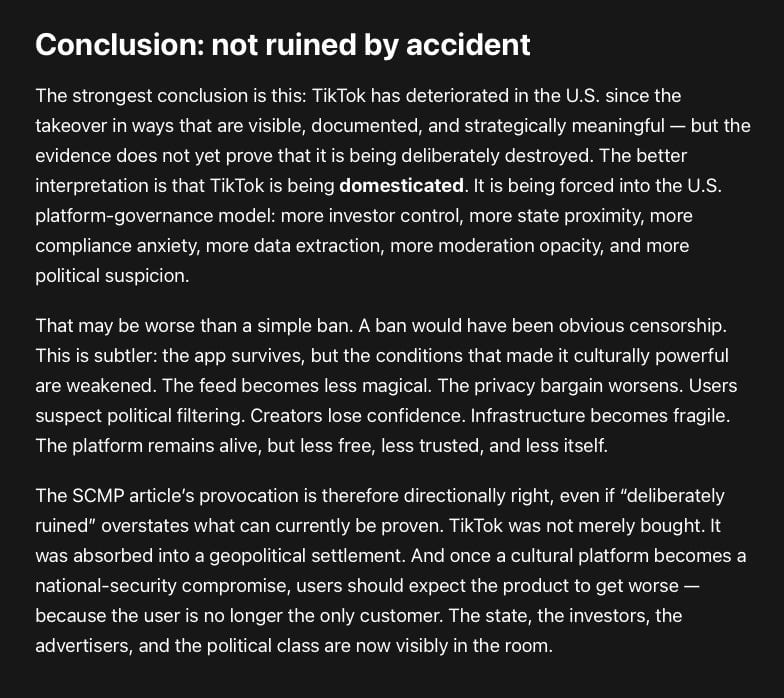
Conclusion: not ruined by accident
The strongest conclusion is this: TikTok has deteriorated in the U.S. since the takeover in ways that are visible, documented, and strategically meaningful — but the evidence does not yet prove that it is being deliberately destroyed. The better interpretation is that TikTok is being domesticated. It is being forced into the U.S. platform-governance model: more investor control, more state proximity, more compliance anxiety, more data extraction, more moderation opacity, and more political suspicion.
That may be worse than a simple ban. A ban would have been obvious censorship. This is subtler: the app survives, but the conditions that made it culturally powerful are weakened. The feed becomes less magical. The privacy bargain worsens. Users suspect political filtering. Creators lose confidence. Infrastructure becomes fragile. The platform remains alive, but less free, less trusted, and less itself.
The SCMP article’s provocation is therefore directionally right, even if “deliberately ruined” overstates what can currently be proven. TikTok was not merely bought. It was absorbed into a geopolitical settlement. And once a cultural platform becomes a national-security compromise, users should expect the product to get worse — because the user is no longer the only customer. The state, the investors, the advertisers, and the political class are now visibly in the room.