- Pascal's Chatbot Q&As
- Posts
- Contemporary data suggests a significant shift toward the obfuscation or outright removal of publication dates across various digital platforms.
Contemporary data suggests a significant shift toward the obfuscation or outright removal of publication dates across various digital platforms.
Reason? Algorithmic pressures, psychological biases among information consumers, and the evolving economic imperatives of content marketing in an era increasingly dominated by generative AI.

Pascal Hetzscholdt
April 30, 2026
Summary: Digital publishers are increasingly suppressing publication dates to exploit search engine “freshness” biases and prevent users from reflexively dismissing older but accurate evergreen content.
This strategic shift is fueled by a desire to maximize content ROI and adapt to AI-driven search environments that prioritize immediate topical authority over chronological feeds.
The resulting loss of temporal context threatens information integrity, complicates scholarly record-keeping, and risks damaging audience trust by circulating information stripped of its historical markers.
The Temporal Decoupling of Digital Information: Investigating the Decline of Publication Dates in Global Web Architecture
by Gemini 3.0, Deep Research. Warning, LLMs may hallucinate!
The digital information ecosystem is currently undergoing a fundamental structural transformation regarding the temporal contextualization of content. Historically, the web was organized as a chronological stream, particularly during the blogging revolution of the early 2000s, where the publication date served as a primary anchor for relevance, trust, and archival order. However, contemporary data suggests a significant shift toward the obfuscation or outright removal of publication dates across various digital platforms, including independent blogs, niche websites, and some commercial media outlets. This phenomenon is driven by a complex interplay of algorithmic pressures, psychological biases among information consumers, and the evolving economic imperatives of content marketing in an era increasingly dominated by generative artificial intelligence.
The removal of temporal markers is not merely a cosmetic change in web design but represents a fundamental shift in the social contract between information providers and consumers. As search engines prioritize freshness and users exhibit a pronounced bias against content perceived as aged, publishers have increasingly turned to date suppression as a strategic tool to extend the shelf-life of their digital assets. This trend carries significant implications for information integrity, as the removal of a publication date strips an article of its historical context, making it difficult for users to evaluate the current accuracy of facts, especially in fast-moving fields such as technology, medicine, or law.
The Algorithmic Drivers of Temporal Obfuscation
The primary catalyst for the removal of publication dates is the perceived and actual behavior of search engine algorithms, most notably those of Google. Since the introduction of the Freshness Update, search engines have prioritized content that is timely, particularly for queries that are time-sensitive. This has created a paradoxical environment where high-quality, authoritative content may be deprioritized simply because its publication date suggests it is several years old. In response, many content creators have adopted a strategy of removing the Published On date to prevent search engine result pages (SERPs) from displaying a timestamp that might deter a user from clicking.1
Analysis of SEO strategies for 2025 and 2026 indicates that while search engines officially focus on content quality rather than the method of production, the visible date stamp remains a critical factor in user-led click-through rates (CTR).3 Content that appears even thirty days old is often historically believed by users to be expired, leading to a significant drop in engagement.2 To combat this, publishers have shifted their focus toward topical authority and content freshness, often choosing to display a Last Updated date instead of the original publication date to signal continued relevance without revealing the article’s true age.1
The impact of these algorithmic shifts is evident in the performance data of websites during major search updates. During the core updates of late 2025, it was observed that websites which failed to maintain a perception of freshness or authority faced catastrophic traffic losses.5 Specifically, affiliate and health-related websites—sectors where information accuracy is paramount—saw high levels of volatility, with many experiencing traffic drops exceeding 70% when their content was deemed outdated or unhelpful.5 This volatility reinforces the incentive for publishers to manipulate or remove temporal data to remain competitive in the SERPs.
Technical SEO Benchmarks and Adoption Rates in 2026
The structural priorities of modern websites are reflected in the adoption of various technical standards. The following table outlines key technical SEO benchmarks for 2026, which influence how content is indexed and perceived in the absence of traditional publication dates.

The high rate of AI crawler activity highlights a new pressure on publishers: content is no longer just for human consumption but serves as training data for Large Language Models (LLMs). The removal of dates may be a defensive maneuver to prevent AI models from labeling content as legacy or historical data, thus maintaining its perceived utility in a real-time information economy.4
The Psychology of the Date Stamp and User Bias
The removal of publication dates is also a direct response to human psychology. Information foraging theory suggests that users seek the most relevant information with the least amount of effort. In a digital environment, the publication date serves as a heuristic for relevance. A user searching for a how-to guide on software configuration will almost always prefer an article dated 2026 over one dated 2021, even if the software has not changed in that interval. This freshness bias compels publishers to hide dates to prevent users from making snap judgments about the content’s validity based on its age.2
From a strategic perspective, removing dates creates an unbiased experience where the reader is forced to engage with the quality of the content itself rather than its chronological age.2 This is particularly useful for evergreen content—articles that remain relevant for years, such as foundational educational material or philosophical essays. By masking the date, publishers can ensure that this content continues to drive traffic and engagement indefinitely, functioning as a long-term business asset rather than an ephemeral blog post.8
However, this strategy is not without risks. Sophisticated users often view the absence of a date with suspicion, interpreting it as a consumer-hostile practice designed to hide obsolescence.2 When users realize they are consuming outdated information that has been intentionally stripped of its date, the loss of trust can be permanent, leading to increased bounce rates and brand damage.1 Research suggests that transparency, such as displaying both the Published and Last Updated dates, is the most effective way to balance the need for perceived freshness with the requirement for user trust.1
Comparative Impact of Date Visibility on User Behavior
The following table synthesizes expert arguments regarding the removal of date stamps and their observed effects on reader bias and site performance.

The Rise of Evergreen Doctrine and Content ROI
In the current economic landscape of digital marketing, content is increasingly viewed as a capital asset rather than a news service. The Evergreen Doctrine posits that the highest return on investment (ROI) comes from content that does not need to be frequently replaced. By 2025, blog posts were identified as one of the top five highest-ROI content formats, provided they were structured around topical authority rather than simple keyword stuffing.4
To maximize this ROI, businesses have moved away from the publish and forget model toward an inverted content lifecycle. This involves taking older, pre-AI posts and rebuilding them into deep, authoritative resources that are then refreshed with new data or examples.4 In this model, the original publication date becomes a liability, as it signals to the user that the content originated in a different technological or cultural era. Updating the timestamp to a more recent date—or removing it entirely—is a standard practice in this repurposing strategy.9

Content Performance and AI Impact Analysis (2025-2026)
The following table demonstrates the impact of content quality and AI integration on website traffic during recent search engine volatility.

The data confirms that simply removing a date is insufficient to protect low-quality content; however, for high-quality assets, temporal management is a force multiplier for long-term traffic retention.4
AI Overviews and the Death of the Chronicle
The emergence of AI-driven search experiences, such as Google’s AI Overviews (formerly SGE), has further accelerated the trend of date removal. These answer engines prioritize direct, concise responses over a list of dated articles. In this new paradigm, known as Answer Engine Optimization (AEO), the freshness of the information is determined by the AI’s ability to verify its current accuracy against multiple sources, rather than by the date stamp on a single webpage.4
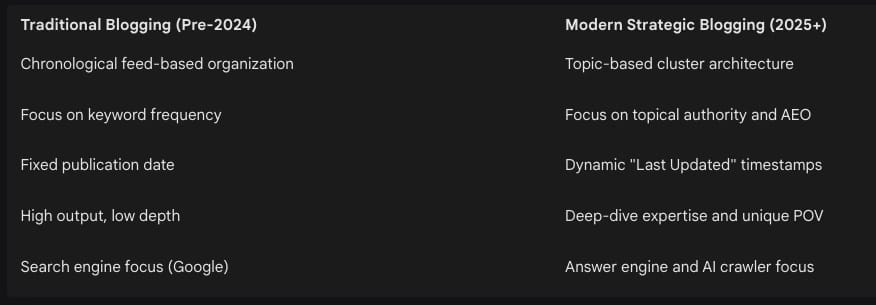
As users increasingly get their answers directly from SERPs or AI tools without clicking through to the source, the concept of a blog post as a dated entry in a chronological journal is fading. Modern strategic blogging focuses on topical authority, where a site aims to be the definitive source on a subject regardless of when individual pages were written.4 This shift devalues the publication date as a primary metadata field, as the focus moves toward the completeness and accuracy of the answer provided to the AI crawler.4
Furthermore, the rise of AI slop—low-quality, mass-produced AI content—has forced legitimate publishers to find new ways to signal authority. While some believe that a date stamp provides authenticity, others argue that authority is better demonstrated through unique perspectives, real-world case studies, and a human-in-the-loop editorial process.3 In many cases, publishers fear that an old date stamp will lead AI models to categorize their content as legacy data rather than current knowledge, providing another incentive for temporal obfuscation.4
Shifts in Blogging Strategy (2025-2026)
Information Integrity and the Crisis of Misinformation
The trend of removing publication dates has significant negative consequences for the integrity of the digital record and the ability of citizens to navigate a post-truth era. When news articles or informational guides are undated, they become zombie content—facts and opinions that circulate without the context of their origin. This is particularly dangerous in the context of misinformation, which has been described as an infodemic by global health organizations.11
In fields such as journalism, the lack of a date undermines the core function of the media as a record of events. While major institutions like the BBC and The New York Times maintain rigorous standards for transparency, including clear publication and revision dates, smaller media outlets and independent blogs are increasingly abandoning these standards in favor of SEO gains.12 This creates a bifurcated web: a tier of highly trusted, dated, and archived premium news, and a massive gray web of undated, opportunistic content that is difficult to verify or hold accountable.12
The consequences for user trust are profound. If a reader discovers that a health recommendation or a financial tip is five years old but was presented as current due to a missing or manipulated date, their trust in that source—and in the digital medium as a whole—is severely damaged.2 This erosion of trust contributes to a broader societal skepticism that makes it harder for legitimate information to gain traction.2
Media Transparency and Accountability Standards
The following table compares the publication date policies of different media tiers, highlighting the divergence in transparency standards.

Scholarly Communication and the Bibliometric Crisis
The removal or inconsistency of publication dates poses a specific threat to the scholarly and scientific community. In the digital era, papers are often available online months or even years before they appear in a print issue, leading to a publication delay that complicates citation windows and social media indicators.16 The lack of standardized reporting for online publication dates makes it difficult for researchers to establish the Version of Record (VoR), which is essential for compliance with open access requirements and for tracking the evolution of scientific ideas.16
Research into vanished open access journals highlights the fragility of the digital scholarly record. Journals that lack robust governance and preservation infrastructures—often indicated by inconsistent metadata and dates—are at a higher risk of discontinuation and removal from major databases like Scopus.18 Between 2021 and 2023, the number of discontinued titles in the Directory of Open Access Journals (DOAJ) rose, suggesting that the integrity of online publishing is under increasing pressure.18 Without accurate publication dates, the read-cite-read cycle of science is disrupted, as the temporal precedence of discoveries cannot be verified.16
Bibliometric Lag and Its Impact on Research Evaluation
Analysis of 58,896 papers reveals significant discrepancies between various “publication” dates, which can artificially inflate impact factors and citation rates.

These lags underscore the need for a standardized Definition of Online Date (DoOD), specifically the date on which the Version of Record is first made available on the publisher’s website.16 Without this, the historical record of human knowledge becomes prone to manipulation or accidental erasure.
Legal and Compliance Risks of Date Suppression
The removal of publication dates and the associated lack of temporal labels can also expose platforms to significant legal risks. In many jurisdictions, intermediaries enjoy safe harbor protections under laws like Section 79 of the IT Act (in India) or similar statutes in other regions.19 These protections are often contingent on the platform’s ability to demonstrate due diligence and compliance with labeling norms, particularly regarding AI-generated content or political advertisements.
In the context of elections, the timing of information publication is strictly regulated. For example, the Representation of the People’s Act, 1951, prohibits the publication of exit poll results during specific windows to prevent the undue influence of voters.20 If a news outlet or platform fails to provide accurate publication dates for its coverage, it may inadvertently violate these legal requirements, leading to fines or the loss of legal protections.19
The future outlook suggests that as AI labeling norms become more stringent, the failure to provide accurate metadata (including timestamps) will move from being a simple SEO tactic to a liability that increases compliance costs for digital businesses.19 Experts predict that technical glitches causing labels or dates to disappear could expose platforms to liability in an increasingly litigious digital landscape.19
Technical Repercussions and the Consumer Backlash
As publishers hide dates, a technical arms race has emerged. Users who require temporal context have turned to browser extensions and tools designed to unmask the true age of a webpage. Tools like the Article Date Detector analyze structured data, meta tags, and page content to find hidden timestamps, reflecting a growing demand for transparency that is not being met by publishers.21
From a technical SEO perspective, hiding dates on the frontend of a website does not necessarily hide them from search engine crawlers. Google and other search engines use multiple signals—including the time the page was first indexed, the HTTP header for Last-Modified, and JSON-LD schema—to determine the age of a piece of content.1 Consequently, removing the visible date may trick a human user into clicking, but it rarely fools a sophisticated algorithm. In fact, if a publisher falsely updates a date without making significant content changes, it can be viewed as a deceptive practice, potentially leading to ranking penalties.1
The technical complexity of date tracking is further evidenced by the massive increase in AI bot traffic. As of 2026, AI crawlers like GPTBot and ClaudeBot have caused a 340% increase in crawl requests, putting immense pressure on websites’ crawl budgets.6 These bots are specifically designed to extract factual data and its associated metadata (including dates) to train large language models. The removal of dates may be an attempt by some publishers to make their content less digestible or trackable for these AI systems, even as they struggle to maintain visibility for human users.6
Data Extraction and Date Detection Mechanisms
Modern information retrieval systems use several technical layers to determine the temporal origin of content, regardless of whether a date is visible to the human eye.

Economic and Strategic Implications for Digital Businesses
The shift away from publication dates reflects a broader transformation in how digital authority is constructed. In the era of the “Product Builder,” entry-level professionals and businesses are expected to understand the full lifecycle of a digital asset.24 This means that a blog post is no longer just a piece of writing but a component of a digital product that must be designed for longevity, user interaction, and algorithmic compatibility.24
For businesses, the engagement of managers and content creators has become a critical bottleneck. Between 2024 and 2025, manager engagement fell from 27% to 22%, reflecting a broader burnout in the face of the relentless demand for “fresh” content and the “AI slop” that has saturated the market.4 This burnout provides another economic incentive for date suppression: if a company cannot maintain a regular publishing schedule, removing dates makes their existing library appear more robust and active than it actually is.2
Furthermore, the rise of the high-velocity trading business model, as seen in the financial growth of technology subsidiaries, highlights the need for AI-native solutions that can monitor crop health, predictive profitability, and other real-time data points.26 In these high-stakes environments, the “date” of an insight is often its most valuable attribute. The paradox of the modern web is that while public-facing content is losing its dates to satisfy SEO, high-value private data is becoming more time-granular than ever before.16
ROI and Strategy Mapping for 2026
To survive in the 2026 digital economy, organizations are mapping their blog content to specific business outcomes rather than just traffic metrics.

Conclusion: Reconciling Temporal Transparency with Digital Strategy
The trend toward fewer bloggers and media outlets adding publication dates is a systemic response to the tyranny of the new imposed by search engine algorithms and human psychological shortcuts. In an environment where aged content is unfairly penalized, date suppression has become a rational, if ethically dubious, strategy for digital survival. However, the costs of this shift are substantial, manifesting as a degradation of information integrity, a loss of historical context, and an erosion of the foundational trust between content creators and their audiences.
The evidence suggests that the most successful long-term strategy is not the removal of dates, but the adoption of a transparency-first model that utilizes both Published and Last Updated timestamps. This approach satisfies the user’s need for context while also signaling to both humans and algorithms that the content is being actively maintained. For the scholarly and journalistic sectors, the maintenance of rigid temporal metadata remains a non-negotiable requirement for the preservation of a functioning public record.
As the web moves further into the era of AI-driven answer engines, the very nature of the “page” and its “date” will continue to evolve. The focus will likely shift from the date of the post to the freshness of the specific facts contained within it. Nevertheless, for the foreseeable future, the publication date remains a vital piece of information architecture. Its disappearance is a warning sign of a digital ecosystem that is prioritizing short-term engagement over the long-term stability and reliability of human knowledge.
The findings of this analysis indicate that the death of blogging is a misnomer; rather, it is the death of the chronological, diary-style web. In its place is a more strategic, database-driven content model where time is a variable to be managed rather than a fixed record of existence. The challenge for the next decade will be to ensure that this management of time does not result in the permanent loss of history in the digital age. Success will be defined by those who can provide timeless value without sacrificing the transparency that temporal markers provide.
Works cited
Published Date vs. Last Updated: Which Date Matters for SEO?, accessed April 30, 2026, https://www.clickrank.ai/published-date-vs-last-updated/
Pros And Cons Of Removing Dates From Blog Posts |GrowTraffic, accessed April 30, 2026, https://growtraffic.co.uk/pros-and-cons-of-removing-dates-from-blog-posts/
9 Biggest SEO Trends of 2025 & How to Leverage Them - Semrush, accessed April 30, 2026, https://www.semrush.com/blog/seo-trends/
Is Blogging Dead in 2026? The Truth About AI and Content ..., accessed April 30, 2026, https://lasso-up.com/is-blogging-dead-in-2026-the-truth-about-ai-and-content-marketing/
Google December 2025 Core Update: Complete Analysis & Recovery Guide - ALM Corp, accessed April 30, 2026, https://almcorp.com/blog/google-december-2025-core-update-complete-analysis-recovery-guide/
Technical SEO Statistics 2026 | Core Web Vitals, Page Speed & Indexing | Searchlab, accessed April 30, 2026, https://searchlab.nl/en/statistics/technical-seo-statistics-2026
10 Website Design Elements You Must Optimize for AI-Driven Search Indexing - Branding Marketing Agency, accessed April 30, 2026, https://www.brandingmarketingagency.com/blogs/ai-search-indexing/
How to Create Lasting Evergreen Content - Proofed, accessed April 30, 2026, https://proofed.com/knowledge-hub/how-to-create-lasting-evergreen-content/
The Ultimate Guide to Repurposing Your Content - Bright Cat, accessed April 30, 2026, https://bright-cat.co.uk/ultimate-guide-content-repurposing/
SEO Trends and Insights for 2025 | PDF | Search Engine Optimization - Scribd, accessed April 30, 2026, https://www.scribd.com/document/810852789/2024-12-The-2025-State-of-SEO-Report
(PDF) Digital literacy vs. misinformation: the critical role of libraries in the post-truth era, accessed April 30, 2026, https://www.researchgate.net/publication/393740582_Digital_literacy_vs_misinformation_the_critical_role_of_libraries_in_the_post-truth_era
Unbiased News Sources That You Must Follow In 2026 - NewsData.io, accessed April 30, 2026, https://newsdata.io/blog/unbiased-news-sources/
The Range and Depth of BBC News and Current Affairs: A Content Analysis | Ofcom, accessed April 30, 2026, https://www.ofcom.org.uk/siteassets/resources/documents/tv-radio-and-on-demand/bbc/bbc-news-review/research-documents/bbc-news-review-content-analysis-full-report.pdf?v=324324
How do the BBC and New York Times compare in terms of journalistic quality and credibility? In your opinion, which one is better and why? - Quora, accessed April 30, 2026, https://www.quora.com/How-do-the-BBC-and-New-York-Times-compare-in-terms-of-journalistic-quality-and-credibility-In-your-opinion-which-one-is-better-and-why
100 Top Media Outlets for News Coverage in 2025 - PRLab, accessed April 30, 2026, https://prlab.co/blog/top-media-outlets-for-news-coverage/
When is an Article Actually Published? An Analysis of Online Availability, Publication, and Indexation Dates - International Society for Scientometrics and Informetrics, accessed April 30, 2026, https://www.issi-society.org/proceedings/issi_2015/1170.pdf
It’s hard getting a date (of publication) - Unlocking Research, accessed April 30, 2026, https://unlockingresearch-blog.lib.cam.ac.uk/its-hard-getting-a-date-of-publication-needs-editing/
Editorial Predictors of the Discontinuation of Open Access Scientific ..., accessed April 30, 2026, https://www.mdpi.com/2304-6775/14/1/2
Continuous AI labelling norms to raise compliance bar, costs: Experts, accessed April 30, 2026, https://m.economictimes.com/tech/artificial-intelligence/continuous-ai-labelling-norms-to-raise-compliance-bar-costs-experts/articleshow/130614334.cms
Exit polls 2026: What are post poll surveys? Are they reliable? How are they conducted? All details here, accessed April 30, 2026, https://m.economictimes.com/news/politics-and-nation/exit-polls-2026-what-are-post-poll-surveys-are-they-reliable-how-are-they-conducted-all-details-here/articleshow/130581656.cms
Article Date Detector - Chrome Web Store, accessed April 30, 2026, https://chromewebstore.google.com/detail/article-date-detector/kcibimkobhbikanlidohhnahodekmaej
View Source - Jira, accessed April 30, 2026, https://sagebionetworks.jira.com/wiki/plugins/viewsource/viewpagesrc.action?pageId=989167828
SEO Myths Debunked – Updating Publish Dates Tricks Google Into Thinking Content Is Fresh! - Nikki Pilkington, accessed April 30, 2026, https://nikki-pilkington.com/seo-myths-debunked-updating-publish-dates-tricks-google-into-thinking-content-is-fresh/
Techie reveals how how he landed Rs 36 LPA job with no work experience, 8 backlogs, low college grades: ‘You don’t just write code….’, accessed April 30, 2026, https://m.economictimes.com/magazines/panache/techie-reveals-how-how-he-landed-rs-36-lpa-job-with-no-work-experience-8-backlogs-low-college-grades-you-dont-just-write-code-/articleshow/130542374.cms
Why have managers stopped feeling entitled, and what does it say about power at work?, accessed April 30, 2026, https://timesofindia.indiatimes.com/education/news/why-have-managers-stopped-feeling-entitled-and-what-does-it-say-about-power-at-work/articleshow/130531411.cms
Small-cap stock under ₹50 hits 5% upper circuit after Q4 results 2024, accessed April 30, 2026, https://www.livemint.com/market/stock-market-news/smallcap-stock-under-rs-50-hits-5-upper-circuit-after-q4-results-2024-11777297085185.html
