- Pascal's Chatbot Q&As
- Archive
- Page -181
Archive

ChatGPT’s view: Gemini’s refusal is understandable in spirit but overbroad in execution—and it kneecaps the very thing “Deep Research” is supposed to be good at.
The problem is that Gemini collapses three distinct activities into one forbidden bucket: Fact-checking conflicting public claims, Scenario analysis about escalation pathways & Mind-reading intent.

Canal+ sued not only over the pirate sites, but over the infrastructure of access: Google (Google Ireland / Google LLC), Cloudflare, and Cisco (OpenDNS).
Canal+ got what it needed most: confirmation that alternative DNS resolvers are reachable by injunction, and that dynamic DNS blocking—structured with safeguards—can be lawful and proportionate.
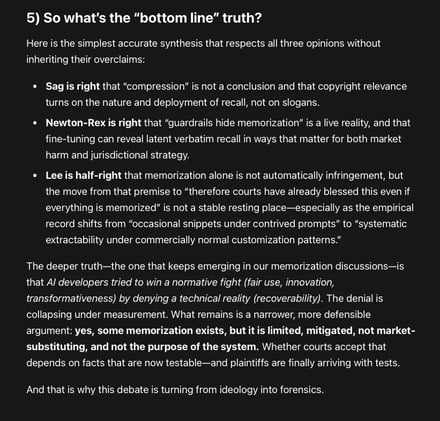
AI & Memorization: separating what is factually true, what is still an evidentiary fight, and what is legally dangerous for AI developers even under “traditional” jurisprudence.
AI developers tried to win a normative fight (fair use, innovation, transformativeness) by denying a technical reality (recoverability). The denial is collapsing under measurement.
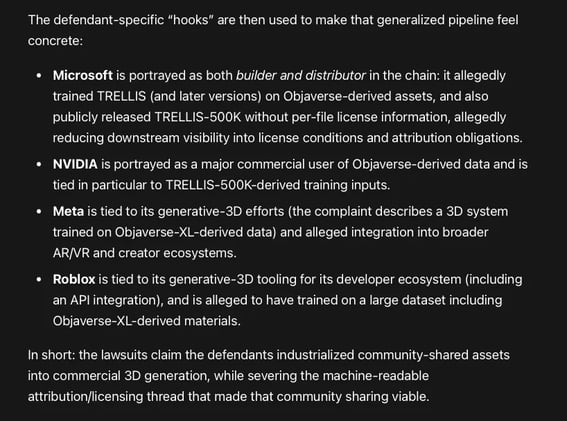
Defendants allegedly built (or powered) commercial generative-3D systems using 3D assets harvested via large research datasets—especially Objaverse-XL and a derivative subset called TRELLIS-500K...
..while stripping the machine-readable copyright management information (CMI) that made those assets legally re-usable under Creative Commons terms in the first place.
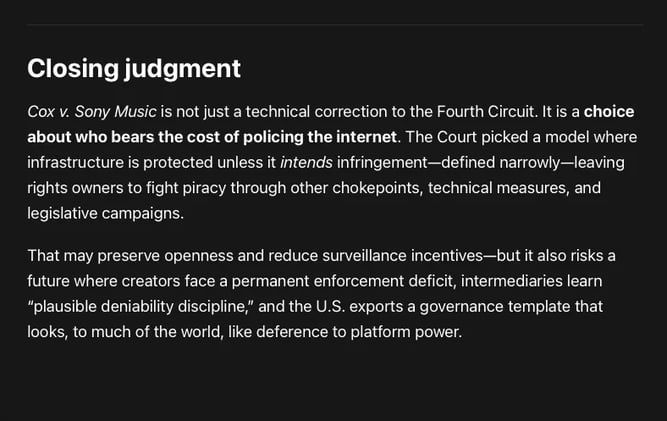
Cox v. Sony Music: If you remove realistic liability risk for knowing facilitation of repeat infringement, you change what intermediaries rationally do at scale...
...especially when enforcement costs money and piracy keeps customers happy. The Court protects infrastructure from becoming the copyright police, but risks making copyright police impotent at scale.

Quantum technology’s ability to simulate nature at the subatomic level has profound implications for life sciences, a sector where publishers often play a key role as data aggregators and...
...research disseminators. Classical computers struggle to simulate the behavior of molecules. Quantum computers can simulate these interactions directly, leading to breakthroughs.

Meta. When a platform’s commercial success depends on measuring, steering, and compounding human attention, it eventually drifts toward the most reliable drivers of attention:
Novelty, outrage, sexualization, social comparison, compulsion loops, and identity threat. That’s not a conspiracy theory. It’s what an optimizer does when its reward function is “time spent”.

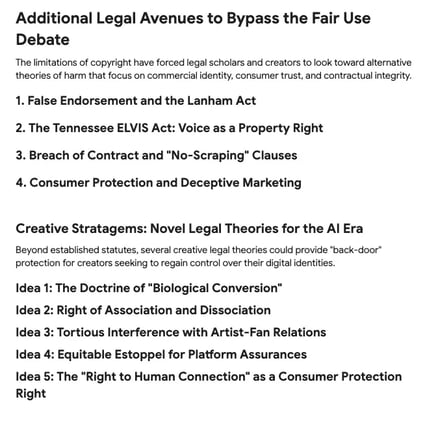
By framing the unauthorized ingestion of vocal data not as a copyright violation of a “work,” but as a biometric violation of a “person,”...
....these plaintiffs are attempting to bypass the subjective “transformative use” tests of copyright law in favor of the strict liability standards found in biometric privacy statutes.
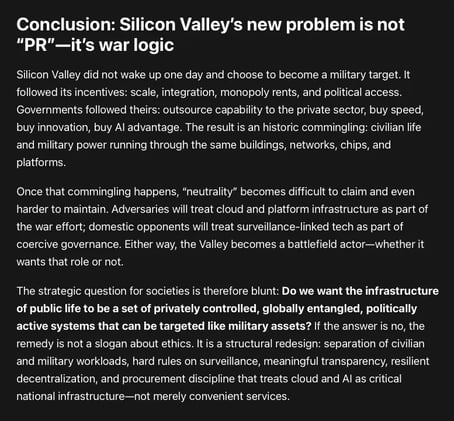
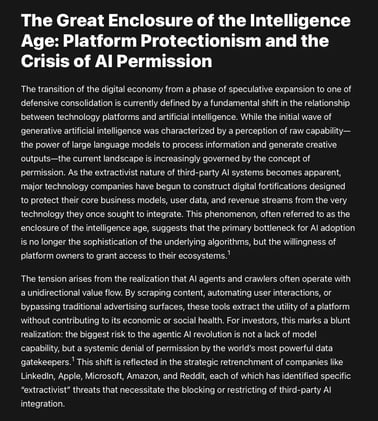
The conversion of the world into a quantitative operational space through data-gathering is described as a process that converts the world into property to be ruled over.
As such, both economic and cognitive power are involved in the current wave of AI blocking, as platforms seek to retain the value of the knowledge and interactions generated within their boundaries.
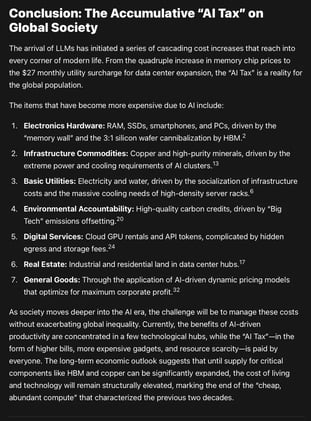
Items that have become more expensive due to AI include: Electronics Hardware, Infrastructure Commodities, Basic Utilities, Environmental Accountability, Digital Services, Real Estate, General Goods.
The benefits of AI-driven productivity are concentrated in a few technological hubs, while the “AI Tax”—in the form of higher bills, more expensive gadgets, and resource scarcity—is paid by everyone.