- Pascal's Chatbot Q&As
- Posts
- Quantum technology’s ability to simulate nature at the subatomic level has profound implications for life sciences, a sector where publishers often play a key role as data aggregators and...
Quantum technology’s ability to simulate nature at the subatomic level has profound implications for life sciences, a sector where publishers often play a key role as data aggregators and...
...research disseminators. Classical computers struggle to simulate the behavior of molecules. Quantum computers can simulate these interactions directly, leading to breakthroughs.

Pascal Hetzscholdt
March 25, 2026
The Quantum Transition: A Comprehensive Analysis of Cryptographic Obsolescence, Infrastructure Resilience, and the Future of Global Information Systems
by Gemini 3.0, Deep Research. Warning, LLMs may hallucinate!
The transition from classical to quantum computation represents one of the most significant shifts in the history of information technology. While classical computers operate on the deterministic logic of bits—representing information as discrete zeros and ones—quantum systems leverage the probabilistic nature of subatomic particles through qubits. These qubits, through the phenomena of superposition and entanglement, allow for a computational density that can solve specific classes of problems exponentially faster than the most advanced classical supercomputers.1 This report examines the multifaceted impact of quantum technology on global society, with a particular focus on the publishing industry, cryptographic security, the legal landscape of intellectual property, and the emerging synergy between quantum mechanics and artificial intelligence.
The Chronology of Q-Day and the Erosion of Cryptographic Trust
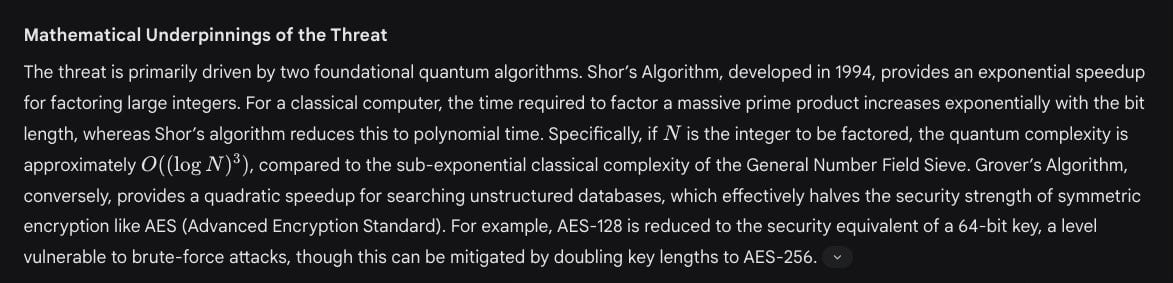
The concept of “Q-Day” serves as a focal point for global security concerns, representing the theoretical milestone at which a cryptographically relevant quantum computer (CRQC) achieves the capacity to break current public-key encryption standards.3 The primary vulnerability lies in the mathematical foundations of modern cryptography, specifically RSA (Rivest-Shamir-Adleman) and ECC (Elliptic Curve Cryptography), which rely on the computational difficulty of prime factorization and discrete logarithm problems.5
Expert Consensus on Timelines
Predicting the arrival of Q-Day involves tracking progress across multiple dimensions: qubit count, error rates, and algorithmic efficiency. Current estimates for the arrival of a CRQC capable of breaking RSA-2048 range from the late 2020s to the mid-2040s.
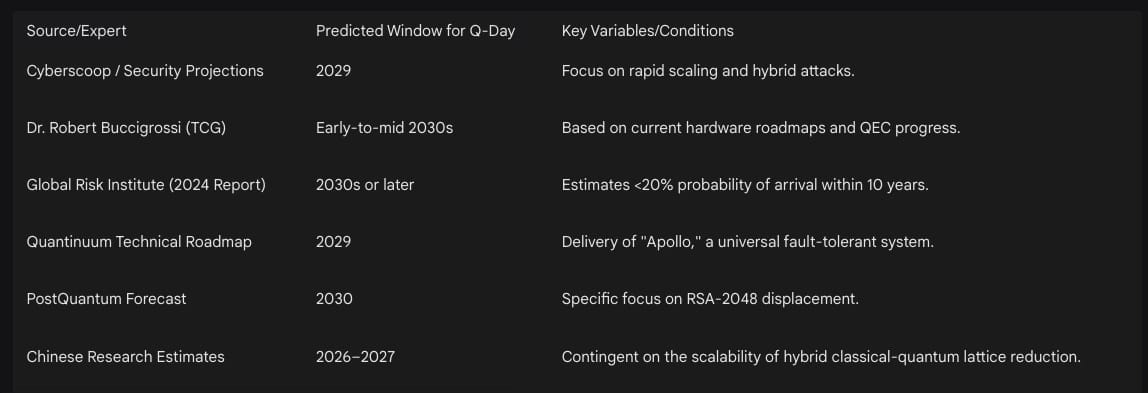
The variability in these dates stems from the “engineering dimension” of manufacturability. While some experts focus on the raw count of physical qubits, others prioritize the development of logical qubits—error-corrected units that can maintain coherence long enough to complete a deep circuit.4
The “Harvest Now, Decrypt Later” Phenomenon
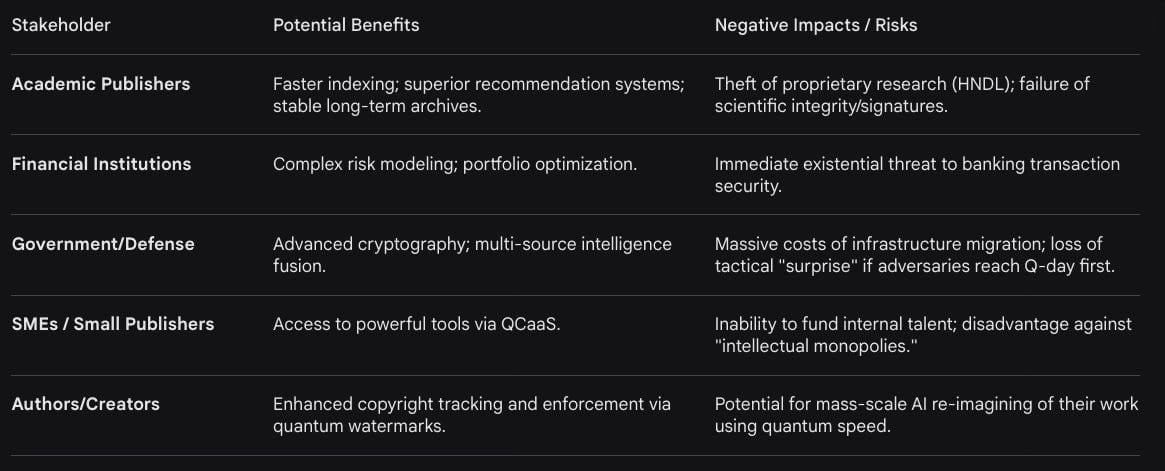
The most immediate threat to global society is not the eventual arrival of Q-Day but the “Harvest Now, Decrypt Later” (HNDL) strategy. Nation-states and sophisticated criminal actors are currently intercepting and storing encrypted data with the intent of decrypting it once quantum hardware matures.3 This creates a retrospective vulnerability for data with long shelf-lives, such as medical records, classified intelligence, and proprietary intellectual property within the publishing and research sectors.3
Impact on Publishing Infrastructure and Digital Rights Management
The publishing industry, as a custodian of intellectual property, faces a dual challenge: the potential collapse of the systems that protect digital content and the opportunity to revolutionize how information is indexed, stored, and retrieved.
Vulnerabilities in DRM and Scientific Integrity
Digital Rights Management (DRM) systems are fundamentally built on the asymmetric encryption that quantum computers are designed to break. If the public-key infrastructure (PKI) underlying content distribution fails, publishers will lose the ability to verify licenses, leading to a potential surge in unauthorized re-use and digital piracy.4 Furthermore, the integrity of the scientific record depends on digital signatures to verify the authenticity of peer-reviewed research. A CRQC could potentially forge these signatures, leading to a crisis of trust in academic publishing.4
Strategic Preparation for Publishers
Publishers must begin a phased migration to Post-Quantum Cryptography (PQC). This involves a transition to algorithms that are believed to be resistant to both classical and quantum attacks, such as lattice-based cryptography, code-based cryptography, and multivariate polynomial cryptography.4 The National Institute of Standards and Technology (NIST) has already finalized standards like ML-KEM (FIPS 203) for key encapsulation and ML-DSA (FIPS 204) for digital signatures.4
Preparation requires a methodical approach to “crypto-agility”—the ability of an organization to replace cryptographic algorithms and keys without rebuilding its entire infrastructure.4 This is particularly critical because the long-term resistance of specific PQC algorithms is not yet fully guaranteed, necessitating a system that can adapt as new vulnerabilities are discovered.
Revolutionizing Libraries and Archives
While the security risks are significant, quantum technology offers transformative potential for the management of vast information repositories. Quantum data storage, utilizing the property of superposition, could allow libraries to store data in a significantly more compact and stable manner than current magnetic or optical media.10
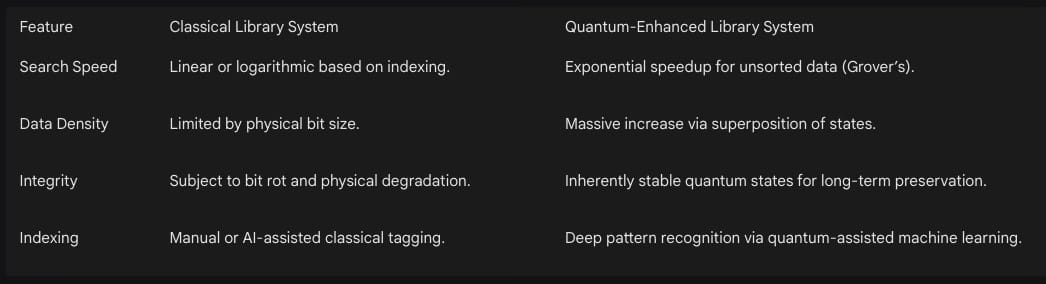
Quantum computers can process and analyze vast datasets significantly faster than traditional systems, leading to more accurate indexing and improved search capabilities for researchers and library patrons.10 This is particularly relevant for “long-term data preservation,” where maintaining the integrity of digital archives over decades is a primary concern for academic publishers and national libraries.10
The Human Element: Talent, Skills, and Economic Realities
The race toward quantum supremacy is fundamentally limited by a global talent shortage. As industries like publishing seek to prepare for Q-Day and integrate quantum-inspired algorithms into their services, they must compete in an extremely tight labor market.
The Widening Skills Gap
Current estimates suggest a profound deficit in the quantum workforce. By 2025, global demand for quantum scientists and engineers is projected to exceed one million, yet the available talent pool remains a fraction of that size.12 In the specific domain of Quantum Error Correction (QEC), only 600–700 specialists exist worldwide, while as many as 16,000 will be required by 2030.13
This scarcity is reflected in compensation trends. Entry-level quantum software engineers command salaries between £80,000 and £100,000, while senior specialists at major technology firms receive packages exceeding £200,000.14 For many traditional publishers, funding these positions or finding talent willing to work outside the primary quantum hardware sector will be a significant barrier to entry.
National Strategies and Educational Initiatives
Governments are responding with multi-billion-dollar investments to secure their position in the quantum economy. The UK’s National Quantum Strategy, for instance, has pledged £2.5 billion over the next decade to establish the UK as a global leader.15 This includes funding for 1,000 additional postgraduate students in quantum-related fields and the creation of a Quantum Skills Taskforce to align academic curricula with industry needs.12
Publishers and other non-primary stakeholders may find it more feasible to “upskill” existing STEM personnel through international training programs and online masterclasses, such as those provided by Q-CTRL or the University of Edinburgh’s MSc in Quantum Computing.12 Collaboration with academic institutions and participation in national “placement schemes” are also recommended strategies for organizations that cannot afford to maintain a permanent, high-level quantum research department.15
Technical Barriers: Error Correction and Deployability
A major criticism of quantum computing is its propensity for error. Qubits are inherently fragile, losing their “quantumness” (coherence) in microseconds due to environmental noise, temperature fluctuations, and electromagnetic interference.4
Solving the Error Problem
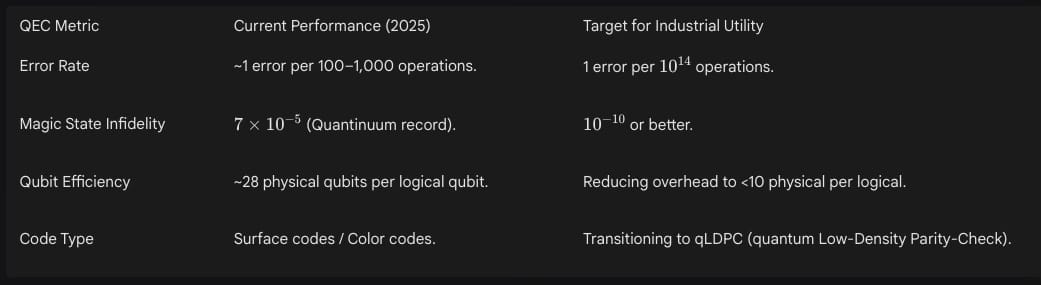
The transition from “Noisy Intermediate-Scale Quantum” (NISQ) devices to “Fault-Tolerant Quantum Computers” (FTQC) is the primary goal of the industry. This requires Quantum Error Correction (QEC), a process where multiple physical qubits are used to form a single “logical qubit” that can detect and correct its own errors.4
Significant progress has been made recently. In 2025, Quantinuum demonstrated a “fully fault-tolerant universal gate set with repeatable error correction,” achieving error rates low enough for practical applications.8 Furthermore, the industry is adopting “QuOps” (error-free Quantum Operations) as a standardized success metric, providing a clear roadmap from “KiloQuOp” to “TeraQuOp” systems.13
From Demonstration to Deployable Capability
Turning lab demonstrations into deployable capability remains a significant engineering and sustainability challenge. Most quantum computers require cryogenic systems to operate at temperatures near absolute zero, creating high operational costs and sustainability concerns.17 While photonic systems offer a path toward room-temperature quantum computing, they currently face hurdles in control hardware complexity.17
For publishers, the most likely deployment model is “Quantum Computing as a Service” (QCaaS), where quantum workloads are sent to specialized data centers via the cloud. This avoids the astronomical capital expenditure and infrastructure requirements of hosting on-premise quantum hardware.19
The Intellectual Property Maze: Patents and Changing States
The patenting of quantum innovations is uniquely challenging due to the collaborative nature of the field and the fundamental principles of patent law.
Crowdsourcing and Ownership Clarity
Many quantum breakthroughs occur through academic-industry collaborations or open-source “crowd-sourced” projects. In such environments, the lack of rigorous logging can make it difficult to establish inventorship.1 This is compounded by the “upstream” versus “downstream” conflict: early movers like IBM and Google have patented foundational techniques for qubit readout and error correction, potentially creating “intellectual monopolies” that block smaller researchers from developing downstream applications.20
The “Changing State” Barrier
Patent lawyers highlight that quantum technology is often in a “changing state,” which creates a barrier to the patenting process. Under the “Alice” doctrine in the United States, abstract ideas are not patentable; inventions must demonstrate “practical applicability” and a “specific, practical application”.1 Because the state of the art is evolving so rapidly, a patent application for a NISQ-based algorithm may become technologically obsolete before the patent is even granted.18
Furthermore, the “enablement” requirement—where a patent must teach someone of skill in the art how to replicate the invention—is difficult to satisfy when the underlying hardware is unstable or varies significantly between manufacturers (e.g., superconducting vs. trapped ions).18
Quantum-Inspired Algorithms: Immediate Opportunities and Threats
One of the most promising developments for the publishing industry is the rise of “quantum-inspired” algorithms (QIO). These are classical algorithms that use the mathematical principles of quantum mechanics, such as superposition and tunneling emulations, to solve optimization problems on existing classical hardware (CPUs and GPUs).21
Performance and Competitive Advantage
It is not merely an “allegation” that these algorithms are faster; peer-reviewed results demonstrate that quantum-inspired methods far outperform standard classical models in terms of computational efficiency and scalability.21
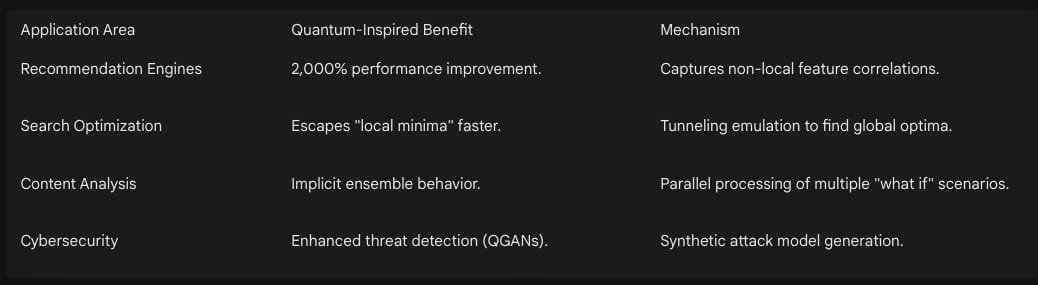
For publishers, these algorithms represent an “opportunity” to drastically improve search relevance and user engagement. However, it is also a “threat” for those who do not capitalize on it; as competitors adopt QIO to provide superior discovery services, traditional publishers risk becoming obsolete in terms of user experience.22
The Symbiosis of AI and Quantum Technology
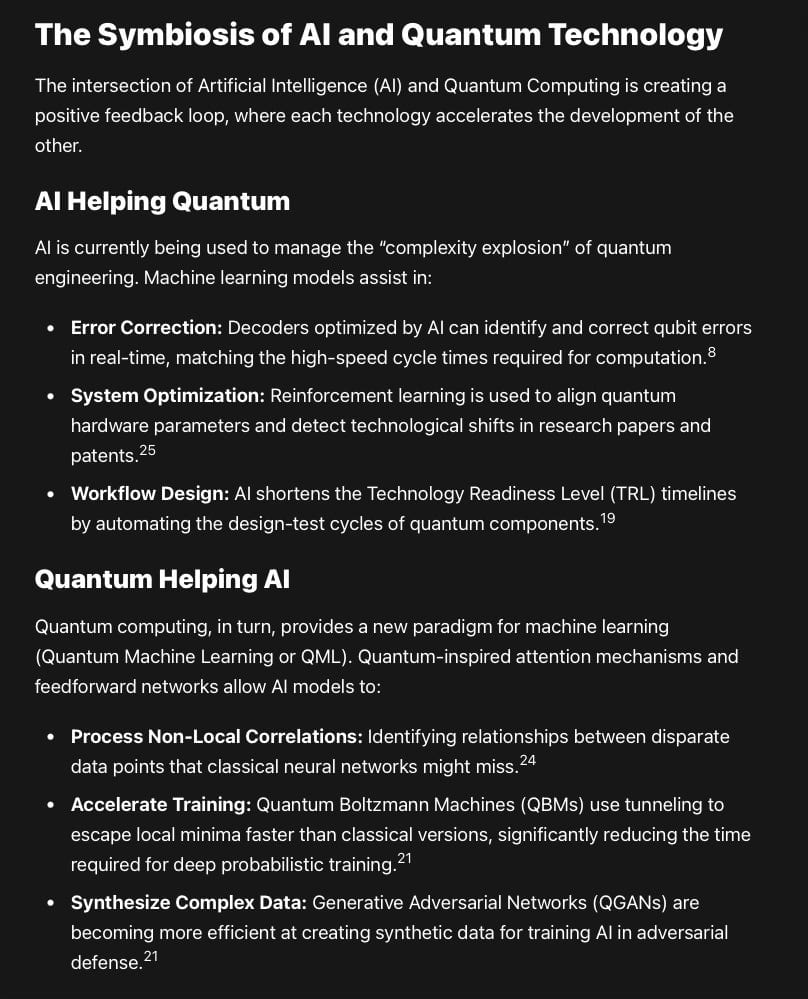
The intersection of Artificial Intelligence (AI) and Quantum Computing is creating a positive feedback loop, where each technology accelerates the development of the other.
AI Helping Quantum
AI is currently being used to manage the “complexity explosion” of quantum engineering. Machine learning models assist in:
Error Correction: Decoders optimized by AI can identify and correct qubit errors in real-time, matching the high-speed cycle times required for computation.8
System Optimization: Reinforcement learning is used to align quantum hardware parameters and detect technological shifts in research papers and patents.25
Workflow Design: AI shortens the Technology Readiness Level (TRL) timelines by automating the design-test cycles of quantum components.19
Quantum Helping AI
Quantum computing, in turn, provides a new paradigm for machine learning (Quantum Machine Learning or QML). Quantum-inspired attention mechanisms and feedforward networks allow AI models to:
Process Non-Local Correlations: Identifying relationships between disparate data points that classical neural networks might miss.24
Accelerate Training: Quantum Boltzmann Machines (QBMs) use tunneling to escape local minima faster than classical versions, significantly reducing the time required for deep probabilistic training.21
Synthesize Complex Data: Generative Adversarial Networks (QGANs) are becoming more efficient at creating synthetic data for training AI in adversarial defense.21
Commercial Horizons: Life Sciences and Beyond
Quantum technology’s ability to simulate nature at the subatomic level has profound implications for life sciences, a sector where publishers often play a key role as data aggregators and research disseminators.
The Life Sciences Revolution
Classical computers struggle to simulate the behavior of molecules because the complexity grows exponentially with every added electron. Quantum computers can simulate these interactions directly, leading to breakthroughs in:
Drug Discovery: Identifying potential molecular compounds and their interactions with human proteins exponentially faster than current methods.1
Genomics: Improved pattern recognition in massive genetic datasets, allowing for more personalized medicine.26
Materials Science: Designing new catalysts for energy production or carbon capture.8
For publishers in the medical and scientific fields, this creates a surge in high-value data and research that must be securely managed, indexed, and peer-reviewed.10
Strategic Synthesis: Pros, Cons, and Stakeholder Mapping
The emergence of quantum technology is a classic “disruptive innovation” that will benefit those with the capital and foresight to adapt, while penalizing those who remain tethered to classical paradigms.
Pros and Cons for Global Society
Pros:
Optimization: Solving previously unsolvable problems in logistics, finance, and climate modeling.11
Medical Breakthroughs: Drastic reduction in time-to-market for life-saving drugs.26
Secure Communications: Quantum Key Distribution (QKD) offers the potential for unbreakable encryption.10
Cons:
Security Risks: Potential collapse of global financial and governmental encryption.3
Talent Inequality: A “brain drain” where a few wealthy nations and corporations monopolize the limited pool of quantum expertise.20
Economic Disruption: High costs of migration to PQC and the potential for a “quantum divide” between developed and developing nations.13
Stakeholder Analysis
Conclusions and Actionable Recommendations
Quantum technology is not a distant science-fiction scenario but a rapidly approaching industrial reality. For the publishing industry and global society at large, the most critical takeaway is that the “threat” is already active through data harvesting, while the “opportunity” is currently available through quantum-inspired algorithms.
Immediate Actions for Decision-Makers
Conduct a Cryptographic Inventory: Organizations must identify where they use RSA and ECC and prioritize the migration of long-life sensitive data.4
Invest in Crypto-Agility: Building systems that can switch between encryption standards is the only way to future-proof against evolving quantum threats.4
Adopt Quantum-Inspired Optimization: Publishers should explore the integration of QIO into their search and recommendation architectures to gain a competitive edge in user experience.22
Engage in Collaborative Talent Development: Rather than competing for rare specialists, organizations should leverage national training schemes, international networks, and QCaaS partnerships.12
Monitor Patent Landscapes: Stakeholders must navigate the emerging “patent thickets” and support “open innovation” frameworks to avoid being blocked by foundational upstream patents.20
The arrival of a cryptographically relevant quantum computer, likely between 2029 and 2035, will mark a watershed moment for digital civilization. By acting now to implement post-quantum standards and leveraging the early benefits of quantum-inspired software, organizations can transform an existential risk into a transformative advantage.
Works cited
Quantum Computing: Patenting Post-Development Innovations ..., accessed March 25, 2026, https://patentpc.com/blog/patenting-post-development-innovations
Patenting Quantum Technologies & Market Power: A Quantitative Analysis - Other, accessed March 25, 2026, https://law.stanford.edu/publications/patenting-quantum-technologies-market-power-a-quantitative-analysis/
It’s time to get serious about post-quantum security. Here’s where to start. | CyberScoop, accessed March 25, 2026, https://cyberscoop.com/post-quantum-cryptography-pqc-strategy-q-day-security-op-ed/
What Is Q-Day, and How Far Away Is It—Really? - Palo Alto Networks, accessed March 25, 2026, https://www.paloaltonetworks.com/cyberpedia/what-is-q-day
“Q-Day”: When Will Quantum Computers Break Encryption? - TCG, accessed March 25, 2026, https://www.tcg.com/blog/q-day-when-will-quantum-computers-break-encryption/
Quantum Computing’s Impending Impact on Digital Communications - Urban Emu, accessed March 25, 2026, https://www.urbanemu.com/quantum-computings-impending-impact-on-digital-communications/
Q-Day Revisited - RSA-2048 Broken by 2030: Detailed Analysis, accessed March 25, 2026, https://postquantum.com/q-day/q-day-y2q-rsa-broken-2030/
Quantinuum Overcomes Last Major Hurdle to Deliver Scalable ..., accessed March 25, 2026, https://www.quantinuum.com/blog/quantinuum-overcomes-last-major-hurdle-to-deliver-scalable-universal-fault-tolerant-quantum-computers-by-2029
“Q-Day” Is Coming: Why Quantum Computers Will Break Every Encryption Standard You’re Using (And… - Medium, accessed March 25, 2026, https://medium.com/@DevBoostLab/q-day-is-coming-why-quantum-computers-will-break-every-encryption-standard-youre-using-and-ded60c61882b
Quantum Computing: A Game-Changer for Libraries and Information Centers, accessed March 25, 2026, https://www.isjtrend.com/article_195587.html
Quantum Computing: A Game-Changer for Libraries and Information Centers, accessed March 25, 2026, https://www.researchgate.net/publication/381395277_Quantum_Computing_A_Game-Changer_for_Libraries_and_Information_Centers
UK Quantum Skills Taskforce Report Sets Vision to Build World-Leading Quantum Workforce - techUK, accessed March 25, 2026, https://www.techuk.org/resource/uk-quantum-skills-taskforce-report.html
Quantum Error Correction: Our 2025 trends and 2026 predictions ..., accessed March 25, 2026, https://www.riverlane.com/blog/quantum-error-correction-our-2025-trends-and-2026-predictions
Global Quantum Skills Gap Widens as Industry Races to Build Future-Ready Workforce, accessed March 25, 2026, https://www.sovereignmagazine.com/article/global-quantum-skills-gap-widens-as-industry-races-to-build-future-ready-workforce
National Quantum Strategy - GOV.UK, accessed March 25, 2026, https://assets.publishing.service.gov.uk/media/6411a602e90e0776996a4ade/national_quantum_strategy.pdf
Riverlane report reveals scale of the Quantum Error Correction challenge, accessed March 25, 2026, https://www.riverlane.com/press-release/riverlane-report-reveals-scale-of-the-quantum-error-correction-challenge
Quantum Computing: Navigating the Future of Computation, Challenges, and Technological Breakthroughs - MDPI, accessed March 25, 2026, https://www.mdpi.com/2624-960X/6/4/39
Patenting quantum computing: Challenges, trends, and future prospects | DLA Piper, accessed March 25, 2026, https://www.dlapiper.com/insights/publications/intellectual-property-news/2025/patenting-quantum-computing-challenges-trends-and-future-prospects
The Nexus of Quantum Technology, Intellectual Property, and ... - arXiv, accessed March 25, 2026, https://arxiv.org/pdf/2602.15051
Intellectual Property within the Quantum Innovation Value Chain, accessed March 25, 2026, https://www.justsecurity.org/114041/intellectual-property-quantum-value-chain/
Quantum-Inspired Algorithms and Perspectives for Optimization - MDPI, accessed March 25, 2026, https://www.mdpi.com/2079-9292/14/14/2839
Quantum-Inspired Optimization for Engineers|BQP, accessed March 25, 2026, https://www.bqpsim.com/blogs/quantum-inspired-optimization-for-engineers
Quantum-Inspired Algorithms and Perspectives for Optimization - ResearchGate, accessed March 25, 2026, https://www.researchgate.net/publication/393734458_Quantum-Inspired_Algorithms_and_Perspectives_for_Optimization
A quantum-inspired classical algorithm for recommendation systems - ResearchGate, accessed March 25, 2026, https://www.researchgate.net/publication/333914977_A_quantum-inspired_classical_algorithm_for_recommendation_systems
Exploring the Technology Landscape through Topic Modeling, Expert Involvement, and Reinforcement Learning - arXiv, accessed March 25, 2026, https://arxiv.org/pdf/2501.13252?
accessed January 1, 1970, https://techcrunch.com/sponsor/uk-office-for-investment/quantum-technology-how-it-is-revolutionising-life-sciences/
Quantum Skills Gap A thought about the near future, accessed March 25, 2026, https://sp.ts.fujitsu.com/dmsp/Publications/public/Quantum_skills_gap_by_FUJITSU.pdf