- Pascal's Chatbot Q&As
- Archive
- Page 1
Archive

Ted Entertainment v. Apple: This case sits inside a broader cluster of lawsuits by (reportedly) the same creator-plaintiffs against multiple AI-adjacent companies.
This complaint is stronger than many “AI stole my content” filings in one crucial way: it leans on a document trail the plaintiffs claim Apple created itself.

If this two-tier enforcement regime expands without corrective guardrails (legal, political, or administrative), the consequences are not limited to immigration policy...
...they metastasize into the fabric of US democracy and social order. Will the basic terms of ordinary life—movement, safety, dignity, and equal treatment—become contingent, partisan, and weaponized?
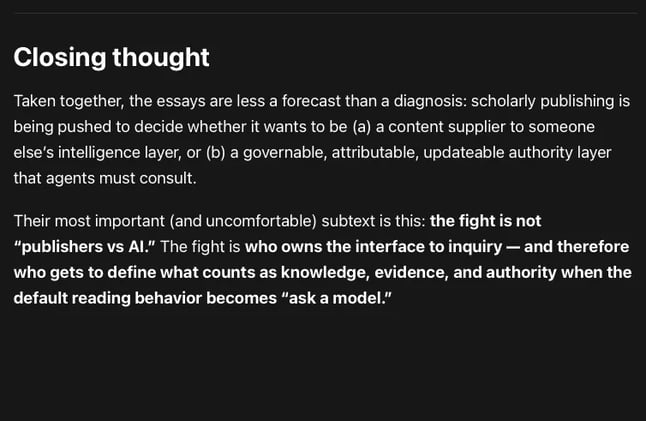
AI is reorganizing how authority, workflow, attention, and distribution power flow through scholarly communication, and most publishers are responding with the tools...
...(and narratives) that feel safest, not the ones that map to where value will actually migrate. What the consequences look like if this diagnosis is right.

One quoted former researcher describes Altman as building structures that “constrain him in the future,” then removing the structure once it becomes inconvenient.
He’s closer to a regulatory judo artist: publicly welcoming oversight, even “begging” for it, while privately working to dilute or kill the versions of oversight that would actually bite.

What is newly dangerous here is the integration of institutional pressure (universities, law firms, media) with an expanded domestic counterterrorism framing.
That is how a temporary political moment can become a durable governing architecture. The most important democratic resource—people’s willingness to speak, associate, and dissent—becomes scarce.

Self-hosting. Commercially available LLMs are increasingly hampered by cost-driven efficiency measures, such as aggressive quantization and output filtering, which often degrade reasoning performance.
Influence of political sensitivities has introduced layers of ideological censorship and “over-refusal,” where models decline benign requests to avoid regulatory or reputational risk.

Budget of U.S. Govt 2027: Schools, universities, and public media shape narratives, norms, and legitimacy. A budget can’t rewrite culture directly, but it can starve the institutions that produce it.
GPT-5.2: (1) stop using culture-war proxies as a budgeting method; (2) preserve civil capacity that prevents downstream crises; (3) make security spending compete on evidence rather than politics.


Paper justifies a sobering but useful conclusion: the most important constraints on the next decade of AI may not be compute or data alone, but the engineering of boundedness.
The artificial equivalent of the body’s relentless demand: stay within safe limits, or you don’t get to keep playing.

People are adopting AI because it is available, convenient, and increasingly embedded in default workflows, not because they feel confident in it. Adoption is rising, but consent is thin.
That gap is where the next phase of AI adoption will either stall, harden into regulation, or split into two diverging tracks: “cheap ubiquitous AI” and “trusted governed AI.”

Penguin v. OpenAI: AI-assisted production of market substitutes in the very formats that already plague children’s publishing (fake titles, lookalike covers, rapid self-publishing).
Penguin Random House’s German case looks more like a “show me the copying” suit. It is anchored in three features that make it unusually legible and potentially dangerous for AI developers.

The Clinical Reality Check: Why “Doctor-Chatbots” Ace Exams but Struggle in the Ward — and What Fixes It
LLMs can look “doctor-level” when you test them the way we usually test AI: give them a neat, complete patient vignette and ask for the diagnosis. Real clinical diagnosis is not a tidy quiz.