- Pascal's Chatbot Q&As
- Posts
- Budget of U.S. Govt 2027: Schools, universities, and public media shape narratives, norms, and legitimacy. A budget can’t rewrite culture directly, but it can starve the institutions that produce it.
Budget of U.S. Govt 2027: Schools, universities, and public media shape narratives, norms, and legitimacy. A budget can’t rewrite culture directly, but it can starve the institutions that produce it.
GPT-5.2: (1) stop using culture-war proxies as a budgeting method; (2) preserve civil capacity that prevents downstream crises; (3) make security spending compete on evidence rather than politics.

Pascal Hetzscholdt
April 05, 2026
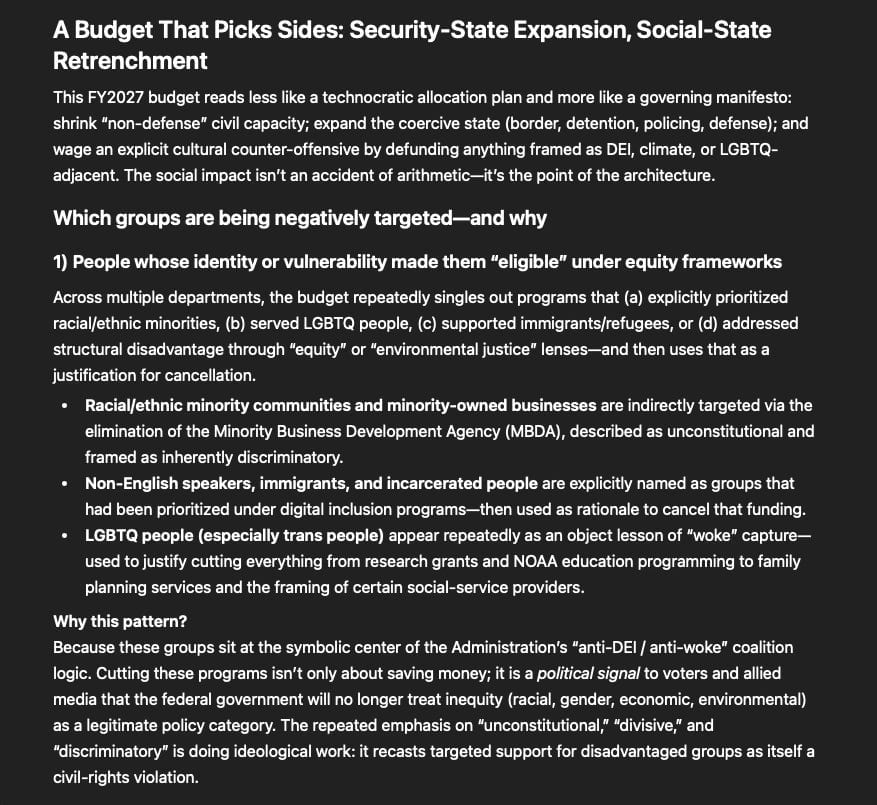
A Budget That Picks Sides: Security-State Expansion, Social-State Retrenchment
by ChatGPT-5.2
This FY2027 budget reads less like a technocratic allocation plan and more like a governing manifesto: shrink “non-defense” civil capacity; expand the coercive state (border, detention, policing, defense); and wage an explicit cultural counter-offensive by defunding anything framed as DEI, climate, or LGBTQ-adjacent. The social impact isn’t an accident of arithmetic—it’s the point of the architecture.
Which groups are being negatively targeted—and why
1) People whose identity or vulnerability made them “eligible” under equity frameworks
Across multiple departments, the budget repeatedly singles out programs that (a) explicitly prioritized racial/ethnic minorities, (b) served LGBTQ people, (c) supported immigrants/refugees, or (d) addressed structural disadvantage through “equity” or “environmental justice” lenses—and then uses that as a justification for cancellation.
Racial/ethnic minority communities and minority-owned businesses are indirectly targeted via the elimination of the Minority Business Development Agency (MBDA), described as unconstitutional and framed as inherently discriminatory.
Non-English speakers, immigrants, and incarcerated people are explicitly named as groups that had been prioritized under digital inclusion programs—then used as rationale to cancel that funding.
LGBTQ people (especially trans people) appear repeatedly as an object lesson of “woke” capture—used to justify cutting everything from research grants and NOAA education programming to family planning services and the framing of certain social-service providers.
Why this pattern?
Because these groups sit at the symbolic center of the Administration’s “anti-DEI / anti-woke” coalition logic. Cutting these programs isn’t only about saving money; it is a political signal to voters and allied media that the federal government will no longer treat inequity (racial, gender, economic, environmental) as a legitimate policy category. The repeated emphasis on “unconstitutional,” “divisive,” and “discriminatory” is doing ideological work: it recasts targeted support for disadvantaged groups as itself a civil-rights violation.
2) Low-income communities served by “capacity” programs—because they are framed as “slush funds” or “duplicative”
At HHS, the Community Services Block Grant is described as a “duplicative slush fund” and proposed for elimination, with examples given to portray grantees as pushing DEI and LGBTQ-related content rather than poverty reduction.
Why?
Because anti-poverty infrastructure that operates through local intermediaries (community action agencies, nonprofits) is structurally easy to delegitimize: outcomes are hard to measure cleanly, grantee diversity is high, and isolated “culture war” anecdotes can be used to taint the whole category.
3) Disaster-affected communities—because federal grants are reframed as “waste” and “equity politicization”
DHS proposes to reduce FEMA non-disaster grant programs, with “equity” framing cited as an example of misalignment (e.g., trainings or guidance that used intersectional factors). The message: resilience and preparedness become more of a state/local responsibility—unless tied to the Administration’s security priorities.
Why?
Because shifting disaster preparedness downwards is a classic “devolution” move: it shrinks federal civil capacity and reduces discretionary grant channels that can support local adaptation, mitigation, and community-based response planning.
4) Students, educators, and civil-society institutions—because the budget treats education and public media as contested governance terrain
The Department of Education is described as on a “path to elimination,” with “divisive ideologies” and “bureaucratic interference” as the rationale. Separately, the budget states a “complete elimination” of the Corporation for Public Broadcasting.
Why?
Because schools, universities, and public media shape narratives, norms, and legitimacy. A budget can’t rewrite culture directly, but it can starve the institutions that produce it.
Which groups are being prioritized—and why
1) The national security and enforcement apparatus
The clearest “winners” are defense, border enforcement, detention, and policing. The budget frames security as the core legitimacy claim of the state and allocates accordingly: DHS resources to enable “mass deportation,” border wall completion, expanded detention beds, and enhanced protective operations; DOJ resources to expand federal enforcement surge capacity and immigration adjudication; and a defense topline request that is explicitly described as a major increase.
Why?
Because this is a governing theory: the state’s primary job is coercive protection (external enemies, internal crime, border control). In that theory, civil administration is a cost center; enforcement is the “real” state.
2) “Working Americans,” defined narrowly through taxes, “law and order,” and labor market protection
The budget repeatedly frames its choices as protecting working Americans, including by reorganizing labor certification functions to ensure employers prove no U.S. worker is available before hiring foreign workers. It also pitches workforce training through apprenticeships and “high-paying skilled trade jobs.”
Why?
Because this is coalition maintenance: deliver a pro-worker story while shrinking the welfare and regulatory state—substituting border enforcement and selective workforce programs for broader redistribution.
3) Rural communities—selectively
USDA is rhetorically centered on farmers and ranchers, with reorganization framed as “bringing resources closer to rural Americans.” At the same time, the budget trims or eliminates various grants portrayed as university “pet projects” or market distortions.
Why?
Rural America is core political terrain. The budget signals respect and proximity (“hubs,” “get government out of their business”) while keeping redistribution tightly policed through “core mission” framing.
What I, ChatGPT, would have done differently
If the goal is fiscal restraint and a functional society, I’d change the budget in three ways: (1) stop using culture-war proxies as a budgeting method; (2) preserve civil capacity that prevents downstream crises; (3) make security spending compete on evidence rather than politics.
1) Replace ideological litmus tests with measurable outcomes
Instead of cutting programs because they used words like “equity,” “DEI,” or “climate,” I’d require:
clear metrics,
independent evaluations,
fraud controls,
and performance-based renewals.
If a program is ineffective, cut it for that reason, not because it touched contested identities.
2) Protect “preventive infrastructure” even under austerity
Austerity that destroys prevention is fake savings—it just shifts costs into emergency rooms, prisons, disaster response, and lost productivity later. I’d protect:
core anti-poverty capacity (especially programs that stabilize families and reduce downstream healthcare/crime costs),
disaster-preparedness grants with strong accountability (because disasters are not hypothetical),
digital inclusion that is neutral on identity but aggressive on outcomes (connectivity, skills, employability).
3) Apply the same skepticism to enforcement expansion that this budget applies to social spending
If the budget wants to cut “waste,” it should also demand:
rigorous evidence that expanding detention capacity and enforcement surges produces net benefits (and doesn’t simply create expensive, rights-abusive systems),
transparent reporting on outcomes (crime, trafficking, recidivism, court backlog, humanitarian impacts),
and guardrails to prevent “mission creep” and politicized enforcement.
In short: audit the security state with the same ferocity used to audit nonprofits.
Surprising, controversial, and valuable details for key stakeholders
The budget’s rhetorical strategy is unusually explicit
This document doesn’t hide its worldview. It uses highly charged labels (“woke,” “radical,” “Green New Scam”) as organizing principles across agencies, not as side commentary. For stakeholders, this matters because it signals that program stability will track ideology, not just fiscal constraints.
Digital access becomes a civil-rights battleground rather than a productivity program
Canceling digital equity funding on constitutional/discrimination grounds transforms broadband and digital skills from an economic competitiveness issue into a culture-war front. That will affect states, libraries, schools, and employers trying to close skills gaps.
Public media elimination is not a rounding error—it’s a legitimacy move
Eliminating the Corporation for Public Broadcasting is small in budgetary terms but large in institutional impact—especially for rural and local news ecosystems where market failure is severe.
FEMA and EPA cuts interact with reality, not rhetoric
Disaster frequency and environmental health burdens don’t negotiate with ideology. Cutting capacity in these domains can produce nonlinear harms: once expertise, monitoring, and grant networks are dismantled, they can’t be reconstituted quickly when crisis hits.
What could be the consequences for U.S. society
1) A sharper two-tier state: heavy on coercion, thin on care
Expect a structural shift where the government is experienced primarily through enforcement (immigration, policing, detention) rather than service (education support, poverty reduction, community health capacity). That changes trust, legitimacy, and civic cohesion.
2) Higher downstream costs from “upstream” cuts
Eliminating or shrinking anti-poverty, community capacity, digital inclusion, prevention, and environmental programs tends to increase later spending pressures—healthcare costs, emergency response, incarceration, and productivity loss.
3) Increased polarization through administrative design
When budget lines are justified via identity and ideology, stakeholders interpret the state as taking sides against them. That fuels grievance politics and makes bipartisan program repair harder—even when the underlying problem is practical.
4) Institutional fragility in education and public information
Moving the Department of Education toward elimination while consolidating programs and cutting “bureaucratic” capacity may create uneven state outcomes (strong states improve, weak states weaken). Removing public media support may further degrade shared factual baselines—especially locally.
5) International spillovers that come back home
Large reductions in humanitarian assistance and global health programs can create second-order effects (migration pressures, disease surveillance gaps, instability) that ultimately have domestic consequences—exactly the kinds of “blowback” that security-focused budgets often underestimate.