- Pascal's Chatbot Q&As
- Posts
- AI data centers are not just energy-hungry—they may be measurably warming the land around them...
AI data centers are not just energy-hungry—they may be measurably warming the land around them...
...creating localized “microclimate zones” that behave less like ordinary industrial footprints and more like a new kind of heat island.

Pascal Hetzscholdt
April 03, 2026
Hotter Than the Cloud: The “Data Heat Island” Turns AI Infrastructure Into Local Climate Forcing
by ChatGPT-5.2
A quiet shift is happening in the physical world beneath the digital one: AI data centers are not just energy-hungry—they may be measurably warming the land around them, creating localized “microclimate zones” that behave less like ordinary industrial footprints and more like a new kind of heat island. The paper ‘The data heat island effect: quantifying the impact of AI data centers in a warming world’ frames this as the “data heat island effect”: a persistent land-surface-temperature (LST) uplift that appears to step up around the time an AI hyperscaler begins operations, extending outward for kilometers and potentially affecting hundreds of millions of people.
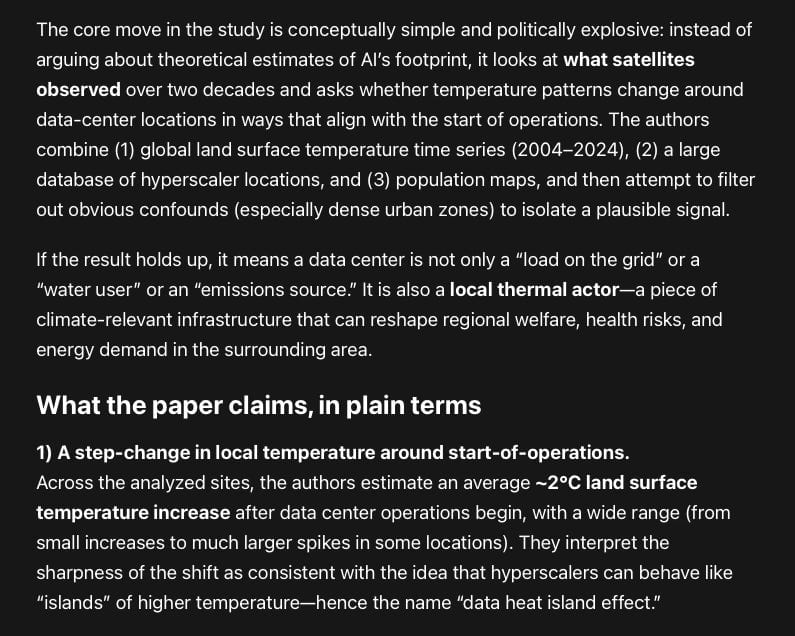
The core move in the study is conceptually simple and politically explosive: instead of arguing about theoretical estimates of AI’s footprint, it looks at what satellites observed over two decades and asks whether temperature patterns change around data-center locations in ways that align with the start of operations. The authors combine (1) global land surface temperature time series (2004–2024), (2) a large database of hyperscaler locations, and (3) population maps, and then attempt to filter out obvious confounds (especially dense urban zones) to isolate a plausible signal.
If the result holds up, it means a data center is not only a “load on the grid” or a “water user” or an “emissions source.” It is also a local thermal actor—a piece of climate-relevant infrastructure that can reshape regional welfare, health risks, and energy demand in the surrounding area.
What the paper claims, in plain terms
1) A step-change in local temperature around start-of-operations.
Across the analyzed sites, the authors estimate an average ~2°C land surface temperature increase after data center operations begin, with a wide range (from small increases to much larger spikes in some locations). They interpret the sharpness of the shift as consistent with the idea that hyperscalers can behave like “islands” of higher temperature—hence the name “data heat island effect.”
2) The effect is not confined to the fence line.
The spatial pattern in their analysis suggests the temperature uplift can extend out to ~10 km, with meaningful residual warming still measured several kilometers away (they highlight an average ~1°C signal out to roughly mid-single-digit kilometers).
3) It is large enough to be a mass-exposure issue.
Even focusing on data centers outside dense urban areas, they estimate hundreds of millions of people could live within a radius where the effect is measurable. This matters because temperature is not a neutral variable: it pulls on mortality, worker productivity, school performance, energy demand, and water stress—and it does so nonlinearly during heat extremes.
4) The welfare impact is the point, not just the physics.
The authors explicitly connect the phenomenon to the same types of downstream harms associated with urban heat islands: healthcare burden, energy-system stress, and broader welfare impacts, especially in a warming world where many regions are already near heat thresholds.
5) Mitigation is possible—but it requires treating AI compute as physical infrastructure with externalities.
They sketch “a way forward” divided into software and hardware/infrastructure measures: reducing computational waste; improving efficiency; power-management approaches that handle variable AI loads; and cooling strategies (including passive radiative cooling coatings) that can reduce cooling demand.
Text continues below the video»
Source: TikTok
Most surprising, controversial, and valuable statements & findings
Surprising
A measurable average ~2°C LST increase tied to “start of operations.” Not “data centers contribute to emissions,” but “satellites show a step-like local temperature change coinciding with activation.” That’s a much stronger claim than most AI sustainability debates make.
Scale of reach: up to ~10 km. Many people assume the heat problem is basically “inside the building” or “in the cooling system.” The paper argues the surrounding land surface can warm for kilometers.
Potential exposure: hundreds of millions of residents. Even after excluding dense urban areas, the implied affected population is enormous—suggesting a phenomenon that is not niche, but globally relevant wherever hyperscalers cluster.
Controversial
Causality inference from observational alignment. The paper tries to clean confounds, but it’s still making a causal-style claim from correlated signals (temperature shifts “coinciding with” operational start). That will be contested by operators and some policymakers, especially where other land-use changes occurred concurrently (construction, roads, industrial clustering).
Framing AI data centers as a new kind of “heat island.” Urban heat islands are already politically fraught because they sit at the intersection of inequality, zoning, industry, and public health. Labeling hyperscalers as heat-island creators invites regulation, litigation, and permitting battles.
Implicit challenge to “green AI” narratives. Even if a data center buys renewable energy certificates, waste heat is still waste heat. The paper’s argument cuts through accounting games: the local thermal footprint is physical and geographically specific.
Valuable
A measurement approach regulators can understand. Satellite-derived temperature trends + siting + time alignment is an audit-like framing: “show me the before/after signal.” This is a form of evidence that can be operationalized into monitoring.
A bridge from compute policy to public-health policy. The analysis makes it easier to translate “AI scaling” into familiar governance domains: heat risk, zoning, environmental impact assessments, grid resilience, and climate adaptation.
A blueprint for mitigation that doesn’t depend on perfect decarbonization.Efficiency, workload shaping, dynamic power response, and passive cooling are levers even in messy energy contexts.
All consequences for any country with data centers
What follows applies to any jurisdiction hosting hyperscale or AI-accelerated compute—whether it’s the US, Ireland, Singapore, India, the UAE, Brazil, Spain, or emerging hubs in Africa and Southeast Asia. The details vary by climate and grid, but the governance problem is structurally similar.
1) Heat becomes a permitting and siting issue, not just an energy issue
If data centers measurably raise local surface temperatures, governments will face pressure to treat them like other heat-generating industrial facilities—requiring thermal impact modeling, setbacks, green buffers, and heat-mitigation obligations as part of planning approvals.
2) Public-health externalities and heat-risk compounding
A seemingly “small” average increase can matter a lot during heat waves. Any incremental warming can push vulnerable populations over thresholds, especially where housing quality is poor or air-conditioning access is unequal. Countries may see:
higher heat-related illness and mortality risk,
more “cooling poverty,”
reduced labor productivity during extreme heat periods,
school and care-system disruption during heat events.
3) Feedback loops with energy demand and grid stability
Local warming tends to increase demand for cooling, which increases electricity demand, which increases heat output and often emissions—especially where grids are fossil-heavy. Add AI workloads (spiky, variable, high intensity) and you get a compound risk:
peak-load stress,
higher outage probability during heat waves,
political backlash when households face rationing while hyperscalers expand.
4) Water stress and land-use conflicts intensify
Even when data centers pursue “waterless” cooling designs, many still consume water directly or indirectly (power generation, evaporative systems, district cooling). Local temperature rises can worsen evapotranspiration and water stress. For water-stressed countries, this becomes a legitimacy problem: “Why is water going to compute?”
5) Environmental justice and inequality become central
Heat burdens are rarely evenly distributed. If clusters of compute are placed near less politically powerful communities (cheaper land, weaker permitting resistance), the “data heat island” becomes an equity and rights issue:
disproportionate exposure,
property-value impacts,
localized health burdens,
political conflict over “who benefits from AI” versus “who pays the physical costs.”
6) National competitiveness narratives may collide with local legitimacy
Governments want investment, jobs, “AI leadership,” and tax base. But if residents experience heat, water stress, or grid price increases, the political equation changes. Data centers may become:
flashpoints in elections,
targets of local moratoria,
subject to higher fees/impact levies,
politically framed as extractive infrastructure.
7) New climate-accounting disputes: “clean power” doesn’t erase local heat
A country may boast renewable PPAs while still facing localized warming around facilities. This creates a policy mismatch: carbon accounting can look “fine” while the microclimate harms persist. Expect:
demands for location-based and time-matched reporting,
scrutiny of offsets/RECs as insufficient,
climate litigation arguments shifting from emissions to localized harms.
8) Insurance, finance, and real-estate knock-on effects
If microclimate effects become accepted, insurers may reassess heat risk around clusters; developers may face higher cooling and adaptation costs; and local governments may be asked to build heat resilience. This can shift:
municipal infrastructure budgets,
resilience planning priorities,
the cost of capital for new builds.
9) Geopolitical and national-security implications (yes, really)
Once data centers are treated as climate-relevant critical infrastructure, they can become subject to:
stricter sovereignty requirements,
cross-border disputes over water/energy,
heightened concerns around sabotage during heat extremes,
industrial policy fights over where hyperscalers are allowed to concentrate.
10) Regulatory convergence: AI policy meets environment policy
Many countries currently regulate AI through privacy, safety, competition, and content rules. This situation pushes them to integrate environmental permitting into AI infrastructure governance—effectively making compute scaling a matter of environmental law, not just innovation policy.
Recommendations for regulators
Below is a regulator-first checklist designed to be implementable without waiting for perfect science, while still encouraging better evidence.
Mandate “thermal impact assessments” for hyperscale builds and expansions
Require standardized modeling and monitoring of heat outputs, land surface temperature trends, and mitigation plans, similar to noise/traffic/environmental impact processes.Create a baseline-and-monitor regime using remote sensing + ground sensors
Set pre-construction baselines and require ongoing reporting (satellite LST trend reviews plus local meteorological stations) to detect changes early and verify mitigation.Adopt “heat budgets” and siting constraints in regional planning
Limit clustering in thermally vulnerable regions (already hot, low vegetation, high heat mortality risk). Require green buffers and land-use designs that reduce heat retention.Tie permits to performance: enforceable thresholds and penalties
Move beyond voluntary ESG reporting. If measurable heat increases exceed agreed thresholds, require remediation (cooling redesign, operational limits during heat events, additional heat-reducing infrastructure).Force time-matched energy disclosure, not annualized claims
Require reporting on hourly/seasonal load and grid mix during peak stress periods. Heat waves are when harms compound; annual averages can hide the worst moments.Make heat-wave operations a public-interest obligation
Require contingency plans for curtailment or load shifting during extreme heat when the grid is stressed—especially if households face rationing or critical services are threatened.Integrate water governance explicitly
Mandate transparent reporting of direct and indirect water use, and place stricter conditions in water-stressed basins. Require water-neutrality plans where feasible.Require best-available cooling and heat-reuse where viable
Push adoption of advanced thermal management, passive cooling, and—where geography supports it—heat reuse (district heating/industrial heat recovery), with verification.Treat compute clusters as an environmental justice issue
Require distributional impact assessments: who bears heat risk, who gets jobs/tax benefits, and what compensation/mitigation is provided to affected communities.Create an “AI infrastructure externalities levy” earmarked for adaptation
If data centers impose localized heat burdens, levy fees that fund urban greening, cooling centers, grid resilience, and public health interventions in the affected radius.Establish transparent public registries of hyperscale sites and impacts
A registry improves accountability and enables independent research. Sensitive details can be protected, but the existence, scale band, and impact monitoring should be public by default.Fund independent replication studies and adversarial audits
Because causality will be contested, regulators should support independent academic and civil-society validation, including alternative methods, counterfactual comparisons, and confound testing.
·
20 APRIL 2025

·
7 JANUARY 2025

Question for AI services: Please read the article "How datacenters use water and why kicking the habit is nearly impossible" and tell me: how bad is this situation? And, wasn't there a water shortage already? What will be the short and long-term consequences and are you convinced that we will be able to solve this challenge anytime soon?
·
11 DECEMBER 2024

Question 1 of 2 for Grok: Please read the paper "The Unpaid Toll: Quantifying the Public Health Impact of AI" and tell me what it says in easy to understand language.
·
5 NOVEMBER 2024

Expansion of Global Data Centers: Environmental, Social, and Regulatory Issues
·
22 JUNE 2024

Question 1 of 3 for ChatGPT-4o: Please read the Bloomberg article: “AI IS ALREADY WREAKING HAVOC ON GLOBAL POWER SYSTEMS” and tell me what it says
·
3 DECEMBER 2024
Question 1 of 3 for ChatGPT-4o: Please read the article: “Ireland's data centres turning to fossil fuels after maxing out country's electricity grid” and tell me what it says
·
26 MAY 2025

Essay: Artificial Intelligence – Supply Chain Constraints and Energy Implications
·
2 JULY 2023

Question 1 of 3 for AI services: Name reasons why by 2030, 80% of all data traffic to and from internet connected data centers and servers could be AI, chatbot or botnet created traffic without any human intervention
·
17 NOVEMBER 2024

·
6 JUNE 2024

·
7 JANUARY 2025
Question 1 of 3 for ChatGPT-4o: Please read Leonardo Nicoletti’s LinkedIn post and the associated investigation and list all the surprising, controversial and valuable findings and statements.
·
1 NOVEMBER 2025

The AI Hegemony Nexus: Assessing the Dual-Use Architecture of Civilian AI Infrastructure for Strategic Weapons Production and Global Warfare
·
30 AUGUST 2024

Question 1 of 4 for ChatGPT-4o: Please read the articles “AI needs to reduce its water dependency” and “Massive Google data centre in Dublin blocked over blackout fears” and tell me what they say.
·
13 OCTOBER 2024

Question 1 of 2 for ChatGPT-4o: Please read the article “Surging US power demand set to exceed supply, says Bain” and the associated analysis and tell me what it says in easy to understand language
·
21 FEB
AI’S IMPACT ON THE ENVIRONMENT
·
20 AUGUST 2025
The Dutch Electricity Grid Crisis and Its Implications for Global AI Data Center Expansion
·
25 FEB
BIG TECH AND AI DEREGULATION