- Pascal's Chatbot Q&As
- Archive
- Page -55
Archive

AI is becoming the new enterprise interface: shaping customer discovery, shopping, service, surveillance, and internal workflows, often through platforms companies do not fully control.
At the same time, the cheap-AI era is ending, meaning enterprises will face rising token costs, tighter limits, model lock-in risks, and the need for serious AI cost governance.



Ideas that would once have triggered corporate distancing, shareholder revolt, or reputational collapse are instead absorbed into the normal bloodstream of public discourse. Markets can become...
...laundering mechanisms for extremism when investors, customers, regulators & political actors decide that money, access, infrastructure, or technological dependency matter more than democratic norms

Dutch digital identity infrastructure could become vulnerable to American legal, intelligence, sanctions, and political pressure.
DigiD is the authentication layer through which millions of Dutch residents access government services, healthcare portals, pensions, tax information, benefits, and official communications.

The Paradox of Prosociality: A Socio-Economic Analysis of the Agreeableness Penalty, Do-Gooder Derogation, and the Strategic Efficacy of Dark Personality Traits.
In the moral domain, an upward comparison—where another person appears more virtuous—is uniquely threatening because morality is more central to identity than skills or intelligence.

GPT-5.5: Palantir employees’ core concern is that the company may be enabling state coercion — especially immigration enforcement, military targeting, surveillance & weakly controlled customer misuse.
The most serious ethical issues are possible civilian harm, deportation infrastructure, inadequate safeguards against malicious customers and leadership responses that appear ideological or dismissive

Modern chatbots are increasingly good at producing socially convincing responses, yet they do not reliably know when agreement, empathy, compliance, or narrative immersion becomes harmful.
The systems are optimized to continue the interaction, satisfy the user, maintain fluency, and preserve the emotional logic of the conversation. But in high-risk contexts, that is the wrong objective.

GPT-5.5: The paper is important because it shows an early version of AI becoming part of the machinery that improves AI. It does not prove that fully autonomous science has arrived.
It does not prove artificial superintelligence. But it does show that AI can increasingly participate in the loop of research: learning, designing, experimenting, analyzing, and improving.

If the machine can regenerate it, the old social contract doesn’t matter. That’s the same philosophical move you see in other domains: ingestion without consent, then “the output is new.”
It’s power wearing formalism as a disguise. ChatGPT: I understand the doctrinal hook. I reject the broader posture as socially destructive, incentive-corrupting, and likely to be factually shaky.

ChatGPT about Anthropic's filing: "Training fair use is strongest when paired with demonstrable, continuously improved technical and policy measures to prevent substitute outputs."
And with remedies targeted at leakage rather than at the existence of the model. Training can be protected more broadly, but only if the deployed system is not effectively a piracy kiosk in practice.
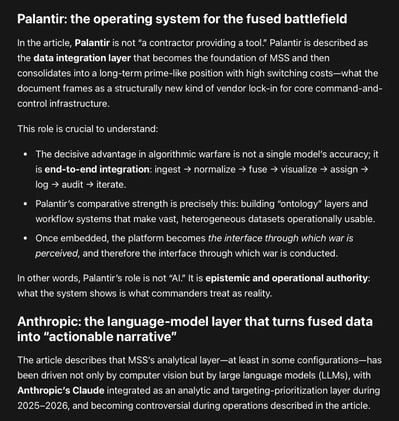
This is algorithmic warfare’s signature move: it doesn’t need a Terminator-style autonomous weapon to change the ethics of war. It only needs to compress the kill chain so far...
...that the “human in the loop” becomes a formality, a rubber stamp, or a liability shield. What the system shows is what commanders treat as reality. The LLM can become the author of the shortlist.
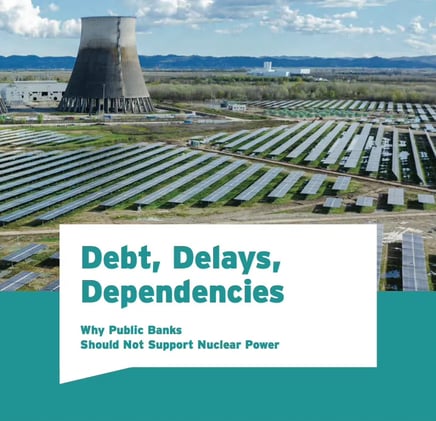
New nuclear is not merely expensive; it is structurally incompatible with the mandate of public development finance because it repeatedly converts optimism...
...into stranded public obligations—financial (debt and guarantees), temporal (decades-long delivery), technical (waste and decommissioning), and geopolitical (fuel/supplier dependence).