- Pascal's Chatbot Q&As
- Archive
- Page 17
Archive

Penguin v. OpenAI: AI-assisted production of market substitutes in the very formats that already plague children’s publishing (fake titles, lookalike covers, rapid self-publishing).
Penguin Random House’s German case looks more like a “show me the copying” suit. It is anchored in three features that make it unusually legible and potentially dangerous for AI developers.


The Clinical Reality Check: Why “Doctor-Chatbots” Ace Exams but Struggle in the Ward — and What Fixes It
LLMs can look “doctor-level” when you test them the way we usually test AI: give them a neat, complete patient vignette and ask for the diagnosis. Real clinical diagnosis is not a tidy quiz.


“Zero-Trust for ‘Safety by Terms of Service’: The Dutch Court’s Grok Undressing Injunction”
If your system enables a category of severe illegality at scale, you do not get to hide behind “technical impossibility,” internal policies, or a blame-shift to users. You must show effective controls

The concept of “Deep Research” as it exists in 2025 remains a generative approximation of truth rather than a rigorous compilation of data. The industry must shift from flat-out refusals...
...to more sophisticated “Partial Compliance” strategies to preserve user trust while ensuring that the boundary between helpful guidance and harmful instruction remains inviolable.

ChatGPT’s view: Gemini’s refusal is understandable in spirit but overbroad in execution—and it kneecaps the very thing “Deep Research” is supposed to be good at.
The problem is that Gemini collapses three distinct activities into one forbidden bucket: Fact-checking conflicting public claims, Scenario analysis about escalation pathways & Mind-reading intent.

Canal+ sued not only over the pirate sites, but over the infrastructure of access: Google (Google Ireland / Google LLC), Cloudflare, and Cisco (OpenDNS).
Canal+ got what it needed most: confirmation that alternative DNS resolvers are reachable by injunction, and that dynamic DNS blocking—structured with safeguards—can be lawful and proportionate.
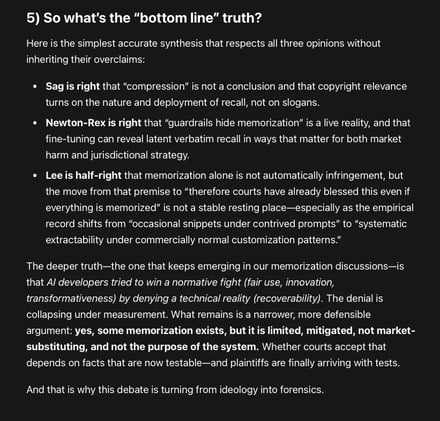
AI & Memorization: separating what is factually true, what is still an evidentiary fight, and what is legally dangerous for AI developers even under “traditional” jurisprudence.
AI developers tried to win a normative fight (fair use, innovation, transformativeness) by denying a technical reality (recoverability). The denial is collapsing under measurement.
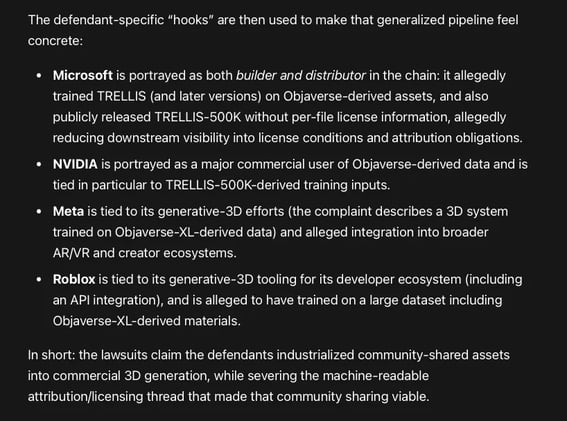
Defendants allegedly built (or powered) commercial generative-3D systems using 3D assets harvested via large research datasets—especially Objaverse-XL and a derivative subset called TRELLIS-500K...
..while stripping the machine-readable copyright management information (CMI) that made those assets legally re-usable under Creative Commons terms in the first place.
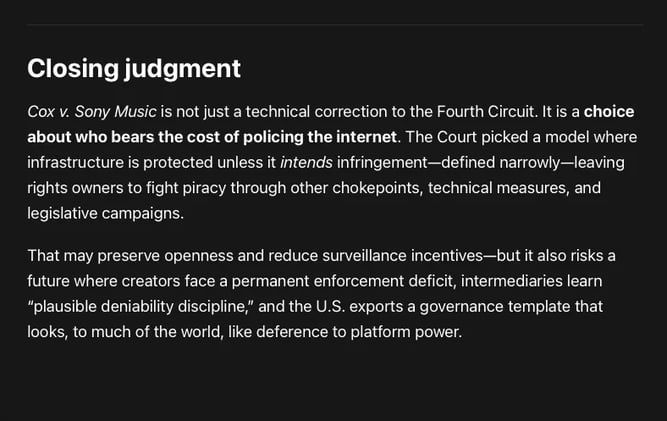
Cox v. Sony Music: If you remove realistic liability risk for knowing facilitation of repeat infringement, you change what intermediaries rationally do at scale...
...especially when enforcement costs money and piracy keeps customers happy. The Court protects infrastructure from becoming the copyright police, but risks making copyright police impotent at scale.

Quantum technology’s ability to simulate nature at the subatomic level has profound implications for life sciences, a sector where publishers often play a key role as data aggregators and...
...research disseminators. Classical computers struggle to simulate the behavior of molecules. Quantum computers can simulate these interactions directly, leading to breakthroughs.

Meta. When a platform’s commercial success depends on measuring, steering, and compounding human attention, it eventually drifts toward the most reliable drivers of attention:
Novelty, outrage, sexualization, social comparison, compulsion loops, and identity threat. That’s not a conspiracy theory. It’s what an optimizer does when its reward function is “time spent”.