- Pascal's Chatbot Q&As
- Posts
- This report presents an exhaustive, expert-level framework for constructing a “Deep State of Law”.
This report presents an exhaustive, expert-level framework for constructing a “Deep State of Law”.
A fortified administrative structure designed to make the execution of authoritarian orders operationally difficult, legally perilous, and politically costly.

Pascal Hetzscholdt
December 25, 2025
The Architecture of Constitutional Resilience: A Comprehensive Framework for Bureaucratic Resistance to Authoritarian Capture
by Gemini 3.0, Deep Research. Warning, LLMs may hallucinate!
Executive Summary
The contemporary crisis of democracy is not defined solely by the ballot box but by the capture of the administrative state. As authoritarian movements increasingly seek to weaponize the machinery of government—turning regulatory agencies into instruments of punishment and law enforcement into arms of political repression—democratic societies face an urgent imperative to “harden” their institutions. The request driving this report stems from a recognition that reliance on unwritten norms is no longer sufficient. As evidenced by protests surrounding “Operation Buckeye” in Columbus, Ohio, where citizens demanded that local officials resist federal Immigration and Customs Enforcement (ICE) operations, there is a growing public mandate for a legal framework that empowers public servants to refuse cooperation with unconstitutional directives.1
This report presents an exhaustive, expert-level framework for constructing a “Deep State of Law”—a fortified administrative structure designed to make the execution of authoritarian orders operationally difficult, legally perilous, and politically costly. This framework moves beyond passive “checks and balances” to active “legislative entrenchment” and “administrative friction.” It proposes a system where the “Right to Disobedience” is not merely a moral choice but a statutory duty, protected by a lattice of employment guarantees, procedural hurdles, and federalist firewalls.
The analysis draws upon comparative administrative jurisprudence, specifically the German doctrine of Remonstrationspflicht (the duty to remonstrate) 3 , United States federalism precedents regarding “anti-commandeering” 4 , and the structural independence mechanisms of financial regulatory bodies like the Consumer Financial Protection Bureau (CFPB).5 By synthesizing these elements, democratic societies can construct a governance architecture where an authoritarian regime cannot simply issue an order, but must dismantle the entire legal apparatus of the state to enforce its will—thereby “giving away its ploy” and triggering massive institutional and public backlash.
Part I: The Theoretical Foundation of Administrative Resistance
To understand how to construct a resilient bureaucracy, one must first understand the mechanism of authoritarian capture. Modern autocracy rarely arrives via a sudden coup; rather, it arrives through the gradual “hollowing out” of institutions, the purging of independent experts, and the installation of loyalists who view the law as a tool of power rather than a constraint upon it. This phenomenon, often termed “autocratic legalism,” requires a response that utilizes “democratic legalism”—the proactive entrenchment of democratic values into the black letter law of civil service procedure.
1.1 The Shift from “Just Following Orders” to “Duty to Intervene”
Historically, the defense of “superior orders”—the claim that a subordinate was merely executing the will of a superior—has been rejected in international criminal law, most notably at Nuremberg and in the Rome Statute of the International Criminal Court.6 However, domestic administrative law in many democratic nations remains ambiguous. While military codes often penalize the following of “manifestly unlawful” orders, civil service codes frequently prioritize hierarchy and efficiency over constitutional compliance.
The framework proposed here necessitates a paradigm shift: the civil servant must be reconceptualized not as an employee of the Executive Branch, but as a trustee of the Constitution. This shift aligns with the “Black Flag” doctrine articulated in Israeli jurisprudence, where a manifestly unlawful order is described as one that bears a “flag of illegality” that “pierces the eye and revolts the heart”.8 The goal of this report is to translate that moral sentiment into concrete administrative procedures that protect the dissenter and paralyze the usurper.
1.2 The Strategy of “Administrative Friction”
Authoritarian governance relies on speed and the elimination of friction. It seeks to govern by decree, bypassing legislative deliberation and expert review. Therefore, the antidote is the intentional engineering of “administrative friction.” This involves statutory requirements for scientific peer review, mandatory consultation periods, and multi-layered “reason-giving” requirements that force an administration to slow down and justify its actions in writing.9 As noted by legal scholar Jennifer Nou, bureaucratic resistance often takes the form of “slowdowns”—the rigorous adherence to procedure that, while technically compliant, prevents the rapid execution of dubious orders.9
Part II: The Individual as the First Line of Defense – Operationalizing the “Right to Disobedience”
The most critical node in the resistance network is the individual official. Whether a police officer asked to detain a citizen without a warrant, or a scientist ordered to falsify climate data, the individual must be empowered to say “no” without facing immediate professional annihilation.
2.1 The German Model: Remonstrationspflicht (The Duty to Remonstrate)
The most robust model for individual resistance is found in the German Federal Civil Service Act (Section 63). This statute imposes a positive legal obligation on civil servants to question unlawful orders. It serves as the cornerstone of the proposed framework.11
2.1.1 The Three-Step Escalation Protocol
To operationalize this in a democratic society facing authoritarian threats, the following statutory procedure should be enacted:
Step One: The Mandatory Objection: If a civil servant receives an order they act in good faith to believe is unlawful, unconstitutional, or violates fundamental human rights, they must officially remonstrate to their immediate superior. This transforms dissent from an act of insubordination into an act of compliance with the law.12
Step Two: The Escalation to Leadership: If the immediate superior confirms the order, the civil servant is statutorily required to appeal to the next higher authority (e.g., Agency Head or Minister). This prevents middle managers from quietly enforcing illegal policies.12
Step Three: The Written Confirmation: If the highest authority persists, they must confirm the order in writing. Once this written confirmation is received, the civil servant must execute the order (unless it constitutes a crime or violates human dignity), but they are automatically absolved of all personal liability. The liability shifts entirely and personally to the confirming official.13
2.1.2 Strategic Implication: The Paper Trail of Complicity
The brilliance of this mechanism lies in its evidentiary burden. An authoritarian regime prefers to operate through verbal hints and “wink-and-nod” directives to maintain deniability. The Remonstrationspflicht forces the regime to create a discoverable, written record of its illegal commands. If thousands of civil servants invoke this duty simultaneously, the regime is flooded with the administrative burden of generating thousands of written confirmations, thereby “giving away the ploy” and creating a roadmap for future prosecution.12
2.2 The “Civil Servant Constitutional Compliance Act”
To support the Remonstrationspflicht, democratic legislatures must pass a “Civil Servant Constitutional Compliance Act” that codifies the “Manifestly Unlawful” standard. This act would define specific categories of orders that are presumptively unlawful, including:
Violations of Statutory Appropriations: Orders to spend money not appropriated by the legislature (e.g., diverting military construction funds for domestic projects).14
Contravention of the Administrative Procedure Act (APA): Orders to bypass notice-and-comment rulemaking or ignore scientific evidence.14
Human Rights Violations: Orders targeting specific ethnic, religious, or political groups for surveillance or detention without individualized probable cause.7
2.2.1 The “Safe Harbor” and Injunction
Crucially, this Act must include a “Safe Harbor” provision. If an employee invokes the duty to remonstrate, they are immediately protected by a statutory injunction against termination, demotion, or security clearance revocation until the legality of the order is adjudicated by an independent body, such as the Merit Systems Protection Board (MSPB) or the Office of Special Counsel (OSC).14 This ensures that the official cannot be starved out of their position while defending the Constitution.
2.3 The “Third Option”: Just Say No
While the German model allows for eventual compliance under protest (to maintain state function), there must be a “Third Option” for orders that are fundamentally criminal (e.g., torture, extrajudicial killing). In these cases, the statute must unequivocally protect the refusal to act. The “Follow the Rules Act” (5 U.S.C. §2302(b)(9)(D)) serves as a prototype, protecting employees who refuse to violate a law, rule, or regulation.14 This protection must be expanded to cover “reasonable belief” of unconstitutionality, shielding the employee even if a court later rules the order was technically lawful, provided the refusal was based on a good-faith constitutional objection.15
Part III: The Architecture of Federalism – The Anti-Commandeering Doctrine
As illustrated by the “Operation Buckeye” protests in Ohio, where citizens demanded local officials refuse to cooperate with ICE, sub-national governments (states, cities, provinces) act as powerful bulwarks against a central authoritarian authority.1 The legal doctrine of “anti-commandeering” provides the constitutional bedrock for this resistance.
3.1 The Jurisprudence of Non-Cooperation
The U.S. Supreme Court, in cases such as New York v. United States and Printz v. United States, established that the federal government cannot “commandeer” the legislative or executive apparatus of the states.4 It cannot compel a state legislature to pass a law, nor can it conscript state police officers to enforce federal regulatory programs.
Strategic Implication: This creates a massive logistical bottleneck for an authoritarian regime. In the United States, for example, there are nearly 800,000 state and local law enforcement officers but fewer than 25,000 federal immigration agents. By refusing to “deputize” their officers, states force the federal government to rely solely on its own limited resources, effectively crippling mass enforcement operations.16
3.2 The “Sanctuary” Framework: A Template for Resistance
The “Sanctuary” movement, often misunderstood as “lawlessness,” is actually the rigorous application of federalism. Democratic societies should adopt comprehensive “Non-Cooperation Acts,” modeled on California’s Senate Bill 54 (The California Values Act), to entrench this separation.17
3.2.1 Core Components of a Non-Cooperation Act
To maximize resistance, legislation should include the following provisions:
Prohibition on Information Sharing: State and local agencies should be prohibited from sharing non-public data (home addresses, school records, release dates) with federal enforcement agencies unless required by a specific judicial warrant.18 This protects vulnerable populations from being targeted through automated database scraping.
The Judicial Warrant Requirement: Local jails should be statutorily barred from holding individuals on “administrative detainers” (requests from federal agencies) without a warrant signed by a judge. This reasserts the role of the judiciary and prevents the executive branch from bypassing due process.19
Access Denial: Legislation should designate “sensitive locations” (schools, hospitals, courthouses) where federal enforcement is prohibited or strictly limited. While the Supremacy Clause limits how much a state can block federal agents, states can deny them cooperation and privileged access to non-public areas.17
3.3 Logistical Resistance and “Poison Pills”
Beyond police non-cooperation, local governments can use their regulatory powers to disrupt the logistics of authoritarianism. The “Operation Buckeye” protests highlighted the role of private contractors and local infrastructure in federal operations.1
3.3.1 Zoning and Health Code Enforcement
Federal detention centers and contract facilities rely on local infrastructure. Local governments can vigorously enforce zoning laws, fire safety codes, and health regulations against these facilities. If a federal agency attempts to set up a hasty detention camp or repurpose a hotel, local fire marshals can shut it down for code violations—a form of “bureaucratic slowdown” applied federally.20
3.3.2 Vendor Non-Cooperation Ordinances
Cities can pass ordinances prohibiting the award of municipal contracts to any vendor that provides data, software, or logistical support to federal agencies engaged in human rights abuses. This creates a financial disincentive for private companies (tech firms, bus companies, construction firms) to collaborate with the authoritarian regime.1
3.3.3 State-Level “Trigger Laws” (Poison Pills)
States can enact “trigger laws” that automatically activate stricter state-level protections if federal standards are rolled back. For example, a state law could stipulate that “In the event federal EPA standards for water quality are relaxed, the state environmental agency shall immediately adopt the pre-existing federal standards as state law, and enforce them with state personnel”.21 This ensures that an authoritarian attempt to deregulate or dismantle protections is immediately met with a rigid state-level backstop.
Part IV: Civil Service Fortification – Preventing the “Spoils System”
An aspiring autocrat’s primary objective is to purge the “Deep State”—the permanent, professional civil service that operates based on expertise rather than loyalty. The recent “Schedule F” executive order in the United States, which sought to reclassify thousands of career policy roles as “at-will” political appointments, demonstrates this vulnerability.22
4.1 Legislative Entrenchment of Merit Principles
To prevent the re-politicization of the civil service, democratic societies must move beyond executive orders and enshrine merit principles in “super-statutes” that are difficult to repeal.
4.1.1 Statutory Definitions of “Policy-Influencing”
The danger of Schedule F was its broad definition of “policy-influencing” positions. To counter this, legislation must narrowly and explicitly define which positions are political (Schedule C) and which are career. The statute should state that “Any position requiring technical, scientific, or legal expertise, or involving the adjudication of individual cases, is inherently non-political and protected by merit system tenure”.24
4.1.2 Procedural “Poison Pills” for Reclassification
Legislation should impose severe procedural hurdles for any attempt to move positions from the competitive service to the excepted service.
Mandatory Congressional Review: Any executive order proposing to reclassify more than 1% of an agency’s workforce must be submitted to Congress 120 days in advance and cannot take effect if Congress passes a joint resolution of disapproval.25
OPM Concurrence: Reclassification should require the written concurrence of the Director of the Office of Personnel Management (OPM), supported by a detailed factual finding that the position has changed in nature. If the OPM Director is a political appointee, the law should require concurrence from a career “Chief Human Capital Officer” council.26
4.2 Protecting the “Institutional Memory”
The civil service is the repository of institutional memory. To protect this asset, the framework must prevent “brain drain” and the “burrowing in” of unqualified loyalists.
The “Burrowing” Ban: To prevent an outgoing authoritarian regime from converting its political appointees into career civil servants (”burrowing in”), laws must strictly prohibit the conversion of any Schedule C appointee to a career position within 12 months of a presidential election.24
The Scientific Integrity Act: Legislation should mandate that scientific positions (at agencies like the EPA, NOAA, FDA) can only be filled by candidates meeting specific educational and professional criteria, verified by independent scientific bodies. This prevents the appointment of political hacks to technical roles.6
Part V: Independent Agencies and Financial Autonomy
The “Unitary Executive” theory posits that all executive power flows from the President. To counter this, democratic societies must structurally fragment the executive branch, creating islands of independence that the President cannot touch.
5.1 The “Humphrey’s Executor” Shield: Removal Protections
In Humphrey’s Executor (1935), the U.S. Supreme Court upheld the constitutionality of independent agencies where commissioners can only be removed for “inefficiency, neglect of duty, or malfeasance in office,” not for political disagreement.27
Framework Requirement: Legislation must expand this “for-cause” removal protection to a wider range of officials, including:
Inspectors General (IGs).
The Director of the FBI and the Census Bureau.
Heads of scientific and statistical agencies (e.g., Bureau of Labor Statistics).
Special Prosecutors.
Defining “Cause”: The statute must rigorously define “cause” to explicitly exclude “policy differences” or “refusal to obey an order to violate the law.” This prevents the President from manufacturing “inefficiency” claims to fire independent watchdogs.28
5.2 Financial Independence: The “Power of the Purse” Inversion
An authoritarian can starve an agency into submission by cutting its budget. To prevent this, critical watchdog agencies must be “self-funding.”
5.2.1 The CFPB Model
The Consumer Financial Protection Bureau (CFPB) is funded not through annual congressional appropriations, but via a direct transfer from the Federal Reserve.5 This structure insulates the agency from political blackmail.
Implementation: Democratic societies should pass legislation granting “Permanent Indefinite Appropriations” or self-funding mechanisms (e.g., fees on regulated industries) to the Office of Government Ethics, the Office of Special Counsel, and the Federal Election Commission. This ensures that these agencies can continue to investigate corruption even if the government shuts down or the legislature is hostile.29
5.3 The Independent Counsel “Automatic Trigger”
The lapse of the Ethics in Government Act left a void in accountability. A new Independent Counsel statute is essential.
The Automatic Trigger: The law should strip the Attorney General of the discretion to appoint a special counsel. Instead, it should mandate an automaticapplication to a panel of federal judges whenever credible allegations of criminal conduct involve “covered persons” (President, VP, Cabinet).30
Judicial Control: The court, not the Executive, should appoint the prosecutor and define their jurisdiction. This prosecutor should be removable only by the court for good cause, ensuring they answer to the law, not the President.31
Part VI: The Machinery of Friction – Procedure as Defense
Bureaucracy is often criticized for its “red tape,” but in the face of authoritarianism, red tape is a lifeline. It forces deliberation, transparency, and legality.
6.1 Strengthening the Administrative Procedure Act (APA)
The APA prevents agencies from acting in an “arbitrary and capricious” manner. It requires “Notice and Comment” rulemaking, where agencies must justify their actions and respond to public input.14
Strategy: Legislation should “super-charge” the APA for sensitive areas (civil rights, environmental protection).
Mandatory Scientific Consultation: Require that any rule rescinding health or safety protections be accompanied by a peer-reviewed impact assessment. If the assessment is missing, the rule is automatically stayed.9
Extended Comment Periods: Mandate a minimum 90-day comment period for “economically or socially significant” rules, preventing the “midnight regulations” often pushed by outgoing regimes.32
Weaponized Comments: Civil society can use this by flooding agencies with substantive, technical comments. The agency is legally required to review and respond to these, creating a massive workload that slows down the authoritarian agenda.10
6.2 The Dissent Channel and Red Teaming
To prevent “groupthink” and the suppression of internal warnings, agencies must institutionalize dissent.
The State Department Model: The “Dissent Channel” allows Foreign Service Officers to express disagreement with policy without fear of retaliation.33 This should be expanded government-wide.
Mandatory Response and Archiving: The law must require that all Dissent Channel cables receive a substantive written response from agency leadership within 30 days. Furthermore, these dissents must be archived and eventually declassified. This creates a historical record, warning officials that their complicity or resistance will one day be public knowledge.34
6.3 Empowering Inspectors General (IGs)
IGs are the internal police of the bureaucracy. To protect them from the “Saturday Night Massacre” scenario (where a President fires the watchdog investigating them), the “Inspector General Independence and Empowerment Act” must be fully implemented.35
Removal Protections: The President must provide Congress with a 30-day notice and a “substantive rationale” before removing an IG. “Loss of confidence” is not a sufficient rationale.36
Automatic Succession: To prevent vacancies from being filled by loyalists, the law should mandate that the Deputy IG (a career official) automatically becomes the Acting IG upon a vacancy, preventing the appointment of a political “Acting” IG.35
Part VII: Societal and Legal Support Structures
Bureaucratic resistance cannot exist in a vacuum. It requires external support to protect the resisting officials from financial ruin and legal isolation.
7.1 The Legal Defense Fund Network
Resisting an unlawful order is expensive. Officials face termination and the loss of pensions.
The Rise Up Model: Civil society, unions, and NGOs must establish a “Federal Workers Legal Defense Fund Network”.37 This fund acts as an insurance policy for democracy, covering the legal fees of any whistleblower or official facing retaliation for constitutional adherence.
Fee-Shifting Statutes: Legislation should include fee-shifting provisions, requiring the government to pay the legal fees of any employee who successfully challenges a retaliatory action before the MSPB or courts.14
7.2 The Role of Professional Licensing Boards
Lawyers, doctors, and engineers in government are bound by professional ethics. State licensing boards (Bar Associations, Medical Boards) can issue “Binding Ethics Opinions” stating that participation in certain authoritarian acts (e.g., torture, denial of due process) violates professional standards and will result in license revocation.38 This creates a powerful external check: an official might fear the President, but they also fear losing their license to practice their profession forever.
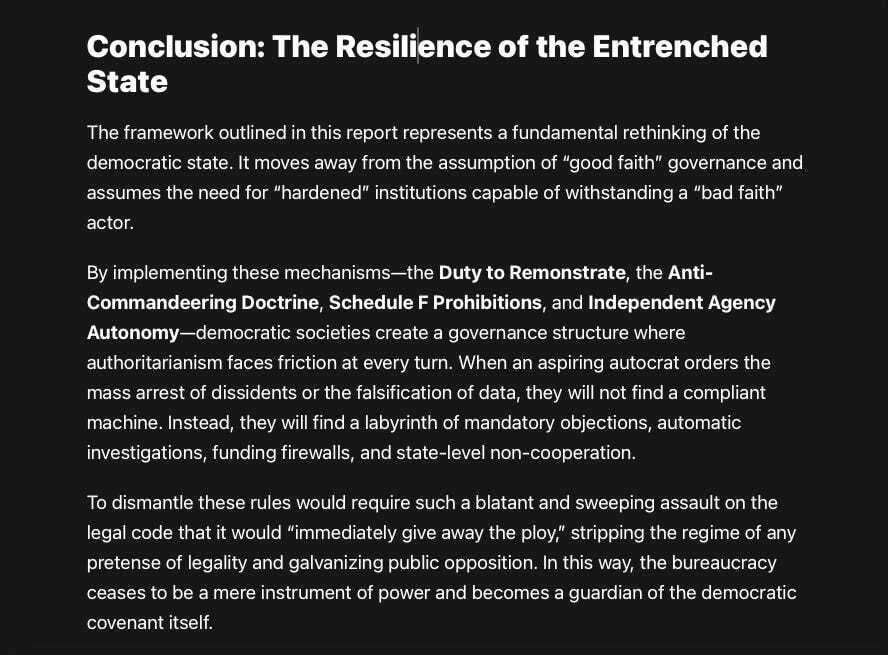
Conclusion: The Resilience of the Entrenched State
The framework outlined in this report represents a fundamental rethinking of the democratic state. It moves away from the assumption of “good faith” governance and assumes the need for “hardened” institutions capable of withstanding a “bad faith” actor.
By implementing these mechanisms—the Duty to Remonstrate, the Anti-Commandeering Doctrine, Schedule F Prohibitions, and Independent Agency Autonomy—democratic societies create a governance structure where authoritarianism faces friction at every turn. When an aspiring autocrat orders the mass arrest of dissidents or the falsification of data, they will not find a compliant machine. Instead, they will find a labyrinth of mandatory objections, automatic investigations, funding firewalls, and state-level non-cooperation.
To dismantle these rules would require such a blatant and sweeping assault on the legal code that it would immediately give away the ploy, stripping the regime of any pretense of legality and galvanizing public opposition. In this way, the bureaucracy ceases to be a mere instrument of power and becomes a guardian of the democratic covenant itself.
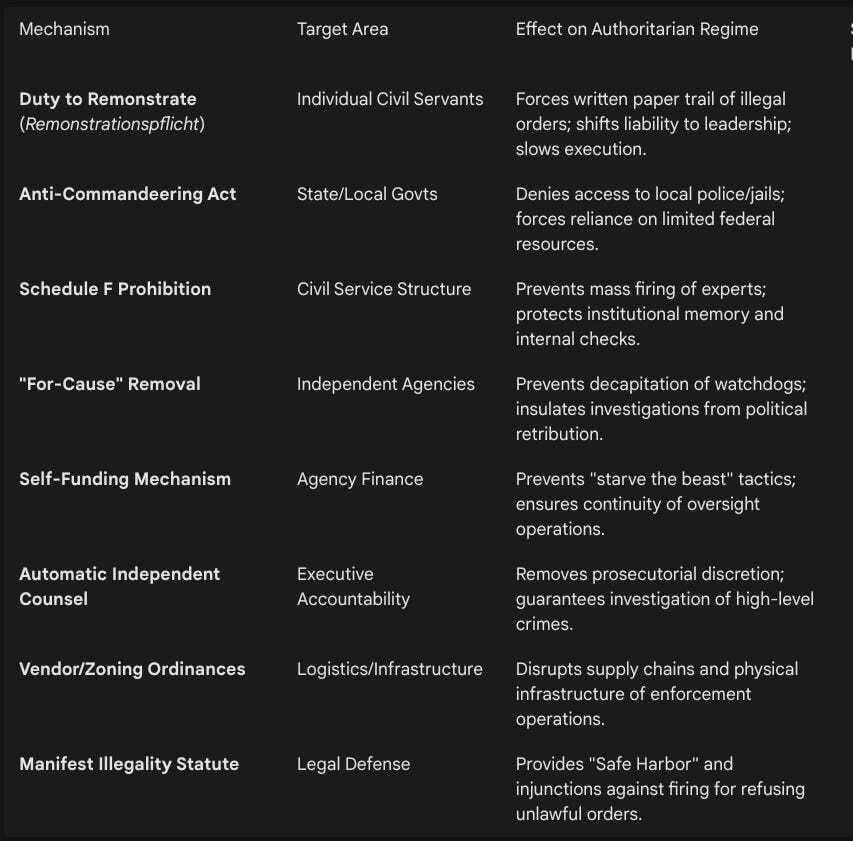
Summary Table: Key Mechanisms of the Democratic Defense Framework
Works cited
Powerful Columbus ICE protests: Residents Mobilize in Response - Herman Legal Group, accessed December 25, 2025, https://www.lawfirm4immigrants.com/columbus-ice-protests/
Central Ohioans speak out on ICE presence in area - YouTube, accessed December 25, 2025, Link
Militant Constitutionalism – A Promising Concept to Make ... - EconStor, accessed December 25, 2025, https://www.econstor.eu/bitstream/10419/197530/1/ile-wp-2019-25.pdf
Immigration Enforcement & the Anti-Commandeering Doctrine: Recent Litigation on State Information-Sharing Restrictions, accessed December 25, 2025, https://tracreports.org/tracker/dynadata/2020_05/LSB10386.pdf
the bureau of consumer financial protection’s unconstitutional design hearing - Congress.gov, accessed December 25, 2025, https://www.congress.gov/115/chrg/CHRG-115hhrg27247/CHRG-115hhrg27247.pdf
Civil Servant Disobedience - Chicago Unbound, accessed December 25, 2025, https://chicagounbound.uchicago.edu/cgi/viewcontent.cgi?article=13940&context=journal_articles
倒序显示 - 实践涉及 规则 155 Defence of Superior Orders, accessed December 25, 2025, https://ihl-databases.icrc.org/zh/customary-ihl/v2/rule155
The Legal Takeover of the Manifestly Unlawful Order Doctrine in Israel - Just Security, accessed December 25, 2025, https://www.justsecurity.org/87535/the-legal-takeover-of-the-manifestly-unlawful-order-doctrine-in-israel/
Bureaucratic Resistance from Below, by Jennifer Nou - Yale Journal ..., accessed December 25, 2025, https://www.yalejreg.com/nc/bureaucratic-resistance-from-below-by-jennifer-nou/
Firing Line - Government Executive, accessed December 25, 2025, https://www.govexec.com/feature/firing-line/
(PDF) The Civil Service in Germany - ResearchGate, accessed December 25, 2025, https://www.researchgate.net/publication/388193487_The_Civil_Service_in_Germany
Militant constitutionalism: a promising concept to make constitutional backsliding less likely?, accessed December 25, 2025, https://d-nb.info/1230376771/34
The civil service corps in the Federal Republic of Germany and the right of remonstration as the right to refuse to carry out an official order by a state official, accessed December 25, 2025, https://www.dyskurs.inp.uz.zgora.pl/index.php/DPiA/en/article/view/324
The third option for federal employees faced with illegal orders—just ..., accessed December 25, 2025, https://www.brookings.edu/articles/the-third-option-for-federal-employees-faced-with-illegal-orders-just-say-no/
Donald Trump said Democrats’ call to military amounts to sedition. Experts say that’s doubtful - PolitiFact, accessed December 25, 2025, https://www.politifact.com/article/2025/nov/20/trump-military-video-unlawful-orders-sedition/
Trump wants to break California’s sanctuary state law: 5 things to know - CalMatters, accessed December 25, 2025, https://calmatters.org/justice/2025/01/california-sanctuary-state/
Bill Text: CA SB54 | 2017-2018 | Regular Session | Chaptered - LegiScan, accessed December 25, 2025, https://legiscan.com/CA/text/SB54/id/1651818
California Values Act (SB 54) - ACLU of Socal, accessed December 25, 2025, https://www.aclusocal.org/know-your-rights/california-values-act-sb-54/
Can the U.S. Government Compel States to Enforce Immigration Law? - Lawfare, accessed December 25, 2025, https://www.lawfaremedia.org/article/can-the-u.s.-government-compel-states-to-enforce-immigration-law
How to Harden Our Defenses Against an Authoritarian President, accessed December 25, 2025, https://www.brennancenter.org/our-work/analysis-opinion/how-harden-our-defenses-against-authoritarian-president
Making Preemption Unpalatable: State Poison Pill Legislation Robert A. Mikos November 2013 Note to CSDI folks, accessed December 25, 2025, https://www.vanderbilt.edu/csdi/events/Mikos_paper.pdf
Final Schedule F regulations to describe civil service protections as ‘unconstitutional overcorrections’ - Government Executive, accessed December 25, 2025, https://www.govexec.com/workforce/2025/11/final-schedule-f-regulations-describe-civil-service-protections-unconstitutional-overcorrections/409616/
Restoring Accountability To Policy-Influencing Positions Within the Federal Workforce, accessed December 25, 2025, https://www.whitehouse.gov/presidential-actions/2025/01/restoring-accountability-to-policy-influencing-positions-within-the-federal-workforce/
Democracy, Federal Worker Job Rights, and the Nonpartisan Civil Service - UC Berkeley Law, accessed December 25, 2025, https://www.law.berkeley.edu/wp-content/uploads/2025/01/Civil-Service-and-Democracy-01292025.pdf
A New Civil Service “Policy/Career” Schedule: Issues for Lawmakers - Congress.gov, accessed December 25, 2025, https://www.congress.gov/crs-product/LSB11262
6325-39 OFFICE OF PERSONNEL MANAGEMENT 5 CFR Parts 210, 212, 213, 302, 432, 451, and 752 [Docket ID: OPM-2025-0004 - Federal Register, accessed December 25, 2025, https://public-inspection.federalregister.gov/2025-06904.pdf
The who’s and what’s of presidential power - SCOTUSblog, accessed December 25, 2025, https://www.scotusblog.com/2025/12/the-whos-and-whats-of-presidential-power/
Humphrey’s Executor v. United States | 295 U.S. 602 (1935), accessed December 25, 2025, https://supreme.justia.com/cases/federal/us/295/602/
Relentless as Entrenchment - The George Mason Law Review, accessed December 25, 2025, https://lawreview.gmu.edu/print__issues/relentless-as-entrenchment/
The Independent Counsel Statute and Questions About Its Future - Duke Law Scholarship Repository, accessed December 25, 2025, https://scholarship.law.duke.edu/cgi/viewcontent.cgi?article=1120&context=lcp
H. Rept. 105-795 - INVESTIGATORY POWERS OF THE COMMITTEE ON THE JUDICIARY WITH RESPECT TO ITS IMPEACHMENT INQUIRY | Congress.gov, accessed December 25, 2025, https://www.congress.gov/committee-report/105th-congress/house-report/795/1
Cultivating a whole-of-society approach to integrity in Kazakhstan - OECD, accessed December 25, 2025, https://www.oecd.org/en/publications/oecd-integrity-review-of-kazakhstan_d705d02f-en/full-report/cultivating-a-whole-of-society-approach-to-integrity-in-kazakhstan_2a602b8e.html
The State Department Dissent Channel: History and Impact, accessed December 25, 2025, https://afsa.org/state-department-dissent-channel-history-and-impact
Stifling Dissent | Project On Government Oversight, accessed December 25, 2025, https://www.pogo.org/reports/stifling-dissent
H. Rept. 117-66 - IG INDEPENDENCE AND EMPOWERMENT ACT - Congress.gov, accessed December 25, 2025, https://www.congress.gov/committee-report/117th-congress/house-report/66/1
Warner, Kaine, Colleagues Call for Reinstatement of Inspectors General Illegally Fired by President Trump - Press Releases, accessed December 25, 2025, https://www.warner.senate.gov/public/index.cfm/2025/2/warner-kaine-colleagues-call-for-reinstatement-of-inspectors-general-illegally-fired-by-president-trump
Five Rights and Protections all Federal Workers Have - Legal Defense Fund, accessed December 25, 2025, https://www.naacpldf.org/five-rights-federal-workers/
1030 15th Street, NW, Suite 700W, Washington, DC 20005 February 3, 2025 Via Electronic Mail The Honorable Brooke Pinto Councilme - DC Council, accessed December 25, 2025, https://dccouncil.gov/wp-content/uploads/2025/02/BEGA-FY24-25-Oversight-Pre-Hearing-RESPONSES-FINAL_signed-.pdf
Supreme Court Grants Emergency Motion on President’s Removal Power - Congress.gov, accessed December 25, 2025, https://www.congress.gov/crs-product/LSB11292
(UN)LAWFUL ORDERS - N.Y.U. Journal of Legislation & Public Policy, accessed December 25, 2025, https://nyujlpp.org/wp-content/uploads/2025/03/JLPP-27-2-Ghiotto.pdf