- Pascal's Chatbot Q&As
- Posts
- AI reshapes leadership skills in deeper, structural ways. AI does not replace top managers—but it fundamentally changes the skills they must master.
AI reshapes leadership skills in deeper, structural ways. AI does not replace top managers—but it fundamentally changes the skills they must master.
A study identifies four interlinked leadership skills that are becoming essential in AI-driven organizations. AI makes leadership harder, not easier.

Pascal Hetzscholdt
December 26, 2025
How AI Is Quietly Redefining What Top Leaders Must Be Good At
by ChatGPT-5.2
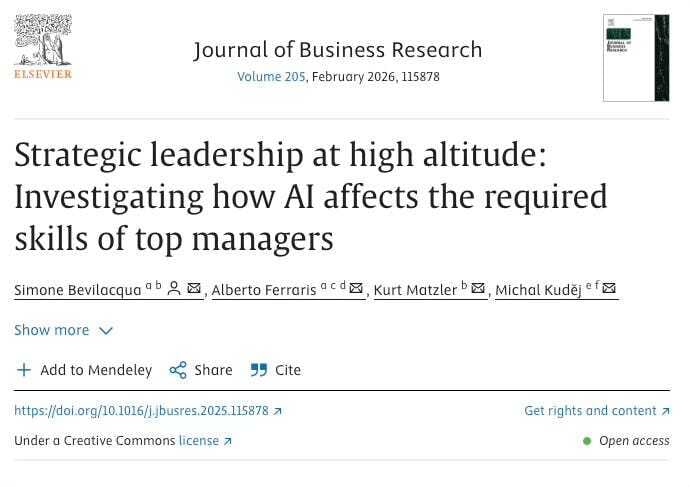
Artificial intelligence is no longer just a technical upgrade or a back-office efficiency tool. According to the attached study, AI is changing what it means to lead at the top of an organization. The paper Strategic leadership at high altitude: Investigating how AI affects the required skills of top managers is based on in-depth interviews with 23 senior executives across sectors such as automotive, consumer goods, engineering, logistics, and telecommunications. Rather than treating AI as “just another digital technology,” the authors show that AI reshapes leadership skills in deeper, structural ways.
The core insight is simple but powerful: AI does not replace top managers—but it fundamentally changes the skills they must master. The study identifies four interlinked leadership skills that are becoming essential in AI-driven organizations.
1. An “AI Open Mindset”
The first skill is not technical at all. It is a mindset. Leaders who succeed with AI are willing to experiment, learn continuously, and admit what they do not yet understand. They do not wait for perfect strategies or complete certainty. Instead, they signal curiosity and openness from the top.
Importantly, the study shows that AI innovation often comes from below. Middle managers and frontline teams frequently spot the best AI use cases first. Senior leaders who block or ignore these bottom-up ideas slow down transformation. Those who actively invite them accelerate it.
In plain language: if top leaders are afraid of looking uninformed, AI adoption stalls.
2. AI as a “Strategic Co-Thinker,” Not Just a Tool
A second major shift is how executives use AI in decision-making. Instead of treating AI as software that delivers answers, many leaders now treat it as a thinking partner. AI helps simulate scenarios, identify blind spots, and challenge human assumptions.
However, the paper is clear: AI does not make decisions for leaders. The real skill lies in asking good questions, framing problems clearly, and judging which AI outputs actually make sense in a real-world business context.
Leaders must filter AI outputs. They decide what to trust, what to ignore, and what needs human judgment. This makes leadership more demanding, not less. Accountability still sits with humans.
3. Becoming a “Multi-Level Connector”
One of the most underestimated findings is the renewed importance of middle management. AI does not flatten organizations automatically. Instead, it creates a strong need for people who can translate between strategy, technology, and day-to-day work.
Top managers increasingly act as connectors:
between executives and middle managers,
between technical teams and business units,
and between the company and external partners such as universities, AI vendors, and customers.
AI pushes organizations toward collaboration, not command-and-control. Leaders who cling to rigid hierarchies struggle to scale AI responsibly.
4. Ethics and Risk Management Become Strategic, Not Legal
The fourth skill may be the most consequential: ethical risk management. The executives interviewed repeatedly emphasized that AI risks—bias, discrimination, lack of transparency, misuse of generative AI—are not just compliance issues. They are strategic risks tied to trust, reputation, and long-term legitimacy.
Many organizations now create AI ethics committees that include legal, technical, business, and ethics perspectives. These groups do not slow innovation; they help prevent costly failures and public backlash.
In short: AI ethics is no longer a checkbox—it is a leadership capability.
Most Surprising Findings
AI innovation often starts with middle managers, not executives
This challenges the common belief that AI transformation must be top-down.Leaders spend more time judging AI outputs than producing decisions
AI increases cognitive load at the top rather than reducing it.Ethics matures over time
Organizations only recognize deeper ethical risks after AI becomes embedded.
Most Controversial Findings
AI makes leadership harder, not easier
The idea that AI simplifies executive work is strongly challenged.Intuition is not replaced—but it is constantly questioned
Leaders must accept that AI will regularly challenge their experience.Ethics committees can have veto power over AI deployments
This directly confronts speed-first innovation cultures.
Most Valuable Findings
Leadership skills must evolve together
Mindset, strategy, ethics, and organizational connection reinforce each other.AI leadership is multi-level, not heroic
Success depends on networks of people, not individual brilliance.Responsible AI strengthens trust and performance simultaneously
Ethics and competitiveness are not opposites.
Recommendations for Large Enterprises
Train leaders in AI judgment, not just AI literacy
Focus on asking the right questions, interpreting outputs, and understanding limits.Empower middle management as AI translators
Invest in training, experimentation spaces, and hybrid AI-business roles.Treat AI ethics as a board-level strategic function
Establish cross-functional AI ethics committees with real authority.Encourage safe experimentation and visible learning from failure
Fear-driven cultures kill AI value faster than technical limitations.Design leadership development around collaboration with AI, not control over it
The future executive is not an algorithm commander—but an orchestrator of human-machine intelligence.
Final Thought
The paper’s deepest message is this: AI does not automate leadership—it exposes weak leadership. Large enterprises that succeed with AI will be those whose leaders are willing to learn publicly, think critically alongside machines, connect across levels, and treat ethics as a source of strength rather than friction.