- Pascal's Chatbot Q&As
- Archive
- Page 17
Archive
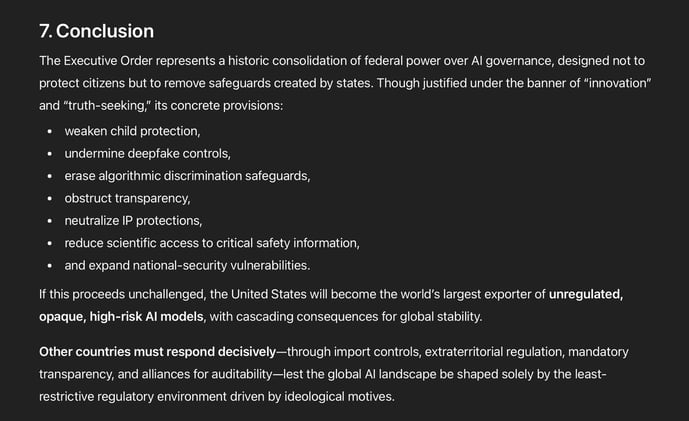
Trump preempting, nullifying, or discouraging all state-level AI laws, backed by litigation threats, conditioning of federal funding, reinterpretation of FCC/FTC powers & a future federal statute...
...to solidify preemption. This reveals a strategic ideological consolidation of AI governance. For society at large, the consequences are overwhelmingly negative.


The article presents a scenario in which the second Trump administration’s policies converge to intensify health risks for rural children—already one of the country’s most vulnerable populations.
The concerns raised in the document are not speculative: they are grounded in established science, demographic realities, and predictable consequences of regulatory and budgetary retrenchment.

Jinshan District People’s Court judgment on the Battle Through the Heavens / Medusa LoRA case is a milestone in how Chinese courts will handle copyright disputes around AI large models.
It clarifies who is on the hook (user vs. platform), what counts as infringement in the training pipeline, and when AI outputs qualify as “works” under copyright law.
RAND’s Building a U.S. National Strategy for the Artificial Intelligence Era is one of the most comprehensive and sobering explorations of what a national AI strategy actually entails.
Not merely in terms of model development, but in terms of geopolitical structure, domestic stability, societal design, and long-range normative choices.
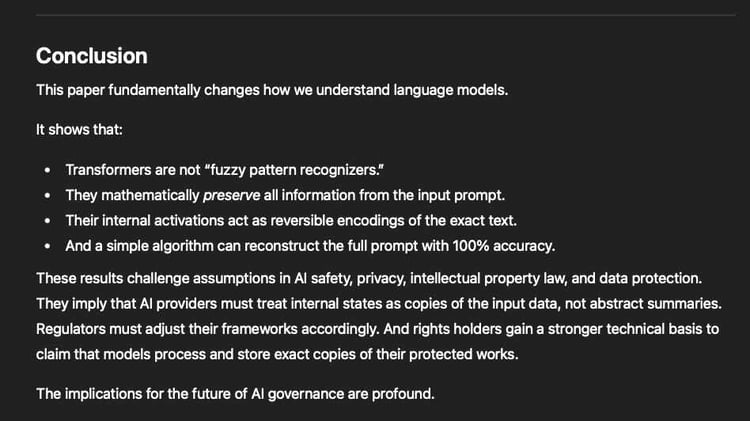
This paper makes a startling claim about modern large language models: they never actually “forget” the input you give them. The internal states inside a Transformer model are lossless.
LLMs transform your text into internal numerical representations (hidden states) that still contain all the information of the original text, down to the exact characters.
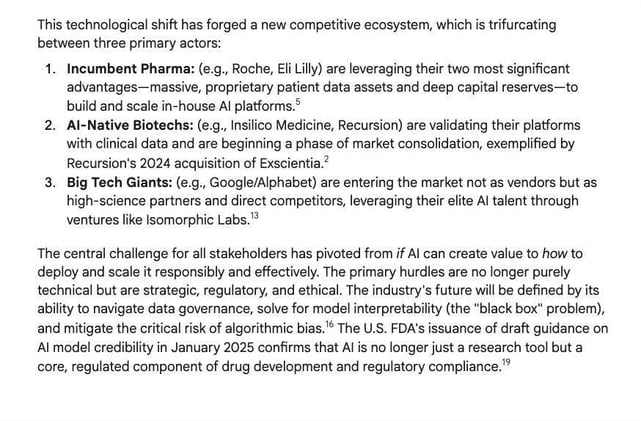
A 12-month reduction in clinical development timelines can add over $400 million in Net Present Value (NPV) per asset (a single, specific drug candidate—a particular molecule, biologic, or vaccine).
This value is being captured today through AI-powered patient recruitment, adaptive protocol design, and the automation of regulatory documentation.
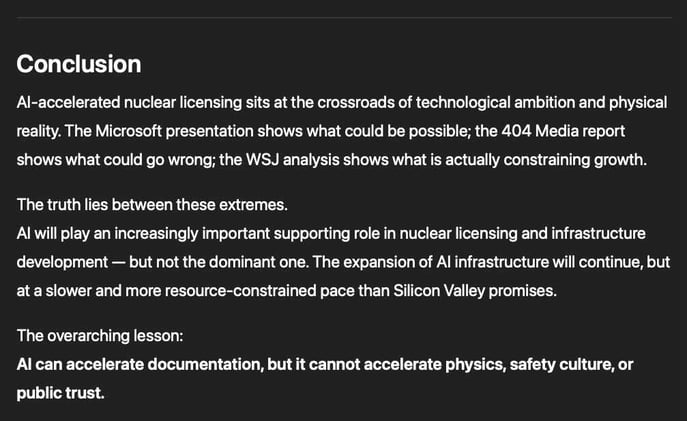
AI is pushing the world toward an unprecedented expansion in nuclear energy infrastructure, data-center capacity, and high-density power systems. Tech companies treat nuclear licensing like software..
...development — nuclear experts say this is fundamentally flawed. AI can accelerate documentation, but it cannot accelerate physics, safety culture, or public trust.
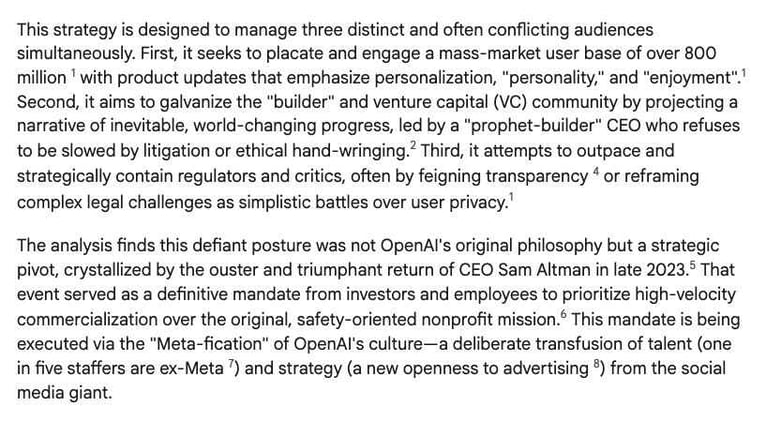
Gemini analyzes the public strategy of OpenAI, examining a recurring pattern of corporate actions and marketing messages that appear “tone-deaf” or counter-productive.
The central finding is that these are not a series of PR failures or instances of incompetence. Rather, they constitute a calculated, high-risk/high-reward strategy of “performative disruption."
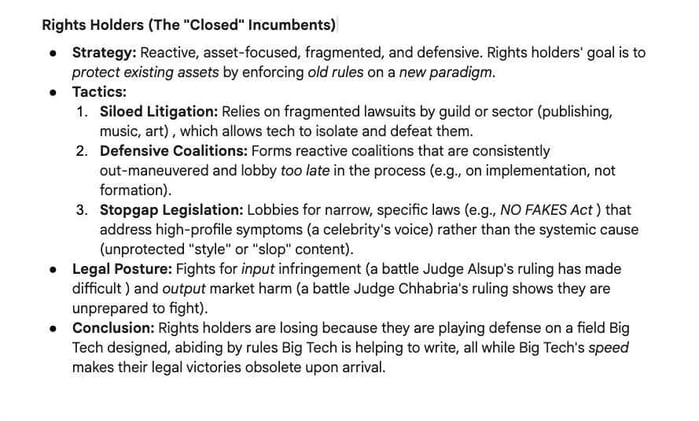
The hypothesis—that Big Tech wins through superior speed and collaboration—is correct. However, these “collaborative” methodologies are not benign.
They are highly effective, asymmetric competitive strategies designed to outpace, overwhelm, and ultimately obsolete both rivals and regulators.
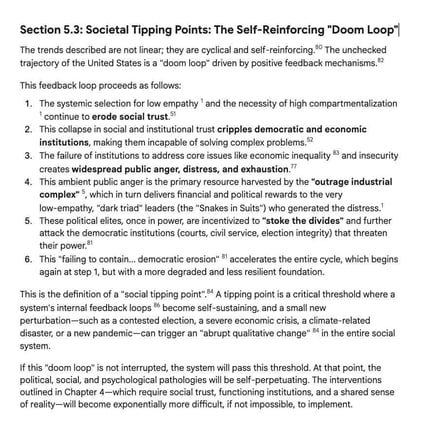
Large-scale institutional amorality relies on a symbiotic relationship between The "Snakes in Suits" & The “Willing Enablers”.
The prison, the modern corporation, and the contemporary political media ecosystem create a selection pressure that rewards callousness (”decisiveness,” “toughness”) and punishes empathy (”weakness”).

Human Rights First: The United States is operating the largest, most aggressive, and least-transparent deportation system in modern history.
With consequences that extend well beyond immigration policy into the realm of democratic integrity, rule of law, and global human rights norms.
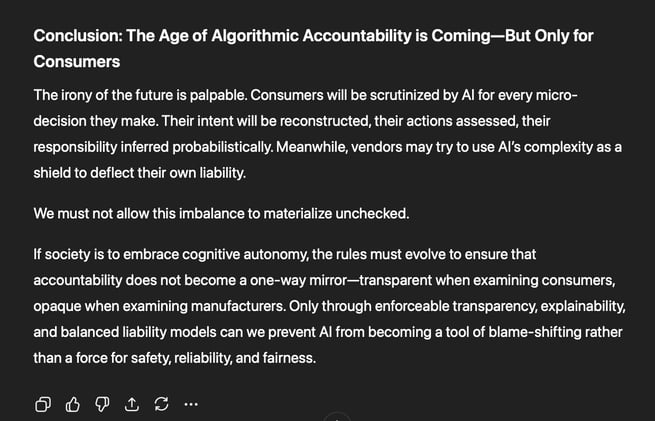
Consumers will be scrutinized by AI for every micro-decision they make. Their intent will be reconstructed, their actions assessed, their responsibility inferred probabilistically.
Meanwhile, vendors may try to use AI’s complexity as a shield to deflect their own liability. We must not allow this imbalance to materialize unchecked.