- Pascal's Chatbot Q&As
- Archive
- Page 18
Archive

How AI’s rapid industrialization—especially around data centers, GPU supply, export controls, consumer surveillance, and political lobbying—feeds a circular economy of power between governments...
...corporations, and intelligence-linked actors such as Palantir. Erosion of accountability when AI and hardware companies amass structural power, shape markets, laws, and even foreign policy.


Gemini 2.5 Pro: This report provides a forensic analysis of a complex conspiracy theory alleging the United States government orchestrated a $15 billion Bitcoin theft, subsequently disguising it...
...as a legal asset forfeiture. The analysis of the transcript and associated evidence reveals that the narrative is not simple disinformation but a sophisticated “truth-sandwich” structure.

The ASIS&T paper shows that the contamination of AI models is not an accident; it is the natural consequence of an industry built for scale, not care. Institutions that build these models were never..
...designed to uphold scholarly integrity. Not because they are malicious, but because they are structurally, culturally, and economically misaligned with the norms of science.

Thele v. Google LLC is the first major test of silent AI activation, the boundaries of consent in the AI-driven workplace, and the applicability of decades-old wiretapping laws to frontier AI systems.
Google faces exposure for privacy violations & secondary harms imposed on enterprises—breaches of confidentiality, contract violations, and regulatory non-compliance triggered by silent AI activation.

The author claims that a trained model file—a persistent, multi-gigabyte object stored on disk—is a “tangible medium of expression.” Because verbatim training data can be extracted from these weights
...the model file itself allegedly fits the statutory definition of “Copies”: “material objects... in which a work is fixed...and from which the work can be... reproduced...with the aid of a machine.

The paper Library Genesis to Llama 3 investigates a troubling link between the training of LLMs like Meta’s Llama 3 and the use of pirated, retracted, or otherwise compromised scholarly data.
When AI trains on corrupted science, society inherits the consequences. Ethical data curation is not an optional best practice — it is a prerequisite for trustworthy intelligence.

The paper states plainly that AI companies’ 2030 net-zero aspirations cannot be met without “substantial reliance on highly uncertain carbon offset and water restoration mechanisms”.
The authors propose that AI companies should co-invest in monitoring air quality (e.g., PM2.5 sensors) and water systems with local governments.

Deployment of genAI systems in courts constitutes a de facto delegation of public power that engages, and potentially threatens, the constitutional principles that structure the rule of law in the EU.
It implicates the fundamental right to an effective judicial remedy under Article 47 CFR, judicial independence, the duty to state reasons, and essential conditions for accountable governance.

Data Centers are absorbing unprecedented levels of capital, reshaping job markets, distorting energy systems, and redefining the financial landscape. While the analysis is U.S.-centric...
...the consequences are unmistakably global. The dynamics unfolding today foreshadow a world economy increasingly shaped by AI infrastructure, corporate concentration, and energy scarcity.

Wolf underscores the one institution still standing between authoritarian overreach and complete impunity: the judiciary. But even there, he argues, the guardrails are failing.
Lower-court judges issue rulings blocking unconstitutional executive actions, only to see them swept aside by the Supreme Court through emergency orders issued on the “shadow docket”.
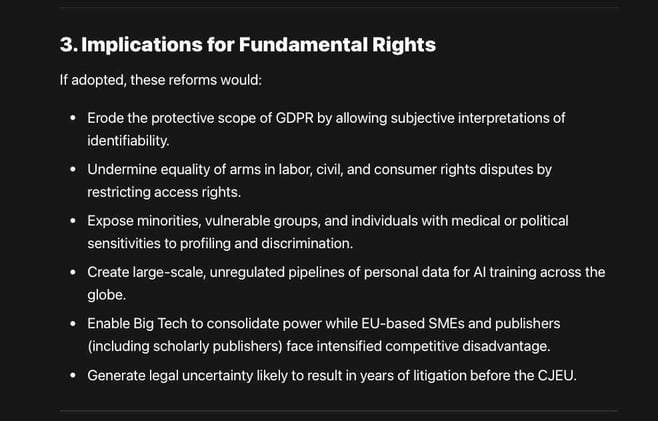
Ready to sacrifice GDPR on the altar of the AI God? 1. Narrowing the definition of “personal data.” 2. Restricting data subject rights to “data-protection purposes” only.
3. Allowing AI companies to train models on Europeans’ personal data under a broad “legitimate interest.” 4. Providing a “wildcard” legal basis for any AI system’s operation. And much more...
GEMA v. OpenAI: The allegation was that these lyrics had been used to train ChatGPT without a license and that ChatGPT subsequently reproduced them nearly verbatim for users.
The court accepted GEMA’s core argument that this constituted unlicensed Vervielfältigung (reproduction) and Wiedergabe (making available/communication to the public) under German copyright law.