- Pascal's Chatbot Q&As
- Archive
- Page 19
Archive
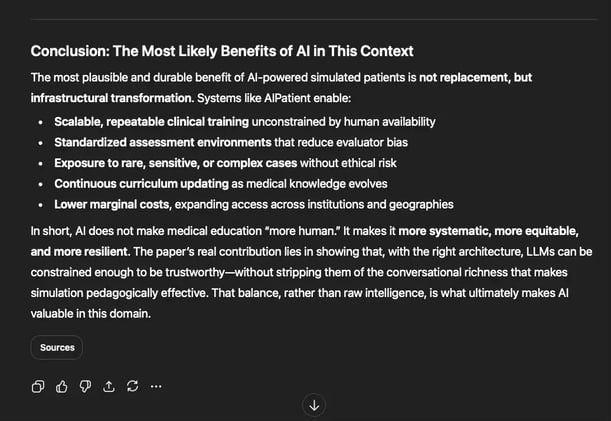
Medical students rated AIPatient as equal or superior to human-simulated patients across fidelity, emotional realism, usability, and support for clinical reasoning.t
Notably, AIPatient outperformed humans on emotional realism and technical reliability, challenging the long-held assumption that empathy and nuance are inherently human advantages in simulation.


SerpApi allegedly bypassed a technical access-control system (SearchGuard) that Google built to prevent automated extraction of search-result pages containing third-party copyrighted material.
Courts, regulators, and counterparties are increasingly likely to examine symmetry of conduct—whether an organisation’s enforcement stance aligns with its own data-acquisition practices.

There’s an uncomfortable political-economy implication here: AI infrastructure expands fastest where permitting and incentives are friendliest,...
...not necessarily where water and grid constraints are lowest. That pushes real, localised conflict—even if global averages look “manageable.”

This report quietly dismantles a popular myth: that Europe’s AI problem is mainly about spending too little. The real issue is how, where, and for how long money is spent.
AI innovation is not just a budget line—it is an ecosystem problem. And ecosystems, once formed, are hard to change.


GPT-5.2 analyses a 'Powers of Corruption' Diagram. If you want to go from “dark diagram” to proof-grade claims, you’d look for: Primary money trails, Procurement/ethics documentation,...
...Quid-pro-quo evidence, and Pardon pipeline evidence. The ecosystem of influence is real; the video’s single-mastermind diagram is rhetorical compression that slides into conspiratorial thinking.

By aligning with Russia and adopting its grievances against the Western liberal order, the administration validates its own domestic war against the “globalists” who built that order.
The “Reverse Kissinger” strategy—aligning with Russia to counter China—serves a potent domestic political function: to frame its abandonment of NATO, EU not as isolationism, but as "smart" realpolitik

Coursera will acquire Udemy. For publishers—especially scholarly, professional, and educational publishers—the merger is not just an ed-tech headline.
It is a clear signal that scale, data, distribution, and AI-readiness are becoming existential requirements rather than optional advantages.

Adobe’s SLMs and their alleged training on pirated books via SlimPajama, a derivative of Books3. If courts accept that weights encode infringing copies, the legal consequences would be profound.
Complaint paints a sharply different picture—one that, if substantiated, could undermine industry narratives about clean datasets, open-source insulation, and technical abstraction from infringement.

A multi-vector attack on the entire AI music business model, combining copyright law, DMCA anti-circumvention claims, biometric privacy (BIPA), right-of-publicity law, and consumer deception.
The defendants—Kunlun Tech and its Singapore-based AI subsidiary Skywork—operate Mureka, a large-scale AI music generation platform marketed as a “royalty-free” replacement for licensed music.

The Russia-adjacent “connective tissue” points that are real, documentable, and potentially problematic if Trump Media (TMTG / Truth Social) is merging with TAE.
TAE: past Russian state-linked investment + Russia-based technical collaboration history. TMTG: reported Russia-linked emergency financing.