- Pascal's Chatbot Q&As
- Archive
- Page -223
Archive
The question is whether AI is being deployed less as a productivity miracle for humanity and more as an industrial substitute for a creator economy that the platforms themselves had already broken.
The evidence supports the hypothesis on every major point. It is no longer speculative. It is documented. The platforms have said so, on their earnings calls, in writing, in court.
The Machine’s Human Cost. The lived reality is unpaid testing, chaotic onboarding, sudden project cancellations, constant Slack monitoring...
...shifting rules, rapid offboarding, falling rates, and a humiliating dependence on “tasks” that may vanish before the worker can even access them.
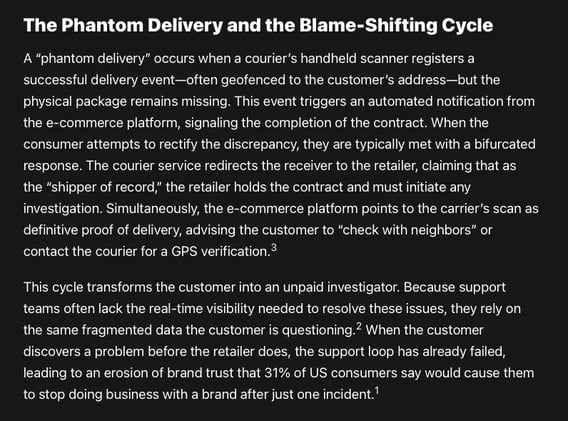
The “phantom delivery” loop: a scenario in which third-party delivery services record a successful drop-off that the consumer never receives, leading to a state of procedural limbo.
This failure is compounded by the deployment of generative AI chatbots that act as defensive buffers for both retailers and couriers, effectively removing the human element from dispute resolution.

Public statements of AI leaders are rarely subjected to the systematic, AI-assisted scrutiny that the technology itself makes cheap. The strategic logic guiding AI capital allocation appears to be...
...more reactive than the quantitative tools available would justify. The gap between what AI could do for the AI industry and what the latter asks of AI is wide enough to deserve sustained attention.

The human capacity for the denial of reality represents one of the most resilient and complex cognitive mechanisms in the species’ repertoire. When individuals or collectives are faced with adversity,
defined here as any condition that threatens physical survival, social standing, or psychological coherence—the brain frequently prioritizes internal equilibrium over the reception of objective truth.

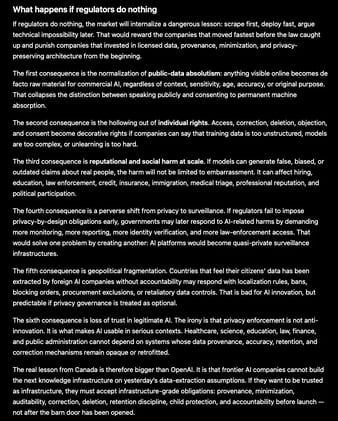
Canada & OpenAI: If regulators do nothing, the market will internalize a dangerous lesson: scrape first, deploy fast, argue technical impossibility later. That would reward the companies...
...that moved fastest before the law caught up and punish companies that invested in licensed data, provenance, minimization, and privacy-preserving architecture from the beginning.

The Stanford/EVOX lawsuit shows that academic AI datasets may carry serious “dataset debt” when copyrighted works were scraped, hosted and redistributed without clear permission.
For AI developers and universities, the lesson is clear: provenance, rights clearance, controlled access and dataset governance must become core research infrastructure, not legal afterthoughts.

The AI Act was sold as Europe’s attempt to regulate powerful AI systems before they became too deeply embedded in society.
Now, before the most consequential obligations even fully apply, Europe is already softening, delaying and simplifying under pressure from competitiveness arguments.


The legal theory used against commercial AI companies may also reach academic AI research, open models, university labs and public-interest research infrastructure.
Apple is not merely saying “we did not infringe.” It is saying that the plaintiffs’ legal theory, if accepted broadly, would not only affect Apple. It could destabilise the entire AI research pipeline.