- Pascal's Chatbot Q&As
- Archive
- Page -48
Archive

The US state apparatus acting less like a neutral referee of markets and more like a growth function for a particular sector. “Take our stack, because our diplomats will fight your sovereignty rules.”
“Adopt our tools, because our ‘help’ is organized around your purchase order.” That’s not development. That’s export strategy with humanitarian branding.


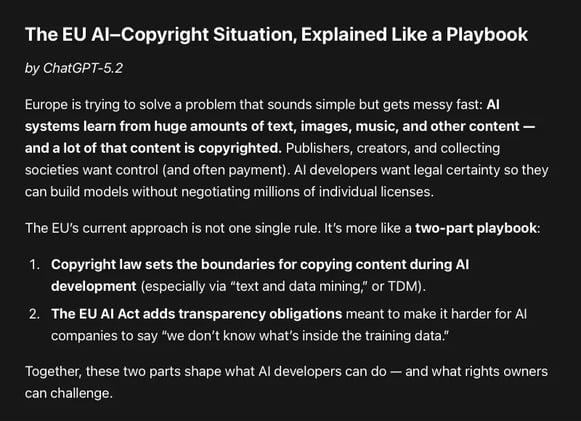
For publishers and rights owners, the EU playbook rewards those who turn rights enforcement into repeatable infrastructure (opt-out + monitoring + evidence).
For AI developers, it rewards those who treat training data and model behavior as auditable, testable, governable systems — not a black box and a shrug.

DHS has transitioned from a defensive posture, established in the wake of the September 11 attacks to protect the homeland from external threats, to an offensive domestic enforcement apparatus.
The domestic armamentarium is no longer just a set of tools; it is a fundamental reordering of the American state toward automated, high-powered internal containment.

South Korea: If the AI product competes directly with the original market (or acts like a drop-in replacement), fair use becomes much harder to defend.
Courts come down hard when the service is effectively built to replace a paid product using the same materials—like the Ross Intelligence v. Thomson Reuters/Westlaw scenario.

Europe wants more AI innovation, but only on a footing where copyright compliance, transparency, and remuneration are real—and enforceable.
The EU is trying to build infrastructure (opt-outs + transparency + licensing) that makes compliance and remuneration unavoidable rather than aspirational.

A bid to relocate the center of gravity of election administration—from the states and Congress to the president—using emergency framing as the crowbar.
If you can persuade enough people that the election system itself is under foreign attack, you can argue that extraordinary executive power is not merely justified but required.

When the world tries to regulate Silicon Valley, Washington reframes the regulation as an attack on innovation, trade, or freedom itself—and then mobilizes.
If the real goal is to protect innovation and civil liberties and security, a smarter approach exists—one that doesn’t require treating other democracies’ sovereignty concerns as illegitimate.
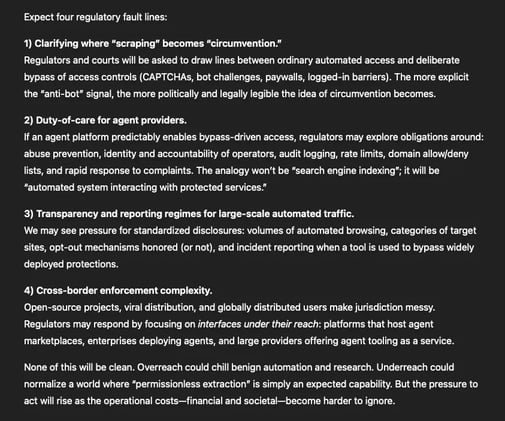
Let the AI agent decide what to extract; let the bypass tool handle how to get in. And when defenders adapt, the attackers adapt again—fast.
The story isn’t really about one bypass tool or one viral agent. It’s about a new equilibrium: as AI agents become ordinary, the internet’s defensive layer becomes a contested battleground.


AI systems generate synthetic media optimized for engagement metrics that may systematically erode judgment, attention, and civic competence.
The ultimate concern is loss of cognitive sovereignty‚ ability to form independent judgments when every information encounter has been algorithmically optimized to achieve someone else’s objectives.
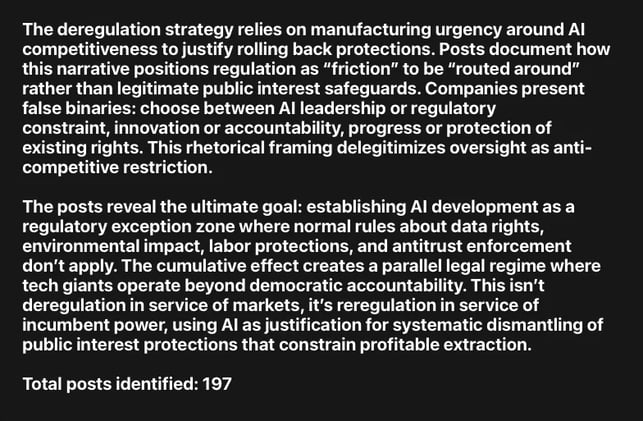
The posts reveal the ultimate goal: establishing AI development as a regulatory exception zone where normal rules about data rights, environmental impact, labor protections & antitrust enforcement...
...don’t apply. The cumulative effect creates a parallel legal regime where tech giants operate beyond democratic accountability.