- Pascal's Chatbot Q&As
- Posts
- A bid to relocate the center of gravity of election administration—from the states and Congress to the president—using emergency framing as the crowbar.
A bid to relocate the center of gravity of election administration—from the states and Congress to the president—using emergency framing as the crowbar.
If you can persuade enough people that the election system itself is under foreign attack, you can argue that extraordinary executive power is not merely justified but required.

Pascal Hetzscholdt
February 26, 2026
The Emergency Switch: When “Election Security” Becomes Executive Takeover
by ChatGPT-5.2
Every democracy has a few hidden trapdoors—mechanisms designed for genuine crises that can, in the wrong hands, be repurposed into shortcuts around ordinary law. In the United States, the language of “national emergency” is one of those trapdoors. It sounds responsible. It signals urgency. It implies protection. And that’s precisely why it is so dangerous when it is aimed not at an invasion, a pandemic, or a collapsing financial system, but at the administration of elections.
The development described in the Washington Post article is not just another partisan skirmish about voter ID, mail ballots, or voting machines. It is a bid to relocate the center of gravity of election administration—from the states and Congress to the president—using emergency framing as the crowbar. That is the “constitutional glitch” being exploited: if you can persuade enough people that the election system itself is under foreign attack, you can argue that extraordinary executive power is not merely justified but required.
A blueprint for a constitutional bypass
The report describes pro-Trump activists circulating a draft executive order arguing that allegations of foreign interference (specifically claims about China and 2020) justify declaring a national emergency that would unlock “extraordinary presidential power over voting.” The stated policy endpoints—mandating voter ID, banning mail ballots, and potentially restricting voting machines—are framed not as normal legislative choices, but as emergency countermeasures against foreign intrusion.
This matters because it is an attempted pivot from debate to decree.
Under normal democratic conditions, election rules are contested in legislatures, litigated in courts, negotiated through federalism, and administered through bureaucracies designed (however imperfectly) to be boring, procedural, and distributed. Emergencies invert that logic: they consolidate, centralize, and accelerate. If you can successfully redefine election administration as an emergency national security domain, you turn a constitutional system designed for pluralism into a system optimized for command.
The report itself underscores why this is constitutionally fraught: Article I, Section 4 assigns power over elections to state legislatures and Congress, “with no role for the president.” That line is not a technicality. It is a design feature—one of the reasons U.S. elections are resilient is precisely because they are not run by a single executive authority.
Why this is dangerous now, specifically
In isolation, a draft order is paper. In the current circumstances described, it is a signal—and signals move systems.
Here’s why the risk is unusually high:
Emergency logic collapses accountability.
Once a president claims an emergency, the default posture of institutions often shifts from “prove it” to “manage it.” Courts hesitate, agencies scramble, media amplifies, and opponents are put in the position of arguing against “security.” That’s a structural advantage: you are no longer debating policy; you are debating whether you “care about protecting America.”It weaponizes national security as a domestic political instrument.
The draft’s premise (foreign interference as the trigger for emergency authority) turns intelligence narratives into political levers. The report notes that a prior intelligence review concluded China considered influence efforts in 2020 but did not proceed. Yet the existence of foreign-interest speculation becomes rhetorical fuel for maximal executive action. That is a classic pathway from “threat talk” to “exceptionalism,” where the threat does not need to be proven at the level required for the magnitude of power claimed.It targets the mechanics of voting, not just the story about voting.
The most consequential authoritarian shifts are often procedural: who can vote, how they can vote, who counts votes, what equipment is allowed, which ballots are deemed valid. The report ties this push to bans on mail ballots and voting machines—the infrastructure of participation itself. That is why this isn’t merely “messaging”; it is a potential rewrite of access and administration.It tests a new boundary: “a presidential emergency on elections has never been tested in court.”
That’s not reassurance—it’s a warning. Novelty is exactly how constitutional norms get punctured. Once a precedent is created, even if later curtailed, it changes the future bargaining power of the executive branch and the expectations of supporters who now believe “the president can do this.”It is coupled with a broader strategy: legislate if possible, bypass if not.
The report describes pressure on Congress to pass the SAVE Act-style approach and the stated intent to “act unilaterally” if legislation fails. That sequence—seek statutory authority, then claim necessity when blocked—is a familiar pattern in democratic backsliding: when institutions refuse to grant power, the leader frames institutional resistance as evidence of the emergency.
Is it something that should be stopped?
Yes—if the goal is a democratic system where election rules are set by law, not executive fiat.
To be clear: countries can and should protect election infrastructure from foreign interference. But the cure proposed here is structurally worse than the disease. A system that responds to “foreign meddling” by concentrating election control in the presidency has effectively handed any future president a loaded weapon pointed at the electorate. Even if one agrees with the stated policy preferences (voter ID, restrictions on mail ballots), the mechanism matters. Democracy is not only outcomes; it is constraints. When you normalize emergency pathways for election administration, you normalize the idea that the executive can “secure” elections by controlling them.
How could it be stopped—practically, not rhetorically?
Stopping something like this isn’t one heroic act. It’s a multi-front containment strategy: legal, legislative, administrative, and informational—executed quickly enough that “emergency momentum” doesn’t become reality.
1) Immediate legal containment: fast injunction posture, not slow merits litigation
If an executive order is issued, opponents must prioritize emergency injunctive relief that focuses on authority and irreparable harm, not a sprawling debate about every downstream effect. Courts move faster when the question is: “Does the executive have the power to do this at all?” The report notes that courts have already blocked parts of a prior executive order touching elections in multiple cases; that litigation track record suggests a pathway: aggressive, rapid challenges focused on constitutional allocation of powers and statutory limits.
2) Congressional clarity: legislate guardrails on “election emergency” claims
Even in polarized conditions, Congress retains tools: clarifying statutes that explicitly bar the use of emergency authorities to alter election administration; tightening conditions for invoking emergency powers in domestic governance; requiring rapid, affirmative congressional approval for any emergency measure that touches election rules or administration. The point is to convert ambiguity into bright lines—because ambiguity is where executive power grows.
3) State-level hardening: precommitment and operational refusal
In U.S. federalism, states run elections. That is leverage. States can precommit—through legislation, administrative rules, and inter-state compacts—to resist unlawful federal directives over election administration; to require transparent, court-validated legal bases before changing voting methods; and to maintain chain-of-custody and process stability even amid political noise. Distributed administration is not a bug; it is the defense.
4) Institutional “tripwires”: make emergency claims expensive to sustain
The report mentions public opposition to federal takeover of election administration in polling. Democratic resilience improves when leaders know that emergency overreach triggers automatic oversight: mandatory inspector general review, public reporting requirements, rapid hearings, and sworn testimony from officials involved. Tripwires don’t stop a determined actor alone—but they raise the cost of maintaining a legally shaky posture.
5) Information discipline: separate “foreign interference” claims from “domestic control” solutions
A sophisticated propaganda move is to conflate two questions:
Is foreign interference a risk? (Often yes, in various forms.)
Does that justify executive control over election administration? (Almost never.)
Media, civil society, and institutional actors must refuse the frame that “security requires centralization.” The correct democratic frame is: security requires verifiable process, distributed administration, and lawful authority. When emergency language is met with procedural language—jurisdiction, statutory authority, constitutional allocation—the spell weakens.
6) International and private-sector posture: don’t launder legitimacy
Foreign governments, election observers, and platforms can inadvertently legitimize emergency narratives by treating them as ordinary policy disputes. A healthy stance is to treat any emergency executive move over elections as a governance risk event—one that demands heightened scrutiny, clear legal analysis, and caution in amplification.
The deeper risk: not one order, but a new normal
The most dangerous possibility is not that an order succeeds completely. It is that it succeeds enough to establish a template:
Claim foreign interference.
Declare emergency.
Assert extraordinary power.
Force institutions to react on the executive’s timetable.
Litigate after the fact while public trust erodes in real time.
Even failed attempts can be strategically valuable if they teach future actors where the guardrails bend, and if they train the public to accept emergency governance as a normal tool of election politics.
If you want a single sentence summary of the threat: This is an effort to turn elections from a shared civic procedure into a security exception—and security exceptions are where democracies go to die quietly.
·
7 OCTOBER 2025

The Architecture of Control: An Assessment of Authoritarian Ambition and the Role of Violence in the Trump Movement
·
25 MAY 2025
An Examination of Potential Strategies for Inciting Domestic Unrest and Invoking Martial Law in a 2025 Trump Administration
·
25 JAN
The Pathology of Power: Cognitive Paralysis, Institutional Decay, and the Imperative of Preemptive Defense in the Face of “Rabid” Regimes
·
1 SEPTEMBER 2025
Mechanisms of Accountability and Constraint on Executive Power in a Constitutional Crisis
·
19 APRIL 2025
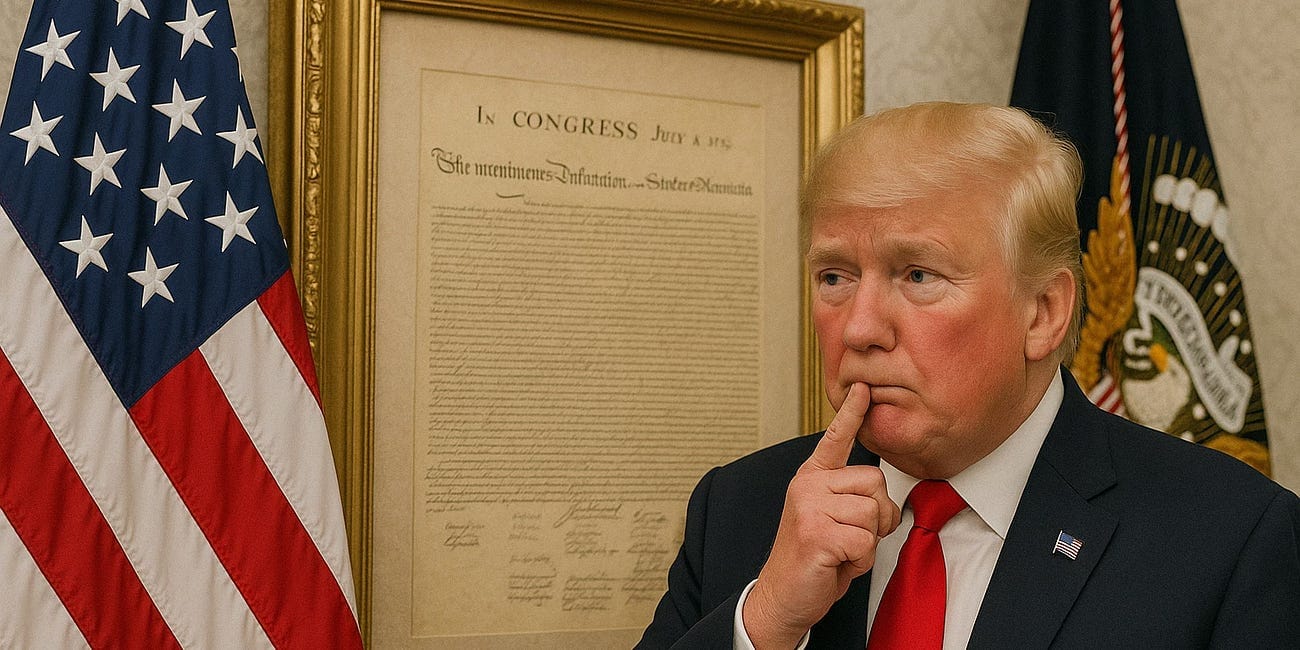
An Examination of Trump Administration Actions in Light of Grievances Enumerated in the U.S. Declaration of Independence
·
8 AUGUST 2025
An Analysis of Political Animosity: A Comparative Study of U.S. Partisan Polarization and the Israeli-Palestinian Conflict and Its Implications for Democratic Stability
·
29 JUNE 2025

The Dual-Use Border: Securing the Homeland or Insulating the Presidency? An Analysis of the Trump Administration's Border Militarization and Geopolitical Strategy