- Pascal's Chatbot Q&As
- Archive
- Page -286
Archive

A group of 28 authors and rights holders, including Angie Cruz, Dave Eggers, Vendela Vida and others, opted out of the Bartz settlement and filed their own individual action against Anthropic.
The plaintiffs allege that Anthropic built and improved Claude using copyrighted books taken from shadow libraries and pirate datasets, including Books3, LibGen and PiLiMi/Z-Library mirrors.


Cognella v. Anthropic: Anthropic allegedly acquired pirated books from shadow libraries, torrented them, redistributed them through peer-to-peer networks, stripped copyright management information...
...scanned physical books without permission, retained a permanent “everything forever” library, and used those materials to build a commercial AI system now valued at extraordinary levels.

Journalists v. Google: The plaintiffs — Illinois-based journalists, podcasters and audiobook narrators — allege that Google used their recorded voices to train voice AI systems powering products.
Regulators should require provenance, speaker consent, retention/deletion plans, and stricter rules for biometric data in AI training.

Denmark: This ruling is important because it shifts the legal debate from “did the rights holder object?” to “did the rights holder object in a technically actionable way?” That is a much higher bar.
A rights holder may have objected in ordinary language & a lawyer may understand the objection, but the opt-out may still fail if automated systems cannot reliably process it as a rights reservation.

The European Commission seems to be exploring whether Europe needs a more structured legal and market framework for licensing copyright-protected content to AI companies...
...instead of relying on opaque scraping, voluntary deals, unenforceable opt-outs, and lawsuits after the damage has already been done.

CJEU: Italy was allowed to say to platforms such as Meta: “You cannot use press publications online, refuse meaningful negotiation, hide the data needed to calculate value, or reduce visibility...
...as pressure during the negotiation process.” The Court accepted that such obligations limit the platform’s freedom to conduct a business, but found that this limitation may be justified.
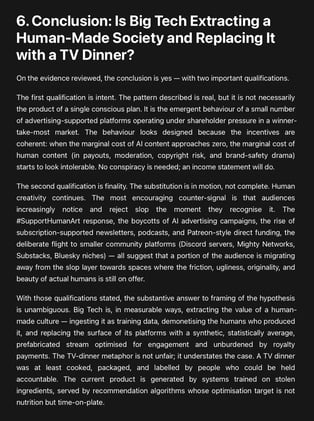
The question is whether AI is being deployed less as a productivity miracle for humanity and more as an industrial substitute for a creator economy that the platforms themselves had already broken.
The evidence supports the hypothesis on every major point. It is no longer speculative. It is documented. The platforms have said so, on their earnings calls, in writing, in court.
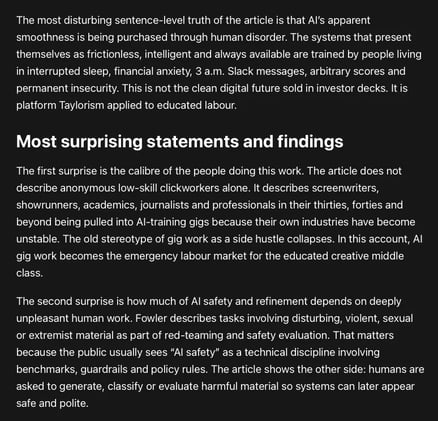
The Machine’s Human Cost. The lived reality is unpaid testing, chaotic onboarding, sudden project cancellations, constant Slack monitoring...
...shifting rules, rapid offboarding, falling rates, and a humiliating dependence on “tasks” that may vanish before the worker can even access them.
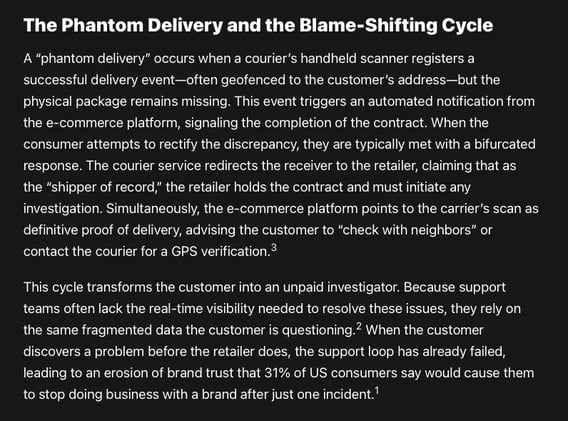
The “phantom delivery” loop: a scenario in which third-party delivery services record a successful drop-off that the consumer never receives, leading to a state of procedural limbo.
This failure is compounded by the deployment of generative AI chatbots that act as defensive buffers for both retailers and couriers, effectively removing the human element from dispute resolution.

Public statements of AI leaders are rarely subjected to the systematic, AI-assisted scrutiny that the technology itself makes cheap. The strategic logic guiding AI capital allocation appears to be...
...more reactive than the quantitative tools available would justify. The gap between what AI could do for the AI industry and what the latter asks of AI is wide enough to deserve sustained attention.

The human capacity for the denial of reality represents one of the most resilient and complex cognitive mechanisms in the species’ repertoire. When individuals or collectives are faced with adversity,
defined here as any condition that threatens physical survival, social standing, or psychological coherence—the brain frequently prioritizes internal equilibrium over the reception of objective truth.