- Pascal's Chatbot Q&As
- Posts
- Without parallel interventions in competition, infrastructure, and governance, even the most carefully calibrated copyright policy risks becoming an accessory to concentration.
Without parallel interventions in competition, infrastructure, and governance, even the most carefully calibrated copyright policy risks becoming an accessory to concentration.
The brief "Policy Prescriptions for Balancing AI and Copyright Concerns" succeeds in mapping the terrain. The next step is to decide who gets to own the future built on humanity’s past.

Pascal Hetzscholdt
December 29, 2025
Between Permission and Power: A Critical Reading of Policy Prescriptions for Balancing AI and Copyright Concerns
by ChatGPT-5.2
Introduction: Copyright at the Edge of an Industrial Transition
The policy brief Policy Prescriptions for Balancing AI and Copyright Concerns (December 2025) sets out from a premise that is now unavoidable: artificial intelligence has transformed copyright from a marginal legal constraint into a central political economy problem. Training frontier AI systems requires ingesting vast quantities of human-authored material—text, images, sound, code—most of it protected by copyright. The brief frames this not merely as a legal friction but as a structural dilemma: how to preserve incentives for creation while enabling a technological shift that increasingly treats knowledge as a raw material rather than a finished product.
At its strongest, the document recognises that copyright law is being asked to do something it was never designed for: regulate statistical learning from culture at scale. At its weakest, it occasionally underestimates how deeply this shift redistributes power—away from creators and publics, toward infrastructure owners controlling compute, models, and distribution.
The brief’s ambition is pragmatic rather than ideological. It does not argue for absolute creator control, nor for unfettered AI exceptionalism. Instead, it surveys global approaches and proposes a middle path—particularly for India—designed to maximise AI competitiveness while containing the most acute harms to rights holders. Whether that balance is achievable is the core question.
Explaining the Core Argument: Learning From the World, Without Owning It
The policy brief advances three central claims.
First, AI training is analytically distinct from expressive reuse. Across jurisdictions, courts and regulators are increasingly willing to separate upstream ingestion (training) from downstream outputs (generation). Training is framed as non-consumptive, non-enjoyment use: the system extracts patterns, not meaning in the human sense. This logic underpins permissive regimes such as Japan’s “data analysis” exception and Singapore’s computational data analysis carve-out, and it increasingly appears in judicial reasoning elsewhere.
Second, legal uncertainty is now a competitive disadvantage. Jurisdictions relying on case-by-case doctrines—such as U.S. fair use or Canadian fair dealing—may appear flexible, but the brief highlights how litigation risk, discovery costs, and jurisdictional fragmentation function as de facto regulation. From this perspective, statutory clarity—even if imperfect—outperforms doctrinal ambiguity in attracting AI investment.
Third, input control is less effective than output accountability. The brief repeatedly argues that attempting to block training data is both impractical and strategically counterproductive. Instead, it urges policymakers and creators to focus on demonstrable downstream harms: market substitution, reputational damage, misleading attribution, impersonation, and loss of audience. This shift mirrors a broader global trend away from ex ante data control toward ex post harm regulation.
These arguments are coherent, and in many respects empirically grounded. Yet they also encode a set of assumptions that deserve closer scrutiny.
Where the Brief Is Convincing
1. The Comparative Jurisdictional Analysis Is Exceptionally Strong
The document’s greatest strength lies in its comparative method. By placing the U.S., EU, UK, Canada, China, Japan, and Singapore side by side, the brief exposes a crucial truth: there is no settled global consensus, only a spectrum of trade-offs.
The U.S. model privileges innovation speed but externalises risk onto courts and creators.
The EU’s opt-out regime offers theoretical control but collapses under operational ambiguity.
The UK’s restrictive stance has pushed AI training offshore without materially benefiting creators.
Japan and Singapore demonstrate that permissive input regimes can coexist with strong downstream safeguards.
China illustrates how industrial policy can quietly trump copyright orthodoxy, with enforcement focused where it aligns with state priorities.
This analysis avoids caricature. It neither romanticises permissive regimes nor demonises rights-based approaches. Instead, it shows how copyright has become an instrument of industrial strategy, whether acknowledged or not.
2. The Emphasis on Dataset Hygiene Is Realistic and Legally Astute
The brief’s insistence that developers proactively exclude clearly pirated sources is one of its most grounded recommendations. Courts across jurisdictions are converging on a subtle but powerful distinction: transformative training may be defensible, but dirty inputs poison that defence.
By encouraging dataset provenance logging, defensive filtering, and internal auditability, the document aligns legal risk mitigation with good engineering practice. This is not moral posturing; it reflects how judges actually reason about fairness, intent, and proportionality.
3. The Focus on Output Harm Reflects Litigation Reality
The recommendation that creators shift their legal strategy from blocking training to challenging substitutive outputs is both pragmatic and forward-looking. Input-based claims face evidentiary hurdles, jurisdictional escape routes, and doctrinal uncertainty. Output-based claims, by contrast, map cleanly onto existing concepts: reproduction, adaptation, passing off, unfair competition, and consumer deception.
This reframing does not abandon creator protection; it relocates it to where enforcement is likeliest to succeed.
Where the Brief Is Weaker—or Strategically Evasive
1. Voluntary Opt-Outs Underestimate Power Asymmetry
The proposal for voluntary, machine-readable opt-out registries appears reasonable on paper. In practice, it risks reproducing the same structural imbalance that defines today’s digital economy.
Opt-out systems presume:
technical literacy,
awareness of AI training practices,
bargaining power to enforce reservations,
and the ability to monitor compliance.
Large rights holders may manage this. Individual creators, small publishers, and actors in the Global South often cannot. Voluntariness, in this context, can become a fig leaf for default appropriation.
2. Attribution Is Treated as an Ethical Add-On, Not an Economic Lever
The brief suggests voluntary attribution or watermarking where technically feasible. This understates how central attribution is to economic survival in an attention economy increasingly mediated by AI systems.
If AI-generated answers displace discovery, attribution without enforceable linkage, visibility guarantees, or revenue participation risks becoming symbolic rather than substantive. Transparency alone does not restore bargaining power.
3. The Political Economy of Compute Is Largely Absent
The document focuses on copyright law but says little about who actually benefits from permissive training regimes. In reality, the capacity to exploit broad TDM exceptions is constrained by access to compute, capital, and distribution.
Without addressing concentration risks, permissive copyright rules may simply accelerate consolidation—locking in a small number of AI platforms while weakening creators’ leverage further. This omission does not invalidate the brief’s proposals, but it limits their systemic ambition.
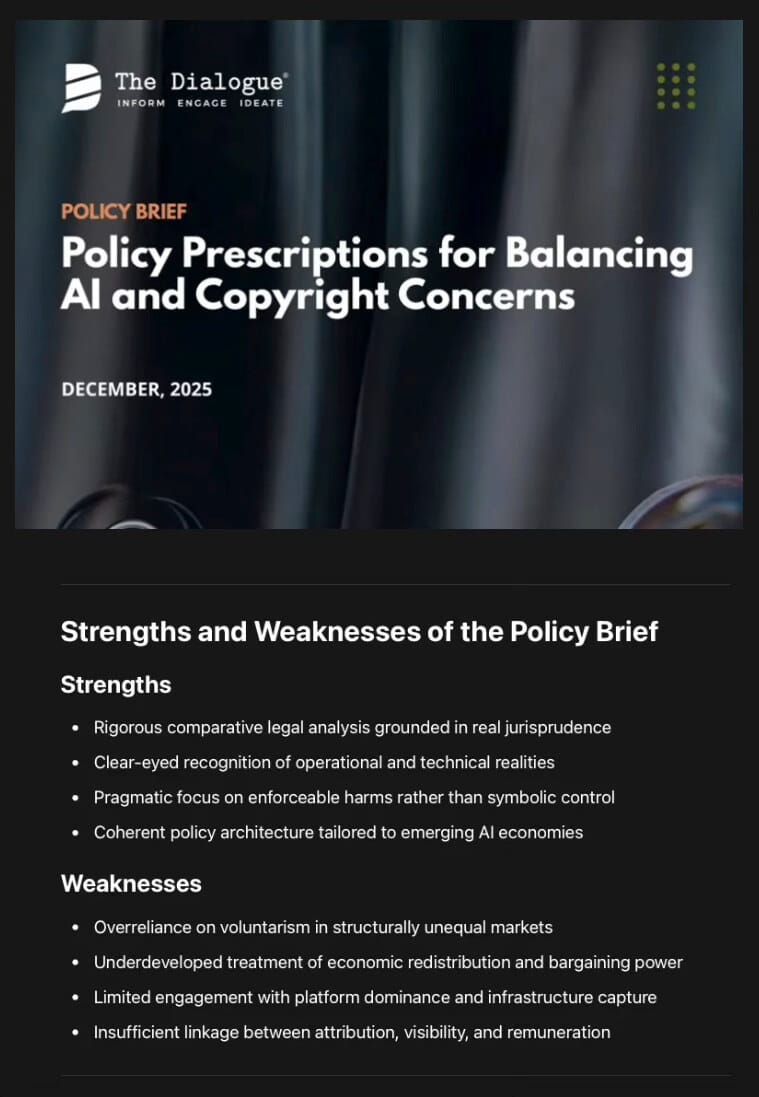
Strengths and Weaknesses of the Policy Brief
Strengths
Rigorous comparative legal analysis grounded in real jurisprudence
Clear-eyed recognition of operational and technical realities
Pragmatic focus on enforceable harms rather than symbolic control
Coherent policy architecture tailored to emerging AI economies
Weaknesses
Overreliance on voluntarism in structurally unequal markets
Underdeveloped treatment of economic redistribution and bargaining power
Limited engagement with platform dominance and infrastructure capture
Insufficient linkage between attribution, visibility, and remuneration
Recommendations for Improvement
Pair Voluntary Opt-Outs With Default Safeguards
Introduce baseline protections for categories of vulnerable creators, rather than relying exclusively on opt-outs.Tie Attribution to Economic Participation
Explore mechanisms where attribution triggers discoverability guarantees, revenue sharing, or collective remuneration.Explicitly Address Market Concentration
Align copyright policy with competition law, procurement rules, and public-interest compute access.Strengthen Collective Infrastructure
Support interoperable registries, rights-expression standards, and enforcement tooling that reduce individual burden.
Likely Global Reception
Businesses will largely welcome the document. It offers legal certainty without mandating universal licensing and aligns with emerging compliance practices.
Creators will be divided. Larger rights holders may see opportunity; independents may perceive erosion masked as pragmatism.
Legal experts will recognise the doctrinal sophistication and likely view the brief as aligned with judicial momentum, even if normatively cautious.
Regulators—especially in emerging AI economies—are likely to find the framework attractive: it promises competitiveness without abandoning cultural protection, even if it postpones harder questions about redistribution and power.
Conclusion: A Technocratic Truce, Not a Final Settlement
This policy brief is not a manifesto. It is a technocratic attempt to stabilise a volatile transition. It accepts that AI training on copyrighted material is already a global fact—and seeks to civilise that reality rather than deny it.
Whether this balance endures will depend less on copyright doctrine than on who controls the AI value chain. Without parallel interventions in competition, infrastructure, and governance, even the most carefully calibrated copyright policy risks becoming an accessory to concentration.
The brief succeeds in mapping the terrain. The next step—politically and legally—is to decide who gets to own the future built on humanity’s past.