- Pascal's Chatbot Q&As
- Posts
- Where no human creative input is involved, copyright’s “originality” logic struggles, because originality in EU copyright doctrine is tied to human “free and creative choices” expressed in the work.
Where no human creative input is involved, copyright’s “originality” logic struggles, because originality in EU copyright doctrine is tied to human “free and creative choices” expressed in the work.
In practice, EU design registration can accommodate “AI output” as long as it meets design-law criteria. Even “low-creativity” processes can still yield protectable designs.

Pascal Hetzscholdt
January 21, 2026
“No Muse Required”: How EU Design Law Quietly Became the IP Backstop for AI Output
by ChatGPT-5.2
Two short texts, one big message: if you’re relying on copyright to protect AI-generated visuals, you may be leaning on the wrong pillar — but design law can still carry the weight.
What these two pieces are really saying
1) Copyright is (still) about human creative freedom — and AI-only output often won’t qualify.
The IPKat guest post frames the core point plainly: where no human creative input is involved, copyright’s “originality” logic struggles, because originality in EU copyright doctrine is tied to human “free and creative choices” expressed in the work. In that framing, fully autonomous AI output lacks the “personal stamp” copyright is looking for.
2) Design law is different: it protects the look, not the creative struggle.
Both documents converge on the same pivot: EU design protection doesn’t require proof of creative effort. The threshold is novelty and individual character (i.e., a different overall impression on the “informed user”), not whether the creator had a spark of genius.
3) This isn’t theoretical: the guest post claims a fully AI-generated EU design was registered.
The IPKat piece describes an EU design filing for an AI-generated plate (prompt-only Midjourney output, with an explicit disclosure that no human editing occurred) that was accepted and remains registered. The rhetorical point is sharp: in practice, EU design registration can accommodate “AI output” as long as it meets design-law criteria.
4) Even “low-creativity” processes can still yield protectable designs.
The Mr. Online article (and the guest post) highlight Deity Shoes: if a design is assembled from pre-existing catalog components (or, by analogy, generated from templates or model priors), that alone doesn’t kill design protection—again, because the test is the resulting overall impression, not the romantic story of authorship.
5) Unregistered design rights matter — especially for fast-moving AI content.
A major practical implication is emphasized: in the EU, unregistered design protection can arise upon first disclosure, offering a “quick shield” for short-lived commercial designs (fashion, product skins, marketing visuals, UI/UX elements, etc.), even where registering everything is unrealistic.
Is this usable worldwide, or is it EU-specific?
What travels well (broadly applicable ideas)
These strategic ideas are useful almost everywhere, even if the legal hooks differ:
Stop treating “no copyright” as “no protection.” Build a multi-right strategy (designs, trademarks, unfair competition/passing off, trade secrets, contract).
Protect outputs based on what they do in the market (distinct look, source signal, consumer confusion risk), not on whether they feel “creative.”
Move faster than infringers: document provenance, publish strategically, monitor copying, and enforce early.
Those are global business truths.
What is more EU-leaning (law-specific advantages)
The most powerful “plug-and-play” version of the approach in the attachments is particularly strong in the EUbecause:
EU design law’s gatekeeping is about novelty + individual character, not human creativity.
The EU has a well-known concept of unregistered design protection arising from disclosure, which is especially attractive for high-volume / high-velocity AI-generated design pipelines.
Where other regions may diverge
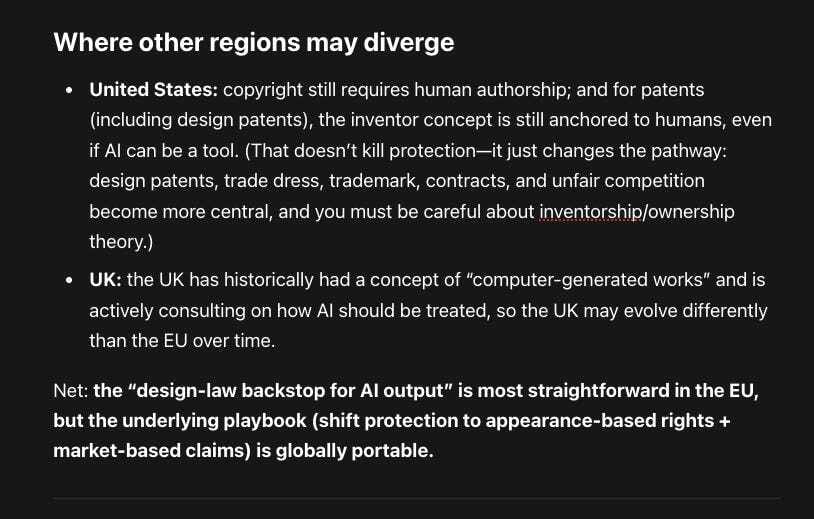
United States: copyright still requires human authorship; and for patents (including design patents), the inventor concept is still anchored to humans, even if AI can be a tool. (That doesn’t kill protection—it just changes the pathway: design patents, trade dress, trademark, contracts, and unfair competition become more central, and you must be careful about inventorship/ownership theory.)
UK: the UK has historically had a concept of “computer-generated works” and is actively consulting on how AI should be treated, so the UK may evolve differently than the EU over time.
Net: the “design-law backstop for AI output” is most straightforward in the EU, but the underlying playbook (shift protection to appearance-based rights + market-based claims) is globally portable.
Benefits of the approach (practical and commercial)
Here’s the full benefit stack implied by the attachments, spelled out for rights owners:
A) Protection even when copyright fails
A legal hook for enforcement when AI output lacks human authorship/originality.
Less dependence on messy debates about “prompting as authorship.”
B) Speed and scale for AI-era creation
Unregistered design rights can cover high-volume output where registering everything is unrealistic.
Faster time-to-protection for short product cycles (fashion drops, seasonal packaging, UI refreshes, marketing assets).
C) Stronger deterrence and cleaner litigation posture
Design claims can be more “visual-comparison” driven (overall impression), often clearer than proving substantial similarity + authorship chain in copyright-heavy fights.
Creates a credible enforcement narrative: “this look is ours” rather than “our creative soul is in this.”
D) Monetisation and licensing leverage
Registered designs are licensable assets that can be packaged (bundled licensing, franchising, OEM deals, platform partnerships).
Can support valuation, M&A diligence, and collateralisation (where relevant).
E) Cleaner internal governance
Encourages organisations to build repeatable capture of: disclosure dates, design variants, novelty checks, and ownership chains.
Helps clarify who “owns” AI output inside a company (prompt user / commissioning entity), at least operationally.
F) Better alignment with how copying actually happens
Many infringers copy the look, not the “creative process.” Design rights target the real-world harm.
Overall recommendations for rights owners worldwide
Adopt a “copyright-last” mindset for AI visuals.
Treat copyright as a bonus layer when you can evidence meaningful human creative control, not as your default line of defence.Build a design-rights pipeline (especially if you sell products, not just content).
Decide what you will register (hero designs, flagship product lines, high-margin SKUs, signature UI).
Use unregistered design protection tactically where available (fast cycles, experimental variants).
Operationalise “novelty hygiene.”
Design rights live or die on novelty and distinct overall impression. Put lightweight controls in place:
pre-release clearance checks (even partial),
controlled disclosure timing,
internal logging of first publication.
Document the AI workflow like evidence, not like marketing.
Keep records of:
prompt/versioning, seeds (if relevant), generation dates, selection decisions, first disclosure dates, and who directed the process.
This supports ownership, enforcement credibility, and internal governance.
Stack rights: design + trademark/trade dress + unfair competition + contracts.
In many jurisdictions, trademarks/trade dress and unfair competition claims become the “global glue,” especially where design-law equivalents vary.Enforcement posture: monitor early, act proportionately, settle strategically.
AI accelerates copying. The winning posture is usually fast detection + consistent, scalable enforcement, not “bet-the-company” litigation every time.Policy engagement: push for clarity, not miracles.
The EU approach highlighted here is a pragmatic compromise: protect market-facing visual investment without pretending the AI “created” like a human. Rights owners should push regulators for:
clear registrability rules for AI-era designs,
workable disclosure/ownership standards,
and enforcement mechanisms that scale.