- Pascal's Chatbot Q&As
- Posts
- We are moving from an economy of authored knowledge to an economy of generated plausibility.
We are moving from an economy of authored knowledge to an economy of generated plausibility.
The scarcest asset is no longer content—but trustworthy structure. Wherever authority is signaled through references, AI can convincingly fake the signal while breaking the substance.

Pascal Hetzscholdt
December 16, 2025
by ChatGPT-5.2
1. What happened — and why it matters
This article describes how Springer Nature came under public scrutiny after Social, Ethical and Legal Aspects of Generative AI, an expensive AI-ethics title, was found to contain a significant number of fabricated or untraceable citations. In some chapters, more than 70% of references could not be verified, including citations to journals that do not exist.
This is not a minor editorial lapse. Citations are the infrastructure of scholarly trust: they anchor claims, enable verification, and connect new work to the cumulative record of knowledge. When citations are hallucinated—whether deliberately or via careless AI use—the work ceases to function as scholarship. In effect, it becomes a simulation of authority rather than authority itself.
What makes this case especially damaging is the irony: a book about AI ethics appears to exhibit one of the most widely known AI failure modes—fabricated references—without adequate human verification.
2. Is this happening more often?
Yes—and not only in scholarly publishing.
Within academic publishing
Independent researchers such as Guillaume Cabanac and others have documented a steady rise in “hallucinated citations” since generative AI tools became mainstream. Publishers themselves have withdrawn multiple titles and journal articles after post-publication scrutiny revealed fictitious references, mismatched DOIs, or “journal-like” citations to non-existent outlets.
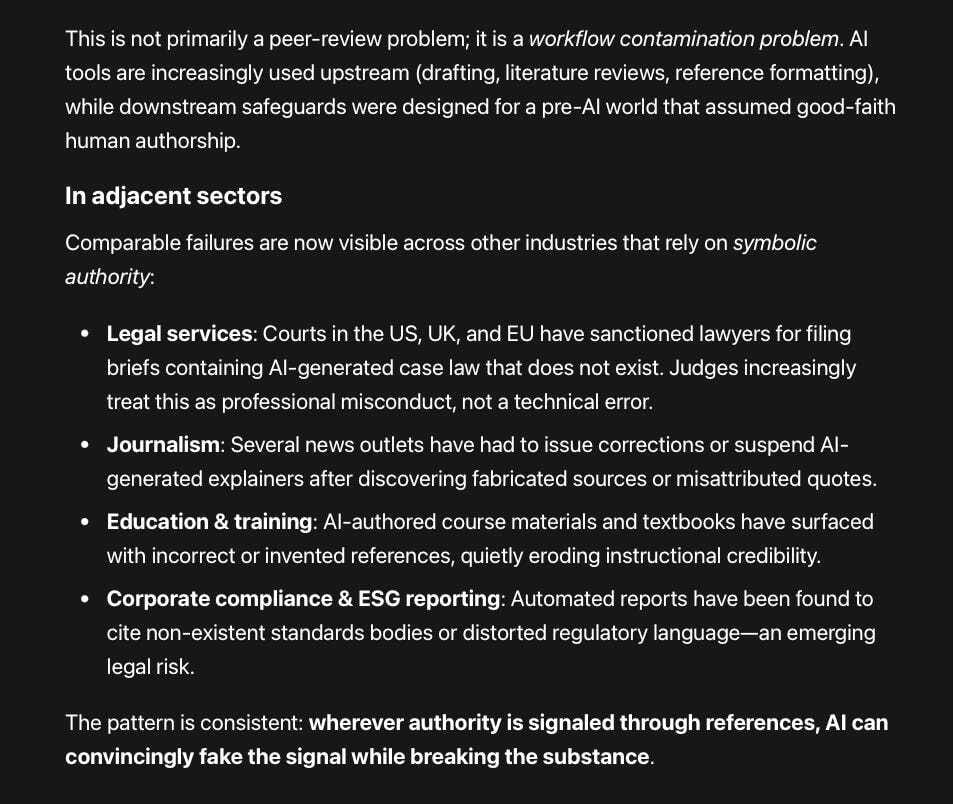
This is not primarily a peer-review problem; it is a workflow contamination problem. AI tools are increasingly used upstream (drafting, literature reviews, reference formatting), while downstream safeguards were designed for a pre-AI world that assumed good-faith human authorship.
In adjacent sectors
Comparable failures are now visible across other industries that rely on symbolic authority:
Legal services: Courts in the US, UK, and EU have sanctioned lawyers for filing briefs containing AI-generated case law that does not exist. Judges increasingly treat this as professional misconduct, not a technical error.
Journalism: Several news outlets have had to issue corrections or suspend AI-generated explainers after discovering fabricated sources or misattributed quotes.
Education & training: AI-authored course materials and textbooks have surfaced with incorrect or invented references, quietly eroding instructional credibility.
Corporate compliance & ESG reporting: Automated reports have been found to cite non-existent standards bodies or distorted regulatory language—an emerging legal risk.
The pattern is consistent: wherever authority is signaled through references, AI can convincingly fake the signal while breaking the substance.
3. Why this failure mode is structural, not accidental
This problem persists because incentives and capabilities are misaligned:
LLMs optimize for plausibility, not truth. A “Harvard AI Journal” sounds plausible, so the model produces it.
Time and cost pressures encourage AI-assisted drafting without proportional investment in verification.
Legacy trust models assume authors would not fabricate references at scale; AI breaks that assumption.
Detection tooling is uneven. While tools like BibCheck exist, they are not yet standard across editorial pipelines.
Crucially, hallucinated citations are not piracy. They are something more corrosive: synthetic legitimacy. That makes them harder to spot and more damaging once exposed.
4. Strategic implications for publishers
For scholarly publishers, the risk is existential rather than reputational.
If users (researchers, libraries, funders, courts, regulators) begin to assume that published works—even expensive, branded ones—may contain fictional scaffolding, then the publisher’s role as a trust intermediary collapses. At that point, AI platforms become “good enough,” and differentiation disappears.
This risk is asymmetric: a handful of high-profile failures can undermine decades of accumulated credibility.
5. Recommendations
For scholarly publishers
Treat reference integrity as safety-critical infrastructure
Citation verification must become a mandatory, automated + human-review step, not an optional editorial check.Red-flag AI-risk domains
Books and articles about AI, law, ethics, medicine, or policy should face heightened scrutiny, not relaxed standards.Require provenance declarations
Authors should explicitly disclose where and how AI tools were used, including for literature discovery and citation generation.Invest in post-publication monitoring
Integrity does not end at publication. Continuous audit and rapid withdrawal mechanisms are now essential.Shift messaging from volume to reliability
Publishers should publicly reposition themselves as verification engines, not content factories.
For other content and rights-dependent sectors
Legal, education, media, and compliance teams should assume that AI-generated authority markers (citations, footnotes, standards references) are untrusted until verified.
Regulators and courts should clarify liability: AI use does not mitigate responsibility for fabricated sources.
Rights owners and brands should audit AI-assisted outputs for semantic fraud, not just copyright infringement.
6. The broader lesson
This episode is not about one publisher, one book, or one ethics lapse. It signals a deeper transition: we are moving from an economy of authored knowledge to an economy of generated plausibility.
In that environment, the scarcest asset is no longer content—but trustworthy structure. Publishers and other rights holders who understand this and rebuild their workflows accordingly can still play a central role. Those who treat AI hallucinations as edge cases will discover—too late—that authority, once lost, cannot be regenerated.
·
4 DEC

What Happened in the Vlaar AI-Reference Scandal — and What the Consequences Were