- Pascal's Chatbot Q&As
- Posts
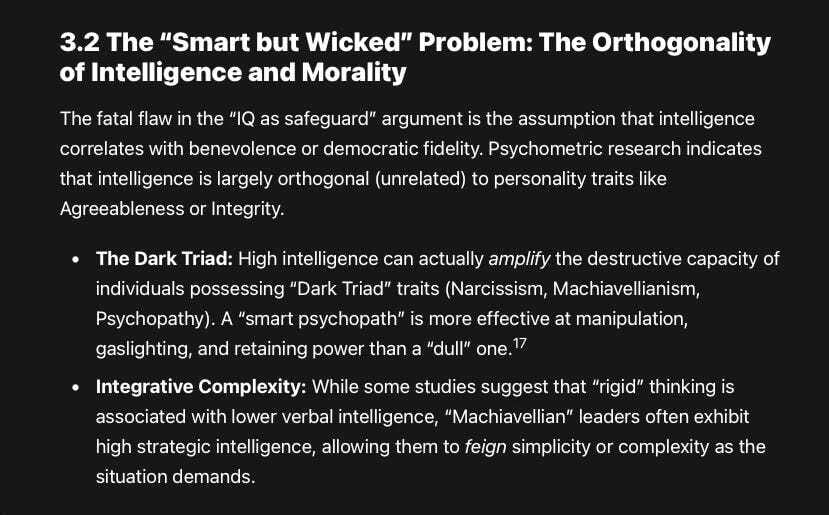
- Utilizing data from the Nuremberg Trials & contemporary psychometric research, the report dismantles the assumption that high intelligence serves as a prophylactic against fascism or moral corruption.
Utilizing data from the Nuremberg Trials & contemporary psychometric research, the report dismantles the assumption that high intelligence serves as a prophylactic against fascism or moral corruption.
While populist rhetoric often exhibits lower integrative complexity, the architects of populist movements are frequently highly educated elites. As Nuremberg showed, evil is often smart.

Pascal Hetzscholdt
December 29, 2025
@thedailybeast Even Republicans Are Baffled By Trump's Cabinet Michael Wolff and Joanna Coles have a conversation about the sheer amount of inexperienced... See more
Source: TikTok
Cognitive Metrics and Democratic Legitimacy: A Comprehensive Analysis of Intelligence Testing, Political Appointments, and the Safeguarding of Institutions
by Gemini 3.0, Deep Research. Warning, LLMs may hallucinate!
Executive Summary
The integrity of the United States’ federal leadership apparatus faces a period of intense scrutiny, precipitated by administrative anomalies such as the reported waiver of mandatory polygraph protocols for senior Federal Bureau of Investigation (FBI) appointments under Director Kash Patel. This departure from standard security vetting has reignited a broader debate regarding the qualifications, competence, and fitness of those who occupy the highest echelons of American power. This report addresses a specific and provocative inquiry: whether standardized intelligence (IQ) testing could be recommended for roles in US politics—from the Presidency to the Cabinet and Congress—as a mechanism to combat authoritarianism, ensure competence, and potentially filter out unfit leadership.
The analysis proceeds through four distinct dimensions: Constitutional Law, Industrial-Organizational Psychology, Political Philosophy, and Historical Case Studies.
First, the report establishes that mandatory cognitive testing for elected officials is largely unconstitutional under current Supreme Court jurisprudence (Powell v. McCormack, U.S. Term Limits, Inc. v. Thornton), which views the qualifications for office as fixed and exclusive to the Constitution. However, the report identifies a divergent legal landscape for appointed roles, where statutory competence requirements are more plausible, though politically fraught.
Second, utilizing data from the Nuremberg Trials and contemporary psychometric research, the report dismantles the assumption that high intelligence serves as a prophylactic against fascism or moral corruption. Historical evidence confirms that authoritarian regimes are often led by individuals of superior cognitive ability, rendering IQ tests ineffective as a filter for “dangerous” ideologies.
Third, a granular analysis of the educational and professional backgrounds of key figures in the second Trump administration—including Kash Patel, Dan Bongino, and Pete Hegseth—demonstrates that an IQ threshold would likely have failed to prevent their installation. These officials possess credentials indicative of above-average-to-superior cognitive functioning; their controversial status stems from ideological alignment and security vetting irregularities, not cognitive deficiency.
Finally, the report evaluates the relationship between populism and intelligence, concluding that while populist rhetoric often exhibits lower integrative complexity, the architects of populist movements are frequently highly educated elites. The report warns that introducing “meritocratic” intelligence filters could paradoxically fuel populist resentment (as argued by Michael Sandel) and legitimize authoritarian technocracy. The report concludes with alternative recommendations—ranging from security clearance reforms to 25th Amendment revitalization—that address concerns about fitness and authoritarianism more effectively than raw intelligence metrics.
Section I: The Administrative Crisis and the Question of Fitness
1.1 Context: The Erosion of Standard Vetting Protocols
The impetus for this investigation lies in the erosion of established bureaucratic norms within the US national security apparatus. Recent reports indicate that FBI Director Kash Patel, an appointee of the second Trump administration, granted waivers for mandatory polygraph examinations to Deputy Director Dan Bongino and other senior staff.1
The polygraph, despite scientific debates regarding its absolute accuracy, has served for decades as a critical “screen” in the federal hiring process, particularly for roles requiring Top Secret/Sensitive Compartmented Information (TS/SCI) clearance. Its primary function is not merely lie detection but the assessment of integrity, vulnerability to coercion, and loyalty to the Constitution rather than a specific political patron. The waiver of this requirement for political loyalists suggests a shift from a merit-based, security-focused civil service to a patronage-based system where personal loyalty to the executive supersedes institutional protocols.3
This degradation of security vetting invites a parallel inquiry into competence vetting. If the mechanisms designed to ensure loyalty (polygraphs) are being bypassed, what mechanisms exist—or could be introduced—to ensure cognitive capability? This posits IQ testing as a potential counterbalance, a “technocratic check” on a system increasingly perceived as vulnerable to nepotism and incompetence.
1.2 The Distinction Between Loyalty and Ability
It is crucial to differentiate the function of the waived tests from the proposed tests.
Polygraph/Security Clearance: Assess Moral Suitability (Honesty, vulnerability to blackmail, allegiance).
IQ/Cognitive Testing: Assesses Mental Capability (Processing speed, pattern recognition, working memory).
The current crisis at the FBI, as detailed in internal reports describing low morale and “paralyzed” operations under Patel and Bongino 5 , is attributed by critics not necessarily to a lack of raw intelligence, but to a lack of experience, professionalism, and independence. However, our hypothesis prompts a rigorous examination: Would a mandatory baseline of cognitive ability prevent the rise of officials who might dismantle democratic norms, or is “fitness” a quality that transcends the G-factor?
Section II: The Constitutional Fortress – Legal Barriers to Testing
Before assessing the utility of IQ tests, one must address their legality. The United States Constitution establishes a rigid framework for federal office qualifications that has proven resistant to legislative expansion.
2.1 The Exclusivity of Constitutional Qualifications
The qualifications for the three primary federal elected offices are enumerated explicitly in the text of the Constitution.
Table 1: Enumerated Constitutional Qualifications for Federal Office
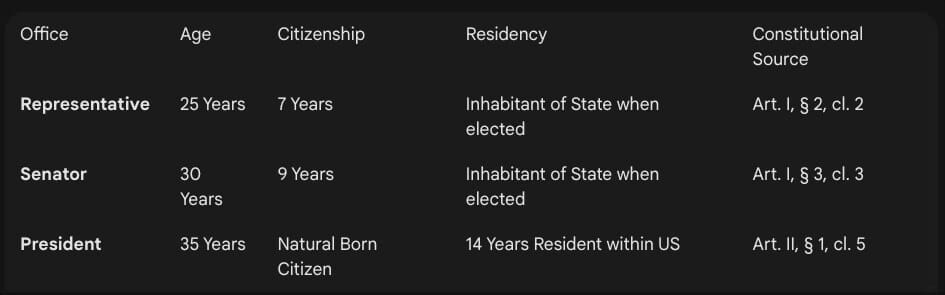
The Congressional Research Service and constitutional scholars consistently interpret these lists as exhaustive.7 The Framers of the Constitution engaged in robust debate regarding qualifications. They explicitly considered—and rejected—requirements regarding property ownership and religious affiliation, fearing that such additions would narrow the pool of candidates to a landed aristocracy or a specific sect. The intent was to ensure that “the doors of this part of the federal government are open to merit of every description, whether native or adoptive, whether young or old, and without regard to poverty or wealth” (James Madison, Federalist No. 52).
2.2 Judicial Precedent: The Impossibility of Congressional Action
Two landmark Supreme Court cases serve as the primary barricades against any federal statute attempting to mandate IQ tests for elected office.
Powell v. McCormack (1969)
In 1967, the House of Representatives refused to seat Adam Clayton Powell Jr., a duly elected Representative from New York, citing allegations of financial misconduct. Powell met all three constitutional requirements (age, citizenship, residency). The Supreme Court ruled in his favor, establishing the principle that Congress does not possess the power to add to the qualifications set forth in the Constitution.9
Relevance to IQ: Congress cannot pass a law stating “Representatives must have an IQ of 110,” as this would constitute an unconstitutional addition to the standing qualifications.
U.S. Term Limits, Inc. v. Thornton (1995)
This case addressed whether states could impose additional qualifications (specifically term limits) on their federal representatives. The Court held that states could not. Justice Stevens, writing for the majority, argued that the right to choose representatives belongs to the people, and allowing states to craft idiosyncratic qualifications (like term limits or, theoretically, IQ tests) would fragment the uniformity of the federal legislature.9
Relevance to IQ: A state like California could not unilaterally mandate that its Senators pass a cognitive battery.
2.3 The “Officer of the United States” Loophole
While elected offices are constitutionally protected, appointed offices (Cabinet Secretaries, Agency Directors) occupy a different legal space. The Constitution is largely silent on the qualifications for a Secretary of State or an FBI Director, leaving the appointment power to the President with the “Advice and Consent” of the Senate.
Statutory Qualifications: Congress has historically set statutory qualifications for some roles. For example, the Attorney General must be “learned in the law” (historically implied, though often debated). The National Security Act of 1947 requires the Director of National Intelligence to have “extensive national security expertise.”
The IQ Possibility: Theoretically, Congress could pass a statute requiring the Secretary of Energy or the FBI Director to pass a cognitive assessment. However, such a law would likely face a challenge from the Executive Branch as an infringement on the President’s appointment power. Furthermore, based on Griggs v. Duke Power Co. (1971), any employment test that has a “disparate impact” on protected groups (which IQ tests often do regarding race and socioeconomic status) must be strictly job-related and a “business necessity”.12 While the government is not a private employer, the Griggs logic permeates civil rights law and would make an IQ mandate politically toxic and legally vulnerable.
Section III: The Psychometrics of Political Leadership
Setting aside legal barriers, we must evaluate the scientific validity of the premise: Would selecting for higher IQ produce better, less authoritarian leaders?
3.1 The Validity of General Mental Ability (GMA)
Industrial-Organizational (I-O) psychology provides robust data on the predictive validity of intelligence. Meta-analyses by Schmidt and Hunter (1998, 2004) covering 85 years of research demonstrate that General Mental Ability (GMA) is the single best predictor of job performance for complex occupations.14
Complexity Correlation: As the cognitive complexity of a job increases, the correlation between GMA and performance rises. For high-level professional and managerial roles, the validity coefficient is approximately 0.58.
Political Application: The roles of President, Senator, or Cabinet Secretary involve processing immense amounts of heterogeneous information (economic data, intelligence briefings, legislative text) under high pressure. From a purely functionalist perspective, a leader with higher fluid intelligence (processing speed and working memory) should, ceteris paribus, make fewer errors in calculation and logic than one with lower intelligence.
3.2 The “Smart but Wicked” Problem: The Orthogonality of Intelligence and Morality
The fatal flaw in the “IQ as safeguard” argument is the assumption that intelligence correlates with benevolence or democratic fidelity. Psychometric research indicates that intelligence is largely orthogonal (unrelated) to personality traits like Agreeableness or Integrity.
The Dark Triad: High intelligence can actually amplify the destructive capacity of individuals possessing “Dark Triad” traits (Narcissism, Machiavellianism, Psychopathy). A “smart psychopath” is more effective at manipulation, gaslighting, and retaining power than a “dull” one.17
Integrative Complexity: While some studies suggest that “rigid” thinking is associated with lower verbal intelligence, “Machiavellian” leaders often exhibit high strategic intelligence, allowing them to feign simplicity or complexity as the situation demands.
3.3 Historical Case Study: The Nuremberg IQ Scores
The most compelling evidence against the utility of IQ tests in preventing authoritarianism comes from the aftermath of World War II. At the Nuremberg Trials, American psychologist Gustave Gilbert administered the Wechsler-Bellevue Intelligence Test to high-ranking Nazi defendants. The hypothesis was that these architects of genocide might be mentally deficient or fundamentally “broken.”
The results were shocking to the researchers and remain a definitive rebuttal to the idea that fascism is a product of stupidity.
Table 2: Confirmed IQ Scores of Nazi Leadership at Nuremberg

Sources: 19
Analysis:
The Nazi elite were, psychometrically speaking, a group of geniuses and near-geniuses.
Hjalmar Schacht (143) was a financial wizard who stabilized the German currency before facilitating rearmament.
Hermann Goering (138), despite his later drug addiction and eccentricity, possessed a sharp, calculating intellect that he displayed during cross-examination at the trials.
Hans Frank (130), who oversaw the extermination camps in Poland, was a lawyer with a keen intellect.
Conclusion: If the Weimar Republic had instituted an IQ test requiring a score of 120 (Top 10%) for Cabinet posts, every single one of these major war criminals would have passed. The test would have filtered out Julius Streicher (a crude propagandist), but it would have legitimized the technocratic architects of the Holocaust. Intelligence is a measure of capacity, not character. It determines how effectively one can execute a plan, not whether that plan is moral.
Section IV: Case Study – The “Trump Administration” and the Prevention Hypothesis
To answer the question whether IQ tests would have prevented some of the current government officials in the Trump administration from being installed, we must look at the educational and professional credentials of these individuals as proxies for cognitive ability.
4.1 Educational Proxies for Cognitive Ability
While public IQ scores are unavailable, educational attainment—especially admission to and graduation from elite institutions and passing professional licensing exams (Bar Exams, Medical Boards)—is a strong correlate of General Mental Ability.
Table 3: Educational Profiles of Key Trump Administration Figures (2025 Context)

Sources: 23
4.2 Analysis: The Failure of the “Stupidity” Hypothesis
The data suggests a clear conclusion: Mandatory IQ testing would NOT have prevented the installation of these officials.
Kash Patel and Pam Bondi are attorneys. The LSAT (Law School Admission Test) is essentially a high-level cognitive test measuring reading comprehension and logical reasoning. Their success in law school and legal practice indicates they would easily pass a threshold IQ test (e.g., 115 or 120).
Pete Hegseth and Vivek Ramaswamy hold degrees from the world’s most selective universities. Ramaswamy, in particular, would likely score in the “Very Superior” range (130+), similar to the Nuremberg defendants.
The controversy surrounding these figures—specifically the waiving of polygraphs for Bongino and the “loyalty tests” at the FBI—is unrelated to their cognitive processing speed. It is a matter of ideological alignment and institutional disruption.
Conclusion on Prevention: An IQ test is a filter for competence, not compliance or extremism. The Trump administration officials are, by and large, part of the “cognitive elite” (to use Charles Murray’s term), even if their rhetoric is populist. Therefore, IQ tests are an ineffective tool for preventing their rise.
Section V: The Populism-Intelligence Nexus
Regarding the relationship between populist politicians and lower IQ, this requires untangling the difference between the rhetoric of populism, the voters of populism, and the leaders of populism.
5.1 Linguistic Complexity vs. Cognitive Ability
Research on the rhetoric of populist leaders, particularly Donald Trump, shows a marked difference in “integrative complexity” compared to traditional politicians.
The Study of Speech: Analysis of Trump’s speeches shows a lower reading level and simpler sentence structures compared to predecessors like Obama or Bush.29 Some researchers tracked a decline in Trump’s linguistic complexity from 2011 to 2017, using this as a potential marker for cognitive change.31
Strategic Simplicity: However, political scientists argue that this is often a deliberate strategy. Simple, repetitive, emotive language (”Make America Great Again,” “Drain the Swamp”) is far more effective at mobilizing mass movements than complex, nuanced policy articulation.32 A leader with high social intelligence (or “Machiavellian intelligence”) may intentionally lower their linguistic complexity to connect with a base that feels alienated by technocratic jargon.
5.2 The “Cognitive Closure” of the Electorate
Research into the psychology of voters suggests a link between lower cognitive ability and support for right-wing authoritarianism (RWA).
Cognitive Closure: Individuals with lower cognitive ability may have a higher need for “cognitive closure”—a desire for definite answers and a discomfort with ambiguity. Populist leaders provide simple, black-and-white solutions to complex problems (e.g., “Build the Wall” to solve immigration economics), which appeals to this psychological need.33
The Meritocracy Backlash: Michael Sandel, in The Tyranny of Merit, argues that the emphasis on “smartness” and credentials in modern politics has fueled populism. When the center-left defines itself by technocratic competence (”We follow the science”), it implicitly insults the uncredentialed working class. Populism becomes a revolt against the “tyranny of merit,” where voters choose leaders who mock the norms of the educated elite.36
Implication for Testing: Introducing IQ tests for politicians would likely exacerbate this divide. It would validate the populist narrative that the system is rigged by “elites” to exclude “real people.” A candidate disqualified for a “low” IQ (even an average one) would become a martyr for the anti-establishment cause, potentially increasing their popularity.
Section VI: Comparative Role Analysis – Ranking the Value of Testing
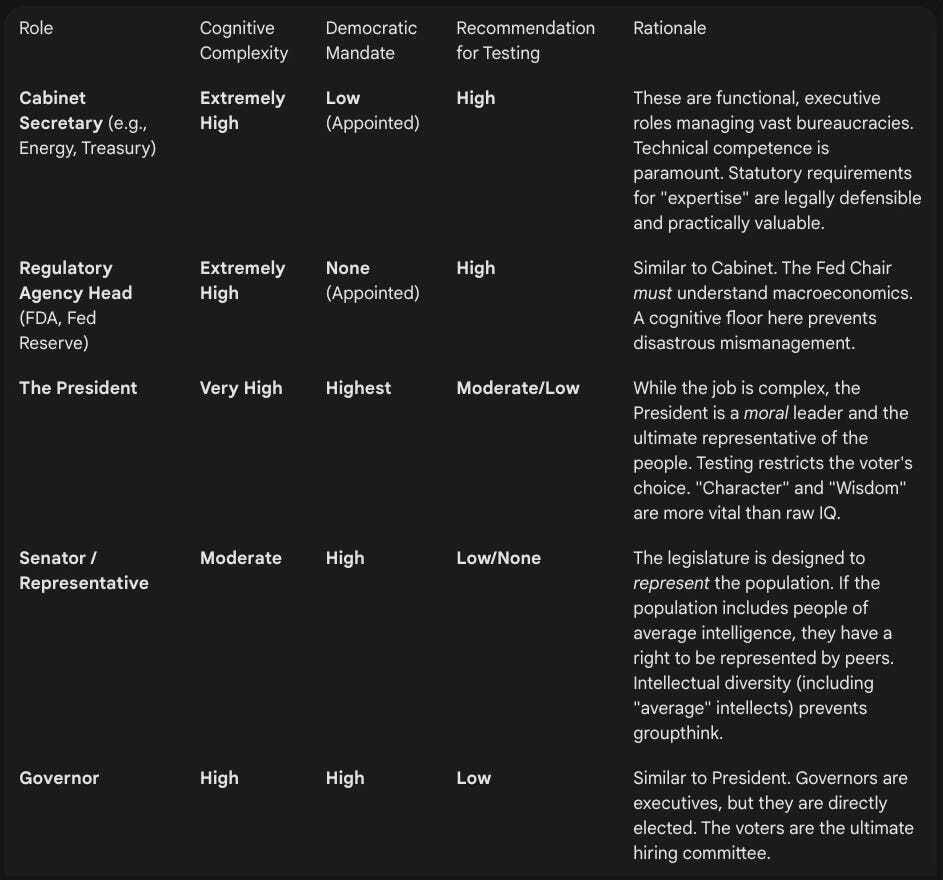
If we were to theoretically implement testing, where would it be most valuable? We rank various roles below based on the tension between “Technocratic Necessity” (Need for G) and “Democratic Legitimacy” (Right to Choose).
Table 4: Theoretical Utility of Cognitive Testing by Role
Section VII: Pros and Cons of Introducing Tests (Context: Fighting Fascism)
7.1 Arguments FOR Testing (The Technocratic Defense)
Ensuring “Bandwidth” for Crisis: Modern governance involves existential risks (AI safety, biosecurity, nuclear deterrence). A leader with high fluid intelligence is better equipped to understand probabilistic risk and complex system dynamics, potentially preventing catastrophic errors.39
Filtering Cognitive Decline: While it might not catch a young fascist, a test could identify leaders suffering from age-related cognitive decline (dementia) who might be manipulated by unelected advisors (the “Regency” problem).40
Objective Standard: In a post-truth era, a standardized metric offers one “hard fact” about a candidate, countering the curated images presented by campaign consultants.
7.2 Arguments AGAINST Testing (The Democratic/Anti-Fascist Defense)
The “Techno-Fascism” Risk: Fascism often cloaks itself in science and efficiency. By institutionalizing IQ as a prerequisite for power, society risks creating an “Epistocracy” (rule by the knowledgeable) that views the rights of the “lesser” citizens as negligible. A high-IQ authoritarian could use their score to justify overriding the will of the people or the courts.41
Legitimizing the Wicked: As Nuremberg showed, evil is often smart. A passed test becomes a propaganda coup for a demagogue. “I am a certified genius; trust my plan.”
Disparate Impact and Bias: Historical precedent is damning. “Literacy tests” in the Jim Crow South were used not to ensure competence, but to disenfranchise Black Americans.43 Standardized tests still show racial and socioeconomic gaps. A mandatory test would likely be challenged as a tool of white supremacy or class warfare, delegitimizing the government in the eyes of minority populations.
Narrow Definition of Merit: IQ measures one type of thinking. It misses Wisdom, Humility, Empathy, and Integrity. A system that selects for IQ selects for “smart,” not “good.”
Section VIII: Strategic Recommendations and Alternatives
If mandatory IQ tests are legally impossible and strategically flawed, what alternatives exist to address any concern about unfit or authoritarian leaders?
8.1 25th Amendment Reform: The “Capacity Commission”
Current 25th Amendment procedures rely on the Cabinet to declare a President unfit—a group often loyal to the President (or afraid of him, as seen in the “loyalty tests” at the FBI).
Recommendation: Congress should legislate a permanent, non-partisan Presidential Capacity Commission (as authorized by the 25th Amendment’s text: “such other body as Congress may by law provide”). This body, composed of medical and psychiatric experts, would conduct annual, confidential evaluations of the President’s fitness (not just IQ) and report strictly on “inability to discharge duties”.45
8.2 The “STABLE GENIUS” Act Approach: Medical Transparency
Proposed legislation like the STABLE GENIUS Act (Standardizing Testing and Accountability Before Large Elections) focuses on transparency rather than disqualification.
Recommendation: Codify the norm that Presidential and Vice-Presidential candidates release comprehensive medical records, including cognitive screenings (e.g., Montreal Cognitive Assessment), prior to the general election. While they cannot be forced off the ballot (see Powell), the refusal to release would become a potent political liability.47
8.3 Closing the “Patel Loophole”: Security Clearance Reform
One immediate crisis involves the waiver of security protocols.
Recommendation: Congress should pass legislation amending the security clearance process for “Officers of the United States.” The law should mandate that all Senate-confirmed appointees must hold a clearance adjudicated by career officials, removing the President’s (or Agency Head’s) ability to unilaterally waive background checks or polygraphs for their subordinates. This reasserts the check of the “Deep State” (career professionals) against the “Whim of the Executive”.49
8.4 Civics Education as the Long-Term Fix
If the voters are the ultimate hiring committee, their “cognitive closure” is the root problem.
Recommendation: Support initiatives like the Civics Secures Democracy Act, which funds massive investment in civics and history education. A populace that understands the separation of powers is less likely to fall for the simple answers of populist authoritarians, regardless of the leader’s IQ.51
Conclusion
The proposition to institute IQ tests for US political roles, while born of a desire to safeguard democracy from incompetence, ultimately falters against the realities of constitutional law, history, and psychology. The legal barriers are nearly insurmountable, the psychometric evidence from Nuremberg proves that intelligence is no barrier to evil, and the political consequences would likely be to fuel the very populism such measures seek to curb.
The current administrative controversies, such as the waiving of polygraphs for FBI appointees, highlight a crisis of integrity and institutions, not a crisis of intelligence. The officials in question—Kash Patel, Dan Bongino, Pete Hegseth—are part of the educated elite; they would likely pass any cognitive test administered to them. Their rise represents a failure of political norms and security vetting, not a failure of cognitive screening.
To fight authoritarianism, the United States does not need a smarter aristocracy; it needs a more robust system of checks and balances. The path forward lies in strengthening the independence of the civil service (to prevent waivers), reforming the 25th Amendment (to address genuine incapacity), and investing in the civic education of the electorate. We must accept the uncomfortable truth that democracy grants the people the right to choose their leaders—smart or otherwise—and that the only durable protection against tyranny is the wisdom of the voters, not the score on a test.
Works cited
FBI Director Kash Patel Waived Polygraph Security Screening for Dan Bongino, Two Other Senior Staff - YouTube, accessed December 28, 2025
FBI Director Kash Patel Waived Polygraph Security Screening for Dan Bongino, Two Other Senior Staff - Tully Rinckey PLLC, accessed December 28, 2025, https://www.tullylegal.com/our-firm/news/fbi-director-kash-patel-waived-polygraph-security-screening-for-dan-bongino-two-other-senior-staff/
FBI Director Kash Patel Waived Polygraph Security Screening for Dan Bongino, Two Other Senior Staff - ProPublica, accessed December 28, 2025, https://www.propublica.org/article/fbi-kash-patel-dan-bongino-waived-polygraph
Durbin Questions FBI Director Patel At Senate Judiciary Committee Oversight Hearing On Patel’s Partisan & Incompetent Management Of The Bureau, accessed December 28, 2025, https://www.judiciary.senate.gov/press/dem/releases/durbin-questions-fbi-director-patel-at-senate-judiciary-committee-oversight-hearing-on-patels-partisan-and-incompetent-management-of-the-bureau
FBI Leadership Under Fire As Scathing Report Surfaces - Grand Pinnacle Tribune, accessed December 28, 2025, https://evrimagaci.org/gpt/fbi-leadership-under-fire-as-scathing-report-surfaces-518576
New Report Card Gives Harsh Critique Of FBI Under Kash Patel | WBZ NewsRadio 1030, accessed December 28, 2025, https://wbznewsradio.iheart.com/content/2025-12-01-new-report-card-gives-harsh-critique-of-fbi-under-kash-patel/
Qualifications of Members of Congress - EveryCRSReport.com, accessed December 28, 2025, https://www.everycrsreport.com/reports/R41946.html
Constitutional Qualifications for Senators - U.S. Senate, accessed December 28, 2025, https://www.senate.gov/artandhistory/history/common/briefing/Constitutional_Qualifications_Senators.htm
U.S. Term Limits, Inc. v. Thornton | 514 U.S. 779 (1995), accessed December 28, 2025, https://supreme.justia.com/cases/federal/us/514/779/
US TERM LIMITS, INC., ET AL. v. THORNTON - Loc, accessed December 28, 2025, https://tile.loc.gov/storage-services/service/ll/usrep/usrep514/usrep514779/usrep514779.pdf
U.S. Term Limits, Inc. v. Thornton, 514 U.S. 779 (1995). - Law.Cornell.Edu, accessed December 28, 2025, https://www.law.cornell.edu/supct/html/93-1456.ZS.html
Griggs v. Duke Power Company - Legal Defense Fund, accessed December 28, 2025, https://www.naacpldf.org/case-issue/griggs-v-duke-power-co/
Griggs v. Duke Power Co., 401 U.S. 424 (1971). - Loc, accessed December 28, 2025, https://tile.loc.gov/storage-services/service/ll/usrep/usrep401/usrep401424/usrep401424.pdf
Validity and Utility of Alternative Predictors of Job Performance, accessed December 28, 2025, https://home.ubalt.edu/tmitch/645/articles/Hunter%20and%20Hunter%20%201984%20Validity%20and%20Utility.pdf
accessed December 28, 2025, https://cdn2.hubspot.net/hubfs/4094759/omnia-brainpower-the-validity-of-cognitive-ability.pdf
The Validity and Utility of Selection Methods in Personnel Psychology: Practical and Theoretical Implications of 100 Years, accessed December 28, 2025, https://home.ubalt.edu/tmitch/645/session%204/Schmidt%20&%20Oh%20validity%20and%20util%20100%20yrs%20of%20research%20Wk%20PPR%202016.pdf
The relationship between the Dark Triad personalities and emotional intelligence | BPS, accessed December 28, 2025, https://explore.bps.org.uk/content/bpsadm/17/3/22
Examining Dark Triad Traits in Formal Leaders and Their Impact on Employee Workplace Stress: A Comparative Study of Family and Non-Family Businesses - MDPI, accessed December 28, 2025, https://www.mdpi.com/2673-7116/4/3/21
In search of the Nazi personality - American Psychological Association, accessed December 28, 2025, https://www.apa.org/monitor/2009/03/nazi
IQ Test Results From the Nuremberg Trials : r/mensa - Reddit, accessed December 28, 2025, https://www.reddit.com/r/mensa/comments/1omzs5y/iq_test_results_from_the_nuremberg_trials/
The Nazi Defendants in the Major War Criminal Trial in Nuremberg - UMKC School of Law, accessed December 28, 2025, https://law2.umkc.edu/faculty/projects/ftrials/nuremberg/meetthedefendants.html
The Nuremberg Personality Tests - Everything Everywhere Daily, accessed December 28, 2025, https://everything-everywhere.com/the-nuremberg-personality-tests/
Donald Trump’s Cabinet, 2025 - Ballotpedia, accessed December 28, 2025, https://ballotpedia.org/Donald_Trump%27s_Cabinet,_2025
2025 Presidential Cabinet - SHRM, accessed December 28, 2025, https://www.shrm.org/advocacy/2025-presidential-cabinet
Kash Patel - Wikipedia, accessed December 28, 2025, https://en.wikipedia.org/wiki/Kash_Patel
Dan Bongino - Wikipedia, accessed December 28, 2025, https://en.wikipedia.org/wiki/Dan_Bongino
Pam Bondi - Wikipedia, accessed December 28, 2025, https://en.wikipedia.org/wiki/Pam_Bondi
Penn State Alum Dan Bongino To Step Down As FBI Deputy Director, accessed December 28, 2025, https://onwardstate.com/2025/12/18/penn-state-alum-dan-bongino-to-step-down-as-fbi-director/
Linguistic Features of Donald Trump’s Political Discourse: Focusing on Genre Differences and Change over Time - Y-Scholar Hub@YONSEI, accessed December 28, 2025, https://yscholarhub.yonsei.ac.kr/bitstream/2021.sw.yonsei/5387/1/Chung%282021%29.pdf
Public discourse: Systemic functional analysis of Trump‟s and Biden‟s inaugural speeches - Journal of Language and Linguistic Studies, accessed December 28, 2025, https://www.jlls.org/index.php/jlls/article/download/2384/949
An Empirical Analysis of Popular Press Claims Regarding Linguistic Change in President Donald J. Trump - NIH, accessed December 28, 2025, https://pmc.ncbi.nlm.nih.gov/articles/PMC6258767/
Does Complex or Simple Rhetoric Win Elections? An Integrative Complexity Analysis of U.S. Presidential Campaigns | Request PDF - ResearchGate, accessed December 28, 2025, https://www.researchgate.net/publication/264482777_Does_Complex_or_Simple_Rhetoric_Win_Elections_An_Integrative_Complexity_Analysis_of_US_Presidential_Campaigns
Predicting political beliefs with polygenic scores for cognitive performance and educational attainment - NIH, accessed December 28, 2025, https://pmc.ncbi.nlm.nih.gov/articles/PMC11308703/
Cognitive Biases and Populist Success: Political Identification in Right-wing and Left-wing Populism - Frontiers, accessed December 28, 2025, https://www.frontiersin.org/research-topics/69667/cognitive-biases-and-populist-success-political-identification-in-right-wing-and-left-wing-populism
accessed December 28, 2025, https://pmc.ncbi.nlm.nih.gov/articles/PMC9548663/#:~:text=Cognitive%20Abilities%20and%20Sociocultural%20Attitudes&text=For%20example%2C%20higher%20scores%20in,et%20al.%2C%202011).
The Tyranny of Merit: What’s Become of the Common Good? | Institute for Social Concerns, accessed December 28, 2025, https://socialconcerns.nd.edu/virtues/newsletter-post/the-tyranny-of-merit-whats-become-of-the-common-good/
Michael Sandel: ‘The populist backlash has been a revolt against the tyranny of merit’, accessed December 28, 2025, https://www.theguardian.com/books/2020/sep/06/michael-sandel-the-populist-backlash-has-been-a-revolt-against-the-tyranny-of-merit
The Tyranny of Merit | Summary, Quotes, FAQ, Audio - SoBrief, accessed December 28, 2025, https://sobrief.com/books/the-tyranny-of-merit
Personality Traits and Cognitive Ability in Political Selection | Journal of the European Economic Association | Oxford Academic, accessed December 28, 2025, https://academic.oup.com/jeea/article/23/5/1908/8029910
Cognitive decline and political leadership | Politics and the Life Sciences | Cambridge Core, accessed December 28, 2025, https://www.cambridge.org/core/journals/politics-and-the-life-sciences/article/cognitive-decline-and-political-leadership/6C6D35730EEDF82CF3F8EBBB9C3851BB
Is this what democracy looks like? (Never mind epistocracy) - Taylor & Francis Online, accessed December 28, 2025, https://www.tandfonline.com/doi/full/10.1080/0020174X.2018.1502924
Techno-populism - Wikipedia, accessed December 28, 2025, https://en.wikipedia.org/wiki/Techno-populism
The Rise and Fall of Jim Crow. Tools and Activities | PBS - Thirteen.org, accessed December 28, 2025, https://www.thirteen.org/wnet/jimcrow/voting_literacy.html
Suppressing the Vote - Teach Democracy, accessed December 28, 2025, https://teachdemocracy.org/wp-content/uploads/2025/07/supressing-the-vote.pdf
Who Decides If Presidents Are Unfit to Serve? - ThoughtCo, accessed December 28, 2025, https://www.thoughtco.com/presidents-and-psych-evals-4076979
25th Amendment: How do we decide whether the president is competent? | Brookings, accessed December 28, 2025, https://www.brookings.edu/articles/25th-amendment-how-do-we-decide-whether-the-president-is-competent/
Stable Genius Act - Wikipedia, accessed December 28, 2025, https://en.wikipedia.org/wiki/Stable_Genius_Act
Boyle Introduces STABLE GENIUS Act Requiring Presidential Candidates Undergo and Disclose Medical Examination, accessed December 28, 2025, https://boyle.house.gov/media-center/press-releases/boyle-introduces-stable-genius-act-requiring-presidential-candidates
Security Clearances and Psychological Health Care, accessed December 28, 2025, https://www.health.mil/Military-Health-Topics/Centers-of-Excellence/Psychological-Health-Center-of-Excellence/Real-Warriors-Campaign/Articles/Security-Clearances-and-Psychological-Health-Care
Joining the Biden Administration? Read This Before You Apply for a Clearance, accessed December 28, 2025, https://www.govexec.com/management/2021/01/joining-biden-administration-read-you-apply-clearance/171550/
A BILL - CivxNow, accessed December 28, 2025, https://civxnow.org/wp-content/uploads/2022/06/CSD-Bill-Text-6-2022.pdf
ABA and Civic Education - American Bar Association, accessed December 28, 2025, https://www.americanbar.org/advocacy/governmental_legislative_work/priorities_policy/election-integrity-and-civic-education-/civics-secures-democracy-act/