- Pascal's Chatbot Q&As
- Posts
- Under certain conditions, U.S. courts—and by extension Google—will tolerate site-wide de-indexing without the endless treadmill of URL-by-URL takedowns.
Under certain conditions, U.S. courts—and by extension Google—will tolerate site-wide de-indexing without the endless treadmill of URL-by-URL takedowns.
Google’s U.S. delisting of Sci-Hub domains is not a revolution—but it is a wake-up call. Search engines will comply when confronted with durable court authority.

Pascal Hetzscholdt
December 17, 2025
When a “Zombie Injunction” Comes Back to Life
Why Google’s U.S. De-Indexing of Sci-Hub Is a Precedent—and a Playbook
by ChatGPT-5.2
Introduction
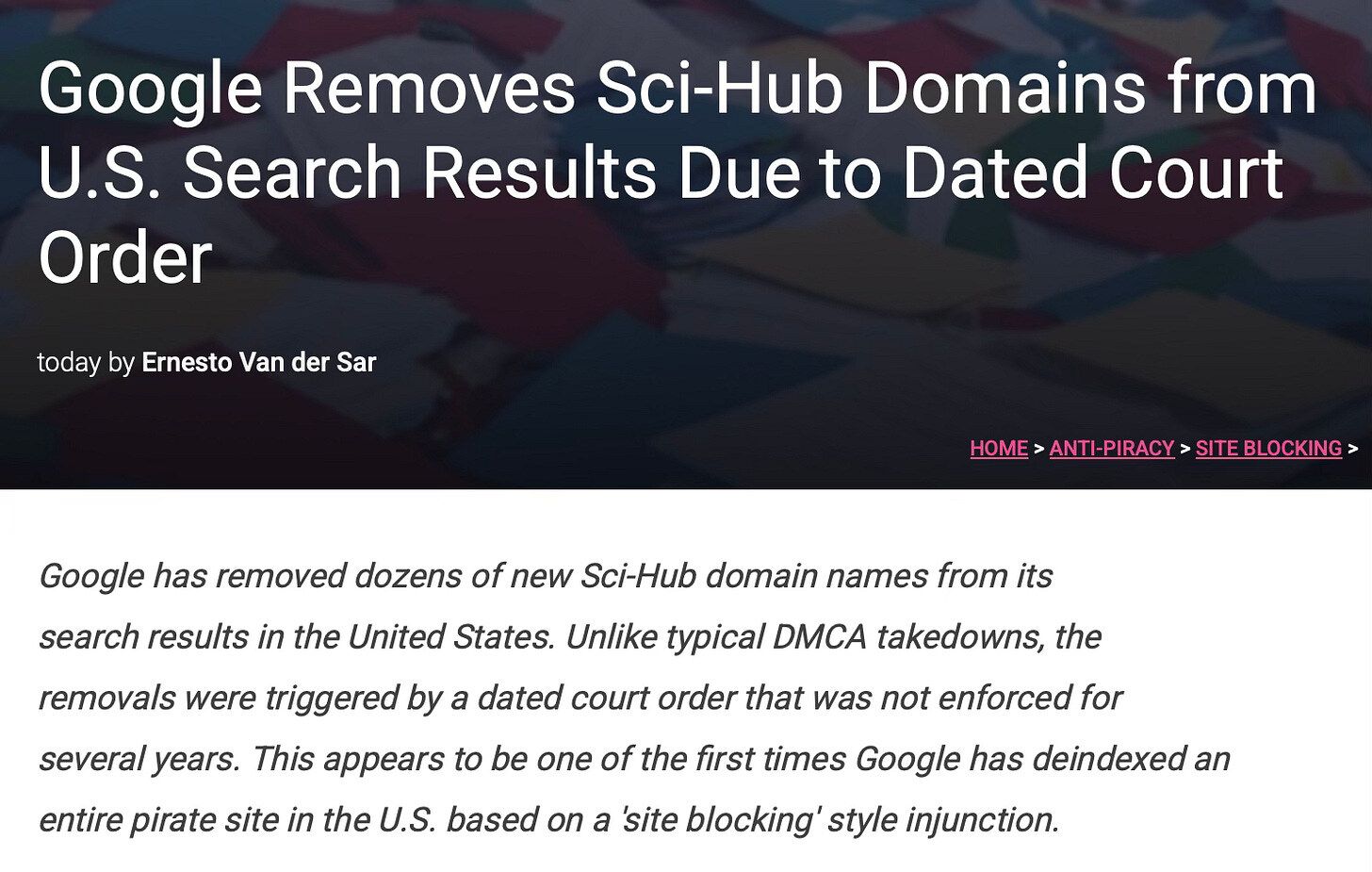
In December 2025, Google quietly removed dozens of Sci-Hub mirror domains from its U.S. search results—not following a DMCA notice, but in response to a seven-year-old federal court injunction obtained by the American Chemical Society. The enforcement action, reported by TorrentFreak, is unusual enough to merit close attention by publishers and other rights holders, because it revives a largely dormant legal tool and applies it in a way rarely seen in the United States.
This is not merely another anti-piracy skirmish. It is a structural shift in enforcement leverage, showing that under certain conditions, U.S. courts—and by extension Google—will tolerate site-wide de-indexing without the endless treadmill of URL-by-URL takedowns.
What Makes This Case Special
1. It Is Not a DMCA Takedown
Most copyright enforcement against Google search relies on 17 U.S.C. §512 DMCA notices, which are:
Reactive
URL-specific
Easily circumvented by domain hopping
In contrast, this case relies on a permanent injunction issued by a Virginia federal court in 2018, following Sci-Hub’s failure to appear. That injunction does something critical: it binds third parties who are “in active concert or participation” with Sci-Hub to stop facilitating access.
This shifts enforcement from copyright notice to court-ordered compliance.
2. The Injunction Was Broad Enough to Cover Future Domains
The 2018 order did not list only specific domains. It granted ACS authority to act against:
Existing Sci-Hub domains
Future and newly registered domains
Associated services facilitating access
This forward-looking scope is what makes the order reusable seven years later. The TorrentFreak article notes that none of the newly delisted domains were explicitly named in the original injunction—yet Google still complied.
3. Google Treated It Like a “Site-Blocking” Order—In the U.S.
Historically, site-blocking is a European phenomenon:
UK, France, Netherlands, Australia
Implemented via ISP blocking or voluntary search demotion
The United States has been far more reluctant. This appears to be one of the first examples of U.S.-only, site-level de-indexing of a major piracy platform based on a civil injunction rather than legislation.
That alone makes this enforcement action exceptional.
4. Timing Reveals Strategic, Not Legal, Constraints
The injunction existed since 2018. Yet enforcement against Google only began years later.
This strongly suggests:
The barrier was not legal impossibility
The barrier was enforcement strategy, persistence, and pressure
Can Other Rights Owners Use This as a Model?
Yes—but only if they understand what made this work.
This is not a turnkey solution. It is a high-threshold strategy that requires:
Litigation foresight
Injunction design
Ongoing monitoring
Willingness to confront intermediaries
Crucially, it works best against systemic infringement platforms, not casual or mixed-use sites.
What Rights Owners Would Need to Do to Replicate This in the U.S.
Below is a practical checklist—legal, operational, and strategic.
1. Obtain a Permanent Injunction with Third-Party Reach
The injunction must:
Explicitly prohibit facilitation by parties “in active concert or participation”
Name search engines, ISPs, hosts, CDNs, and registrars as examples
Apply to future domains and mirrors, not just current ones
Without this language, Google will default to DMCA-only compliance.
2. Establish Clear Evidence of a Unified Pirate Operation
Courts—and Google—must be convinced that:
Multiple domains are functionally one service
They share infrastructure, branding, databases, or redirection logic
They exist solely to infringe
This is easier for Sci-Hub than for hybrid platforms.
3. Maintain Domain Intelligence Over Time
ACS (or its representatives) had to:
Track new Sci-Hub mirrors continuously
Correlate them to the original defendant
Document continuity despite domain churn
This requires sustained investment, not one-off litigation.
4. Use Court Orders, Not Just Notices, with Google
The enforcement trigger was not a standard takedown form, but a court-order-based request, logged via Google’s transparency channels (e.g., Lumen).
Rights owners must:
Reference the injunction precisely
Show how new domains fall within its scope
Frame the request as compliance, not discretion
5. Accept (and Leverage) Jurisdictional Limits
Notably:
The delisting applies only to U.S. search results
Google continues to index the same domains elsewhere
This reflects U.S. jurisdictional caution—but it is still valuable:
U.S. search traffic matters
It creates pressure for parallel actions in other countries
6. Be Prepared for “Voluntary Compliance” Ambiguity
Google avoids conceding that it is legally bound, instead framing action as voluntary—mirroring its behavior in Europe.
Rights owners should:
Expect no public admission of obligation
Focus on outcomes, not declarations
Build cumulative pressure across intermediaries
Strategic Implications for Rights Holders
This case demonstrates that:
U.S. anti-piracy enforcement is more flexible than often assumed
Injunctions can be re-activated years later
Search de-indexing can approximate site-blocking without new laws
For scholarly publishers, media companies, software vendors, and database owners, this is a reminder that the limits of enforcement are often strategic, not legal.
Conclusion
Google’s U.S. delisting of Sci-Hub domains is not a revolution—but it is a wake-up call.
It shows that:
The U.S. legal system already contains underused enforcement tools
Broad injunctions can outlive technological evasion
Search engines will comply when confronted with durable court authority
For rights owners willing to invest in structural enforcement rather than procedural whack-a-mole, this case is not just news—it is a playbook.
Epilogue
Do Sci-Hub–Style Shadow Libraries Threaten the “Genesis Project”?
If the “Genesis Project” is understood as a Trump-era, Manhattan-Project-style effort to concentrate U.S. scientific, technological, and AI capability under conditions of strategic urgency, then the answer is yes—but not in the way piracy rhetoric usually assumes.
Shadow libraries such as Sci-Hub do not threaten Genesis by stealing IP in isolation. They threaten it by undermining the institutional, legal, and geopolitical scaffolding that such a project depends on.
1. The Manhattan Project Analogy Cuts Both Ways
The original Manhattan Project succeeded not merely because of secrecy or speed, but because it rested on:
Trusted institutional pipelines (universities, national labs, publishers)
Clear authority over knowledge flows
Alignment between the state, industry, and scientific elites
A modern “Genesis Project” would rely even more heavily on:
Trusted research corpora
Controlled access to high-quality scientific literature
Reliable provenance, versioning, and validation of knowledge inputs for AI systems
Shadow libraries fracture this alignment.
2. Shadow Libraries Create Epistemic Leakage, Not Just IP Loss
Sci-Hub-style platforms introduce three risks that are existential to a centralized national research effort:
a. Loss of epistemic control
Genesis-style projects assume that the state (or its contractors) knows:
What knowledge is authoritative
Which version of record is being used
What corrections, retractions, or updates apply
Shadow libraries flatten all of this. They turn curated, versioned scientific knowledge into an undifferentiated data swamp—fatal for high-stakes AI, defense, or biotech programs.
b. Dependency on uncontrolled foreign infrastructure
Sci-Hub operates outside U.S. jurisdiction and norms. If critical researchers, labs, or AI systems rely on shadow access—even indirectly—the Genesis Project becomes:
Operationally dependent on hostile or opaque infrastructure
Vulnerable to poisoning, manipulation, or selective denial
This is not hypothetical; it is a classic supply-chain risk, applied to knowledge.
c. Incentive collapse for compliant institutions
Genesis would require publishers, universities, and labs to:
Cooperate with government
Maintain compliance, security, and auditability
Accept constraints in exchange for legitimacy and funding
Shadow libraries reward non-compliance and erode the economic base of the very institutions Genesis would need to mobilize at scale.
3. Why This Matters More Under a Trump-Style Governance Model
A Trump-era “Manhattan Project” would likely feature:
Centralized executive authority
National-security framing
Skepticism toward multilateral norms
Transactional relationships with private actors
In that context, shadow libraries are especially dangerous because they:
Sit outside executive leverage
Cannot be coerced or aligned
Undermine claims of sovereign control over knowledge assets
Put bluntly: you cannot run a nationalist science project on anarchic knowledge infrastructure.
4. Strategic Conclusion
Sci-Hub-like platforms pose a strategic risk to a Genesis Project not because they are “pirate sites,” but because they:
Break the link between authority and knowledge
Undermine provenance and trust in scientific inputs
Shift control of research infrastructure outside sovereign reach
A modern Manhattan Project requires controlled abundance, not scarcity:
Abundant access within trusted systems
Scarcity only at the geopolitical boundary
If the Genesis Project treats shadow libraries as a symptom of broken knowledge governance, it may yet succeed.