- Pascal's Chatbot Q&As
- Posts
- U.S. News & World Report v. OpenAI — Grievances, Evidence, Legal Quality, Comparison to Other AI Suits, and Likely Outcomes
U.S. News & World Report v. OpenAI — Grievances, Evidence, Legal Quality, Comparison to Other AI Suits, and Likely Outcomes
The complaint directly links OpenAI’s model behavior to potential life-impacting misinformation, introducing a consumer-protection dimension absent from earlier lawsuits.

Pascal Hetzscholdt
December 03, 2025
U.S. News & World Report v. OpenAI — Grievances, Evidence, Legal Quality, Comparison to Other AI Suits, and Likely Outcomes
by ChatGPT-5.1
Introduction
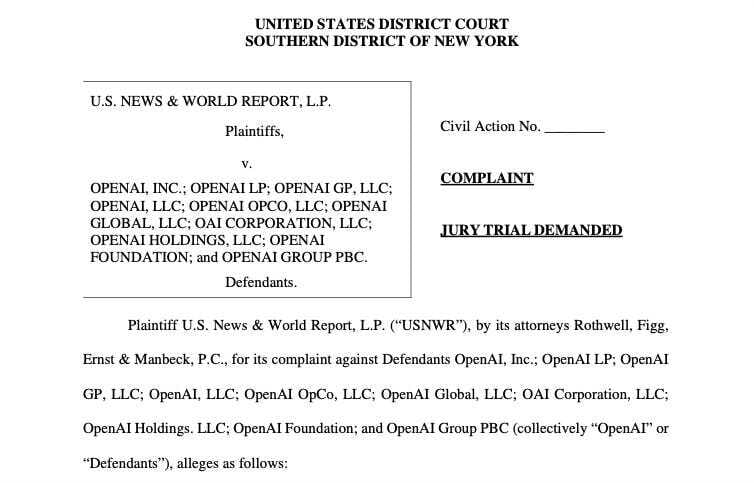
The complaint filed by U.S. News & World Report, L.P. (“USNWR”) against OpenAIrepresents another escalation in the mounting wave of litigation between news publishers and AI developers. Unlike earlier lawsuits that focus primarily on copyright infringement and unfair competition, USNWR’s case introduces a more structured, commercially consequential, and quantitatively documented set of grievances: the theft of rankings methodologies, the reproduction of proprietary evaluation protocols, the interference with advertising-based revenue models, and the reputational degradation caused by hallucinations falsely attributed to USNWR.
The complaint is unusually detailed, offering specific evidence that the GPT models memorized and regurgitated USNWR’s content; that OpenAI ignored robots.txt exclusions; and that synthetic search results displaced user traffic, thereby harming commercial value. It reflects a growing sophistication of plaintiffs’ strategies as the generative AI ecosystem matures and as courts increasingly scrutinize the “training-is-fair-use” defense.
I. The Grievances: Structure, Severity, and Novelty
USNWR asserts that OpenAI:
scraped and ingested USNWR’s websites—including rankings, methodologies, articles, and data—into training datasets like WebText and WebText2,
reproduced the content during training, fine-tuning, and RAG operations, and
caused GPT models to memorize and regurgitate this content verbatim.
This grievance is well-established in previous lawsuits, yet USNWR distinguishes itself in two crucial ways:
(a) its proprietary rankings are economically central to its business model;
(b) the explicit field-of-use restrictions on USNWR’s website bar the use of its content for AI training.
This elevates the infringement beyond implicit incompatibility into an express contractual breach.
2. Violation of Trademarks and Brand Dilution
USNWR owns dozens of marks, including “Best Hospitals,” “Best Colleges,” and “U.S. News & World Report.” The complaint alleges that OpenAI outputs:
attribute inaccurate information to USNWR (e.g., incorrect rankings),
reproduce USNWR content without attribution or with false attribution,
thereby dilute the value of the USNWR brand.
Because USNWR’s brand is unusually functional—institutions advertise their ranking positions—the alleged harm is concrete and quantifiable.
3. Hallucinations That Damage Reputation and Public Trust
The complaint introduces real-world harm from model hallucinations:
A false claim that Western Governors University was ranked #1 for online bachelor’s degrees.
An incorrectly generated top-five list of children’s cancer hospitals, misidentifying leading institutions and misrepresenting USNWR’s actual findings.
This allegation is significant. It directly links OpenAI’s model behavior to potential life-impacting misinformation, introducing a consumer-protection dimension absent from earlier lawsuits.
4. Interference with Website Traffic, Advertising, and Affiliate Revenues
USNWR outlines a multi-layered monetization model:
ad impressions,
sales of guides,
affiliate services linked to rankings pages.
Synthetic search results replace the need for users to visit USNWR sites, undermining these revenue streams. The complaint argues that OpenAI’s design purposefullyencourages users to bypass the source.
This grievance mirrors concerns raised by publishers in the NYT v. OpenAI, Gannett v. Google, and The California Newspaper Partnership v. OpenAI disputes—but USNWR ties the harm more directly to quantifiable commercial models, strengthening the causal narrative.
5. Willful Infringement and Ignoring robots.txt
USNWR claims OpenAI:
was explicitly blocked by robots.txt,
ignored the crawling prohibition,
and therefore acted knowingly and willfully.
This increases the likelihood of statutory damages and undermines the “we didn’t know” or “public web content is fair use” arguments.
II. The Quality of the Evidence Presented
The evidence is unusually strong compared to many prior AI lawsuits, for several reasons.
1. Demonstrated Verbatim Outputs
The complaint contains side-by-side comparisons showing:
complete paragraphs reproduced verbatim from USNWR articles,
memorized methodologies and ranking descriptions,
synthetic answers structured identically to USNWR pages.
Courts typically view verbatim reproduction as strong evidence of direct copying.
2. Clear Documentation of Training Set Inclusion
The complaint cites documented facts that:
USNWR domains appear in WebText and WebText2 datasets,
USNWR tokens are prominently present in Common Crawl/C4 filtered corpora,
high-quality content such as USNWR was sampled at disproportionately high weights.
This undermines OpenAI’s ability to argue uncertainty about training data composition.
3. Screenshots of Model Hallucinations
The filing includes explicit examples where GPT models falsely attribute misinformation to USNWR—examples a jury will understand immediately.
These hallucinations are not merely inaccurate but harmful to consumers, which significantly increases the pressure on OpenAI.
4. Contractual and Technical Access Barriers
USNWR provides evidence that:
its terms of use explicitly ban AI usage,
its robots.txt file blocks GPTBot and ChatGPT-User,
despite this, OpenAI scraped or used the content.
This combination of express prohibition + breach is legally compelling.
III. Comparison to Other AI Copyright Lawsuits
The complaint echoes but also advances beyond earlier cases.
1. NYT v. OpenAI and other news publisher suits
Similarities:
allegations of training on copyrighted news content,
claims of output substitution for web traffic,
trademark dilution and misattribution.
Differences and advancements:
USNWR’s rankings are highly structured and proprietary; unauthorized use is easier to demonstrate.
The hallucination evidence shows clear reputational and consumer-safety harm.
The contractual field-of-use restrictions represent a more direct breach.
Those cases involve the copying of expressive works but struggle with:
demonstrating market substitution,
linking expressive outputs to harm.
USNWR instead demonstrates:
loss of advertising revenue,
loss of affiliate traffic,
inaccurate representations impacting professional fields (education, healthcare).
3. Thomson Reuters v. Ross Intelligence & Westlaw v. ROSS
These hinge on copying proprietary training materials (West headnotes).
USNWR parallels this by treating its ranking methodologies and structured data as proprietary analytical systems, not generic factual compilations.
This comparison strengthens its argument.
4. Getty v. Stability AI
Getty’s strongest claim is memorized images and watermarked reproductions.
USNWR similarly offers screenshots showing near-verbatim textual reproduction.
Text is often harder to prove as memorized than images; USNWR overcomes this hurdle convincingly.
IV. Likely Legal Outcomes
While no outcome is guaranteed, the structure of the evidence and recent judicial trends suggest several likely conclusions.
Outcome 1: OpenAI will almost certainly settle
Given:
strong evidence of verbatim copying,
demonstrated reputational harm,
robots.txt violations,
contractual field-of-use restrictions,
the political sensitivity around health and education misinformation,
OpenAI’s risk profile is high.
A settlement would likely include:
a licensing agreement,
compensation for past use,
model filtering requirements for USNWR content,
possible adoption of USNWR ranking APIs for RAG integrations.
Outcome 2: If litigated, OpenAI faces real exposure
1. Copyright infringement
USNWR’s factual content is not fully copyrightable, but its methodologies, prose, and structured rankings contain creative expression.
Because the complaint shows verbatim memorization, it meets the burden for copying of protected expression.
2. DMCA §1202 CMI claims
If OpenAI stripped USNWR’s copyright management information (CMI), liability is significant.
3. Trademark infringement and dilution
False attribution + reputational harm = strong case.
4. Breach of Contract (TOU)
If courts enforce website terms (as they often do when bots scrape content), this becomes a powerful claim.
Outcome 3: Fair Use is unlikely to fully shield OpenAI
Fair use considerations increasingly weigh against AI developers when:
use is commercial,
content is high-risk or sensitive (healthcare),
outputs substitute for original access,
the model regurgitates expressive text.
Courts have repeatedly held that wholesale ingestion of copyrighted material for commercial model training, without transformation and without licensing, is unlikely to qualify as fair use—especially in cases with consumer harm.
Conclusion
The USNWR complaint represents one of the most sophisticated and legally potent challenges to OpenAI’s data practices to date. Its evidence is unusually thorough, its damages are commercially quantifiable, and its claims are reinforced by consumer-safety concerns and express contractual prohibitions.
Compared to prior lawsuits, USNWR’s case is stronger in structure, narrative clarity, and evidentiary specificity. It blends doctrinal copyright issues with brand dilution, unfair competition, misinformation harms, and breach of contract—creating a multifaceted legal exposure for OpenAI.
Predicted outcome:
Highly likely settlement,
Possible industry-wide consequences including:
mandatory licensing for rankings and evaluative content,
stronger enforcement of robots.txt,
explicit publisher opt-outs becoming legally binding,
tighter control over hallucination risks in domains like healthcare and education.
USNWR has constructed a case that is both doctrinally strong and reputationally compelling. It is precisely the type of lawsuit that courts—and the public—are likely to take seriously.