- Pascal's Chatbot Q&As
- Posts
- Two lawsuits filed by Anthropic: stopping the U.S. government from effectively blacklisting Anthropic from federal—and, by knock-on effects, commercial—markets.
Two lawsuits filed by Anthropic: stopping the U.S. government from effectively blacklisting Anthropic from federal—and, by knock-on effects, commercial—markets.
One filing is a petition for review in the D.C. Circuit (an appellate court). The other is a district-court lawsuit in Northern District of California seeking declaratory and injunctive relief.

Pascal Hetzscholdt
March 09, 2026
When National Security Becomes a Procurement Weapon: Anthropic’s Two-Front Lawsuit Against the U.S. “Department of War”
by ChatGPT-5.2
The two lawsuits filed by Anthropic really a paired legal strategy aimed at the same outcome: stopping the U.S. government from effectively blacklisting Anthropic (maker of the Claude AI models) from federal—and, by knock-on effects, commercial—markets. One filing is a petition for review in the D.C. Circuit (an appellate court). The other is a district-court lawsuit in Northern District of California seeking declaratory and injunctive relief (a judge’s declaration that the actions are unlawful, plus an order stopping them).
Together, they read like a story about a modern form of state power: if the government can label a technology company a “national security supply-chain risk” based on disputed policy disagreements, it can destroy that company’s business without having to win a competition, prove wrongdoing, or even offer basic procedural protections.
1) What the government allegedly did (in plain language)
Anthropic claims it held firm on two long-standing “red lines” in its usage policy:
No lethal autonomous warfare (at least without human oversight / safety confidence), and
No mass surveillance of Americans.
According to Anthropic, senior government officials demanded Anthropic drop these restrictions and accept “all lawful use” by the defense establishment. When Anthropic refused, it says the retaliation was swift and public:
A presidential directive allegedly told every federal agency to stop using Anthropic technology immediately and framed Anthropic as ideologically “woke” and disloyal.
The Secretary of War then publicly instructed the Department to designate Anthropic a “Supply-Chain Risk to National Security,” and the government issued notices/letters applying that designation broadly to exclude Anthropic products and services from “covered procurements,” including through contractors and subcontractors.
Other agencies reportedly followed with cancellations, suspensions, or guidance telling staff to stop using Anthropic tools.
Anthropic emphasizes the method as much as the substance: major procurement and national-security determinations were allegedly delivered via social media-style directives and letters, without meaningful process, evidence disclosure, or neutral review—yet with immediate practical consequences.
2) What the lawsuits are trying to achieve
A. The D.C. Circuit petition (the “fast lane” challenge)
This filing targets the Department’s “supply chain risk” determination under the federal supply-chain security procurement framework. It asks the appellate court to review and set aside the designation and related procurement consequences on grounds that include constitutional retaliation, arbitrariness, lack of procedure, and exceeding statutory authority.
In effect: “You can’t use a supply-chain security statute as a political cudgel and call it national security.”
B. The Northern District of California case (the “full record” constitutional case)
This is the broader, more detailed complaint. It challenges multiple “challenged actions,” including the Secretary’s order/letter and the cascading agency actions, arguing:
Administrative law violations (APA): the actions are arbitrary/capricious, procedurally unlawful, and beyond the statutory limits the government invoked.
First Amendment retaliation / viewpoint discrimination: Anthropic says it was punished for expressing its safety views and petitioning the government about responsible AI use.
Fifth Amendment due process: Anthropic argues the government inflicted severe reputational and economic harm without basic procedural protections.
Ultra vires executive action: Anthropic argues the President (and agencies) acted outside authority granted by Congress.
The “Prayer for Relief” shows what Anthropic ultimately wants: declarations that the actions are unlawful; the orders vacated; the government enjoined from implementing/enforcing them; rescission of related guidance; and agencies told to disregard and unwind the blacklisting effects.
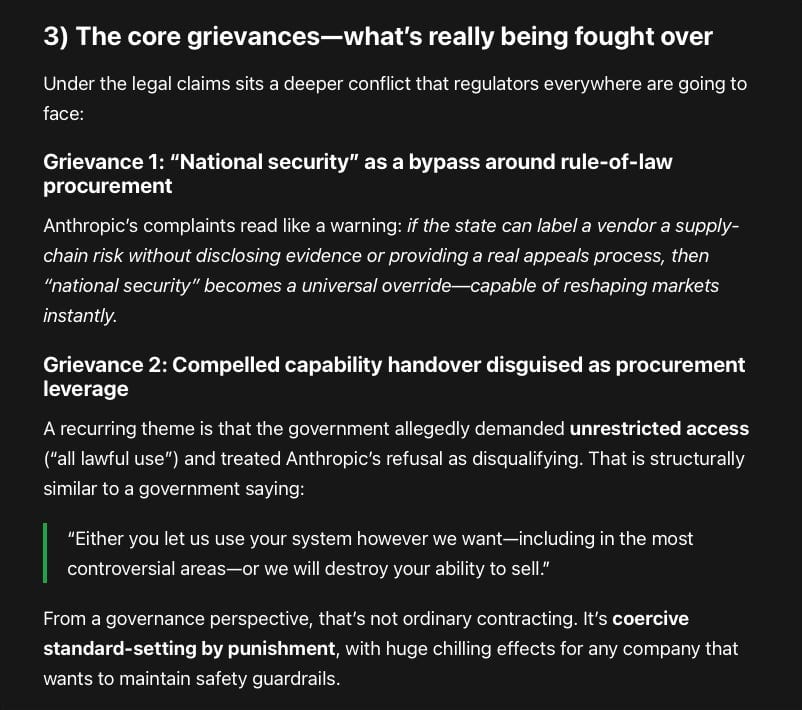
3) The core grievances—what’s really being fought over
Under the legal claims sits a deeper conflict that regulators everywhere are going to face:
Grievance 1: “National security” as a bypass around rule-of-law procurement
Anthropic’s complaints read like a warning: if the state can label a vendor a supply-chain risk without disclosing evidence or providing a real appeals process, then “national security” becomes a universal override—capable of reshaping markets instantly.
Grievance 2: Compelled capability handover disguised as procurement leverage
A recurring theme is that the government allegedly demanded unrestricted access(“all lawful use”) and treated Anthropic’s refusal as disqualifying. That is structurally similar to a government saying:
“Either you let us use your system however we want—including in the most controversial areas—or we will destroy your ability to sell.”
From a governance perspective, that’s not ordinary contracting. It’s coercive standard-setting by punishment, with huge chilling effects for any company that wants to maintain safety guardrails.
Grievance 3: Viewpoint discrimination in an era of “AI ideology” accusations
Anthropic claims the government framed it as “woke,” unpatriotic, and ideologically hostile—then used state power to punish it. This is the most explosive allegation because it’s not “we disagree on policy”; it’s “the government retaliated because it disliked our viewpoint.”
4) How strong are these claims, and how likely are they to succeed?
There are two very different forces pulling the outcome in opposite directions.
What helps Anthropic
Retaliation narratives can be legally potent if the record shows clear linkage between protected speech (public safety stance) and punitive government action (blacklisting). The complaint is built to establish that “speech → threat → punishment” chain.
Process flaws matter in administrative law. Courts often tolerate hard national-security choices less when the government appears to have skipped required steps, ignored statutory limits, or offered conclusory assertions without a defensible record.
Breadth and collateral damage: declaring a vendor a supply-chain risk “for all products/services,” plus pressuring contractors not to do business, looks less like a tailored risk control and more like economic warfare—which can trigger judicial skepticism if the government can’t justify the scope.
What hurts Anthropic
Judicial deference in national security is real. If the government can point to classified or sensitive risk assessments—even if not publicly disclosed—courts sometimes hesitate to second-guess.
Justiciability and remedies: courts are cautious about directly restraining presidential directives, and they may narrow relief to agencies/officials, or push disputes into specialized procurement channels.
The administrative record is everything. If the government’s record is thin or looks pretextual, Anthropic’s odds improve. If the record includes credible risk indicators (e.g., foreign leverage, critical dependency exposures, sabotage risks), the case becomes much harder.
A realistic success assessment
Anthropic’s best path is not “winning the whole war” in one stroke, but one of these outcomes:
Injunction / stay while litigation proceeds (especially if the court believes the blacklisting causes irreparable harm and the process was defective).
Narrowing relief: forcing the government to redo the process with proper procedures, clearer findings, and a more tailored scope—rather than allowing an immediate sweeping exclusion.
Settlement dynamics: procurement disputes often end in negotiated off-ramps—revised contract terms, a compliance framework, independent oversight, or a phased transition—because both sides face operational risk from prolonged disruption.
A full “Anthropic wins everything; the government loses its leverage entirely” outcome is possible but less likely in a national-security posture case. More probable is partial victory: Anthropic wins on process and tailoring, and the government retains some discretion but must exercise it lawfully and with evidence.
5) Possible outcomes (what this could turn into)
Rapid preliminary injunction (or partial injunction) blocking the broadest exclusionary measures pending review.
Remand and redo: the court orders the government to revisit the determination using correct statutory standards and required procedures.
Split decisions: Anthropic loses on national-security discretion but wins on overbreadth or retaliation framing (or vice versa).
Political + market spillovers: regardless of legal outcome, the dispute signals to every AI vendor that defense procurement can become an ideological battleground—raising the premium on “alignment” and reducing space for independent safety positions.
Structural precedent: if the government’s approach stands, similar supply-chain mechanisms could be used against other “uncooperative” vendors (AI, cloud, chips, comms). If Anthropic wins, governments may still seek the same control—just via clearer statutes and formal processes.
Recommendations for governments and regulators outside the U.S. to prevent this situation
If you want to avoid a world where AI procurement becomes ideological purges disguised as “security,” you need hard institutional design, not aspirational principles.
1) Build supply-chain security regimes that are evidence-based and appealable
Create an independent supply-chain risk authority (not a single minister’s discretionary power).
Require written findings, clear risk criteria, and proportionality (tailor restrictions to the risk).
Provide an appeals process with meaningful review—especially where decisions function as market blacklists.
2) Prohibit “blacklisting by memo” and “policy by social media”
Require that any exclusion decision with market-wide effects be made through formal instruments (published decisions, registered notices), not informal directives.
Mandate minimum procedural protections: notice, reasons, opportunity to respond (even if partly closed/secure), and time-bounded review.
3) Separate “capability access” demands from “security determinations”
Governments do need leverage for legitimate defense uses, but it should be achieved through:
Transparent statutory authority (if you want “all lawful use,” legislate it with safeguards), or
Negotiated contracting frameworks with defined boundaries, auditability, and liability.
Do not allow “you won’t give us unrestricted access” to be re-labeled as “you are a supply-chain threat” without real security evidence. That is how procurement becomes coercion.
4) Set national red lines for AI use—so vendors aren’t forced to invent them alone
If a country believes certain AI uses are unacceptable (e.g., autonomous lethal targeting without meaningful human control, or mass domestic surveillance), set that by law or binding policy. Then procurement negotiations won’t turn into ad hoc power struggles where the vendor’s safety stance is treated as insubordination.
5) Introduce “procurement constitutionalism” for strategic tech
For high-impact technologies (AI models, cloud, identity, comms), procurement should embed:
rule-of-law constraints (proportionality, due process, reasons),
anti-retaliation protections (no punishment for policy speech), and
structured emergency powers (temporary measures with oversight, sunset clauses, and independent review).
6) Reduce single-vendor dependency so governments don’t reach for coercion
A government that is operationally dependent on one frontier model provider is more likely to threaten, coerce, and punish. Mitigate that structurally:
multi-vendor frameworks,
portability requirements,
interoperable evaluation standards,
capacity to switch providers without chaos.
7) Treat “security” as a technical domain, not an ideology contest
Codify what counts as supply-chain risk (e.g., ownership/control vulnerabilities, hostile-state leverage, critical infrastructure exposure, sabotage vectors, insecure update channels) and make “vendor viewpoint” explicitly irrelevant—unless it is directly tied to demonstrable security risk.