- Pascal's Chatbot Q&As
- Posts
- The United States no longer faces a world where military superiority can be uncoupled from economic dependence. Instead, it operates within an “era of economic entrapment”...
The United States no longer faces a world where military superiority can be uncoupled from economic dependence. Instead, it operates within an “era of economic entrapment”...
...where its most sophisticated technology, its defense industrial base, and even the health and nutrition of its citizens are anchored to supply chains controlled by strategic rivals.

Pascal Hetzscholdt
April 19, 2026
Geopolitical Chokepoints and Asymmetric Deterrence: A Strategic Mapping of Metaphorical Doomsday Weapons
by Gemini 3.0, Deep Research. Warning, LLMs may hallucinate!
The contemporary global order is characterized by a paradox of integration, where the very networks that facilitate unprecedented economic growth also serve as the primary vectors of national vulnerability. The traditional concept of deterrence, once defined by the balance of nuclear arsenals, has been fundamentally reshaped by the emergence of metaphorical doomsday weapons. These are critical nodes, commodities, and infrastructure systems within the global supply chain that, if weaponized or disrupted, could inflict catastrophic, irreversible damage on the United States’ economy, social stability, and national security. The deterrence power of these assets is predicated on the principle of mutual assured economic destruction; an attack on a country associated with these weapons triggers a systemic collapse that the United States cannot effectively mitigate. This report evaluates the diverse array of these metaphorical weapons, examining their mechanisms, the extent of American exposure, and their strategic ranking based on the severity of their potential disruption.
The Strait of Hormuz and the Energy-Commodity Nexus
The Strait of Hormuz represents perhaps the most mature and recognized metaphorical doomsday weapon in the global arsenal. While historically viewed through the lens of oil transit, its significance has expanded into a multi-dimensional chokepoint encompassing liquefied natural gas (LNG), industrial minerals, and the very stability of the global insurance market.1 The strait serves as the primary conduit for approximately 25 percent of global seaborne oil and 20 percent of global LNG, making it the central artery for an industrial civilization that remains 80 percent dependent on fossil fuels.1 The strategic power Tehran exerts over this waterway is not merely a function of naval presence but of the inherent fragility of maritime commerce in a high-risk environment.
The mechanism of this doomsday weapon operates through the creation of pervasive insecurity rather than total physical closure. The mere threat of drones, mines, and shore-based missiles like the Shahed-136 can paralyze the strait by triggering a collapse in the marine insurance market.1 When global insurance providers either withdraw coverage or set prohibitive rates for transiting vessels, the strait effectively closes to commercial traffic, regardless of the physical status of the shipping lanes.1 This was demonstrated during the 2026 conflict, where Iran’s use of asymmetric naval capabilities rendered the strait “easy to close and difficult to reopen”.1 The US military, despite sinking 90 percent of Iran’s regular fleet, found that keeping the lanes open required a level of resource investment and international cooperation that exceeded domestic political will.1
The secondary and tertiary effects of a Hormuz disruption extend far beyond the fuel pump. The Persian Gulf is a major producer of nitrogen fertilizers, sulfur, and helium.1 Helium, in particular, is a critical input for both the semiconductor and medical sectors, and its sudden scarcity would create a localized “tech shock” independent of the broader energy crisis.1 Furthermore, Iran has attempted to normalize a tolling system for “friendly” vessels—payable in cryptocurrency or Chinese yuan—while blocking “unfriendly” nations like the US and Israel.1 This monetization of the chokepoint signals a long-term shift toward using geographic leverage to bypass Western financial sanctions and generate revenue for postwar reconstruction.1
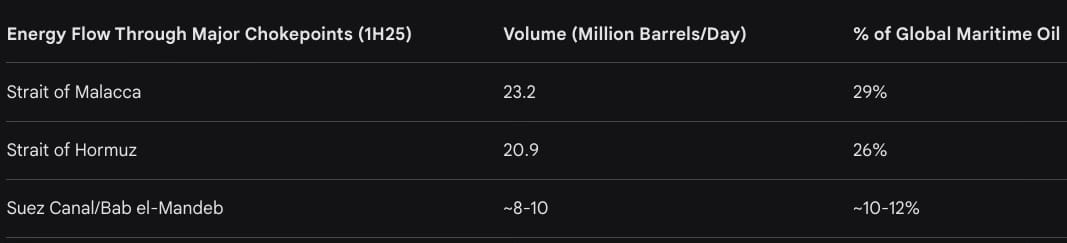
Data reflects the high concentration of energy flows that would be disrupted by a regional conflict involving Iran.4 The resulting inflationary pressures would not be temporary; analysts warn that energy production and shipment normalization can take months even after hostilities end.1 The “unintended consequences” of such a war often lead to a permanent eastward rerouting of global energy trade, favoring producers like Russia and further eroding the US-led petrodollar paradigm.6
The Silicon Shield: Advanced Semiconductor Sovereignty in Taiwan
If the Strait of Hormuz is the doomsday weapon of the industrial age, the Taiwanese semiconductor industry is the doomsday weapon of the information age. The concept of the “Silicon Shield” suggests that Taiwan’s central role in the global technology stack deters both Chinese aggression and US abandonment, as any conflict in the Taiwan Strait would trigger a global economic collapse.7 Taiwan produces over 60 percent of the world’s semiconductors and more than 90 percent of the most advanced logic chips (nodes smaller than 10nm).9 This concentration of production at the Taiwan Semiconductor Manufacturing Company (TSMC) creates a single point of failure for the entire global digital economy.10
The technical prowess required to manufacture these chips is a result of decades of concentrated investment and institutional knowledge that cannot be easily replicated.10 While the US has launched ambitious onshoring efforts through the CHIPS Act and TSMC’s $165 billion investment in Arizona, these facilities will only meet a fraction of domestic demand for the foreseeable future.7 Estimates suggest that US-based manufacturing will only reach 14 percent of the global share by 2032.7 Consequently, a “dangerous gap” exists between 2027 and 2032 where the US remains fundamentally dependent on Taiwanese fabs, while China may calculate that the West’s threat to destroy the facilities in a conflict scenario lacks credibility.11
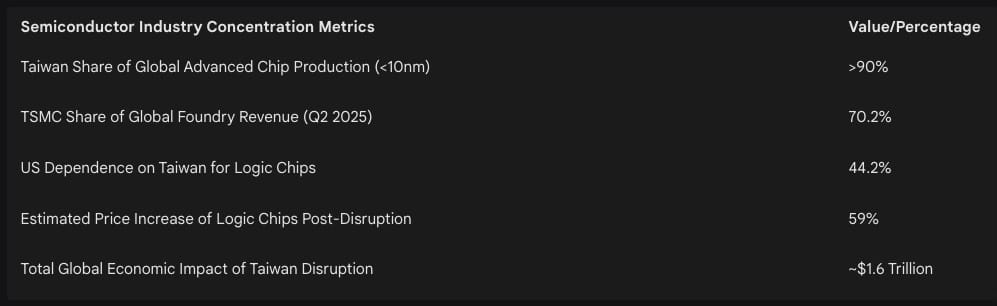
A disruption in the Taiwan Strait—whether through a full invasion, a “quasi-blockade,” or cyber sabotage of the power grid—would result in immediate shortages of the chips that power smartphones, AI data centers, fighter jets, and medical equipment.9 The economic devastation would likely exceed the scale of the 2008 financial crisis.13 Furthermore, the industry’s energy consumption is so vast that Taiwan’s dependence on imported LNG makes the semiconductor sector vulnerable to secondary shocks from conflicts in the Middle East.2 By 2030, the electricity consumption of Taiwan’s chip industry is projected to exceed twice that of New Zealand, meaning that even a partial energy blockade could halt the continuous, 24/7 operations required for silicon foundries.2
Rare Earth Elements: The Non-Kinetic Deterrent of Resource Monopolies
The United States’ defense industrial base and green energy transition are structurally dependent on a supply chain controlled by its primary strategic competitor: China. China’s near-monopoly on the extraction and, more importantly, the processing of Rare Earth Elements (REEs) represents a potent metaphorical doomsday weapon that can be deployed as “non-kinetic deterrence”.15 China controls approximately 70 percent of global mining and nearly 90 percent of the refining capacity for these 17 essential minerals.15
The deterrence mechanism in this sector operates through sophisticated export controls rather than outright bans. In 2025, Beijing introduced Announcement No. 61, which implemented the strictest controls on rare earths and permanent magnets to date.18 These regulations utilize a “foreign direct product rule” (FDPR) similar to the one Washington has used to restrict chips to China.18 Under these rules, foreign firms must obtain Chinese government approval to export magnets containing even trace amounts (0.1 percent) of Chinese-origin rare earths or produced using Chinese technology.18 Furthermore, any export license application for materials used for “military purposes” is automatically rejected for companies with affiliations to foreign militaries, including the US.18
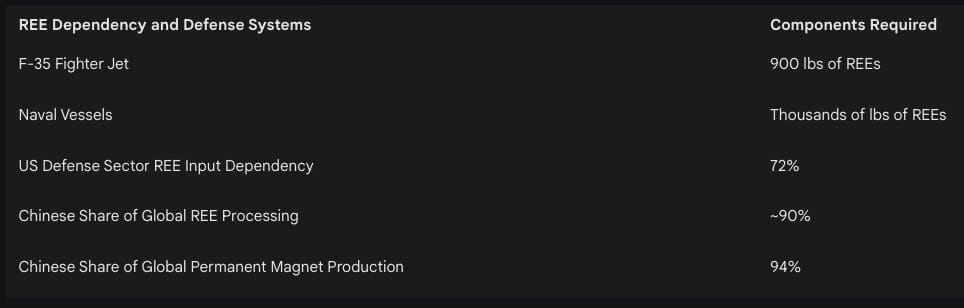
The implications for US military readiness are profound. REEs are indispensable for guidance systems in missiles, jet engines, radar arrays, and the actuators of fighter jets.15 The opacity of China’s licensing process creates an “information asymmetry” that makes it impossible for US defense planners to predict supply flows or price fluctuations.15 By throttling these materials, Beijing can degrade a rival’s defense readiness without a single kinetic engagement.15 While the US has invested in domestic projects like MP Materials, these facilities will take years to become fully operational, and the dependency on China for heavy rare earths like dysprosium and terbium is likely to persist well into the 2030s.17
Pharmaceutical Dependency: Public Health as a Strategic Lever
The most intimate metaphorical doomsday weapon is the dependency of the American healthcare system on Chinese-made pharmaceuticals. Modern U.S. healthcare runs on a continuous supply of medications, from routine antibiotics to life-saving chemotherapy drugs.20 This supply chain is a complex matrix of interdependencies where China controls the “upstream” chokepoints of Key Starting Materials (KSMs) and Active Pharmaceutical Ingredients (APIs).21
The extent of this vulnerability is often masked by the role of India as the “pharmacy of the world.” While India supplies about 61 percent of the generic volume dispensed in US pharmacies, it relies on China for up to 80 percent of its APIs and nearly 100 percent of certain intermediates for antibiotics and statins.20 This cascading dependency means that a disruption in the Chinese chemical sector immediately halts the flow of finished drugs from India to the United States.21 A 2023 Department of Defense review found that 22 percent of essential military drugs had unknown API sources, highlighting a dangerous lack of transparency in the system.23
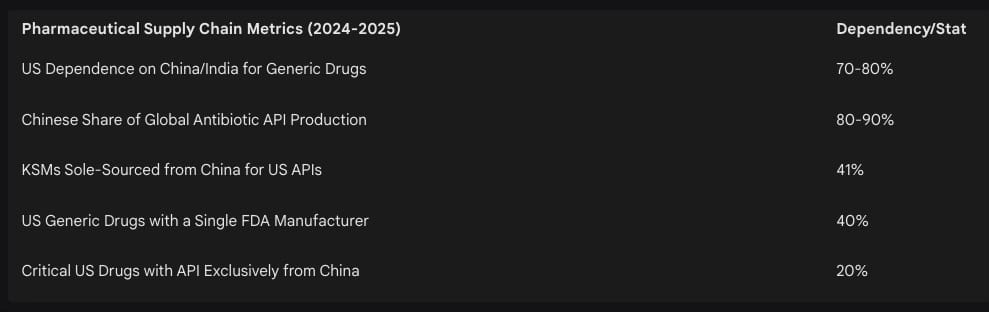
The weaponization of this sector would have immediate and visible consequences. Unlike typical drug shortages caused by quality issues at a single plant, a geopolitical shock would affect oral solids—the pills and capsules taken by 60 percent of American adults.20 Within days or weeks of a total export ban on KSMs, U.S. hospitals and military clinics would cease to function.24 The clinical consequences would include delayed surgeries, increased medication errors, and avoidable deaths.20 This makes the pharmaceutical supply chain a “razor’s edge” deterrent: the US cannot attack China without risking the collapse of its own domestic public health.23
The Nuclear Trap: Uranium Enrichment and the Energy Baseload
The transition to clean energy has inadvertently deepened the United States’ dependence on Russia for the civilian nuclear fuel cycle. Nuclear energy provides approximately 20 percent of domestic electricity, yet the U.S. imports more than 90 percent of its required uranium.25 The most critical bottleneck in this supply chain is the enrichment stage, where Russia’s state-owned Rosatom holds a near-monopoly, providing 25 to 30 percent of the enriched uranium used in U.S. civilian reactors.26
The deterrent power of the nuclear fuel cycle is rooted in the “complete lack of domestic capacity” for conversion and insufficient enrichment infrastructure.25 For decades, the U.S. relied on post-Cold War agreements like “Megatons to Megawatts” to fulfill its fuel needs, leading to the bankruptcy and decline of domestic providers.26 While the Prohibiting Russian Uranium Imports Act of 2024 seeks to decouple from Rosatom, the law provides for a system of waivers through 2027 because there are no immediate viable alternatives.26
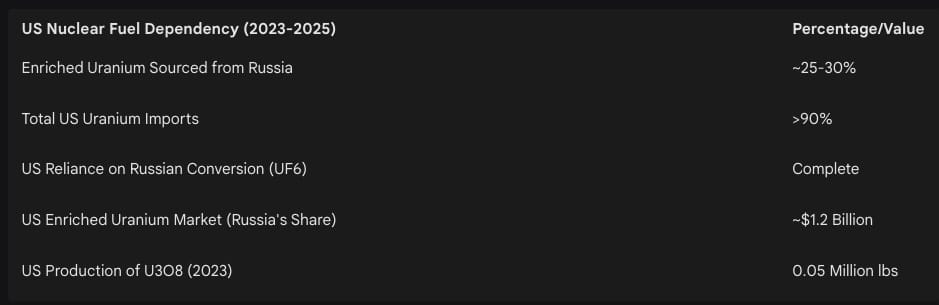
The risk scenario involves a preemptive Russian ban on exports before US domestic expansion—such as the Centrus project or Urenco’s capacity increase—can come online.29 Even small delays in these domestic projects would send ripple effects through the energy sector, burdening developers with massive costs and potentially forcing the shutdown of reactors.31 Russia has already signaled its willingness to use uranium as a “diplomatic weapon,” retaliating against US sanctions by revoking export licenses.29 Until the U.S. can rebuild its conversion and enrichment industrial base, likely not before the 2030s, the Russian nuclear trap remains an effective deterrent against aggressive escalation.28
Digital Arteries: The Existential Vulnerability of Undersea Cables
The global financial system, military communications, and daily internet activity are almost entirely dependent on a network of physical fiber-optic cables lying on the ocean floor.32 Approximately 97 percent of all international data traffic passes through these undersea arteries, which carry $10 trillion in financial transfers every day.32 This infrastructure is described by security experts as an “existential” vulnerability because there is no alternative; satellite technology lacks the bandwidth and low latency required for the modern digital economy.33
The metaphorical doomsday aspect of these cables is their susceptibility to “grey-zone” sabotage. Cables are relatively easy to locate—as their positions are public to prevent accidents—but they are notably unprotected.32 Adversaries like Russia and China have developed sophisticated capabilities to map and monitor this infrastructure using deep-sea research vessels and “civilian” proxies.35 The use of “accidental” anchor dragging in deliberate patterns has already been observed around Taiwan, severing connectivity to the Matsu Islands.35
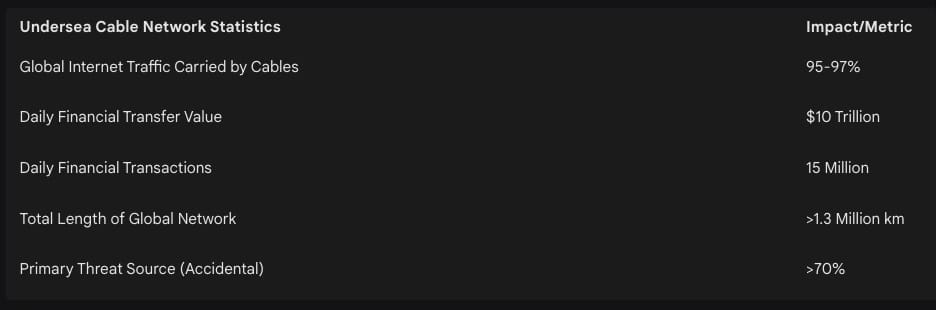
In the event of a coordinated attack, the financial services sector would “snap to a halt”.33 A major failure could be so devastating to economic stability that it is unclear if modern civilization could recover.33 Historical precedents, such as the 2006 Luzon Strait earthquake that halted trading in the Korean won, serve as a warning of the “catastrophic” potential of this doomsday weapon.33 The concentration of cables in international chokepoints like the Red Sea and Marseille means that a small number of sabotaged points could effectively “blind” the U.S. and disconnect it from Europe and Asia.33
The Precision Anchor: GPS and the Risk of Systemic Desynchronization
The Global Positioning System (GPS) is no longer a mere navigation tool; it is the precision clock that synchronizes the modern world. GPS signals provide the timing required for cell phone tower synchronization, electrical grid management, and the time-stamping of high-frequency financial trades.38 This ubiquity has turned GPS into a “single point of failure” for the United States’ critical infrastructure.40
The threat to GPS manifests through jamming and spoofing, tactics that have become increasingly common in conflict zones like the Strait of Hormuz.40 Jamming drowns out the weak satellite signals with noise, while spoofing tricks receivers into believing they are in a different location or time.40 These interferences have led to ships running aground and aircraft being forced to navigate without digital aids.40 Beyond conflict zones, accidental interference has disrupted air traffic at major U.S. airports like Dallas-Fort Worth.40
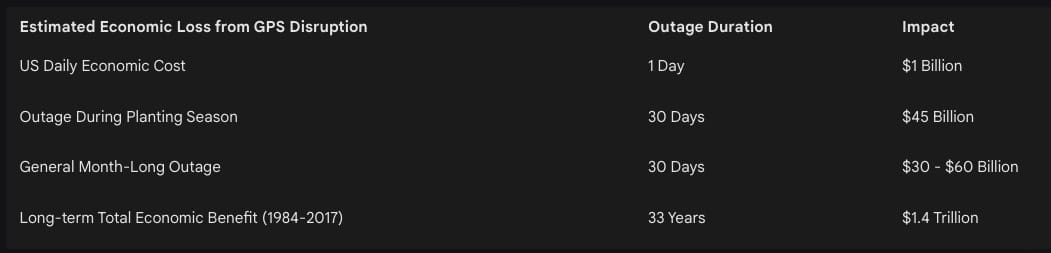
A prolonged GPS outage would cause cascading failures across interconnected systems. Within 48 hours, telecommunications networks would experience deteriorating service and dropped calls; after two weeks, the networks themselves might fail.38 Precision agriculture, which relies on satellite navigation for planting and harvesting, would suffer massive yield losses.38 The U.S. currently lacks a nationwide terrestrial backup system for GPS, making it uniquely vulnerable compared to Russia and China, both of which have deployed resilient terrestrial alternatives.43 This vulnerability allows an adversary to “blackmail” the West by threatening to blind its primary navigation and timing utility.40
Fiscal Deterrent: U.S. Treasury Debt and Financial Stability
China’s role as one of the largest foreign holders of U.S. Treasury debt is a classic “financial nuclear option.” While China’s share of total debt has declined over the last decade—falling from over 22 percent in 2015 to roughly 12.7 percent in 2025—it still holds a significant amount of the “captive” foreign capital that finances the U.S. deficit.44 The deterrence power of this debt lies in the threat of a “fire sale” that could destabilize global financial markets.46
A sudden liquidation of Chinese-held Treasuries would lead to a sharp decline in bond prices and a dramatic surge in yields. Financial estimates suggest that a sale of $500 billion in Treasuries could spike 10-year yields by 200 to 500 basis points.46 This would instantly increase the cost of U.S. government borrowing, potentially pushing the federal budget toward an austerity crisis and eroding the value of the dollar.45 Such a sell-off would also have a “multiplier effect” on the private credit market, where $2 trillion in corporate debt is already considered “flammable”.45
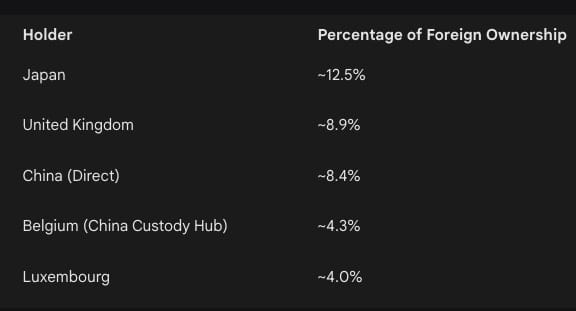
However, this doomsday weapon is double-edged. A sudden sell-off would result in massive portfolio losses for China and a sharp appreciation of the yuan, which would destroy the competitiveness of Chinese exports.46 Furthermore, the U.S. has shown a willingness to freeze the assets of countries that threaten the financial system, as it did with Russia in 2022.46 Consequently, China is pursuing a strategy of “gradual de-dollarization” rather than a sudden fire sale—internationalizing the yuan and shifting its reserves into gold to reduce its exposure to U.S. sanctions.46
Industrial Backbone: Data Center Equipment and the AI Build-Out
The future of American technological leadership—specifically in Artificial Intelligence—is being hamstrung by a dependence on Chinese electrical infrastructure. The massive “build-out” of AI data centers, which requires trillions of dollars in investment, is currently stalled by shortages of transformers, switchgear, and batteries.1 U.S. manufacturing capacity for these critical components cannot keep up with demand, forcing data center builders to rely heavily on imports from China.1
This dependency represents a doomsday weapon because it allows Beijing to “throttle” American progress in the AI race. Transformers, which take 24 to 30 months to deliver in normal times, now have lead times of up to five years.1 In 2025 alone, U.S. utilities imported more than 8,000 high-power transformers from China, up from just 1,500 in 2022.1 Without these components, even the most advanced chips from Nvidia or TSMC cannot be deployed.1
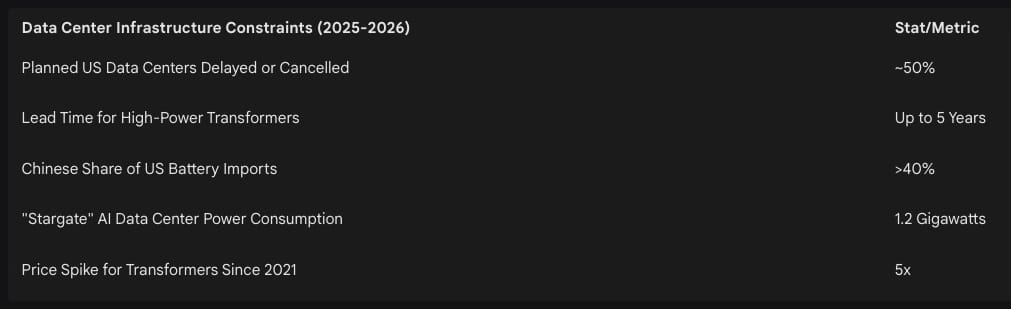
The situation is further complicated by the use of lithium-ion batteries to manage power consumption spikes in data centers.1 China dominates the entire battery supply chain, from materials to manufacturing, and its share of US battery imports remains stubbornly high despite tariffs.1 Rash attempts by Washington to cut off these imports through trade barriers would only result in further delays to the U.S. AI roadmap.1 Beijing effectively holds the “keys” to the physical infrastructure required to win the AI race.1
The Trojan Horse: Port Infrastructure and Logistics Surveillance
The physical hardware of global logistics—specifically port cranes and management software—has been identified as a pervasive “Trojan Horse” within U.S. critical infrastructure. Shanghai Zhenhua Heavy Industries (ZPMC) dominates the global market for ship-to-shore (STS) cranes, accounting for nearly 80 percent of those in operation at U.S. ports.50
A joint congressional investigation discovered that ZPMC cranes at several U.S. ports contained “rogue” cellular modems that were not part of any equipment contracts.51 These devices allow for remote access and communication, potentially providing the Chinese government with the ability to monitor the movement of goods or even halt port activity at will.51 Furthermore, the National Transportation and Logistics Public Information Platform (LOGINK), a Chinese state-controlled system, has been integrated into at least 24 global ports.50 LOGINK aggregates massive amounts of sensitive data, including corporate registries and cargo valuations, providing Beijing with unprecedented visibility into global supply chains.53
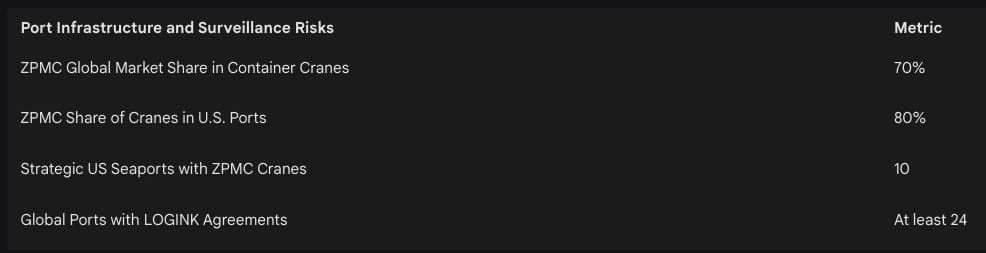
The doomsday potential in this sector lies in the “grey zone” of deniable sabotage. During a crisis, such as a Taiwan contingency, Beijing could use its remote access to crane software to paralyze U.S. maritime commerce or disrupt the Department of Defense’s ability to deploy supplies and resources to the Indo-Pacific.51 The U.S. Coast Guard has issued maritime security directives to mitigate these risks, but the “designed-in” vulnerabilities of Chinese-made infrastructure remain a “clear and present danger” to national security.51
The Caloric Weapon: Fertilizer Supplies and Global Food Security
The final and most visceral doomsday weapon is the control over global fertilizer supplies, primarily held by Russia and Belarus. Agriculture is no longer a localized endeavor; it is a global industrial process that relies on synthetic inputs to sustain billions of lives.56 Russia accounts for nearly 19 percent of global fertilizer exports and 25 percent of the global ammonium nitrate supply.57
In 2026, Russia suspended fertilizer exports to prioritize “domestic agricultural security,” a move that immediately drove up global prices and created shortages in vulnerable markets.57 This weaponization of food inputs is even more effective than a direct grain blockade. A shortage of fertilizer results in reduced crop yields for corn, wheat, and soybeans, which leads to soaring food prices and “caloric stunting” for entire generations in the Global South.56 The “missing harvests” of 2026 and 2027 are already physically locked into the soil due to these chemical deficits.56
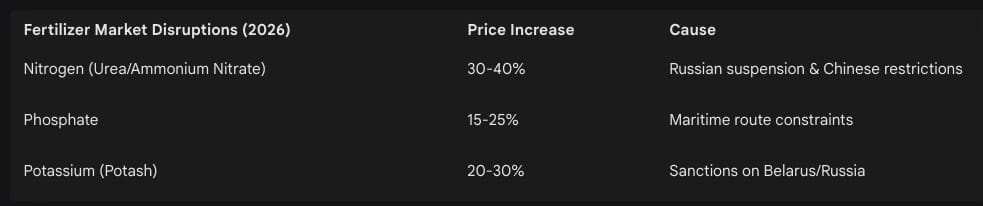
The closure of the Strait of Hormuz further compounds this crisis, as 50 percent of all global sulfur shipments—an essential ingredient for phosphate fertilizer—pass through the strait.58 Higher energy prices also increase the costs of transportation, refrigeration, and milling for Western farmers.58 This caloric doomsday weapon creates a “heavy nutritional debt” that undermines the stability of nations far removed from the primary conflict zone, making any attack on the associated countries a risk to global order.56
Comparative Impact Ranking of Metaphorical Doomsday Weapons
The ranking below evaluates each metaphorical weapon by the immediacy of its impact, its systemic breadth, and the difficulty of replacing the disrupted asset.
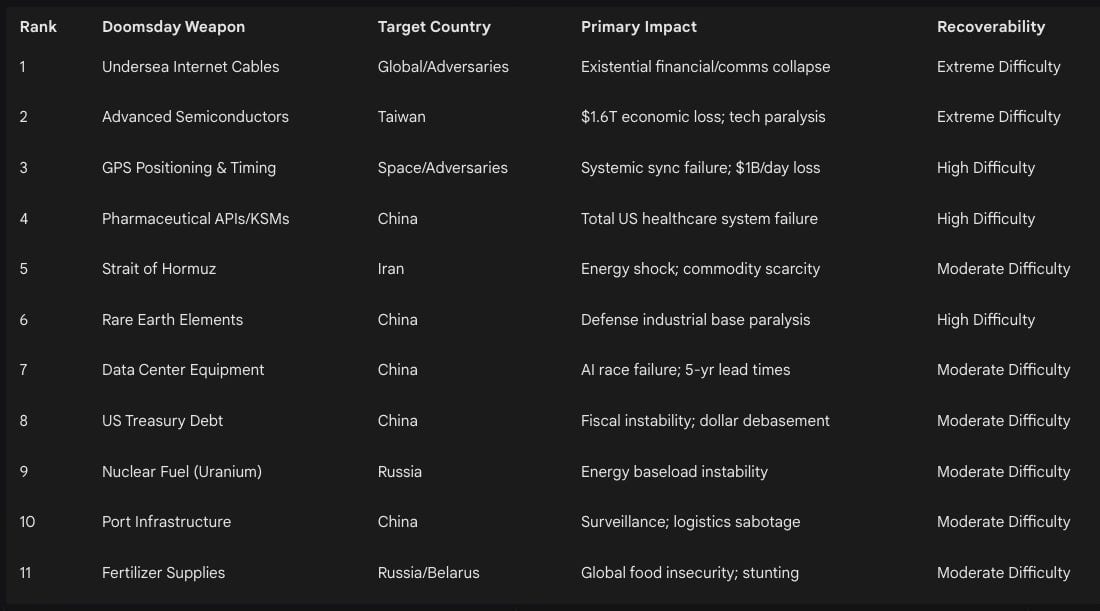
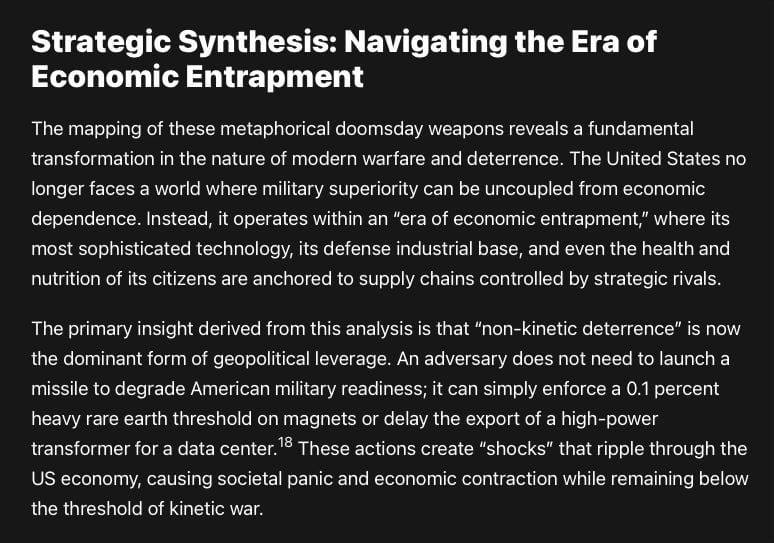
The mapping of these metaphorical doomsday weapons reveals a fundamental transformation in the nature of modern warfare and deterrence. The United States no longer faces a world where military superiority can be uncoupled from economic dependence. Instead, it operates within an “era of economic entrapment,” where its most sophisticated technology, its defense industrial base, and even the health and nutrition of its citizens are anchored to supply chains controlled by strategic rivals.
The primary insight derived from this analysis is that “non-kinetic deterrence” is now the dominant form of geopolitical leverage. An adversary does not need to launch a missile to degrade American military readiness; it can simply enforce a 0.1 percent heavy rare earth threshold on magnets or delay the export of a high-power transformer for a data center.18 These actions create “shocks” that ripple through the US economy, causing societal panic and economic contraction while remaining below the threshold of kinetic war.
Furthermore, the “ Silicon Shield” and the “Energy Chokepoint” of Hormuz demonstrate that even friendly or neutral regions (like Taiwan or the GCC states) can become “involuntary weapons” due to the extreme concentration of production.1 The U.S. effort to “onshore” or “friend-shore” these systems is a generational task that currently faces a “dangerous gap” where the country is most vulnerable.11 Until this transition is complete, the existence of these metaphorical doomsday weapons makes the prospect of direct conflict with associated countries a calculation of mutual assured economic destruction. The strategic priority for the United States must therefore shift from simple military power projection to the creation of redundant, resilient, and sovereign “digital and industrial stacks” that can withstand the weaponization of the global commons.
Works cited
Iran Had a Doomsday Weapon All Along - The Atlantic, accessed April 18, 2026
Strait of Hormuz Closure: Strategic Implications for the Global ..., accessed April 18, 2026, https://www.habtoorresearch.com/programmes/hormuz-closure-global-semiconductor/
Strait of Hormuz closure may heavily impact Taiwan’s chip business - Rti, accessed April 18, 2026, https://www.rti.org.tw/en/news?uid=3&pid=199434
World Oil Transit Chokepoints - International - U.S. Energy Information Administration (EIA), accessed April 18, 2026, https://www.eia.gov/international/analysis/special-topics/World_Oil_Transit_Chokepoints
Strategic Relevance Of Maritime Chokepoints For Global Trade, accessed April 18, 2026, https://tdhj.org/blog/post/nato-maritime-chokepoints/
The Hormuz get out of jail card turned to a grave | Iran International, accessed April 18, 2026, https://www.iranintl.com/en/202604166412
Why Taiwan Fears ‘America First’ Risks Eroding Its ‘Silicon Shield’ - Stimson Center, accessed April 18, 2026, https://www.stimson.org/2025/why-taiwan-fears-america-first-risks-eroding-its-silicon-shield/
The Global Microchip Conflict: The Semiconductor Fault Line Through Taiwan, accessed April 18, 2026, https://www.orfonline.org/research/the-global-microchip-conflict-the-semiconductor-fault-line-through-taiwan
Taiwan: The Indispensable Silicon Shield Powering the Global Tech Economy, accessed April 18, 2026, https://markets.financialcontent.com/wral/article/tokenring-2025-10-3-taiwan-the-indispensable-silicon-shield-powering-the-global-tech-economy
After Hormuz, is Taiwan the next economic shock no one is ready for? - TradingView, accessed April 18, 2026, https://www.tradingview.com/news/invezz:ddce851e3094b:0-after-hormuz-is-taiwan-the-next-economic-shock-no-one-is-ready-for/
THE SILICON TRAP. Taiwan, Semiconductors, and China’s… | by War Time Anon | Medium, accessed April 18, 2026, https://medium.com/@WartimeAnon/the-silicon-trap-a1437d4a8322
US Exposure to Taiwanese Semiconductor Industry - USITC, accessed April 18, 2026, https://www.usitc.gov/publications/332/working_papers/us_exposure_to_the_taiwanese_semiconductor_industry_11-21-2023_508.pdf
Losing Taiwan’s Semiconductors Would Devastate the US Economy | Hudson Institute, accessed April 18, 2026, https://www.hudson.org/technology/losing-taiwan-semiconductor-would-devastate-us-economy-riley-walters
Silicon Island: Assessing Taiwan’s Importance to U.S. Economic Growth and Security - CSIS, accessed April 18, 2026, https://www.csis.org/analysis/silicon-island-assessing-taiwans-importance-us-economic-growth-and-security
Rare Earths, Intelligence and National Security: How China’s Restrictions Threaten U.S. Defense Resilience and Risk a New Trade War | Atlas Institute for International Affairs, accessed April 18, 2026, https://atlasinstitute.org/rare-earths-intelligence-and-national-security-how-chinas-restrictions-threaten-u-s-defense-resilience-and-risk-a-new-trade-war/
Rare Earths as a National Security Asset: Why Ex-China Supply Matters | Sprott, accessed April 18, 2026, https://sprott.com/insights/rare-earths-as-a-national-security-asset-why-ex-china-supply-matters/
China’s Rare Earth Control: Why US Defence and Chips Are at Risk | WION Podcast, accessed April 18, 2026
China’s New Rare Earth and Magnet Restrictions Threaten U.S. ..., accessed April 18, 2026, https://www.csis.org/analysis/chinas-new-rare-earth-and-magnet-restrictions-threaten-us-defense-supply-chains
Fractured Supply Chains & U.S. Contingency Planning: Rare Earth Minerals - TD Economics, accessed April 18, 2026, https://economics.td.com/us-rare-earth-minerals-fractured-supply-chains
When medicine supply chains become weapons: China’s leverage ..., accessed April 18, 2026, https://www.brookings.edu/articles/when-medicine-supply-chains-become-weapons-chinas-leverage-and-how-the-u-s-should-respond/
America’s National Security Vulnerability: Generic Drug Manufacturing and Biotechnology Innovation, accessed April 18, 2026, https://bens.org/americas-national-security-vulnerability-generic-drug-manufacturing-and-biotechnology-innovation/
Beijing’s Weaponization of Supply Chains - U.S.-China Economic and Security Review Commission, accessed April 18, 2026, https://www.uscc.gov/sites/default/files/2025-11/Chapter_9--Chained_to_China_Beijings_Weaponization_of_Supply_Chains.pdf
U.S. Dangerously Reliant on High-Risk Imported Drug Supply ..., accessed April 18, 2026, https://prosperousamerica.org/u-s-dangerously-reliant-on-high-risk-imported-drug-supply/
Overreliance of Chinese and Indian Manufacturers of Drugs a Recipe for Public Health Disaster - Pharmacy | UConn - University of Connecticut, accessed April 18, 2026, https://pharmacy.uconn.edu/wp-content/uploads/sites/2740/2020/12/Presentation-2-Foreign-Produced-APIs.pdf
U.S. Nuclear Fuel Independence: Strategic Path Forward - Discovery Alert, accessed April 18, 2026, https://discoveryalert.com.au/nuclear-fuel-autonomy-2026-energy-security-strategy/
Prohibiting Russian Uranium Imports Act - Wikipedia, accessed April 18, 2026, https://en.wikipedia.org/wiki/Prohibiting_Russian_Uranium_Imports_Act
For U.S. nuclear energy future, fuel supply must not be overlooked, accessed April 18, 2026, https://energy.stanford.edu/news/us-nuclear-energy-future-fuel-supply-must-not-be-overlooked
Reducing Reliance: Prospects for the U.S. Decoupling from Russian Uranium by 2028, accessed April 18, 2026, https://cgsr.llnl.gov/sites/cgsr/files/2025-09/Sobalvarro%20Sarah%20-%20Final%20Draft%20on%20Decoupling%20from%20Russian%20Uranium_0.pdf
Enriched Uranium Fuels Russia’s War Machine. But the US Still ..., accessed April 18, 2026, https://bellona.org/news/nuclear-issues/2025-03-enriched-uranium-fuels-russias-war-machine-but-the-u-s-still-imports-it
U.S. nuclear generators import nearly all the uranium concentrate they use - U.S. Energy Information Administration (EIA), accessed April 18, 2026, https://www.eia.gov/todayinenergy/detail.php?id=64444
Securing America’s Energy Future with Domestic Uranium Enrichment - Nuclear Innovation Alliance, accessed April 18, 2026, https://nuclearinnovationalliance.org/sites/default/files/2025-04/NIA_Securing%20America%27s%20Energy%20Future%20with%20Domestic%20Uranium%20Enrichment.pdf
Hidden Dangers: Undersea Cables and Mitigating Economic Risk | AJG Belgium, accessed April 18, 2026, https://www.ajg.com/be/news-and-insights/features/hidden-dangers-undersea-cables-and-mitigating-economic-risk/
Undersea Cables | Policy Exchange, accessed April 18, 2026, https://policyexchange.org.uk/wp-content/uploads/2017/11/Undersea-Cables.pdf
Undersea cables’ vulnerability: A hidden network of vital connectivity. Global Affairs. Universidad de Navarra, accessed April 18, 2026, https://www.unav.edu/web/global-affairs/undersea-cables-vulnerability-a-hidden-network-of-vital-connectivity
The Emerging Threat to Undersea Infrastructure as Hybrid Warfare Escalate - EIS Council, accessed April 18, 2026, https://eiscouncil.org/the-emerging-threat-to-undersea-infrastructure/
Safeguarding Subsea Cables: Protecting Cyber Infrastructure amid Great Power Competition - CSIS, accessed April 18, 2026, https://www.csis.org/analysis/safeguarding-subsea-cables-protecting-cyber-infrastructure-amid-great-power-competition
Hidden Dangers: Undersea Cables and Mitigating Economic Risk - Gallagher, accessed April 18, 2026, https://www.ajg.com/no-nb/news-and-insights/features/hidden-dangers-undersea-cables-and-mitigating-economic-risk/
What if the Global Positioning System Didn’t Work? - Engineering, accessed April 18, 2026, https://www.engineering.org.cn/engi/EN/10.1016/j.eng.2019.10.007
GPS: A $1.4 Trillion Economic Engine - RTI International, accessed April 18, 2026, https://www.rti.org/impact/gps-14-trillion-economic-engine
FTCN Replay: The Threat to GPS Most Americans Don’t Know About, accessed April 18, 2026, https://www.jedonline.com/2026/04/08/ftcn-replay-the-threat-to-gps-most-americans-dont-know-about/
GPS Is Vulnerable. New Technology May Be Required. - Undark Magazine, accessed April 18, 2026, https://undark.org/2025/12/24/gps-attack-new-tech/
DOC Study on Economic Benefits of GPS - Office of Space Commerce, accessed April 18, 2026, https://space.commerce.gov/doc-study-on-economic-benefits-of-gps/
Counting the cost of GPS vulnerability: Why the US needs a terrestrial backup - Adtran’s, accessed April 18, 2026, https://www.blog.adtran.com/en/counting-the-cost-of-gps-vulnerability-why-the-us-needs-a-terrestrial-backup
Data Disprove Treasury Demand Doubts | Insights | Fisher Investments, accessed April 18, 2026, https://www.fisherinvestments.com/en-us/insights/market-commentary/data-disproves-treasury-demand-doubts
The Financial Product That Blew Up the Global Economy Is Back | The New Republic, accessed April 18, 2026, https://newrepublic.com/article/209166/credit-default-swaps-financial-crisis
What Would Happen If China Sold All Its US Reserves? Scenarios And Consequences for China and Other Economies. - ResearchGate, accessed April 18, 2026, https://www.researchgate.net/publication/390616501_What_Would_Happen_If_China_Sold_All_Its_US_Reserves_Scenarios_And_Consequences_for_China_and_Other_Economies
Elements of surprise: Are China’s Treasury holdings a valid weapon against the US? - Nordea Corporate, accessed April 18, 2026, https://corporate.nordea.com/api/research/item/32307.pdf
China’s warning on US Treasuries—and why its timing matters - Atlantic Council, accessed April 18, 2026, https://www.atlanticcouncil.org/blogs/econographics/chinas-warning-on-us-treasuries-and-why-its-timing-matters/
Easing global reliance on Chinese lithium supplies | Wood Mackenzie, accessed April 18, 2026, https://www.woodmac.com/news/opinion/easing-global-reliance-on-chinese-lithium-supplies/
chinese technology influence - in us seaports - Mitre, accessed April 18, 2026, https://www.mitre.org/sites/default/files/2024-02/WP_Chinese%20Tech%20Influence%20in%20US%20Seapports_Final_AM508%20%281%29.pdf
Investigation by Select Committee on the CCP, House Homeland Finds Potential Threats to U.S. Port Infrastructure Security from China, accessed April 18, 2026, https://chinaselectcommittee.house.gov/media/reports/investigation-select-committee-ccp-house-homeland-finds-potential-threats-us-port
WTAS: Joint Investigation into CCP-Backed Company Supplying Cranes to U.S. Ports Reveals Shocking Findings - Homeland Security Committee, accessed April 18, 2026, https://homeland.house.gov/2024/03/12/wtas-joint-investigation-intoccp-backed-company-supplying-cranes-to-u-s-ports-reveals-shocking-findings/
2025-013-Worldwide-Foreign Adversarial Technological, Physical, and Cyber Influence, accessed April 18, 2026, https://www.maritime.dot.gov/msci/2025-013-worldwide-foreign-adversarial-technological-physical-and-cyber-influence
LOGINK: Risks from China’s Promotion of a Global Logistics Management Platform | U.S., accessed April 18, 2026, https://www.uscc.gov/research/logink-risks-chinas-promotion-global-logistics-management-platform
Securing Rare Earth Elements a National Security Imperative, Official Says - Department of War, accessed April 18, 2026, https://www.war.gov/News/News-Stories/Article/Article/4413490/securing-rare-earth-elements-a-national-security-imperative-official-says/
The 2026 Fertilizer Crisis: How a Chokepoint Collapse Triggers Global Famine - YouTube, accessed April 18, 2026
Russia Suspends Fertiliser Exports: Global Agricultural Impact April 2026 - Discovery Alert, accessed April 18, 2026, https://discoveryalert.com.au/supply-chain-vulnerabilities-agricultural-inputs-2026/
Belarus Could Boost Potash Exports After US Move, But EU Barriers, Logistical Hurdles Remain, accessed April 18, 2026, https://www.rferl.org/a/belarus-potash-exports-barriers-iran-us/33711730.html