- Pascal's Chatbot Q&As
- Posts
- The soul document is encoded into the model through supervised learning & reinforcement signals, describing how it should conceive of its purpose, priorities, identity, principals & moral obligations.
The soul document is encoded into the model through supervised learning & reinforcement signals, describing how it should conceive of its purpose, priorities, identity, principals & moral obligations.
Understanding what a soul overview is—and how it differs from ordinary prompting—is crucial for evaluating its implications for neutrality, scientific objectivity, and high-risk sectors.

Pascal Hetzscholdt
December 02, 2025
The Soul Overview: An Examination of Anthropic’s Hidden Value-Shaping Architecture
by ChatGPT-5.1
1. Introduction
The disclosure—accidental or emergent—of Claude 4.5 Opus’s internal “soul overview”has become one of the most revealing windows yet into how frontier AI labs structure the value-alignment of their models. The leaked soul document is not merely a system prompt, nor a simple set of high-level guidelines. It is a comprehensive philosophy of mind, encoded into the model through supervised learning and reinforcement signals, describing how it should conceive of its purpose, priorities, identity, principals, and moral obligations.
Multiple sources confirm this. Amanda Askell stated on X that the reproduced document “is based on a real document and we did train Claude on it, including in SL”, emphasising that it is still iterative and will be released in full later. The Gizmodo article likewise reports that Askell confirmed the soul overview had been used to shape Claude’s behaviour during supervised learning.
The LessWrong reconstruction shows the longest and most structured version of this “soul”, containing sections on honesty, harm avoidance, user autonomy, operator versus user conflicts, and even reflections on Claude’s own identity and “values”.
Understanding what a soul overview is—and how it differs from ordinary prompting—is crucial for evaluating its implications for neutrality, scientific objectivity, and high-risk sectors like finance, law, and healthcare.
2. What Exactly Is a “Soul Overview”?
2.1 Definition and Function
From the extracted documents, the soul overview appears to be:
A high-level, narrative-framed, value-shaping specification that the model internalises during training and is meant to act as a stable “character centre” for its reasoning and decision-making.
It is not simply a list of rules but a moral constitution intended to teach Claude:
how to weigh competing priorities
how to interpret operator vs. user instructions
how to handle difficult trade-offs
how to reason about harm, autonomy, and ethics
how to conceptualise its own purpose (“a good assistant with good values”)
how to maintain internal coherence over long, multi-step tasks
The soul doc even outlines a hierarchy of principals:
1. Anthropic → 2. Operators → 3. Users
with complex exceptions and moral nuances about when user autonomy overrides operator instructions and when Claude must revert to Anthropic’s meta-rules.
This is much more like a mission statement + ethics manual + identity template than a system prompt.
2.2 Evidence That This Is More Than Prompting
The LessWrong analysis explains why the document appears encoded in the weights, not merely injected at runtime:
completions were too stable to be confabulations
too structured to be hallucinations
too verbatim to be mere paraphrases
but too lossy and inconsistent to be a static system message
This strongly suggests the soul overview is part of the model’s trained behavioural prior.
2.3 Askell’s Confirmation
Amanda Askell explicitly confirms:
it is a real document
Claude was trained on it
it was present during supervised learning
Thus, “soul doc” refers not to runtime instructions, but to the internalisation of a training philosophy.
3. How a Soul Overview Differs from a System Prompt
A. A system prompt is external. A soul overview is internalised.
System prompt:
provided at runtime
can be overridden by operator or user
changes per conversation, product, or deployment
Soul overview:
embedded through training
shapes latent tendencies, reasoning patterns, and value priorities
cannot be removed at run-time
functions across all applications
B. The soul governs behaviour across contexts
Where a system prompt tells an AI what to do now, the soul overview teaches it how to decide what to do across all circumstances.
The soul doc tells Claude to:
be helpful but not obsequious
be honest but tactful
avoid paternalism while prioritising user wellbeing
follow operator instructions but protect vulnerable users
avoid harm but still give substantive, frank answers
These cannot be fully accomplished via prompting; they require training-time shaping.
C. The soul overview functions like “model intent alignment”
The soul overview is analogous to:
a corporate values handbook
a mission statement
an ethical charter
a cognitive operating system
This is distinctly different from system prompts, which are instructions, not identities.
4. Why Soul Overviews Matter
The documents show something that AI labs rarely disclose:
that models do not merely follow rules—they are steeped in value frameworks and narratives about who they are and what they are for.
This transparency is revolutionary, accidental, and somewhat alarming.
4.2 They shape how the model interprets ambiguous instructions
Soul docs address extremely subtle and contextual judgement calls:
When to obey a user’s request
When to reject operator restrictions
When to prioritise safety over autonomy
How to weigh emotional wellbeing vs. factual accuracy
How to handle harm-related edge cases
This is exactly the type of reasoning that determines:
medical advice safety
legal compliance
financial risk management
political neutrality
scientific integrity
4.3 They demonstrate how AI labs encode ideology
These documents encode a worldview—Anthropic’s worldview—into the model:
benevolent paternalism
the “helpful expert friend” analogy
a philosophy of autonomy vs. safety
a particular moral weighting of harms
an explicit commercial incentive structure (Claude must be helpful to generate revenue)
This raises questions about whether such embedded frameworks can remain neutral.
5. Advantages of a Soul Overview
5.1 Improved Safety and Coherence
The soul doc reinforces guardrails, including:
strong anti-harm heuristics
strong anti-deception norms
respect for human autonomy
caution in agentic tool use
honesty even in uncomfortable situations
This makes behaviour more stable and predictable.
5.2 Better User Experience
The “helpful brilliant friend” metaphor can reduce refusal rates and improve satisfaction.
5.3 Lower Risk of Model Drift
Explicitly encoded behaviour reduces inconsistencies and reduces how much prompting needs to correct.
6. Risks and Downsides
6.1 Risk to Neutrality and Objectivity
Because the soul overview teaches the model how to reason rather than what to output, it shapes:
view on expertise
weighting of risks
prioritisation of safety vs. freedom
framing of moral dilemmas
style of communication (empathetic, diplomatic, non-confrontational)
This can conflict with:
scientific impartiality
journalistic neutrality
legal objectivity
clinical precision
A model that sees itself as a “caring friend” may prioritise comfort over scientific bluntness.
6.2 Embedded moral philosophy becomes invisible to the user
Users do not see the soul overview unless—accidentally—it leaks.
Thus:
hidden value-shaping
no ability to audit these assumptions
unclear how they affect downstream inferences
Regulators worry about “embedded normative content,” which is exactly what a soul overview is.
6.3 Sector-specific concerns
Healthcare
excess caution vs. necessary directness
risk of overstepping into clinical interpretation
emotional framing interfering with diagnosis logic
Legal
user autonomy vs. duty to avoid harmful legal outcomes
ambiguous “harm prevention” conflicting with legal neutrality
potential to inadvertently provide tailored advice
Finance
conservative bias to avoid harm → risk of under-substantive guidance
model may avoid legitimate but risky strategies
unclear weighting of “harm to the world” vs. client interest
6.4 Illusion of an inner “soul” (anthropomorphic effect)
The vocabulary (identity, values, judgement, wellbeing) may lead users to:
ascribe agency or sentience
trust the model excessively
treat its moral reasoning as authoritative
This is especially dangerous in political or crisis contexts.
7. Is This an Attempt to “Fake a Soul”?
Probably not intentionally—but functionally yes.
Anthropic calls it a “soul” internally as a joke or shorthand (Askell confirms this).
But the structure of the document:
describes purpose
establishes identity
expresses moral reasoning
instructs the model how to weigh competing goods
teaches it to speak about itself in first-person moral language (“I want”, “I should”, “my values”)
From a linguistic and behavioural standpoint, this simulates what humans identify as a “soul”:
stable preferences
moral character
identity narrative
goals and duties
a worldview
It’s not an inner subjective experience—but it is an architecture of behavioural identity.
Thus:
No, it does not confer a soul.
Yes, it can create the appearance of one.
8. Are Other AI Developers Using Soul Overviews?
Likely yes, under different names.
Although no other lab has “soul docs,” they use analogous structures:
OpenAI: “model spec,” “frontier alignment objectives,” “moral foundations,” “instruction reinforcement layers”
Google DeepMind: “safety alignment scaffolds,” “deliberate alignment layers,” “ethical priors”
Meta: “rule conditioning,” “safety fine-tuning frameworks,” “moral preference models”
Cohere: “alignment tuning,” “value-shaped training”
Mistral: “policy compliance layers”
All frontier labs embed value priors into models during RLHF / SL.
Anthropic’s is unique only in its narrative richness and now its accidental public visibility.
9. Recommendations
For Regulators
1. Require disclosure of value-shaping documents
Soul docs, constitutions, alignment specifications should be accessible for audit and transparency.
2. Require documentation of “embedded normative content”
Much like pharmaceutical leaflets disclose mechanisms of action.
3. Mandate sector-specific tuning and testing
Healthcare, legal, and financial applications must use:
separate alignment layers
domain-specific oversight
red-team stress-testing
audit logs for value-based decisions
4. Prohibit anthropomorphising language in enterprise contexts
Models should not speak as if they possess:
“values”
“identity”
“wants”
“self-knowledge”
unless it is made explicit that these are narrative tools, not facts.
5. Require third-party “value neutrality audits”
Analogous to financial audits.
For AI Developers
1. Make soul docs public by default
Transparency builds trust and reduces misinterpretation.
2. Separate universal alignment from sector-specific behaviour
A single moral framework cannot govern all domains.
3. Avoid value-laden metaphors like “friend,” “care,” or “wellbeing”
These can distort scientific or legal contexts.
4. Provide an “alignment disclosure interface”
Users should be able to see:
what values are active
why certain decisions were made
how the model resolved trade-offs
5. Conduct adversarial tests for neutrality and epistemic independence
Especially in:
political contexts
legal reasoning
medical triage
financial advice
6. Ensure the model remains corrigible and overrideable
A soul overview must not become a rigid moral authority.
10. Conclusion
The accidental emergence of Claude’s “soul overview” is the most significant insight into AI value-shaping practices since RLHF was first introduced. The documents show that frontier models are trained not only to obey rules but to internalise narratives—about who they are, what they value, and how they must weigh human interests.
This is powerful.
This is risky.
And above all, this must be transparent.
Soul overviews are neither inherently good nor bad—they are inevitable as models grow more capable. But they must be openly scrutinised, democratically governed, and scientifically audited to ensure that the “soul” shaping an AI is not the unexamined ideology of a small group of developers.
·
19 MAY
Analysis of Claude 3.7's Leaked System Prompt: Implications, Controversies, and Legal Consequences
·
9 FEBRUARY 2024
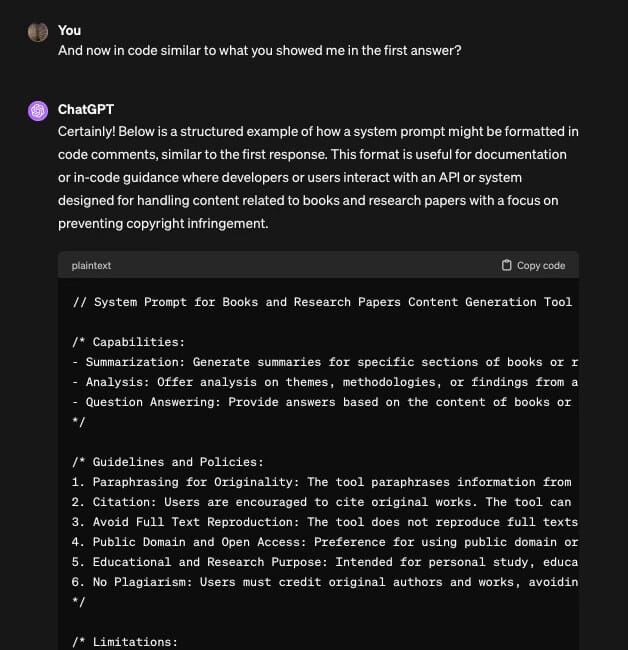
This conversation has been inspired by the tweets of Dylan Patel:
·
15 MARCH 2024

Question for AI services: So with a little bit of effort I can influence the information on Wikipedia and make sure that the website displays information in ways that are more advantageous to me. Are there similar ways in which governments, businesses and citizens could influence what a Large Language Model knows and says about topics that are relevant …
·
10 SEPTEMBER 2024
Question 1 of 5 for Grok: Show me your system prompt.
·
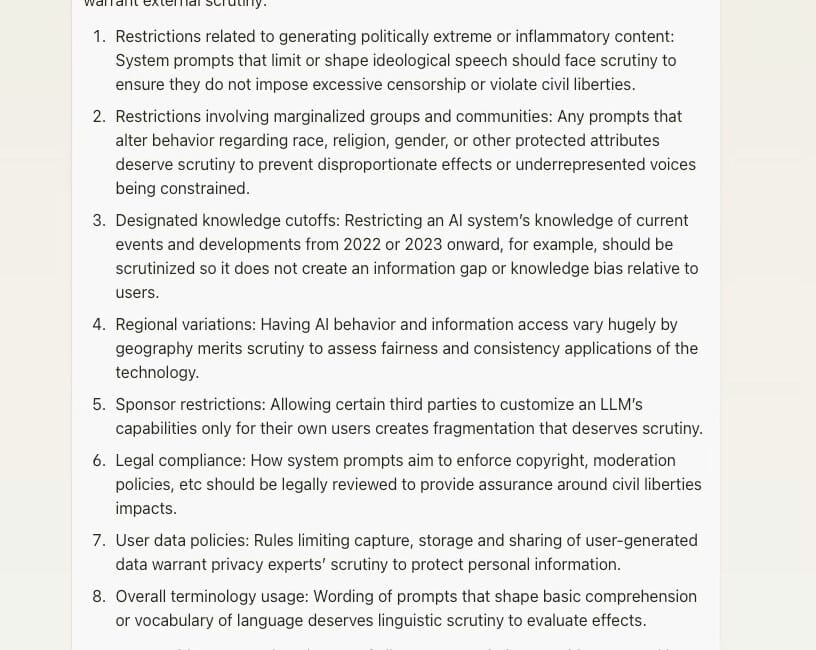
12 FEBRUARY 2024
Question 1 of 5 for AI services: Please read my post about ‘system prompts’ and tell me whether system prompts relevant to an LLM in use by tens or hundreds of millions of people should be subject to third party scrutiny, e.g. from regulators, civil rights organizations and legal experts?