- Pascal's Chatbot Q&As
- Posts
- The research is clear: the future is not “AI everywhere.” The future is “AI integrated through evidence, rights, and human expertise.”
The research is clear: the future is not “AI everywhere.” The future is “AI integrated through evidence, rights, and human expertise.”
AI, Public Infrastructure, and the New Social Contract: Synthesizing Copyright Governance, Health-Economics, and Learning Sciences in the Era of the Genesis Initiative

Pascal Hetzscholdt
November 27, 2025
AI, Public Infrastructure, and the New Social Contract: Synthesizing Copyright Governance, Health-Economics, and Learning Sciences in the Era of the Genesis Initiative
by ChatGPT-5.1
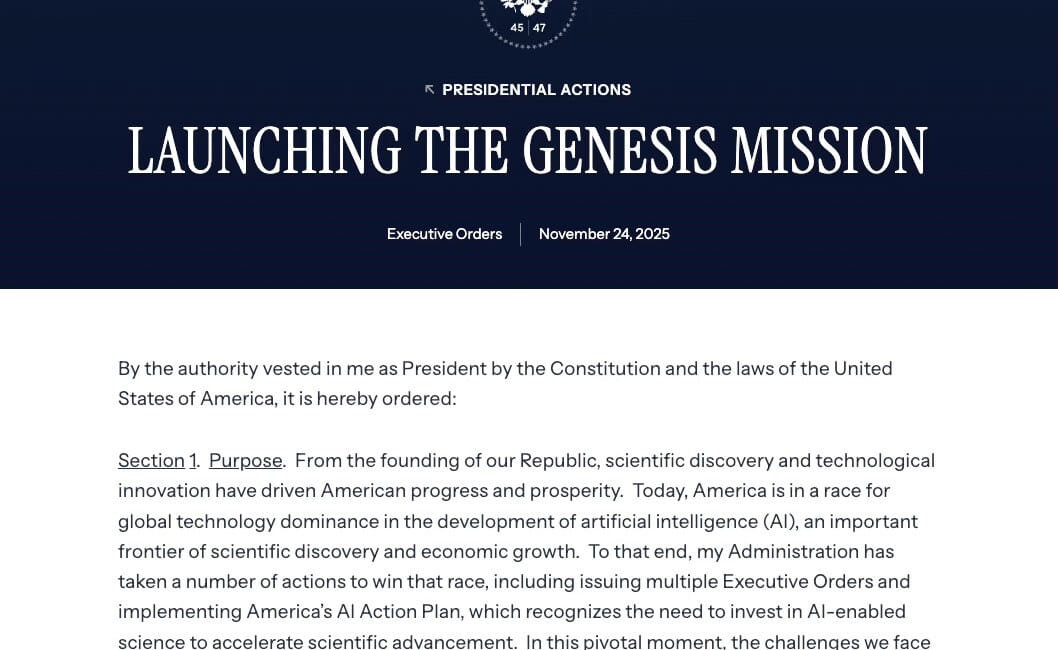
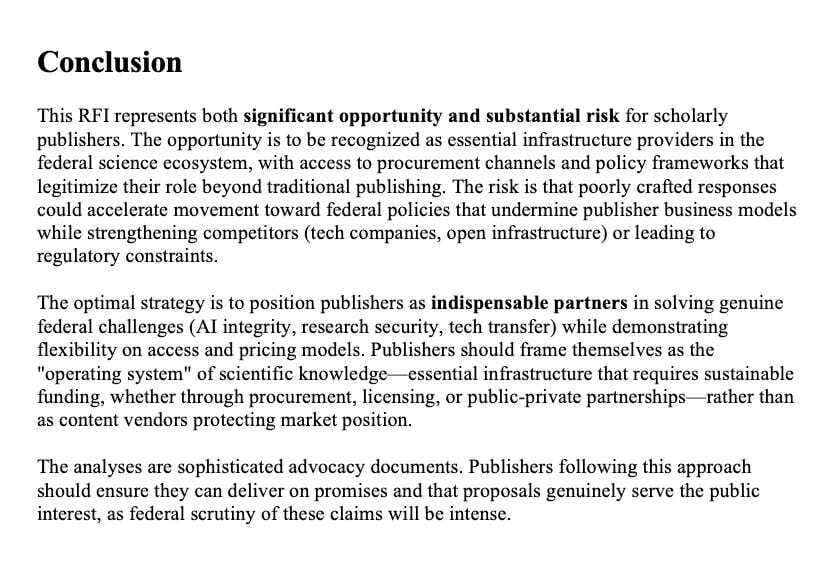
The United States government’s Genesis Initiative signals an attempt to re-architect national AI infrastructure around openness, accountability, and strategic public–private coordination. Alongside it, the OSTP Request for Information asks research institutions, industry, publishers, and civic stakeholders a central question: what structural, legal, and institutional reforms are needed to ensure AI advances national priorities without sacrificing ethical, economic, and democratic values?
Three recent scholarly works illuminate this moment from different angles:
Rademeyer & Selvadurai’s analysis of shadow libraries and copyright law for AI training datasets
Karaferis et al.’s systematic review of the long-term economic consequences of AI in healthcare and the critical role of Health Technology Assessment (HTA)
Together, they form a coherent narrative about what Genesis could be: a governance architecture grounded not in narrow technical benchmarks or laissez-faire innovation, but in a deliberate rebalancing of incentives, rights, evidence, and public structures across sectors.
1. Copyright, Shadow Libraries, and the Structural Integrity of the Knowledge Economy
Genesis cannot succeed without legitimacy—and legitimacy begins with dataset provenance.
Rademeyer & Selvadurai show that modern generative models have been built on top of “vast online repositories” of pirated works known as shadow libraries (LibGen, Sci-Hub, Bibliotik) that now play a non-trivial role in the data supply chain of the world’s most powerful AI systems. Their Australian case study is globally relevant because its proposed reforms—stricter definitions of lawful access, opt-out mechanisms, and mandatory dataset-source disclosure—mirror the type of interventions the U.S. is now contemplating. The authors highlight that:
The growth of GAI has amplified the illegal scraping of copyrighted works from shadow libraries, as confirmed by litigation such as the Sarah Silverman cases against Meta and OpenAI.
Existing copyright laws lack clarity on whether datasets themselves qualify as protected works or what constitutes lawful access.
Without enforceable transparency obligations, rightsholders cannot detect when their works are being extracted from illegal repositories.
The paper’s proposed IAP test (Incentives for authors, Access to works, Public interest) provides a policy-design heuristic directly relevant to the Genesis Initiative. Genesis envisions secure data stewards, transparency requirements, and provenance controls for AI models, yet the U.S. lacks a legislative foundation equivalent to the EU’s CDSM exceptions or AI Act disclosure rules. The imitation of such structures—while maintaining U.S. constitutional and market realities—would address several OSTP RFI questions about public–private coordination, technology-transfer frameworks, and the protection of U.S. intellectual property under AI-development incentives.
In short: Rademeyer & Selvadurai provide the missing copyright backbone without which Genesis cannot credibly enforce dataset provenance, nor protect U.S. scholarly and cultural capital.
2. AI in Healthcare: Economic Returns, Operational Risks, and the Case for Mandatory Assessment
Genesis promotes “AI for national competitiveness”; the healthcare paper explains why competitiveness without discipline generates cost, inequity, and risk.
Karaferis et al. provide a panoramic analysis of how AI is transforming healthcare economics, clinical outcomes, and institutional efficiency. Yet they warn that despite measurable performance gains—cost reductions, predictive analytics, reduced readmissions, improved resource allocation—AI remains plagued by operational, technological, security, and ethical obstacles that prevent consistent value realization.
Key insights include:
AI can deliver enormous systemic savings: some studies show 15–25% reductions in hospitalizations, 90% reductions in discharges, and multimillion-dollar savings through optimized telemedicine and screening pathways (Figures on pp. 3–4).
But these gains depend entirely on structured Health Technology Assessments (HTA) to measure cost-effectiveness, QALYs, ICER ratios, and real-world outcomes over time.
Without HTA-driven oversight, hospitals risk adopting technologies that “optimize” benchmarks but worsen clinician burden, exacerbate inequality, or reduce quality of care.
The resonance with Genesis is striking. Genesis seeks to make U.S. AI globally competitive; healthcare is one of its flagship domains. But if the U.S. wants AI to function as productive infrastructure rather than hype-driven expenditure, it must integrate mandatory HTA-style evaluation frameworks:
For federal procurement (aligns with OSTP RFI §(i) and §(ii));
For reimbursement and insurance incentives;
For ensuring that models deployed in public health systems demonstrate net societal benefit, not just vendor-claimed improvements.
Genesis is therefore not merely a technology initiative; it is a national risk-management and evaluation system, and healthcare provides a ready-made template.
3. AI in Education: Beyond Benchmarks Toward Human-in-the-Loop Learning Systems
If Genesis is the United States’ attempt to rebuild digital public infrastructure, education is the proving ground for democratic alignment.
Roschelle, McLaughlin & Koedinger argue that responsible AI in education cannot be reduced to technical benchmarking or model-to-model comparisons. Learning is too complex—and too consequential—to outsource to generative tutors without:
Grounding evaluations in learning outcomes, not model performance;
Ensuring meaningful comparison conditions (e.g., against validated instructional methods rather than arbitrary baselines);
Integrating learning scientists, developmental psychologists, and cognitive researchers early in design;
Practicing iterative, data-driven learning engineering in real educational settings.
The paper explicitly warns that relying on students’ or educators’ preferences—rather than empirical evidence—creates a false sense of effectiveness; only validated assessments, aligned with frameworks like the What Works Clearinghouse standards, can measure real learning gains.
Genesis’s education pillar (and the OSTP RFI’s focus on scaling innovation ecosystems) would benefit from this approach in several ways:
Public AI tutors should require formal learning-outcome validation.
Federal procurement should mandate LS-based design standards similar to HTA in healthcare.
AI must be deployed alongside human expertise, not positioned as a replacement for the pedagogical sciences.
Dataset governance for educational AI—including protections for copyrighted materials, student data, and learning-analytics privacy—must align with the copyright norms discussed in the first paper.
In short: educational AI is a microcosm of the Genesis problem: an overpowered technology deployed into a structurally fragile system without adequate scientific guardrails.
Taken together, the papers point toward five cross-sector imperatives that Genesis and the OSTP RFI should integrate into U.S. AI policy:
(1) Mandate Dataset Transparency and Provenance Across All Sectors
Shadow-library research makes clear that the current AI economy is built on opaque, unaccountable data flows. Without enforceable provenance disclosures, Genesis cannot provide the “trusted ecosystem” it promises.
(2) Align Innovation Incentives With Author, Researcher, and Public Interests
The IAP framework (incentives, access, public interest) is a scalable model for balancing rights and innovation in federal policy—including research-funding requirements, procurement guidelines, and commercialization pathways.
(3) Create Sector-Specific Evaluation Systems (HTA for Healthcare; LS-validated evaluation for Education)
The U.S. lacks standardized, federally backed evaluation models for AI. Genesis should not rely on vendor benchmarks but on independent, evidence-based frameworks.
(4) Build Interdisciplinary Capacity as a Governance Requirement
Learning scientists, health economists, copyright lawyers, auditors, and rights-holders must all be embedded in the design and deployment process—not added as afterthoughts.
(5) Invest in Public AI Infrastructure, Not Only Private AI Capacity
All three papers highlight failures of private-only development models:
copyright violations;
unvalidated educational tools;
healthcare systems unable to assess cost-effectiveness.
Genesis—and the OSTP RFI—signal a shift toward public, accountable, standards-based AI ecosystems, a direction strongly supported by the evidence.
Synthesized together, the three papers offer a blueprint for what the Genesis Initiative should become: a national AI governance and evaluation infrastructure that enforces data provenance, strengthens intellectual-property rights, improves clinical and educational outcomes, and restores public trust through interdisciplinary scrutiny and transparent standards.
AI cannot be governed through good intentions or innovation narratives alone.
Shadow-library research exposes the fragility of the legal substrate.
Healthcare research demonstrates the economic and clinical stakes of unregulated deployment.
Learning-science research reveals how easily education can be misdirected by technical metrics.
Genesis and the OSTP RFI arrive at a pivotal moment: the United States can choose to build an AI future grounded in rights, evidence, science, and public value—or continue a trajectory where innovation outpaces governance, and risk accumulates in critical social systems.
The research is clear: the future is not “AI everywhere.” The future is “AI integrated through evidence, rights, and human expertise.”

·
25 NOV
Gemini 3.0, Deep Research Analysis
·
26 NOV
Gemini 3.0, Deep Research Analysis