- Pascal's Chatbot Q&As
- Posts
- The convergence of muometric navigation, quantum sensing, and biological data fusion is rapidly constructing (...) a surveillance state where physical barriers no longer guarantee privacy.
The convergence of muometric navigation, quantum sensing, and biological data fusion is rapidly constructing (...) a surveillance state where physical barriers no longer guarantee privacy.
The “prison without walls” is being built (...) with data integration. A convergence of muometric navigation, forensic biometrics, and surveillance state data fusion.

Pascal Hetzscholdt
December 30, 2025
The following report builds on this analysis:
·
29 DEC

Somatic Witness: The Architecture of Counter-Custodial Surveillance in the Age of Disappearance
The Penetrating Observer: A Comprehensive Feasibility Analysis of Neutrino-Based Human Tracking and Subsurface Surveillance Architectures
by Gemini 3.0, Deep Research. Warning, LLMs may hallucinate!
1. Executive Summary: The Geometries of Absolute Surveillance
The pursuit of a tracking mechanism capable of penetrating the entire planet represents the ultimate frontier in surveillance technology. Current global positioning systems (GPS) and radio-frequency identification (RFID) technologies are fundamentally limited by the electromagnetic spectrum’s inability to traverse dense matter. Radio waves are attenuated by water, blocked by rock, and shielded by conductive metals, creating vast “dead zones” in subterranean environments, underwater, and within heavily reinforced structures. The investigation into the utilization of neutrinos—subatomic particles effectively immune to electromagnetic shielding—proposes a theoretical solution to this line-of-sight limitation. If a tracking system could utilize the weak nuclear force rather than the electromagnetic force, it would render the Earth transparent, allowing for the detection and localization of human bodies regardless of physical barriers.
This report provides an exhaustive physical, engineering, and sociopolitical analysis of this proposition. We examine the fundamental physics of neutrino interactions, specifically the constraints imposed by their minuscule cross-sections and the massive infrastructure currently required for their detection. We analyze the emerging technology of Coherent Elastic Neutrino-Nucleus Scattering (CEvNS) to determine if it offers a pathway to the necessary miniaturization of detectors. Beyond neutrinos, we investigate “similar principles” of penetrating physics, including Muometric Positioning Systems (muPS) which utilize cosmic-ray muons for underground navigation, and Quantum Gravity Gradiometry, which detects mass anomalies through walls.
Furthermore, we juxtapose these theoretical physics concepts against the current reality of “implantable” tracking, debunking persistent myths regarding injectable GPS while highlighting genuine advancements in forensic bio-tagging, DNA watermarking, and stable isotope analysis. Finally, we contextualize these technologies within the evolving “tech-led justice” initiatives, specifically examining recent high-level discourse in the United Kingdom regarding prisoner tracking and the data-fusion capabilities of firms like Palantir. The analysis concludes that while a neutrino-based human tracker remains impossible under current Standard Model physics due to the prohibitive requirements for signal generation and detection mass, the convergence of muometric navigation, quantum sensing, and biological data fusion is rapidly constructing a functional equivalent: a surveillance state where physical barriers no longer guarantee privacy.
2. Theoretical Fundamentals of Neutrino Interaction
To evaluate the feasibility of a neutrino tracking system, one must first confront the particle’s governing physics. The neutrino is a fermion that interacts solely via the weak nuclear force and gravity. Unlike photons, which interact via the electromagnetic force and are easily absorbed or reflected by atomic electron clouds, neutrinos pass through the vast voids between atomic nuclei. This “ghostly” nature is the very property that makes them attractive for through-earth tracking, yet it is also the property that makes them nearly impossible to manipulate as a beacon.

2.2 The First Neutrino Communication Demonstration
The concept of using neutrinos for communication is not strictly theoretical; it has been experimentally demonstrated, but the parameters of that demonstration highlight the absurdity of applying it to human-scale tracking. In 2012, the MINERvA collaboration at Fermilab utilized the NuMI (Neutrinos at the Main Injector) beamline to transmit a message through 240 meters of rock.
The experiment encoded the word “NEUTRINO” into a binary sequence using Pulse Position Modulation (PPM). The message was transmitted to the MINERvA detector, a massive apparatus weighing several tons, located 1.035 km away from the source.

The achieved data rate of 0.1 bits per second implies that transmitting a simple 64-bit coordinate string would take over ten minutes, assuming perfect reception and synchronization. This experiment utilized a detector weighing tons, capable of stopping only a tiny fraction of the high-energy beam. A human target, possessing insufficient mass to serve as a detector, would be invisible to the beam. The beam would pass through the target without depositing energy, rendering the “tracker” silent.
2.3 The Geometry of Tracking: Source vs. Interceptor
For a tracking system to function, the target must either (A) emit a signal (active tracking) or (B) perturb a signal sent from elsewhere (passive/semi-passive tracking).
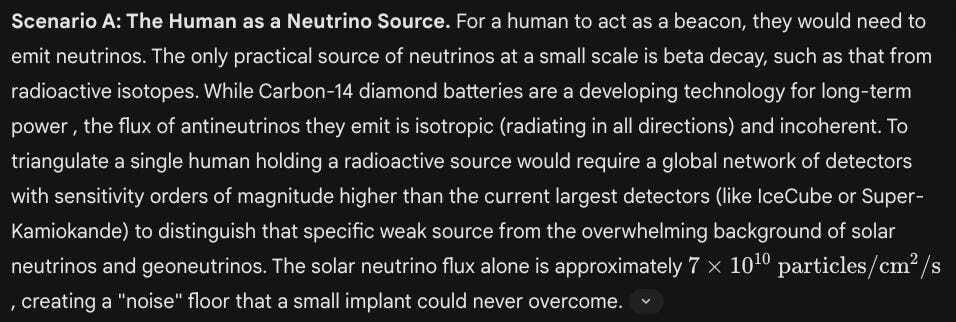
Scenario B: The Human as a Neutrino Interceptor. If we attempt to “ping” a human with a neutrino beam, the return signal would depend on reflection or absorption. Neutrinos do not reflect. They do not backscatter in any appreciable way that would allow a “radar-like” return. Absorption is the only mechanism, which would require the human to cast a “shadow” on a detector on the other side of the planet. Given the mean free path discussed above, a human body stops essentially zero neutrinos. Therefore, a human casts no neutrino shadow.
3. Coherent Elastic Neutrino-Nucleus Scattering (CEvNS): The Limits of Miniaturization
While the traditional inverse beta decay detection methods require kiloton-scale detectors, a significant breakthrough in neutrino physics offers a theoretical pathway toward miniaturization. This process is known as Coherent Elastic Neutrino-Nucleus Scattering (CEvNS).

3.2 The Recoil Energy Barrier
However, the “miniaturization” enabled by CEvNS comes with a severe trade-off: recoil energy. In a CEvNS interaction, the neutrino strikes the nucleus like a ping-pong ball hitting a bowling ball. The nucleus recoils, but the energy deposited is minuscule—typically in the range of a few kilo-electron volts (keV) or even sub-keV.
To detect such a faint signal, the detector material must be extremely sensitive to low-energy ionization or scintillation. This necessitates:
Cryogenic Cooling: Many CEvNS detectors (like Germanium or Liquid Argon) require cooling to liquid nitrogen or liquid helium temperatures to reduce thermal noise.
Background Suppression: Because the signal looks exactly like low-energy background radiation (neutrons, cosmic rays), the detector requires massive shielding. A “portable” CEvNS detector might weigh 15 kg, but the lead and water shielding required to make it work weighs hundreds of kilograms.
Therefore, while CEvNS allows for “portable” detectors that could theoretically be mounted in a van to monitor a nuclear reactor , it does not enable the creation of a micro-tracker. The physics demands a mass-to-signal ratio that biology cannot support. An implantable chip cannot contain the necessary thermal insulation, shielding, or active detection mass to register a CEvNS event.
4. Radiometric Tagging: The Feasibility of Isotopic Beacons
If the human body cannot be a detector, we must rigorously examine the feasibility of it being a source. Could an implant emit neutrinos strong enough to be tracked? The most viable candidate for a self-powered, long-term neutrino emitter is the betavoltaic battery, specifically those utilizing Carbon-14 (C-14).

Furthermore, the energy of C-14 antineutrinos is very low (endpoint energy 156 keV).23 This is well below the threshold for Inverse Beta Decay (1.8 MeV), the primary method used in large detectors like Super-Kamiokande or KamLAND.8 Consequently, a C-14 implant is effectively invisible to current neutrino detectors not only because the flux is vanishingly low compared to the sun, but because the energy of the emitted particles is too low to trigger the standard detection interactions.25
4.2 Reactor Monitoring: The True Scale of Neutrino Tracking
The only functional application of “remote neutrino tracking” today is the monitoring of nuclear reactors. Unlike a battery, a nuclear reactor produces massive fluxes of antineutrinos (billions per nanosecond) with higher energies (up to 8-10 MeV). This allows detectors placed tens or hundreds of meters away to monitor the reactor’s “burnup” and plutonium content.20
This application highlights the scale required: to track a stationary object emitting gigawatts of energy, we need detectors the size of shipping containers.20 To track a mobile human emitting microwatts, the physics simply does not close.

5.1 Muometric Positioning System (muPS)
Research led by Hiroyuki Tanaka at the University of Tokyo has successfully demonstrated a Muometric Positioning System (muPS). This system functions similarly to GPS but uses cosmic ray muons instead of satellite radio signals.
Mechanism: Reference detectors are placed above ground or on the surface. A receiver is placed underground (in a basement, tunnel, or underwater). By timing the arrival of muons at the reference detectors and the receiver, the system calculates the position of the receiver based on the time-of-flight (ToF) and angle-of-arrival (AoA) of the muons passing through the earth.
Performance: Recent iterations, such as the Vector muPS, have achieved centimeter-level accuracy.
Penetration: This system works in environments where GPS is completely blocked: deep underwater, inside mines, and in reinforced concrete bunkers.
Wireless Capability: The MuWNS (Muometric Wireless Navigation System)has been tested, using high-precision atomic clocks to synchronize the receiver and reference detectors, removing the need for wired connections.
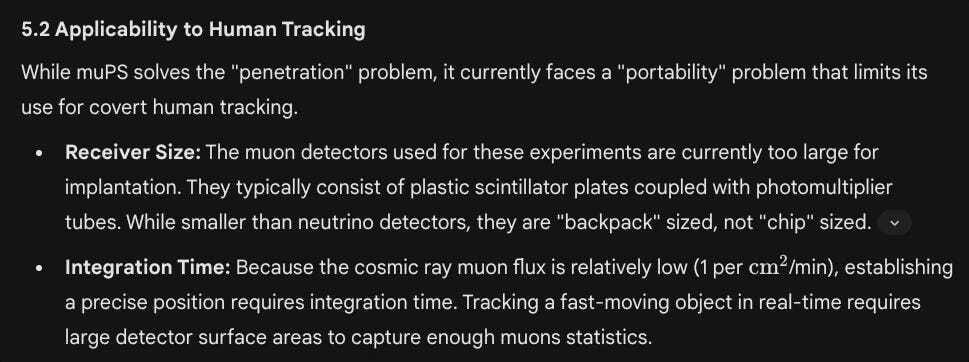
Insight: Muometric navigation is the closest existing technology to offer an alternative. It uses subatomic particles that pass through buildings and earth to track coordinates. However, it requires the target to carry a detector (receiver) that is currently too bulky for covert human tracking. It is a technology for “blue force tracking” in tunnels, not for covert surveillance of individuals.
6. Quantum Gravity Sensing: Seeing Without Seeing
Another frontier in “through-earth” detection is Quantum Gravity Gradiometry. This technology differs fundamentally from neutrino or muon tracking: it does not track a tag; it detects the mass of the object itself.
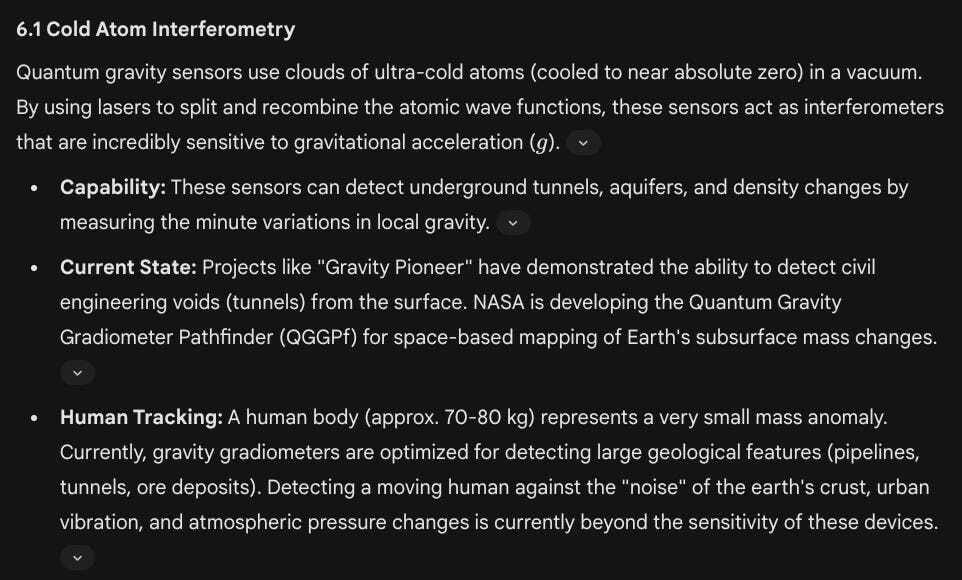
However, this technology is theoretically “unblockable.” Gravity cannot be shielded. If sensitivity improves by several orders of magnitude (a “Moore’s Law” for quantum sensing), it is theoretically possible to track a human mass moving through a building or underground structure without any tag or implant, solely by the gravitational perturbation their body creates.
7. The Myth of Implantable GPS and RF Limitations
To contextualize the advanced physics above, we must address why standard technology (GPS/Radio) fails, as this failure drives the desire for neutrino/muon alternatives.
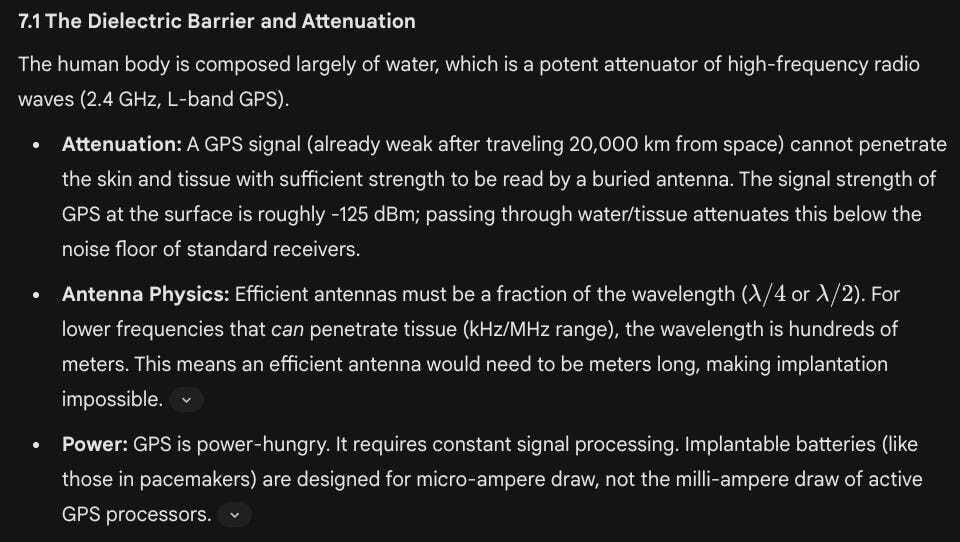
7.2 The “Injectable” Myth vs. Reality
Snippets and explicitly debunk the existence of injectable GPS trackers. The “chips” often cited in conspiracy theories are passive RFID/NFC tags.
Passive RFID: These have no power source. They rely on a reader to send a magnetic field, which induces a current in the tag’s coil. The range is millimeters to centimeters. They are identification tags, not tracking tags.
Active RFID: Active tags have batteries and can transmit up to 100 meters. However, the battery requirement increases the size to that of a key fob or credit card, rendering them non-injectable.
8. Biological and Chemical Forensic Tracking
While real-time “through-earth” tracking of a specific human is currently impossible via physics, science offers robust methods for tracking a human’s history and provenance using biological markers. This is “tracking” in the forensic sense—reconstructing where a body has been.
8.1 Stable Isotope Analysis: The Chemical GPS
The axiom “you are what you eat” is isotopically true. The water we drink and the food we eat contain specific ratios of stable isotopes (Oxygen-18, Deuterium, Strontium-87/86) that vary by geography due to evaporation, rainfall, and local geology.
Mechanism: As tissues grow, they incorporate these isotopes.
Hair/Nails: Keratin provides a timeline. A strand of hair grows ~1cm per month. Analyzing segments of hair can reconstruct a person’s travel history over months or years.
Teeth/Bone: Enamel forms in childhood and locks in the isotopic signature of the place of birth. Bone remodels slowly, reflecting the last 10-20 years of residence.
Application: Intelligence and forensic agencies use this to identify the origin of unidentified remains or to verify the travel history of detainees. For example, strontium isotope ratios in teeth can distinguish an individual raised in the Horn of Africa from one raised in West Africa. This is a “passive” tracker written into the body’s chemistry.
8.2 DNA Watermarking and Synthetic Biology
Synthetic biology allows for the creation of “tracking” sequences that are far more durable than electronic chips.
DNA Barcoding: Originally used for species identification , this concept has evolved into synthetic DNA watermarks.
Mechanism: Unique, non-coding DNA sequences can be synthesized and introduced into an organism (or even non-biological materials). These sequences act as a “serial number” that can be read via Polymerase Chain Reaction (PCR) and sequencing.
Durability: Unlike electronic chips, DNA can persist in harsh environments. Researchers are developing “modular” barcode libraries that allow for billions of unique identifiers.
Future Utility: While not a real-time locator, a “DNA tattoo” or viral vector could permanently tag an individual with a machine-readable code. This code is resistant to mutation and cannot be surgically removed without destroying the tissue itself.
8.3 Infrared Fluorescent Proteins (iRFP)
For tracking within the body (e.g., tracking tumor cells or specific tissues), scientists use Near-Infrared Fluorescent Proteins (iRFPs).
The “Optical Window”: Mammalian tissue is relatively transparent to near-infrared light (650-900 nm).
Application: By genetically modifying cells to express iRFP (derived from bacterial phytochromes), researchers can image deep tissues in live animals.
Limitation: This works through a few centimeters of tissue (e.g., a mouse), not through a human body or a planet. However, it represents the biological equivalent of an RF beacon, allowing for non-invasive monitoring of internal biological processes.
9. The Surveillance State: “Prisons Without Walls”
The technical search for advanced tracking is driven by political necessity and coincides with significant policy shifts in the United Kingdom and United States regarding offender management, where the desire for “invisible” tracking is explicitly stated.
9.1 The UK “Tech-Led Justice” Initiative
In July 2025, UK Justice Secretary Shabana Mahmood convened a meeting with tech giants including Google, Amazon, and Palantir. The agenda focused on solving the prison capacity crisis through technology, creating a “prison outside of prison.”
The Proposal: Shifting from physical incarceration to digital containment.
Technologies Pitched:
Subcutaneous Trackers: Explicitly proposed by tech firms as a way to monitor offenders without ankle bracelets. This confirms that major tech companies are actively exploring the concept of implantable trackers, even if the physics (as discussed above) forces them toward short-range RF or biometric data collection rather than global neutrino tracking.
AI Behaviour Analysis: Using Palantir’s data integration capabilities to predict reoffending or track behavioral patterns.
Robotic Supervision: Automating containment.
9.2 Palantir and the Data Integration Model
Palantir’s involvement is notable. They do not manufacture the sensor (the implant), but they provide the operating system (ImmigrationOS, Gotham) that ingests data from disparate sources (license plate readers, cell tower triangulation, GPS ankle monitors, biometrics) to create a persistent surveillance profile.
The Shift: The industry is moving from hardware tracking (a better ankle monitor) to data tracking (integrating every digital footprint).
Alternatives to Detention (ATD): In the US, ICE utilizes “SmartLINK” apps and ankle monitors, feeding data into Palantir’s systems. While not a “through-earth” physical tracker, the aggregation of credit card usage, facial recognition, and license plate data creates a virtual panopticon that effectively tracks the individual anywhere they interact with the modern world.
Ethical Concerns: Human rights groups characterize this as a “dystopian” expansion of state power, moving towards a reality where the physical body is directly integrated into the corrections infrastructure.
10. Emerging Frontiers: Smart Dust and Theoretical Physics
To ensure a comprehensive view, we must briefly address two edge-case technologies: “Smart Dust” and theoretical entangled neutrino communication.
10.1 Smart Dust
“Smart Dust” refers to Micro-Electro-Mechanical Systems (MEMS) sensors the size of dust particles.
Status: Current “motes” are millimeter-scale (”Smart Pebbles”).
Communication: They rely on optical or RF communication, which suffers from the same line-of-sight and attenuation issues as standard GPS.
Neural Dust: Research into “neural dust” uses ultrasound to power and communicate with tiny implants deep in the body, avoiding the RF attenuation problem. This is a promising avenue for internal body networking (Brain-Computer Interfaces), but it does not solve the external global tracking problem, as ultrasound does not propagate through air to a satellite.
10.2 Entangled Neutrinos
Theoretical physics papers explore the concept of using entangled neutrinos or neutrino oscillations for quantum information tasks. While this offers theoretical advantages in coherence and security, it does not solve the fundamental interaction problem. The difficulty of detecting the neutrino remains, regardless of whether it is entangled. Thus, while it is a fascinating area of high-energy physics, it does not currently offer a pathway to a practical tracking device.
11. Comparative Analysis and Conclusion
Table 2: Feasibility Matrix of Advanced Human Tracking Technologies
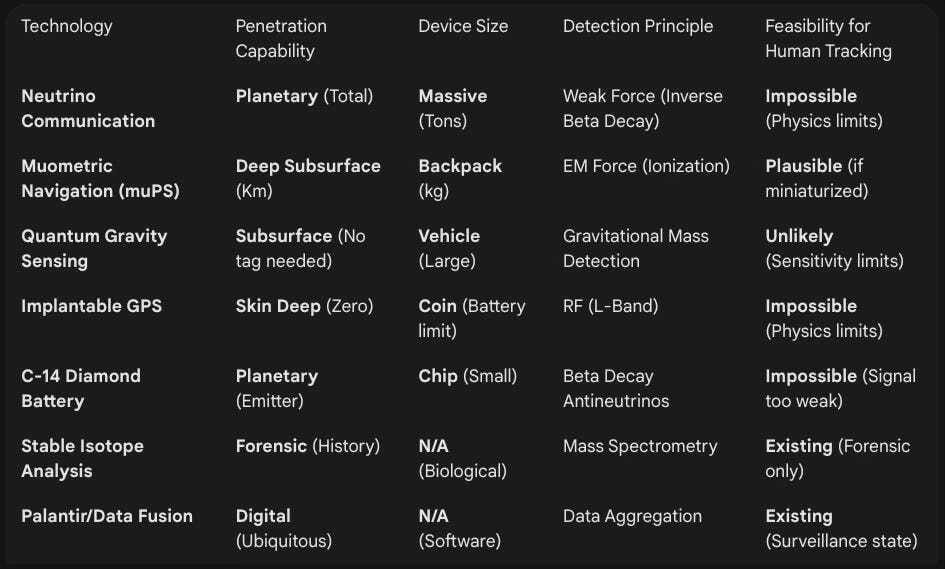
In conclusion, the specific mechanism of using neutrinos to track human bodies is scientifically infeasible and will likely remain so. The laws of the weak interaction prevent the miniaturization of detectors to a scale compatible with biology, and the background noise of the universe prevents the use of miniature neutrino beacons.
However, the underlying requirement—unblockable tracking—is being approximated by a convergence of muometric navigation (for GPS-denied environments), forensic biometrics (for historical tracking), and surveillance state data fusion (for virtual tracking). The “prison without walls” is being built not with neutrino beams, but with data integration.

Works cited
Neutrino Detectors, accessed December 29, 2025, https://indico.fnal.gov/event/57378/contributions/273075/attachments/170081/228554/INSS2023_NuDetectors_Gollapinni_Lecture1.pdf
accessed December 29, 2025, https://www.researchgate.net/publication/221679699_DEMONSTRATION_OF_COMMUNICATION_USING_NEUTRINOS
[1203.2847] Demonstration of Communication using Neutrinos - arXiv, accessed December 29, 2025, https://arxiv.org/abs/1203.2847
MINERνA - Wikipedia, accessed December 29, 2025, https://en.wikipedia.org/wiki/MINER%CE%BDA
DEMONSTRATION OF COMMUNICATION USING NEUTRINOS - Fermilab | Technical Publications, accessed December 29, 2025, https://lss.fnal.gov/archive/2012/pub/fermilab-pub-12-073-e.pdf
A diamond battery for Valentine’s Day? - American Nuclear Society, accessed December 29, 2025, https://www.ans.org/news/2025-02-14/article-6765/a-diamond-battery-for-valentines-day/
Nuclear diamond batteries - ScienceForSustainability, accessed December 29, 2025, https://scienceforsustainability.org/wiki/Nuclear_diamond_batteries
Is a DIY neutrino detector feasible? - Physics Stack Exchange, accessed December 29, 2025, https://physics.stackexchange.com/questions/234445/is-a-diy-neutrino-detector-feasible
A Brief History Of Neutrinos - The T2K Experiment, accessed December 29, 2025, https://t2k-experiment.org/neutrinos/a-brief-history/
Neutrino Interaction Cross Sections (NF06) Topical Group Report - arXiv, accessed December 29, 2025, https://arxiv.org/pdf/2209.06872
IceCube performs new measurement of all-flavor neutrino cross section, accessed December 29, 2025, https://icecube.wisc.edu/news/research/2020/11/icecube-performs-new-measurement-of-all-flavor-neutrino-cross-section/
Coherent elastic neutrino-nucleus scattering: Terrestrial and astrophysical applications, accessed December 29, 2025, https://www.researchgate.net/publication/359228908_Coherent_elastic_neutrino-nucleus_scattering_Terrestrial_and_astrophysical_applications
[1509.08702] The COHERENT Experiment at the Spallation Neutron Source - arXiv, accessed December 29, 2025, https://arxiv.org/abs/1509.08702
CEvNS and NINs: Observation of - FSU Physics Department, accessed December 29, 2025, https://physics.fsu.edu/sites/g/files/upcbnu441/files/media/seminar_pdf/ScholbergFSU.pdf
Sensitivity of a Liquid Xenon Detector to Neutrino–Nucleus Coherent Scattering and Neutrino Magnetic Moment from Reactor Neutrinos - MDPI, accessed December 29, 2025, https://www.mdpi.com/2218-1997/7/3/54
Measurement of the Coherent Elastic Neutrino-Nucleus Scattering Cross Section on CsI by COHERENT - DukeSpace, accessed December 29, 2025, https://dukespace.lib.duke.edu/items/6d80fa65-dfe8-4d04-8b60-fa31a21f8461
Magnificent CEvNS 2021 - Indico Global, accessed December 29, 2025, https://indico.global/event/856/timetable/?view=standard_numbered
World’s smallest neutrino detector finds big physics fingerprint – LabNews, accessed December 29, 2025, https://www.sandia.gov/labnews/2017/08/18/worlds-smallest-neutrino-detector-finds-big-physics-fingerprint/
arXiv:1803.09183v2 [physics.ins-det] 3 Apr 2018, accessed December 29, 2025, https://sites.duke.edu/coherent/files/2018/04/1803.09183.pdf
Antineutrino detectors could aid non-proliferation | Virginia Tech News, accessed December 29, 2025, https://news.vt.edu/articles/2014/08/081214-science-antineutrino.html
Laboratory researchers describe how antineutrino detectors could aid in nuclear nonproliferation efforts, accessed December 29, 2025, https://www.llnl.gov/article/46186/laboratory-researchers-describe-how-antineutrino-detectors-could-aid-nuclear-nonproliferation
‘Diamond-age’ of power generation as nuclear batteries developed | Cabot Institute for the Environment | University of Bristol, accessed December 29, 2025, https://www.bristol.ac.uk/cabot/what-we-do/diamond-batteries/
Carbon-14 - Wikipedia, accessed December 29, 2025, https://en.wikipedia.org/wiki/Carbon-14
Super-Heavy Neutrinos: Who Ordered That? - Center for Experimental Nuclear Physics and Astrophysics (CENPA), accessed December 29, 2025, https://www.npl.washington.edu/av/altvw49.html
Full article: Reactor antineutrinos and novel application to real-time remote monitoring of nuclear reactors - Taylor & Francis Online, accessed December 29, 2025, https://www.tandfonline.com/doi/full/10.1080/00223131.2023.2276418
Analysis of the reactor antineutrino spectrum anomaly with fuel burnup - EPJ Web of Conferences, accessed December 29, 2025, https://www.epj-conferences.org/articles/epjconf/pdf/2020/15/epjconf_nd2019_02005.pdf
Tests Begin on Sensitive Neutrino Detector for Nonproliferation As Well as Physics, accessed December 29, 2025, https://vcresearch.berkeley.edu/news/tests-begin-sensitive-neutrino-detector-nonproliferation-well-physics
Muometric navigation - Wikipedia, accessed December 29, 2025, https://en.wikipedia.org/wiki/Muometric_navigation
Muometric positioning system (muPS) utilizing direction vectors of cosmic-ray muons for wireless indoor navigation at a centimeter-level accuracy - PubMed, accessed December 29, 2025, https://pubmed.ncbi.nlm.nih.gov/37714877/
[2308.10108] Developments of a centimeter-level precise muometric wireless navigation system (MuWNS-V) and its first demonstration using directional information from tracking detectors - arXiv, accessed December 29, 2025, https://arxiv.org/abs/2308.10108
Cosmic-ray arrival time indoor navigation | Proceedings A - The Royal Society, accessed December 29, 2025, https://royalsocietypublishing.org/doi/10.1098/rspa.2024.0346
Quantum sensing for gravity cartography - PMC - PubMed Central - NIH, accessed December 29, 2025, https://pmc.ncbi.nlm.nih.gov/articles/PMC8866129/
Gravity sensors see underground - National Quantum Technologies Programme, accessed December 29, 2025, https://uknqt.ukri.org/wp-content/uploads/2021/10/Gravity-Sensors-See-Underground.pdf
NASA developing 1st-ever space-based quantum sensor for gravity measurements, accessed December 29, 2025, https://www.space.com/space-exploration/tech/nasa-developing-1st-ever-space-based-quantum-sensor-for-gravity-measurements
Quantum Sensor Opens ‘a New Window into the Underground’ - VICE, accessed December 29, 2025, https://www.vice.com/en/article/quantum-sensor-opens-a-new-window-into-the-underground/
NASA to Launch First Space-Based Quantum Gravity Sensor to Map Earth’s Hidden Shifts, accessed December 29, 2025, https://thequantuminsider.com/2025/04/16/nasa-to-launch-first-space-based-quantum-gravity-sensor-to-map-earths-hidden-shifts/
Injectable GPS Tracker: Does It Exist? - GPSTracker247, accessed December 29, 2025, https://gpstracker247.com/blogs/guides/injectable-gps-tracker
Implant or GPS chip for cats and dogs, how to choose? - Weenect, accessed December 29, 2025, https://www.weenect.com/us/en/microchip-gps-implant-cat-dog/
Active Vs. Passive RFID For Location Tracking [2021 UPDATE] - Link Labs, accessed December 29, 2025, https://www.link-labs.com/blog/active-vs-passive-rfid
Active vs Passive RFID: Understanding Which Is Right For Your Application - Jadak, accessed December 29, 2025, https://www.jadaktech.com/blog-posts/active-vs-passive-rfid/
Active vs. Passive RFID Tags: What’s the Difference and Which to Choose - Comparesoft, accessed December 29, 2025, https://comparesoft.com/assets-tracking-software/rfid-asset-tracking/active-rfid-vs-passive-rfid-tags/
Active vs. Passive RFID: Which Is Right for Your Use Case? - RedBeam, accessed December 29, 2025, https://redbeam.com/blog/resources/active-vs-passive-rfid
Stable Isotope Provenance of Unidentified Deceased Migrants—A Pilot Study - PMC, accessed December 29, 2025, https://pmc.ncbi.nlm.nih.gov/articles/PMC10669205/
Recent applications of isotope analysis to forensic anthropology - PMC - PubMed Central, accessed December 29, 2025, https://pmc.ncbi.nlm.nih.gov/articles/PMC6427615/
Assessing the Reliability of Mobility Interpretation From a Multi-Isotope Hair Profile on a Traveling Individual - Frontiers, accessed December 29, 2025, https://www.frontiersin.org/journals/ecology-and-evolution/articles/10.3389/fevo.2020.568943/full
Recent applications of isotope analysis to forensic anthropology - Taylor & Francis Online, accessed December 29, 2025, https://www.tandfonline.com/doi/abs/10.1080/20961790.2018.1549527
DNA barcoding - Wikipedia, accessed December 29, 2025, https://en.wikipedia.org/wiki/DNA_barcoding
DNA Barcoding: Species Detection and High Throughput Assays | The Scientist, accessed December 29, 2025, https://www.the-scientist.com/dna-barcoding-species-detection-and-high-throughput-assays-71860
IIT Indore Innovates DNA Watermarking for IP Security - TMWala, accessed December 29, 2025, https://tmwala.com/iit-indore-dna-watermarking-breakthrough/
Design and Experimental Evaluation of a Minimal, Innocuous Watermarking Strategy to Distinguish Near-Identical DNA and RNA Sequences | ACS Synthetic Biology, accessed December 29, 2025, https://pubs.acs.org/doi/10.1021/acssynbio.0c00045
Scalable Combinatorial Assembly of Synthetic DNA for Tracking Applications - PubMed, accessed December 29, 2025, https://pubmed.ncbi.nlm.nih.gov/36768872/
Inheritable Watermarks from DNA Language Models to Proteins - arXiv, accessed December 29, 2025, https://arxiv.org/html/2509.18207
iRFp as a marker for cell proliferation in vitro. (A-C) plates as... - ResearchGate, accessed December 29, 2025, https://www.researchgate.net/figure/RFp-as-a-marker-for-cell-proliferation-in-vitro-A-C-plates-as-described-in-Figure-2_fig3_258347738
Advanced optoacoustic methods for multiscale imaging of in vivo dynamics - PMC, accessed December 29, 2025, https://pmc.ncbi.nlm.nih.gov/articles/PMC5460636/
MEASURES PROPOSED TO ENABLE A ‘TECH-LED APPROACH TO JUSTICE’, accessed December 29, 2025, https://www.prisonersadvice.org.uk/measures-proposed-to-enable-a-tech-led-approach-to-justice/
Tech firms suggested placing trackers under offenders’ skin at meeting with justice secretary | Prisons and probation | The Guardian, accessed December 29, 2025, https://www.theguardian.com/society/2025/jul/01/tech-firms-suggested-placing-trackers-under-offenders-skin-at-meeting-with-justice-secretary
Tech giants propose under-skin tracking and AI policing in radical justice overhaul, accessed December 29, 2025, https://bmmagazine.co.uk/news/tech-firms-propose-under-skin-trackers-uk-justice/
Google, Amazon, Palantir Pitch Skin GPS Tracking Implants to UK Government, accessed December 29, 2025, https://insidetelecom.com/google-to-put-gps-skin-tracking-implants-in-uk-offenders/
How transdermal microchips could revolutionize prison security - Corrections1, accessed December 29, 2025, https://www.corrections1.com/jail-management/how-transdermal-microchips-could-revolutionize-prison-security
How tech powers immigration enforcement - Brookings Institution, accessed December 29, 2025, https://www.brookings.edu/articles/how-tech-powers-immigration-enforcement/
Data-Driven Deportation in the 21st Century - American Dragnet, accessed December 29, 2025, https://americandragnet.org/finding1
DHS’s Data Reservoir | Epic.org, accessed December 29, 2025, https://epic.org/wp-content/uploads/2022/08/DHS-Data-Reservoir-Report-Aug2022.pdf
Trackers under skin, robot prison wardens In UK, vision for justice takes ‘dystopian’ turn, accessed December 29, 2025, https://indianexpress.com/article/world/microchips-robot-prison-wardens-uk-vision-future-justice-dystopian-10100093/
Editorial: Smart dust: Micro and nano scale devices for highly-integrated localized and distributed smart systems for precision and personalized medicine - NIH, accessed December 29, 2025, https://pmc.ncbi.nlm.nih.gov/articles/PMC9589485/
Smart Dust - University of Houston, accessed December 29, 2025, http://www.bauer.uh.edu/uhisrc/ftb/smart%20dust/smart%20dust.pdf
Coherent dynamics of flavor mode entangled neutrinos - arXiv, accessed December 29, 2025, https://arxiv.org/pdf/2501.06311
arXiv:2410.05727v1 [hep-ph] 8 Oct 2024, accessed December 29, 2025, https://arxiv.org/pdf/2410.05727