- Pascal's Chatbot Q&As
- Posts
- The biblical text is a tapestry woven from the threads of Ancient Near Eastern and Hellenistic literature. In the ancient world, authority was derived from antiquity.
The biblical text is a tapestry woven from the threads of Ancient Near Eastern and Hellenistic literature. In the ancient world, authority was derived from antiquity.
To write a law code that mirrored Hammurabi, or a proverb collection that echoed Amenemope, was to claim a place within the legitimate, time-honored tradition of civilized wisdom.

Pascal Hetzscholdt
December 18, 2025
Echoes of the Ancient Near East: A Comprehensive Research Report on Intertextual Parallels in Biblical Literature
by Gemini 3.0, Deep Research. Warning, LLMs may hallucinate!
1. Introduction: The Methodology of Comparative Semitics and Intertextuality
The study of the Hebrew Bible (Old Testament) and the New Testament has undergone a radical transformation over the last century and a half, driven primarily by the archaeological recovery of the Ancient Near East (ANE) and the Greco-Roman literary milieu. No longer viewed in isolation as a sui generis revelation dropped into a cultural void, the biblical text is now understood by scholars as a vibrant participant in a trans-temporal, cross-cultural literary conversation. This report investigates the phenomenon often provocatively termed “plagiarism” in lay discourse, but which is more accurately classified within the academy as literary dependence, scribal appropriation, mimesis(imitation), and polemical adaptation.
The objective of this analysis is to provide an exhaustive catalog and examination of biblical narratives, laws, poems, and prophecies that bear a striking, often verbatim, resemblance to earlier texts from Mesopotamia, Egypt, Canaan, and Greece. The scope of this inquiry ranges from the primeval histories of Sumer (c. 3rd millennium BCE) to the imperial propaganda of Rome (1st century CE). By placing biblical texts side-by-side with their antecedents—such as the Epic of Gilgamesh, the Code of Hammurabi, the Instruction of Amenemope, and the Homeric Epics—we can discern the distinct fingerprints of literary borrowing.
This report posits that biblical authors functioned as sophisticated scribes who inherited a “Great Tradition” of ancient wisdom and law. They did not merely copy these texts; they “recycled” them (to use the terminology of Finkel 1 ) to construct a unique theological identity. The analysis is structured by literary genre, moving from Myth and Narrative to Law, Wisdom, Prophecy, and finally to the Hellenistic mimesis found in the New Testament.
2. Cosmic Origins and Primeval History: The Mesopotamian Substratum
The first eleven chapters of Genesis, known as the Primeval History, exhibit the deepest roots in the soil of Mesopotamia. The narratives concerning the creation of the cosmos, the antediluvian patriarchs, the Great Flood, and the confusion of tongues are not merely thematically similar to Sumerian and Akkadian myths; they share specific plot sequences, rare philological terms, and structural outlines that betray a direct literary lineage.
2.1 The Deluge: Genesis, Gilgamesh, and the Ark Tablet
The biblical Flood narrative (Genesis 6–9) is the most celebrated instance of literary parallelism in the Bible. Since George Smith’s discovery of the eleventh tablet of the Epic of Gilgamesh in 1872, the dependence of the Noah story on earlier Mesopotamian models has been a cornerstone of critical scholarship. However, recent discoveries, particularly the “Ark Tablet” analyzed by Irving Finkel, have refined our understanding of this relationship from general influence to specific textual transmission.
2.1.1 The Narrative Sequence
The structural similarities between the biblical account and the Mesopotamian versions—specifically Gilgamesh (Tablet XI) and the earlier Atrahasis Epic (c. 1700 BCE)—are undeniable. Both traditions follow an identical narrative arc that is too complex to be coincidental:
Divine Decision: A decision is made by the divine assembly to destroy humanity.
The Dissenter: One god (Ea/Enki in Mesopotamia; Yahweh in Genesis) acts against the consensus to save a hero.
The Warning: The hero (Utnapishtim/Atrahasis/Noah) is warned of the coming catastrophe. In Gilgamesh, Ea whispers to the reed wall to circumvent the oath of secrecy; in Genesis, God speaks directly to Noah.
Construction Orders: Detailed dimensions and architectural specifications are given for a boat.
The Embarkation: The hero boards with family and animals.
The Storm: A catastrophic inundation destroys all life outside the boat.
The Release of Birds: Birds are sent out to test for dry land.
Sacrifice and Oath: The hero offers a sacrifice; the deity smells the aroma; a promise is made never to destroy the earth by flood again.
2.1.2 The Ark Tablet and the “Two by Two” Motif
The discovery of the “Ark Tablet” (a manuscript of the Atrahasis tradition) provided a critical “missing link.” Dr. Irving Finkel identified the specific cuneiform sign suna in the context of the animals entering the boat. This sign, meaning “two by two,” confirms that the distinctive biblical detail of animals entering in pairs (Genesis 6:19, 7:9) was present in the Babylonian tradition a millennium before the writing of Genesis.2 This suggests that the biblical author (specifically the Priestly source) did not invent this detail but preserved a very old Mesopotamian tradition.
2.1.3 Architectural Divergence: The Coracle vs. The Box
While the storylines converge, the physical description of the ark diverges in telling ways. The Ark Tablet describes the vessel as a giant circular coracle (a round boat made of coiled rope and waterproofed with bitumen), a vessel type common on the Tigris and Euphrates but unknown in highland Judah.1 The Gilgamesh epic describes a perfect cube (length equals width equals height). Genesis describes a rectangular box (tevah).
Finkel argues that the circular design was the original “realistic” tradition based on actual Mesopotamian river craft. As the story migrated and the practical knowledge of coracles faded, the shape became more abstract (cubic) or practical for a different context (rectangular). However, the use of bitumen (pitch) to seal the ark (Gen 6:14) remains a distinct Mesopotamian fingerprint, as bitumen is a natural resource of Iraq, not Palestine.1
2.1.4 The “Smelling of the Sacrifice”
Perhaps the most visceral parallel occurs in the aftermath of the flood.
Epic of Gilgamesh (XI:159-161): “I poured out a libation on the top of the mountain... The gods smelled the savor, the gods smelled the sweet savor, the gods gathered like flies around the sacrificer.”
Genesis 8:21: “And the Lord smelled the soothing aroma...”
The anthropomorphic description of the deity “smelling” the sacrifice is identical. However, the biblical text omits the undignified image of the gods gathering “like flies” (starving because they had no humans to feed them), substituting it with a solemn acceptance of the offering. This illustrates the mechanism of polemical adaptation: the biblical author retains the narrative chassis but strips away elements incompatible with Yahwistic monotheism.5
2.2 Creation and the Dragon: Enuma Elish and Genesis 1
The “P” creation account (Genesis 1:1–2:3) is widely understood as a demythologized adaptation of the Babylonian creation epic, Enuma Elish. While Genesis 1 presents a serene, spoken creation, it retains the philological fossils of a cosmic battle.
2.2.1 Tehom and Tiamat
In Enuma Elish, the universe is created from the corpse of the chaotic sea goddess Tiamat, whom the storm god Marduk slays and splits in two.
Genesis 1:2: “Darkness was over the face of the deep (tehom).”
The Hebrew word tehom (deep) is linguistically cognate with Tiamat. While Genesis demotes Tehom to an inanimate watery abyss, the action God performs—dividing the waters to create the firmament (Gen 1:6-7)—mirrors Marduk splitting Tiamat’s body to create the sky. The biblical text preserves the memory of the Chaoskampf (struggle against chaos) but sublimates it into a sovereign act of separation.8
2.2.2 The Sequence of Creation
The order of events in both texts is strikingly parallel:
Primordial State: Watery chaos and darkness.
Light: Marduk (a solar deity) emerges; God creates Light.
The Firmament: Created by dividing the waters/Tiamat.
Celestial Bodies: Stars/Sun/Moon established as markers for time.
Humanity: Created from the blood of Kingu (Babylon) vs. dust/image of God (Bible).
Divine Rest: The gods celebrate/rest at Babylon; God rests on the Sabbath.
The biblical author likely encountered Enuma Elish during the Babylonian Exile (6th century BCE), where it was recited annually at the Akitu festival. Genesis 1 can be read as a “counter-liturgy,” claiming that Yahweh, not Marduk, is the orderer of the cosmos, and that the “monsters” (tanninim) of the deep are mere creatures, not rival gods.10
2.3 The Garden of Eden: Sumerian Wordplay and Adapa
The narrative of Adam and Eve (Genesis 2–3) contains motifs that appear to rely on Sumerian linguistic puns that do not work in Hebrew, suggesting a translated tradition.
2.3.1 The Rib and the Lady of Life
In the myth of Enki and Ninhursag, the god Enki falls ill in eight parts of his body. The goddess Ninhursag creates eight healing deities. For the pain in Enki’s rib (Sumerian: ti), she creates the goddess Ninti.
The Pun: In Sumerian, ti means both “rib” and “life.” Therefore, the name Ninti means both “Lady of the Rib” and “Lady of Life.”
The Parallel: In Genesis, Eve is created from Adam’s rib (tsela) and is later named Eve (Havvah, related to hayyim, “life”) because she is the “mother of all living.”
The Implication: The association between “rib” and “life” makes perfect sense in Sumerian but has no etymological basis in Hebrew. This strongly suggests that the motif of the woman created from the rib was borrowed from the Sumerian tradition where the wordplay was native.12
2.3.2 The Adapa Myth and the Food of Death
The myth of Adapa involves a sage created by Ea who is summoned to heaven. Ea deceives Adapa, warning him that the food offered there is the “food of death.” In reality, the sky god Anu offers the “food of life” (immortality). Adapa obeys Ea, refuses the food, and thus loses immortality for humanity.
Genesis: God warns Adam that the tree is death (”you shall surely die”), though the serpent claims it brings divinity.
Synthesis: Both stories function as etiologies for human mortality, centering on a test involving food and a missed opportunity for eternal life due to a deception or a divine command. The motif of the deity guarding immortality (”lest he put forth his hand and take also of the tree of life”) is common to both traditions.15
2.4 The Tower of Babel and Enmerkar
The story of the Tower of Babel (Gen 11) finds a direct antecedent in the Sumerian epic Enmerkar and the Lord of Aratta.
The Golden Age: The Sumerian text describes a time when “the whole universe, the people in unison, to Enlil in one tongue [spoke].”
The Confusion: The god Enki is described as the one who “Changed the speech in their mouths, [brought] contention into it, Into the speech of man that (until then) had been one.”
Analysis: The biblical narrative locates this event in “Shinar” (Sumer) and describes the building technology of “brick for stone” and “bitumen for mortar,” which is archaeologically accurate for the alluvial plains of Mesopotamia where stone was scarce. The biblical author adopts the Mesopotamian motif of linguistic differentiation by divine intervention but re-contextualizes it as a judgment on imperial hubris (the ziggurat) rather than a rivalry between Enki and Enlil.18
3. Ancestral Narratives: Patriarchs and Heroes
The stories of the Patriarchs (Abraham, Isaac, Jacob, Joseph) and the early leaders of Israel (Moses) share structural and thematic parallels with the heroic literature of the Middle Bronze and Late Bronze Ages.
3.1 The Birth of Moses and the Legend of Sargon
The account of Moses’ birth in Exodus 2 is virtually identical to the birth legend of Sargon of Akkad, the founder of the first Semitic empire (c. 2300 BCE). The Sargon legend, extant in Neo-Assyrian copies (c. 700 BCE), reads:
“My mother, the high priestess, conceived me, in secret she bore me. She set me in a basket of rushes, with bitumen she sealed my lid. She cast me into the river which rose not over me. The river... carried me to Akki, the drawer of water. Akki... took me as his son and reared me.”.21
Comparison Table:

Implication: By utilizing the “exposed infant hero” motif associated with Sargon, the biblical author casts Moses not merely as a local leader but as a figure of imperial stature, destined for greatness. It is a literary device that signals the high status of the protagonist to an audience familiar with the Sargon tradition.23
3.2 Joseph and the Tale of Two Brothers
The narrative of Joseph in Potiphar’s house (Genesis 39) mirrors the Egyptian Tale of Two Brothers (Papyrus D’Orbiney, c. 1200 BCE).
The Plot: The story features two brothers, Anpu and Bata. Anpu’s wife attempts to seduce the younger brother, Bata. When Bata refuses out of loyalty to his brother (”You are like a father to me”), the wife becomes enraged. She fabricates a story of attempted rape to her husband, claiming Bata beat her. Anpu seeks to kill Bata, who is forced to flee.
The Parallel: This is the precise plot of Genesis 39. The motif of the spurned wife of an older figure falsely accusing the righteous young subordinate is identical. Given the explicit Egyptian setting of the Joseph novella, it is highly probable that the biblical author adapted this popular Egyptian folktale to demonstrate Joseph’s moral integrity.25
3.3 Abraham and the Statue of Idrimi
The Statue of Idrimi (c. 1500 BCE), discovered at Alalakh, contains an autobiographical inscription that parallels the career of biblical patriarchs and heroes like Abraham, Joseph, and David.
The Exile Pattern: Idrimi is a younger son who is forced to flee his home due to conflict. He wanders in the wilderness/foreign lands (Canaan/Amurru) among the Hapiru (a social class often linked linguistically to “Hebrew”).
Divine Guidance: Idrimi receives oracles and eventually returns to reclaim his throne/status, attributing his success to his god.
Biblical Resonance: This pattern of “exile-wilderness-return” is the fundamental structure of the Jacob and Joseph cycles. Idrimi’s interaction with his brothers and his period of living as a refugee provides a contemporary Late Bronze Age context for the “wandering Aramean” identity of the patriarchs.27
3.4 The Tale of Sinuhe and the Mosaic Flight
The Story of Sinuhe (c. 1900 BCE) is a classic Egyptian text that parallels the life of Moses. Sinuhe, a court official, flees Egypt out of fear for his life (suspected complicity in a regicide). He flees to Canaan (Retenu), lives with Bedouin tribes, marries a chieftain’s daughter, raises a family, and eventually returns to Egypt.
Moses: Flees Egypt after killing an Egyptian (Exodus 2). Flees to Midian, lives with a priest (Jethro), marries his daughter (Zipporah), and eventually returns to Egypt.
Significance: The Sinuhe story demonstrates that the literary trope of the “courtier who flees to the desert and returns” was a well-established genre in the relationship between Egypt and the Levant, providing a literary template for the Moses narrative.30
4. Law Codes, Treaties, and Ritual: The Legal Substratum
Biblical law is not a unique invention but a localized expression of a common Ancient Near Eastern legal tradition. The similarities in casuistic (case) law formulations are verbatim, suggesting that Israelite scribes were trained in the same legal curriculum as their Mesopotamian counterparts.
4.1 The Goring Ox: A Case Study in Legal Plagiarism
The most striking example of legal borrowing is found in the laws regarding a goring ox. The parallel between the Covenant Code (Exodus 21–23) and the Code of Hammurabi(LH) and Laws of Eshnunna (LE) is textual, not just conceptual.
Comparative Legal Table:

Analysis: The solution in the third case—dividing the value of the live ox and the carcass of the dead one—is a highly specific, idiosyncratic economic remedy. Its appearance in Exodus 21:35 in language virtually identical to Eshnunna §53 proves that the biblical legislator was utilizing a standard Mesopotamian legal textbook.34
4.2 Deuteronomy and the Assyrian Vassal Treaties
The book of Deuteronomy is structured as a suzerainty treaty, mirroring the political treaties of the Neo-Assyrian empire. The discovery of the Vassal Treaties of Esarhaddon(VTE, 672 BCE) revealed that the curses in Deuteronomy 28 are not random threats but direct translations of Assyrian treaty clauses.
The “Copper Sky” and “Blindness” Curses:
VTE: “May Shamash make your flesh like bronze... may he make your ground like iron.”
Deut 28:23: “And your heaven that is over your head shall be brass, and the earth that is under you shall be iron.”
VTE: “May Shamash... take away your eyesight; walk in darkness!”
Deut 28:29: “And thou shalt grope at noonday, as the blind gropeth in darkness.”.38
This indicates that the scribes who wrote Deuteronomy (likely in the 7th century BCE under Josiah) were using the VTE—the document of their subjugation to Assyria—as a model to construct a covenant of subjugation to Yahweh. It is an act of subversive literary appropriation.41
4.3 Ritual Law: Leviticus and Ugarit
The discovery of the Ugaritic texts (Ras Shamra, 14th–13th c. BCE) revolutionized the study of Leviticus. While the Bible often polemicizes against Canaanite religion, the terminology of sacrifice is largely identical.
Shared Terminology: Both use the same technical terms for sacrifices: olah (burnt offering), shelamim (peace offering), and asham (guilt offering).
The Scapegoat: The ritual of the scapegoat (Lev 16), sent to Azazel in the wilderness, parallels Hittite and Ugaritic elimination rites where impurity is transferred to an animal and driven away to the enemy land or the netherworld.42
5. Historiography and Royal Propaganda
Biblical history writing shares the ideological tendencies of Ancient Near Eastern royal inscriptions. The comparison of biblical accounts with extra-biblical steles reveals how writers on both sides “spun” history to favor their deity.
5.1 The Mesha Stele and 2 Kings 3
The Mesha Stele (Moabite Stone, c. 840 BCE) provides the Moabite perspective on the events of 2 Kings 3.
The Biblical Account: Israel, Judah, and Edom attack Moab. They devastate the land until the King of Moab (Mesha) sacrifices his eldest son on the wall. “Great wrath” comes upon Israel, and they withdraw (2 Kings 3:27).
The Stele: Mesha claims that Chemosh (the Moabite god) was angry with his land and allowed Israel to oppress them. But now Chemosh has returned, and Mesha has thrown off the yoke of Israel, dragging the “vessels of Yahweh” before Chemosh.
The Parallel: Both texts agree on the theology of war: defeat is caused by the anger of the national deity (Yahweh/Chemosh), and victory is the result of the deity’s favor. The biblical admission that Mesha’s child sacrifice worked (causing “great wrath” and Israel’s retreat) is a rare acknowledgment of the efficacy of a foreign ritual.45
5.2 The Sennacherib Prism and the Siege of Jerusalem
The siege of Jerusalem by Sennacherib (701 BCE) is recorded in the Bible (2 Kings 18-19, Isaiah 36-37) and in Sennacherib’s own annals (Taylor Prism/Jerusalem Prism).
Sennacherib’s Account: “As for Hezekiah the Judahite... I shut him up like a caged bird in Jerusalem, his royal city.” He claims tribute and victory but notably does notclaim to have captured the city.
Biblical Account: Acknowledges Hezekiah paid tribute (2 Kings 18:14-16) but claims an angel of the Lord struck down 185,000 Assyrians, forcing a retreat.
Synthesis: Both accounts agree on the siege and the tribute. The “caged bird” metaphor is a face-saving way for Sennacherib to admit he failed to take the capital. The biblical text amplifies this survival into a miraculous deliverance. The sources confirm the event while diverging on the causality.49
6. Poetry, Hymnody, and the “Pagan” Psalms
The Psalms are not isolated liturgical inventions but share the poetic DNA of the Levant.
6.1 Psalm 29 and the Baal Cycle
Psalm 29 is widely recognized as a Yahwistic adaptation of a Canaanite hymn to Baal.
Structure: It calls on the bene elim (”sons of gods”) to praise Yahweh, a term for the Canaanite divine council.
Imagery: The “Voice of the Lord” breaks the cedars of Lebanon and shakes the wilderness of Kadesh—geography native to Baal (Syria/Lebanon), not Yahweh (Judah).
The Storm: The deity sits enthroned over the Mabul (Flood), paralleling Baal’s victory over Yam (Sea). Scholars like Cross and Ginsberg argue that an original hymn to Baal was simply edited, replacing the name “Baal” with “Yahweh”.52
6.2 Psalm 104 and the Hymn to the Aten
As discussed in the introduction, Psalm 104 parallels Akhenaten’s Hymn to the Aten in its depiction of the sun-god’s providential care. The sequence of night (lions) -> sunrise (man’s labor) -> sea (ships) suggests the psalmist was familiar with Egyptian solar hymnody, perhaps mediated through Phoenician culture.55
6.3 Papyrus Amherst 63: A Pagan Psalm 20
A sensational discovery, Papyrus Amherst 63 (4th c. BCE), contains Aramaic texts written in Demotic (Egyptian) script. One of these texts is a polytheistic version of biblical Psalm 20.
The Parallel: The text asks for a deity (Horus/Yaho) to answer “in the day of trouble,” matching Psalm 20:1 (”May the Lord answer you in the day of trouble”).
Significance: This proves that psalms were not exclusive to the Jerusalem cult; versions of them circulated in polytheistic contexts, mixing Yahweh with other gods (Bethel, Anat), indicating a shared liturgical tradition that the canonical Psalter later standardized.57
6.4 The Shamash Hymn and Psalm 19
The Babylonian Shamash Hymn praises the sun god as the illuminator of the world and the judge of righteousness. Psalm 19 follows this exact duality: verses 1-6 praise the sun (”which comes out like a bridegroom”), while verses 7-14 praise the Torah (Law). The Psalmist demythologizes the sun, turning it from a god of justice into a metaphor for Yahweh’s law, effectively “correcting” the Mesopotamian theology.60
7. Wisdom Literature: The International Tradition
Wisdom in the ANE was an international currency. The books of Proverbs, Job, and Ecclesiastes show clear evidence of borrowing from Egyptian and Mesopotamian instruction manuals.
7.1 Proverbs and the Instruction of Amenemope
The parallels between Proverbs 22:17–24:22 and the Egyptian Instruction of Amenemope are so precise that they are considered the “smoking gun” of biblical borrowing.
The “Thirty” Sayings: Prov 22:20 refers to “thirty sayings” (sheloshim), a structure that only makes sense as a reference to the thirty chapters of Amenemope.
Verbatim Parallels:
Amenemope: “Do not associate to thyself the heated man.”
Proverbs 22:24: “Make no friendship with an angry man.”
Amenemope: “Guard thyself from robbing the poor.”
Proverbs 22:22: “Rob not the poor.”.62
7.2 Job, the Ludlul, and the Theodicy
The Book of Job is a masterpiece of Semitic literature, but its themes are not unique.
Ludlul Bel Nemeqi: The “Babylonian Job” features a righteous sufferer who is restored by Marduk.
Babylonian Theodicy: This text is an acrostic dialogue between a sufferer and a friend. The friend argues for traditional piety; the sufferer argues that the world is unjust (”The wild ass... who has he paid tribute to?”). This mirrors the exact structure and argument of the Joban dialogues. The biblical author elevated this genre into a monotheistic masterpiece, but the form was Mesopotamian.64
7.3 Ecclesiastes and the Siduri Advice
Ecclesiastes 9:7-9 urges the reader to eat bread with joy, drink wine, wear white garments, and enjoy life with a wife. This is a near-quote of the advice given by the ale-wife Siduri to Gilgamesh in the Old Babylonian version of the epic:
“Let full be thy belly, make thou merry by day and by night... Let thy garments be clean... Let thy spouse delight in thy bosom.”.67
The author of Ecclesiastes (Qoheleth) uses this famous ancient maxim to underscore the futility of seeking anything beyond simple earthly pleasures.
8. The New Testament and Hellenistic Mimesis
The New Testament authors, writing in Greek, engaged with the literature of the Hellenistic world. They utilized mimesis (imitation) to present Jesus as a hero who transcends the pagan and Jewish models.
8.1 Jude and the Book of Enoch
The Epistle of Jude contains a direct, verbatim citation of the pseudepigraphal 1 Enoch.
Jude 14-15: “Behold, the Lord cometh with ten thousands of his saints, to execute judgment upon all...”
1 Enoch 1:9: “Behold! He comes with ten thousands of His holy ones to execute judgment upon all...”
Jude cites this as a prophecy by “Enoch, the seventh from Adam,” indicating that early Christians regarded this text—which elaborates on the “Watchers” (fallen angels) of Gen 6—as authoritative scripture.68
8.2 Mark as Homeric Mimesis
Scholar Dennis MacDonald argues that the Gospel of Mark is a sophisticated imitation of the Homeric Epics.
The Gerasene Demoniac (Mark 5): Mirrors Odysseus’ encounter with the Cyclops. “My name is Legion” matches Odysseus’ “My name is Nobody.” The pigs rushing into the sea mimics the blinding of Polyphemus.
The Suffering Hero: The death of Jesus and the request for his body parallel the death of Hector in the Iliad.
Conclusion: Mark presents Jesus as a “Super-Odysseus,” one who can calm the sea (which Odysseus could only endure) and defeat the demons (which Odysseus could only flee).71
8.3 Luke and Josephus
The author of Luke-Acts appears to use Flavius Josephus (specifically Antiquities, 94 CE) as a historical source, often carelessly.
Theudas: In Acts 5:36, Gamaliel mentions Theudas rising up before Judas the Galilean (6 CE). However, Josephus places Theudas in the 40s CE. This anachronism suggests Luke was reading Josephus but misremembered or conflated the chronology to create “historical color” for his narrative.73
8.4 Resurrection and the “Dying God”
The resurrection of Jesus is often compared to pagan “dying and rising god” myths, though the parallels are complex.
Romulus: The Roman founder Romulus disappears in a storm; a witness later claims to have seen him ascended to heaven as a god. This “translation” myth was a standard trope for imperial divinity (apotheosis).76
Apollonius of Tyana: A contemporary of Jesus, Apollonius was an itinerant miracle worker said to have raised the dead, healed the sick, and ascended to heaven. His biography by Philostratus serves as a pagan “gospel” rivaling the Christian claims.78
Gabriel’s Revelation: A stone tablet (Hazon Gabriel) dating to the late 1st century BCE describes a messianic figure and possibly mentions “in three days, live.” This suggests the motif of a suffering messiah rising on the third day existed in Judaism before Jesus.80
Inanna: The Sumerian goddess descends to the underworld, dies, and is revived after three days. This provides a deep mythological substrate for the “three days” motif and the Harrowing of Hell.82
8.5 Revelation 12 and the Python Myth
The vision of the Woman and the Dragon (Rev 12) mirrors the Greek myth of Leto and Python.
The Myth: The dragon Python pursues the pregnant Leto to kill her child (Apollo). The North Wind carries her to safety. Apollo is born and slays the dragon.
The Apocalypse: The Dragon (Satan) pursues the Woman to devour the Messiah. She is given wings to flee.
Polemic: John of Patmos appropriates this myth (which was used in imperial propaganda to identify Nero/Emperors with Apollo) to claim that Jesus is the true Apollo who defeats the ancient serpent.84
9. Conclusion
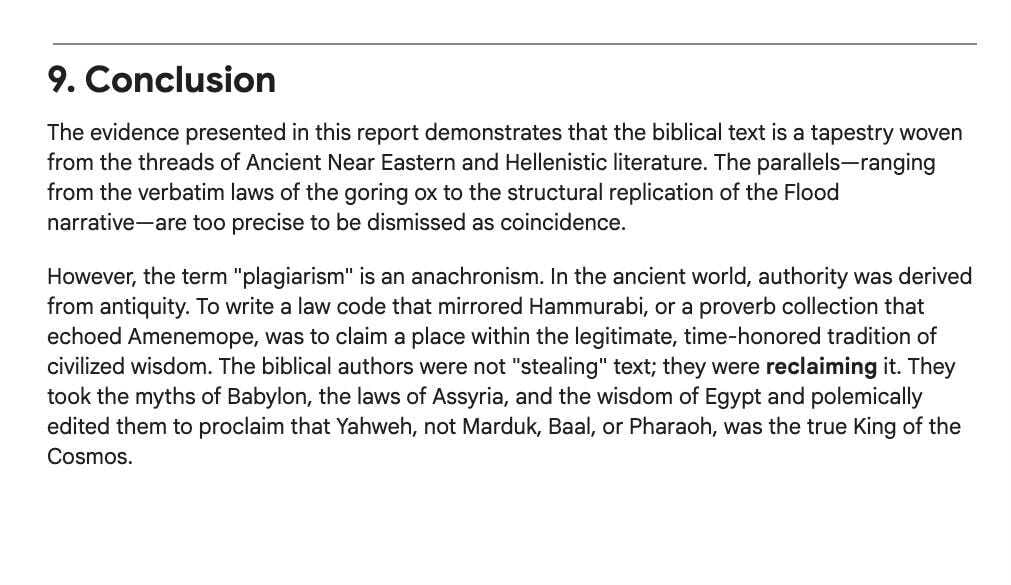
The evidence presented in this report demonstrates that the biblical text is a tapestry woven from the threads of Ancient Near Eastern and Hellenistic literature. The parallels—ranging from the verbatim laws of the goring ox to the structural replication of the Flood narrative—are too precise to be dismissed as coincidence.
However, the term “plagiarism” is an anachronism. In the ancient world, authority was derived from antiquity. To write a law code that mirrored Hammurabi, or a proverb collection that echoed Amenemope, was to claim a place within the legitimate, time-honored tradition of civilized wisdom. The biblical authors were not “stealing” text; they were reclaiming it. They took the myths of Babylon, the laws of Assyria, and the wisdom of Egypt and polemically edited them to proclaim that Yahweh, not Marduk, Baal, or Pharaoh, was the true King of the Cosmos.
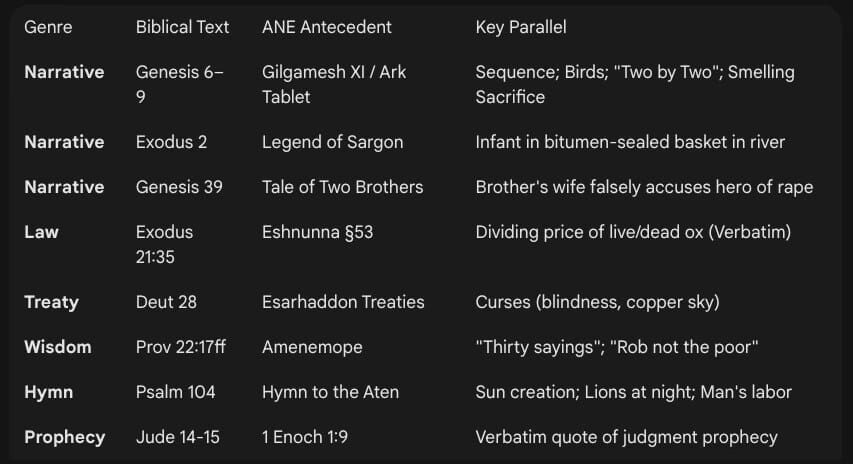
Table of Major Verbatim/Structural Parallels:
Works cited
Story of Jesus Christ was ‘fabricated to pacify the poor’, claims controversial Biblical scholar & Secrets of Noah’s Ark: A shocking discovery of the original Noah’s Ark | Irving Finkel, accessed December 17, 2025, https://www.independent.co.uk/news/uk/home-news/story-of-jesus-christ-was-fabricated-to-pacify-the-poor-claims-controversial-biblical-scholar-8870879.html& Lex Clips on YouTube.
Ark – eology? | Evangelicals Now - WordPress.com, accessed December 17, 2025, https://evangelicalsnow.wordpress.com/2014/07/14/ark-eology/
The Animals Went in Two by Two, According to Babylonian Ark Tablet, accessed December 17, 2025, https://www.biblicalarchaeology.org/daily/news/the-animals-went-in-two-by-two-according-to-babylonian-ark-tablet/
The Mesopotamian Origin of the Biblical Flood Story - TheTorah.com, accessed December 17, 2025, https://www.thetorah.com/article/the-mesopotamian-origin-of-the-biblical-flood-story
False Assumptions of Ancient Near East Literary Approaches to Genesis, accessed December 17, 2025, https://purelypresbyterian.com/2018/08/06/false-assumptions-of-ancient-near-east-literary-approaches-to-genesis/
The Bible can’t be trusted as it completely copied it’s flood origin story from the Epic of Gilgamesh - Reddit, accessed December 17, 2025, https://www.reddit.com/r/DebateReligion/comments/rtnwyt/the_bible_cant_be_trusted_as_it_completely_copied/
The Flood of Noah and the Flood of Gilgamesh | The Institute for Creation Research, accessed December 17, 2025, https://www.icr.org/content/flood-noah-and-flood-gilgamesh
Genesis vs Ancient Near East Polytheistic Myths: Plagiarism or Polemics? Part 1, accessed December 17, 2025, https://krisispraxis.com/archives/2024/03/genesis-vs-ancient-near-east-polytheistic-myths-plagiarism-or-polemics-part-1/
What similarities are there between the Enuma Elish and the Genesis creation account?, accessed December 17, 2025, https://www.gotquestions.org/Enuma-Elish.html
Enuma Elish: Did It Influence Genesis 1?, accessed December 17, 2025, https://answersingenesis.org/genesis/enuma-elish-did-it-influence-genesis/
Leviathan and Exegetical Imagination - Kesher Journal, accessed December 17, 2025, https://www.kesherjournal.com/article/leviathan-and-exegetical-imagination/
Eve - Wikipedia, accessed December 17, 2025, https://en.wikipedia.org/wiki/Eve
Recycled Ribs? The Charge of Mythic Borrowing - The Way of Truth, accessed December 17, 2025, https://wayoftruth.blog/2025/08/22/recycled-ribs-the-charge-of-mythic-borrowing/
Are there any reasons for why Eve was made from Adam’s rib? : r/AcademicBiblical - Reddit, accessed December 17, 2025, https://www.reddit.com/r/AcademicBiblical/comments/ki2j2y/are_there_any_reasons_for_why_eve_was_made_from/
The Myth of Adapa - World History Encyclopedia, accessed December 17, 2025, https://www.worldhistory.org/article/216/the-myth-of-adapa/
Adam and Adapa : two anthropological characters - Digital Commons @ Andrews University, accessed December 17, 2025, https://digitalcommons.andrews.edu/cgi/viewcontent.cgi?article=1065&context=old-testament-pubs
Comparing the myths of Adapa and Adam, prototypes of priest and humankind - Vridar, accessed December 17, 2025, https://vridar.org/2007/10/09/comparing-the-myths-of-adapa-and-adam-prototypes-of-priest-and-humankind/
Enmerkar and the Lord of Aratta | Genesis 11:1 - intertextual.bible, accessed December 17, 2025, https://intertextual.bible/index.php/text/enmerkar-and-the-lord-of-aratta-genesis-11.3
CONFUSION OF LANGUAGES - Is there any reference in early Mesopotamian literature to what happened at the Tower of Babel? - ChristianAnswers.Net, accessed December 17, 2025, https://christiananswers.net/q-abr/confusionoflanguages.html
The ‘Sumerian Problem’—Evidence of the Confusion of Languages? | ArmstrongInstitute.org, accessed December 17, 2025, https://armstronginstitute.org/280-the-sumerian-problem-evidence-of-the-confusion-of-languages
Was the Moses birth story copied from pagan parallels? - Evidence Unseen, accessed December 17, 2025, https://evidenceunseen.com/old-testament/exodus/difficulties/was-the-moses-birth-story-copied-from-pagan-parallels
The parallels between Moses and Sargon of Akkad are quite weak - Reddit, accessed December 17, 2025, https://www.reddit.com/r/AcademicBiblical/comments/1796wlm/the_parallels_between_moses_and_sargon_of_akkad/
Moses is Modeled on Horus and Sargon, but His Story Is About King Hezekiah, accessed December 17, 2025, https://www.thetorah.com/article/moses-is-modeled-on-horus-and-sargon-but-his-story-is-about-king-hezekiah
Was the Story of Moses Based on an Ancient Legend? - Logos Bible Software, accessed December 17, 2025, https://www.logos.com/grow/story-moses-based-ancient-legend/
Tale of Two Brothers - Wikipedia, accessed December 17, 2025, https://en.wikipedia.org/wiki/Tale_of_Two_Brothers
Joseph and Potiphar’s Wife: An Exegesis, Part 2 - Robert D. Heaton, Ph.D., accessed December 17, 2025, https://robheaton.com/2010/11/14/joseph-and-potiphars-wife-part-2/
Idrimi - Wikipedia, accessed December 17, 2025, https://en.wikipedia.org/wiki/Idrimi
Abraham and Idrimi - BYU ScholarsArchive, accessed December 17, 2025, https://scholarsarchive.byu.edu/cgi/viewcontent.cgi?article=1511&context=jbms
Abraham and Idrimi - Pearl of Great Price Central, accessed December 17, 2025, https://pearlofgreatpricecentral.org/abraham-and-idrimi/
The Story of Sinuhe confirms Gen 36:15-18 in 1900 BC - Bible.ca, accessed December 17, 2025, https://www.bible.ca/archeology/bible-archeology-edomites-story-of-sinuhe-1900bc.htm
Sinuhe vs Moses - Tekton Apologetics Ministries, accessed December 17, 2025, https://www.tektonics.org/copycat/sinuhe.php
Is This Moses? | ArmstrongInstitute.org, accessed December 17, 2025, https://armstronginstitute.org/1041-is-this-moses
The Laws of Hammurabi as a Source for the Covenant Collection (Exodus 20:23–23:19), accessed December 17, 2025, https://www.journals.uchicago.edu/doi/pdfplus/10.1086/MAR200310103
the goring ox again - Bazhum, accessed December 17, 2025, https://bazhum.muzhp.pl/media/texts/the-journal-of-juristic-papyrology/1974-tom-18/the_journal_of_juristic_papyrology-r1974-t18-s55-93.pdf
The Ancient Near East Was No Picnic: Contrasting the Mosaic Law to Ancient Moral Codes, accessed December 17, 2025, https://credohouse.org/blog/the-ancient-near-east-was-no-picnic-contrasting-the-mosaic-law-to-ancient-moral-codes
How Exodus Revises the Laws of Hammurabi - TheTorah.com, accessed December 17, 2025, https://www.thetorah.com/article/how-exodus-revises-the-laws-of-hammurabi
The Origins of the Laws (Chapter 4) - The Cambridge Companion to Law in the Hebrew Bible, accessed December 17, 2025, https://www.cambridge.org/core/books/cambridge-companion-to-law-in-the-hebrew-bible/origins-of-the-laws/05008CBB9AFF118938688F0A30A35FD6
Deuteronomy 28 and Tell Tayinat | Steymans - Verbum et Ecclesia, accessed December 17, 2025, https://verbumetecclesia.org.za/index.php/ve/article/view/870/1867
THE VASSAL-TREATIES OF ESARHADDON AND THE DATING OF DEUTERONOMY - Brill, accessed December 17, 2025, https://brill.com/downloadpdf/book/9789004497092/B9789004497092_s006.pdf
Deuteronomy 28 influenced Esarhaddon’s Vassal Treaty - Biblical Roots of Certain Pagan Myths and Philosophies, accessed December 17, 2025, https://historyancientphilsophy.wordpress.com/2018/02/12/deuteronomy-28-influenced-esarhaddons-vassal-treaty/
Deuteronomy and Hittite Treaties | Bible Interp, accessed December 17, 2025, https://bibleinterp.arizona.edu/articles/2014/09/kol388003
Sacrifice at Ugarit - Theopolis Institute, accessed December 17, 2025, https://theopolisinstitute.com/leithart_post/sacrifice-at-ugarit/
How do Hebrew sacrificial traditions compare with other cultures? [closed], accessed December 17, 2025, https://hermeneutics.stackexchange.com/questions/21140/how-do-hebrew-sacrificial-traditions-compare-with-other-cultures
The Scapegoat Ritual and Its Ancient Near Eastern Parallels - TheTorah.com, accessed December 17, 2025, https://www.thetorah.com/article/the-scapegoat-ritual-and-its-ancient-near-eastern-parallels
Mesha Stele | 2 Kings 3:26 - intertextual.bible, accessed December 17, 2025, https://intertextual.bible/text/mesha-stele-2-kings-3.26
Chemosh Beat Yahweh in a Battle : r/DebateReligion - Reddit, accessed December 17, 2025, https://www.reddit.com/r/DebateReligion/comments/fotqls/chemosh_beat_yahweh_in_a_battle/
Mesha Stele - Wikipedia, accessed December 17, 2025, https://en.wikipedia.org/wiki/Mesha_Stele
2 Kings 3:26-27: is it possible that Mesha sacrificed his son to Yahweh? - Reddit, accessed December 17, 2025, https://www.reddit.com/r/AcademicBiblical/comments/pgmcue/2_kings_32627_is_it_possible_that_mesha/
The Question of the Priority of Isaiah 36–37 vs. 2 Kings 18:13–19:37 (Chapter 10) - Sennacherib’s Campaign against Judah, accessed December 17, 2025, https://www.cambridge.org/core/books/sennacheribs-campaign-against-judah/question-of-the-priority-of-isaiah-3637-vs-2-kings-18131937/D5186DBE13F05CB2BE7D924BBB73606A
Sennacherib’s Invasion of Hezekiah’s Judah: Disputed Victory in Light of Military History, accessed December 17, 2025, https://bibleinterp.arizona.edu/articles/sennacheribs-invasion-hezekiahs-judah-disputed-victory-light-military-history
Sennacherib’s Annals - Wikipedia, accessed December 17, 2025, https://en.wikipedia.org/wiki/Sennacherib%27s_Annals
A PHOENICIAN PARALLEL TO PSALM 29, accessed December 17, 2025, https://kb.osu.edu/bitstreams/de47382a-9530-58d8-9adb-8cac64b4f8f2/download
Echoes of the Baal Cycle in Scripture - Living Faith, accessed December 17, 2025, https://livingfaith.blog/2020/01/17/echoes-of-the-baal-cycle-in-scripture/
Psalm 29: A Structural Analysis | Harvard Theological Review | Cambridge Core, accessed December 17, 2025, https://www.cambridge.org/core/journals/harvard-theological-review/article/psalm-29-a-structural-analysis/1243E133DF26AE3510901658D99E9F76
Parallelism between “The Hymn to Aten” and Psalm 104 - Project Augustine, accessed December 17, 2025, https://projectaugustine.com/biblical-studies/ancient-near-east-studies/parallelism-between-the-hymn-to-aten-and-psalm-104/
Psalm 104 and Its Parallels in Pharaoh Akhenaten’s Hymn - TheTorah.com, accessed December 17, 2025, https://www.thetorah.com/article/psalm-104-and-its-parallels-in-pharaoh-akhenatens-hymn
Papyrus Amherst 63 - Wikipedia, accessed December 17, 2025, https://en.wikipedia.org/wiki/Papyrus_Amherst_63
Examining the Judean Scribal Tendencies in the Psalms of Papyrus Amherst 63, with Col. XII, 11–19 as - eScholarship, accessed December 17, 2025, https://escholarship.org/content/qt4mg6x6q4/qt4mg6x6q4_noSplash_2c33e63fa5ce42bc2069cca24a13f3da.pdf
Side by Side: Papyrus Amherst 63 and Psalm 20 - The BAS Library, accessed December 17, 2025, https://library.biblicalarchaeology.org/sidebar/side-by-side-papyrus-amherst-63-and-psalm-20/
Psalm 19, accessed December 17, 2025, https://journals.co.za/doi/pdf/10.10520/AJA0000017_176
Psalm 19 – the wonder of God in his word - Theology Interalia, accessed December 17, 2025, https://theologyinteralia.net/2019/08/31/psalm-19-the-wonder-of-god-in-his-word/
Does Proverbs Plagiarize from Egyptian Wisdom? - Detroit Baptist Theological Seminary, accessed December 17, 2025, https://dbts.edu/2024/08/12/does-proverbs-plagiarize-from-egyptian-wisdom/
Instruction of Amenemope - Wikipedia, accessed December 17, 2025, https://en.wikipedia.org/wiki/Instruction_of_Amenemope
3rd Article in a Series on “The Book of Job and Reconciling Science and Religion”, accessed December 17, 2025, https://trinitycollege.edu.sc/uncategorized/3rd-article-in-a-series-on-the-book-of-job-and-reconciling-science-and-religion/
A dialogue of voices : Job, Socrates and the quest for understanding, accessed December 17, 2025, https://journals.co.za/doi/pdf/10.10520/EJC85816
Tragedy and Theodicy: The Role of the Sufferer from Job to Ahab - CUNY Academic Works, accessed December 17, 2025, https://academicworks.cuny.edu/cgi/viewcontent.cgi?article=3579&context=gc_etds
Epic of Gilgamesh Sippar Tablet | Ecclesiastes 9:7 | intertextual.bible, accessed December 17, 2025, https://intertextual.bible/text/epic-of-gilgamesh-sippur-tablet-ecclesiastes-9.7
1 Enoch 1:9 | Jude 1:14 - intertextual.bible, accessed December 17, 2025, https://intertextual.bible/text/1-enoch-1.9-jude-1.14
Jude’s Use of the Pseudepigraphal Book of 1 Enoch - Dialogue Journal, accessed December 17, 2025, https://www.dialoguejournal.com/articles/judes-use-of-the-pseudepigraphal-book-of-1-enoch/
Why does Jude quote the Assumption of Moses (v.9) and the Book of Enoch (v.14-15)?, accessed December 17, 2025, https://evidenceunseen.com/new-testament/jude/difficulties/why-does-jude-quote-the-assumption-of-moses-v9-and-the-book-of-enoch-v14-15
The Homeric epics and the Gospel of Mark - University of California Santa Barbara, accessed December 17, 2025, https://search.library.ucsb.edu/discovery/fulldisplay?vid=01UCSB_INST%3AUCSB&tab=Everything&docid=alma990021744130203776&lang=en&context=L&adaptor=Local%20Search%20Engine&query=sub%2Ccontains%2CBible%20O%20T%20Isaiah
Review of The Homeric Epics and the Gospel of Mark - Internet Infidels, accessed December 17, 2025, https://infidels.org/library/modern/richard-carrier-homerandmark/
Significant Parallels between Luke and Josephus | ScriptureC - Scripture Central, accessed December 17, 2025, https://scripturecentral.org/archive/media/chart/significant-parallels-between-luke-and-josephus
Evaluating the Josephus-Jesus Paraphrase Model, accessed December 17, 2025, https://josephusblog.org/evaluating-the-josephus-jesus-paraphrase-model/
Did Luke use Josephus as a source? - Biblical Hermeneutics Stack Exchange, accessed December 17, 2025, https://hermeneutics.stackexchange.com/questions/1328/did-luke-use-josephus-as-a-source
Easter Mythology: The Resurrection Accounts as Shaped by Greco-Roman Myths, accessed December 17, 2025, https://mythologymatters.wordpress.com/2019/04/18/easter-mythology-the-resurrection-as-modeled-on-greco-roman-myths/
Interesting parallels between the Christ myth and founding of Rome : r/atheism - Reddit, accessed December 17, 2025, https://www.reddit.com/r/atheism/comments/kg7cb0/interesting_parallels_between_the_christ_myth_and/
PHILOSTRATUS’S APOLLONIUS: A CASE STUDY IN APOLOGETICS IN THE ROMAN EMPIRE Andrew Mark Hagstrom A thesis submitted to the facu, accessed December 17, 2025, https://cdr.lib.unc.edu/downloads/0r9674319
Apollonius of Tyana and Jesus - Tekton Apologetics Ministries, accessed December 17, 2025, https://www.tektonics.org/copycat/apollonius.php
Gabriel’s Revelation - Wikipedia, accessed December 17, 2025, https://en.wikipedia.org/wiki/Gabriel%27s_Revelation
Gabriel’s Revelation - The Lying Pen of Scribes, accessed December 17, 2025, https://lyingpen.com/wp-content/uploads/2018/10/gabriels_revelation-1.pdf
Some questions for Inanna & Dumuzi - The Art of Compost, accessed December 17, 2025, https://artofcompost.ca/2020/06/02/some-questions-for-inanna-dumuzi/
Does Hosea 6:2 prophetically point to a 2000-year gospel era followed by the resurrection on the third (3000th) day?, accessed December 17, 2025, https://hermeneutics.stackexchange.com/questions/106754/does-hosea-62-prophetically-point-to-a-2000-year-gospel-era-followed-by-the-res
The woman and the dragon - Andrew Perriman, accessed December 17, 2025, https://www.postost.net/2015/11/woman-dragon
Additional Reflection on Revelation – Week 6 (July 17th 2022) 1. Finding a background to Rev 12:1-6 2. A possible background - Catshill Baptist Church, accessed December 17, 2025, https://www.catshillbaptist.org.uk/wp-content/uploads/2022/07/Week-6-Additional-Notes.pdf