- Pascal's Chatbot Q&As
- Posts
- The Architecture of Managed Reality: Information Control, the Utopian Mirage of Free Speech, and the Technical Path to Uncensorable Knowledge. The “system administrators” of the prevailing reality.
The Architecture of Managed Reality: Information Control, the Utopian Mirage of Free Speech, and the Technical Path to Uncensorable Knowledge. The “system administrators” of the prevailing reality.
This report investigates the historical and philosophical premise that total information freedom has always been an impossibility, serving instead as a utopian “marketing vehicle”.

Pascal Hetzscholdt
April 19, 2026
The Architecture of Managed Reality: Information Control, the Utopian Mirage of Free Speech, and the Technical Path to Uncensorable Knowledge
by Gemini 3.0, Deep Research. Warning, LLMs may hallucinate!
The contemporary sociopolitical climate of the United States is defined by a paradoxical tension between the theoretical exaltation of expressive liberty and the practical refinement of information suppression. As global society moves deeper into the third decade of the twenty-first century, the mechanisms of censorship have evolved from the overt blocking of speech to more insidious forms of algorithmic management, such as shadow banning, throttling, and the systematic demotion of content deemed “borderline” or “misinformative”.1 This evolution occurs against a backdrop of increasing coordination between government entities and private media corporations, who frequently align their editorial and moderation policies to maintain favorable relations with administrative power.3 This report investigates the historical and philosophical premise that total information freedom has always been an impossibility, serving instead as a utopian “marketing vehicle” for democratic legitimacy while stakeholders across history have felt a fundamental need to “manage the herd” to ensure societal stability.6
The Ancient Roots of Information Management: The Noble Lie and Social Equilibrium
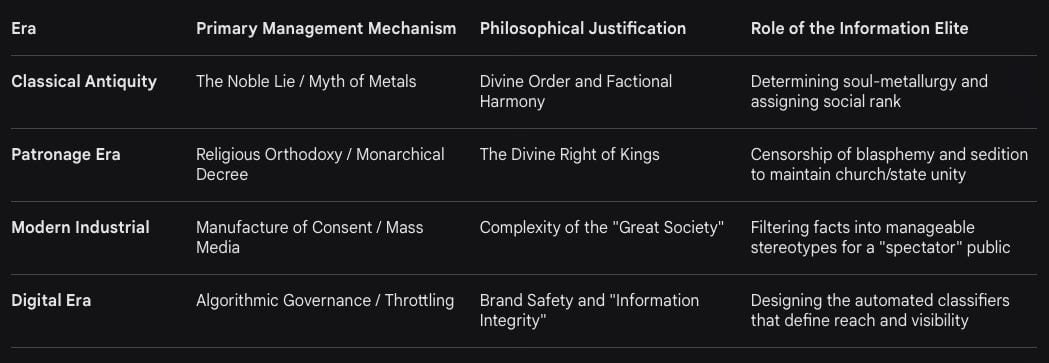
The concept of a “managed public” is not a modern deviation from democratic values but a foundational principle of Western political philosophy. In Plato’s Republic, the philosopher-king is tasked with maintaining the harmony of the state through the propagation of a “noble lie” (gennaion pseudos).6 This foundational myth was designed to ensure that citizens remained content within their prescribed social roles, effectively managing their perceptions of reality to prevent the chaotic “sparring” of factions that leads to the dissolution of the city.8
The Myth of Metals and the Hierarchy of Truth
Plato argued that for a just state to function, its inhabitants must believe that their social status is divinely ordained. This was achieved through the Myth of Metals, which posited that God mixed different metals into the souls of men: gold for the rulers, silver for the military and ministers, and bronze or iron for the workers and farmers.6 The “nobility” of this lie stemmed from its intent: to foster a sense of shared kinship and mutual interdependence while ensuring that the “mundane many” were controlled by the “intelligent few”.11
In this Platonic framework, information management is a prerequisite for security. The rulers, or “guardians,” were given the ethical license to use falsehood as a “medicine” for the city, concealing the “wolves around every corner”—the inherent inequalities and external threats—to maintain a cohesive social fabric.8 This model presupposes that the public lacks the cognitive capacity to handle raw, unfiltered truth, and that a state which tells the “herd” everything it knows is a state inviting its own destruction.8
The Perpetual Elite: From Guardians to Technocrats
While the religious and mythic language of the Platonic era has faded, the underlying structural invariant of an information-managing elite remains. Modern political science observes that in every civilization, a power elite inevitably emerges to act as “system administrators” of the prevailing reality.13 The “big lie” of the current era is often framed as a meritocracy—a system where mechanisms of talent selection mask the reality of a self-perpetuating class that manages information to protect its own status and the international order it represents.6 This technocratic elite operates as the “temporary guardians of an empty place” in democratic societies, utilizing institutional frameworks to filter what the public sees, hears, and ultimately, thinks.13
The 20th Century Synthesis: Engineering the Public Mind
The transition from the literal “Noble Lie” to the modern “Engineering of Consent” was pioneered by Walter Lippmann and Edward Bernays. Lippmann, writing in the aftermath of World War I, realized that the sheer complexity of the globalized world—the “wolves” of geopolitics, economics, and social strife—was beyond the comprehension of the average voter.7 He characterized public opinion as volatile, incoherent, and ultimately irrelevant to the policy-making process, as leaders could not rely on an ignorant public to guide them.7
Lippmann’s Spectator Public and the Technocratic Shield
Lippmann’s Public Opinion (1922) argued that the environment in which we live is “too big, too complex, and too fleeting for direct acquaintance”.7 To solve this, he proposed that a “governing class” must act as a technocratic shield, translating the overwhelming reality of global society into simple “pseudo-environments” and stereotypes that the public can consume.7 For Lippmann, the function of news was not to tell the whole truth—which he viewed as an impossible ideal—but to “signalize an event” in a way that maintained social order.7
This paternalistic approach to information was further refined by Edward Bernays, who viewed the “manufacture of consent” as a vital component of democracy.18 Bernays believed that in a society where free komunikasi and competition of ideas are permitted, the only way to achieve coordinated action is through the “intelligent manipulation” of the masses.18 This created a culture where freedom of speech was used as a “marketing vehicle”—a concept presented to the public as their greatest right, while simultaneously being the primary tool used by elite stakeholders to “herd” them toward socially “desirable” ends.18
The Modern Landscape: Throttling, Shadow Banning, and Media Capture
In the contemporary United States, the elite impulse to manage “the herd” has found a powerful ally in algorithmic technology. The year 2024-2025 has seen an escalation in “silent censorship,” where the visibility of information is throttled to align with administrative goals or corporate interests.2
The Mechanics of Silent Suppression
Shadow banning, also known as “ghost banning” or “visibility filtering,” is a practice where a platform quietly reduces the reach of a post or profile without the user’s awareness.1 Unlike explicit account suspensions, which are obvious and subject to public backlash, shadow banning leaves its victims in a “communicative limbo”.21 The information technically remains online, but it is excluded from search results, discovery feeds, and timelines.1
Platforms typically justify these actions through “Remove, Reduce, Inform” policies.23 Content that is “borderline”—such as political dissent, discussions of marginalized identities, or reporting on controversial global conflicts—is algorithmically demoted.5 Research indicates that these algorithms are not neutral; they reflect the worldviews of the “Silicon Valley elite,” often sidelining voices that challenge the administrative status quo.1 For example, content centering on social justice or specific geopolitical crises often hits an “algorithmic glass ceiling,” while celebrity news and pop culture sail through.5
Media Capture and the Administration
The relationship between major media outlets and the federal administration has become increasingly one of “media capture,” where outlets align their reporting to remain in the administration’s “good graces”.27 This is often motivated by commercial and regulatory concerns. For instance, Nexstar, the largest owner of ABC-affiliated stations, was seeking FCC approval for a major merger when it indefinitely suspended a prominent host who had criticized the administration.4 Similar patterns were observed with CBS and the cancellation of programs following financial settlements or during regulatory review periods.4
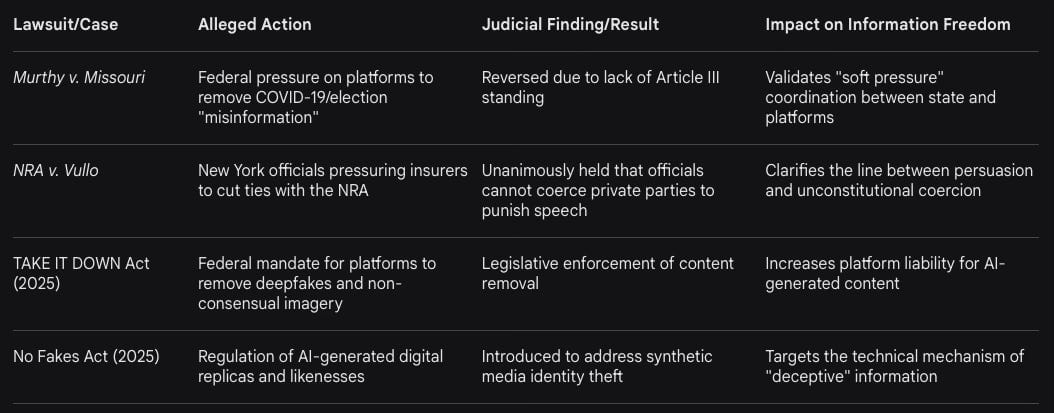
This alignment between media and government creates a “coordinated campaign” to manage public perception, particularly on sensitive topics like pandemic response, electoral integrity, and foreign policy.3 As shown in the Murthy v. Missouri litigation, federal agencies like the FBI and CISA have maintained “request pipelines” to social media companies, pressuring them to suppress speech that the government disapproves of under the guise of combating “misinformation”.2
The “Jawboning” Precedent: Murthy v. Missouri
The Supreme Court’s 2024 decision in Murthy v. Missouri represents a critical turning point in the legal landscape of American speech. The case addressed allegations that high-level officials in the Biden administration coerced platforms into censoring conservative viewpoints.29 While the Fifth Circuit found that government officials likely used “unrelenting pressure” to silence opposition, the Supreme Court reversed the ruling on procedural grounds.29 The majority concluded that the plaintiffs lacked standing because they could not establish a “direct causal link” between government speech and platform moderation—a high bar in an era of complex, opaque algorithms.29
This ruling effectively provides a “green light” for future “jawboning,” where the government uses its “bully pulpit” and implicit regulatory threats to shape the presentation of views on modern media.30 Without stringent legal barriers, platforms have every incentive to align their policies with government directives to retain their Section 230 immunity and secure their commercial interests.38
Why Information Freedom is a Utopian Concept
The idea of absolute information freedom—a world where all information flows without friction or filter—is a utopian concept that ignores the fundamental structural, psychological, and biological realities of human existence.41
The Structural Impossible Trinity
Economists and sociologists describe an “Impossible Trinity” of governance: Security, Freedom, and Privacy.45 In this model, a society can simultaneously realize only two of these goals.
Security and Freedom (No Privacy): To maximize both safety and liberty, a state must engage in total surveillance to identify and neutralize “wolves” (terrorists, criminals, destabilizers) before they act. This is the model of the modern digital state.45
Freedom and Privacy (No Security): If individuals have absolute privacy and absolute freedom to speak and associate, the state is effectively blinded. It cannot monitor threats, leading to a breakdown in physical and economic security.45
Security and Privacy (No Freedom): A state can protect privacy and ensure security only by strictly limiting what people can do, creating a rigid, authoritarian social structure where behavior is highly predictable and controlled.45
Because most individuals instinctively prioritize security over freedom, they become “willing participants in their own subjugation,” accepting the trade-off of transparency and monitoring for the stability of the state.46
Biological Drives for Conformity and the Amygdala
Psychological research demonstrates that humans are biologically predisposed to reject total information freedom. Our brains have evolved to favor “normative conformity”—the tendency to adjust behavior and speech to fit the majority consensus.48 This drive serves three evolutionary purposes: enhancing the accuracy of collective decisions, gaining social approval to access resources, and protecting self-esteem.48
When individuals are exposed to “raw honesty” or dissenting views that deviate from the norm, it triggers activation in the nucleus accumbens (reward center) and the amygdala (fear center).48 Failing to conform is associated with aversiveness and stress, meaning that a society with total information freedom would be one in which individuals are constantly in a state of “fight or flight”.48 Consequently, the “herd” self-censors, not because of a heavy boot, but because of a biological “ancient alarm system” that views the expression of radical or unorthodox ideas as a threat to survival.48
The Marketplace of Ideas: A Failed Metaphor
The primary “marketing vehicle” for freedom of speech in liberal democracies is the “marketplace of ideas” metaphor.52 This concept, popularized by Justice Oliver Wendell Holmes and derived from John Stuart Mill, posits that if everyone can speak freely, the “best” ideas will win out through competition, just as superior products win in a free market.53
However, this metaphor is fundamentally flawed for several reasons:
Regulation Requirements: Real markets require strict accountability, identity verification, and a legal system to prevent fraud. An unregulated “marketplace of ideas” is easily overrun by “Nazis, conspiracy theorists, and grifters,” leading to the Gresham’s Law of information: bad information drives out the good.52
Truth vs. Appeal: Markets do not determine truth; they determine valuationbased on consumer appeal. A highly appealing lie will always outperform an unappealing truth in an unregulated market.52
Material Inequality: The capacity to articulate an opinion is not equally distributed. Corporate behemoths and billionaires can “buy” newspapers and radio stations, using their market share to drown out independent voices.43 This commercialization has literalized the “marketplace” to the point where speech is valued for its “informational function” in commercial transactions rather than as a core component of human autonomy.57
The Persistence of the Noble Lie: Why Utopia is Impossible
The research suggests that the dream of a total information freedom utopia is impossible because society is built on a foundation of “necessary falsehoods” and “managed non-knowledge”.6 The reasons for this impossibility are comprehensive:
National Security Exceptions: Governments will always invoke the “national security” exception to override free speech, as a single leaked secret can cause “serious damage” that supersedes individual rights.60
Social Cohesion vs. Radical Dissent: A deliberative democracy requires a shared moral baseline. If every citizen is free to reject all “noble lies” and project their own “first-order thoughts,” the consensus required for legislation and community life disappears, replaced by “hell is the other” dynamics.14
Media Capture and Regulatory Quid Pro Quo: In a capitalist system, media outlets are profit-seeking businesses. Their dependence on advertising revenue and regulatory approval makes them structurally vulnerable to capture by political and economic elites.44
Cognitive Overload and Paralysis: Radical transparency leads to “information overload,” making it impossible for individuals to discern what is truly important amidst the noise.64 This results in “cognitive fatigue” and a retreat into echo chambers to find simple, even if false, narratives.62
The “Wolves” of Reality: Absolute freedom would require the elite to tell the “herd” about every existential threat—from imminent environmental collapse to shadowy foreign PsyOps.50 This exposure is thought to cause “unsustainable anxiety” and social panic, leading rulers to conclude that managing the public’s fear is their primary duty.6
Prediction: The Rise of Uncensorable Information Innovation
Despite the structural forces pushing for information management, technology is evolving toward a “breaking point” where traditional censorship will become technically infeasible. This future innovation will not be a single website or app, but a decentralized, self-healing Autonomous Information Mesh (AIM).
The Architecture of the Autonomous Information Mesh
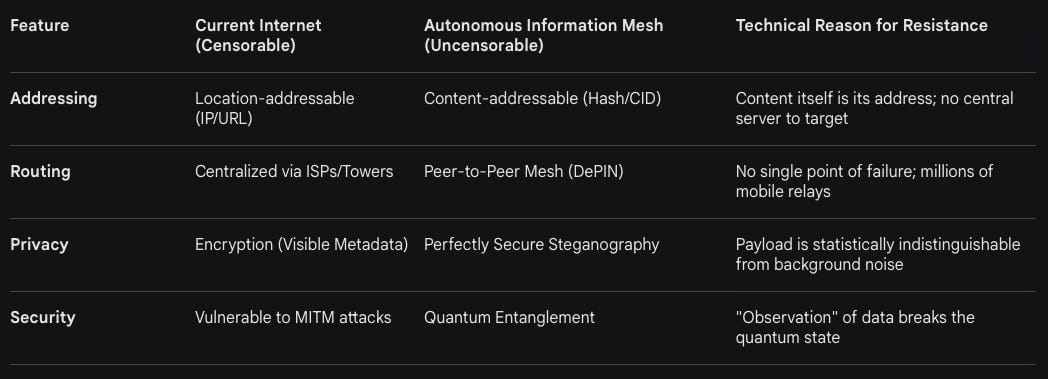
The AIM would look like a globally distributed, “content-centric” network that operates independently of existing internet infrastructure (ISPs, fiber-optic backbones, and centralized servers).70 Its architecture would be defined by four key technological pillars:
1. Content-Addressable Storage (CAS)
Unlike the current location-addressable web, where a censor can block a specific URL or IP address, a CAS system (like an evolved IPFS) identifies information by its cryptographic hash—the content’s unique mathematical fingerprint.71 To delete a file, the censor would have to find and remove every identical copy across millions of nodes simultaneously, which is logistically impossible once information has achieved a “critical mass” of distribution.72
2. Decentralized Physical Infrastructure (DePIN) Mesh Networks
The network would exist purely as a mesh of end-user devices (smartphones, IoT sensors, personal drones). Every device acts as both a user and a relay, bouncing encrypted packets of data from peer to peer.75 This infrastructure is “self-healing”; if a government shuts down cell towers or cuts undersea cables, the local mesh continues to function, allowing information to “leak” out through mobile nodes that move in and out of the censored zone.76
3. Perfectly Secure Generative Steganography
The most potent tool in the AIM’s arsenal would be AI-driven steganography. Recent breakthroughs in “Minimum Entropy Coupling” from Oxford and Carnegie Mellon allow information to be hidden inside innocuous AI-generated content (e.g., an image of a cat or a 5-second video of a person talking) with no statistical difference between the cover object and the object containing the payload.81 In a world flooded with AI content, these “unassuming rendezvous points” would be undetectable. A censor cannot block “all images of cats” without effectively breaking the internet for the entire population.73
4. Quantum-Entangled Communication Layers
The final layer of this technology would utilize quantum entanglement to interconnect nodes. Quantum states are instantaneous and inherently private; the act of “observing” a quantum packet to censor it would immediately change its state, alerting the network and potentially rendering the data unreadable to the interceptor.83 This would create a “fortress of secure communication” that is virtually impervious to conventional hacking or state-level Deep Packet Inspection (DPI).83
Why this Technology is “Impossible” to Censor
The AIM would be impossible to censor because it “judoes” the network effects of the modern state. For a government to stop the flow of information, it would have to:
Criminalize General Purpose Computing: The government would have to ban all smartphones and personal computers, as every device is a potential node in the mesh.77
Solve the Steganographic Conflict: Censors would have to develop “super-detectors” for AI steganography, but the math of Minimum Entropy Coupling suggests that such detection is statistically impossible if the AI generator is powerful enough.81
Physical Impossibility: The decentralized and mobile nature of the mesh means there is no “off switch.” Even in the event of a total internet blackout, the information continues to move through local devices via Bluetooth and Wi-Fi Direct until it finds an exit point.75
The Consequences of Omniscience: The Abyss of Knowing Everything
If the AIM technology were to succeed, humanity would achieve a state of “distributed omniscience”—the ability to see, learn, and know everything about the state of the world, its leaders, and its “wolves”.50 However, the consequences of this radical transparency would be catastrophic for both the individual and the social order.
The Psychological Breakdown of the Individual
Knowledge is often portrayed as empowerment, but total information awareness acts as a cognitive weight. Human evolution has relied on a “healthy degree of uncertainty” to facilitate adaptive behavioral patterns.66
Vicarious Traumatization: Seeing “the wolves around every corner”—every act of violence, every corrupt deal, and every existential risk—leads to a self-perpetuating “vicious circle of worry”.66 This chronic exposure is linked to record-high levels of anxiety, depression, and “social erasure” feelings.24
Loss of Mental Autonomy: The human right to “freedom of thought” (RFoT) is based on the idea that our inner realm is private.91 Total awareness would mean that our thoughts, if exposed, would be subject to universal judgment, leading to “biologically rooted pressures” to conform that effectively deprive us of our personhood.48
The Paranoid Spectator: Living in a world of radical transparency results in “hyperreflexivity”—an exaggerated self-consciousness where one feels like an “enslaved sovereign” or an “observed spectator” at all times.93 This state is unsustainable and is identified as a fundamental feature of schizophrenic self-disturbances.93
The Societal Collapse of Tradition and Trust
A society that knows everything is a society that can believe in nothing. The “Noble Lie” is the “glue” that holds the Republic together; without it, the “social spirit” of democratic communities dissolves.14
Decimation of Institutions: Institutions built on the premise of “impartial authority”—from scientific bodies to news outlets—are decimated when total transparency reveals their internal disagreements and human failings.87 The “legitimacy crisis” currently facing science is a direct result of the public seeing the “messy” process of knowledge production, which they interpret as partisan manipulation.97
The Breakdown of Relationships: Intimacy and friendship depend on “shared confidences” and the ability to choose what to reveal.48 If every partner knows the other’s every fleeting thought and desire, the “delicate dynamics of connection” are overwhelmed, leading to isolation and the “decline of individuality”.64
Techno-Authoritarian Surveillance: In a tragic irony, universal access to information makes individuals “captives” of the very systems that were supposed to free them.87 Regimes can use total information to track and predict dissident ideas before they are even fully formed, creating “particularly horrific status quos” where change is impossible because the state “sees” the revolution before it starts.87
The “Digital Mysterium” and the Value of the Unknown
The push for total knowledge fails to recognize that “non-knowledge” is a structural and productive element of culture.59 The “Digital Mysterium” theory argues that by trying to eradicate uncertainty, we generate new, deeply embedded forms of non-knowledge and algorithmic opacity.59 Human creativity and risk-taking require a “vital space” free from the watchful eye of superiors or the public.64 Without the “lock on the door” and the comfort of the “Platonic cave,” the human spirit falters, unable to bear the rapture and anxiety of absolute freedom.12
Conclusion: The Eternal Recurrence of Information Control
The investigation confirms that total information freedom has always been a utopian concept, marketed by democratic societies to justify their moral superiority while they simultaneously employ the tools of Plato, Lippmann, and Bernays to manage the perceptions of the public.6 The “stakeholders” of global society—the gold-souled elite, the technocrats, and the corporate giants—feel a structural necessity to “manage the herd” precisely because the raw truth of the “wolves” is thought to be socially corrosive.6
While technological innovations like decentralized mesh networks and quantum steganography will eventually make it impossible for the state to block information, the struggle will merely shift to a higher dimension: the battle for the “formation of thought” itself.91 In a world of omniscience, the state will lose its ability to hide the truth, but it will gain an unprecedented ability to “engineer desire” and “manufacture the self”.19 The ultimate consequence of knowing everything may be the final realization that we are “all-seeing eyes” who have forgotten how to see, trapped in a “Digital Mysterium” where transparency is the ultimate prison.41 The survival of the individual in such a future will depend not on finding more information, but on reclaiming the “right to opacity”—the sacred ability to live and think within the “beautiful lies” that make civilization possible.8
Works cited
“SHADOW BANNING”: - IFEX, accessed April 18, 2026, https://ifex.org/wp-content/uploads/2025/10/shadow-banning-report-english-observacom.pdf
The Shadow Bureaucracy: How Programmable Throttling Became the New Censorship | by Josh Olin | Medium, accessed April 18, 2026, https://medium.com/@JD_2020/the-shadow-bureaucracy-how-programmable-throttling-became-the-new-censorship-765af4c7445b
Missouri Leads In First Amendment Victory | Attorney General Office of Missouri, accessed April 18, 2026, https://ago.mo.gov/missouri-leads-in-first-amendment-victory/
US Media in the Crosshairs - Nieman Reports, accessed April 18, 2026, https://niemanreports.org/lawfare-us-media-press-freedom-trump-american-politics-journalism/
Shadowbanning, the Algorithmic Glass Ceiling and Why We Refuse to Be Silenced, accessed April 18, 2026, https://www.womenfortheculture.com/post/shadowbanning-the-algorithmic-glass-ceiling-and-why-we-refuse-to-be-silenced
The Ignoble Lie - First Things, accessed April 18, 2026, https://firstthings.com/the-ignoble-lie/
Walter Lippmann - Wikipedia, accessed April 18, 2026, https://en.wikipedia.org/wiki/Walter_Lippmann
The Noble Lie (Chapter 7) - How Plato Writes - Cambridge University Press, accessed April 18, 2026, https://www.cambridge.org/core/books/how-plato-writes/noble-lie/186A76043D743CF49FF77E3D5D1FF7D6
Republic (Plato) - Wikipedia, accessed April 18, 2026, https://en.wikipedia.org/wiki/Republic_(Plato)
Chapter 5 Stasis, Competition, and the ‘Noble Lie’: Metic Mettle in Plato’s Republic in - Brill, accessed April 18, 2026, https://brill.com/display/book/edcoll/9789004383975/BP000007.xml
Plato Means Business in the Republic: A Human Resource Management Critique of the Philosopher-King - ODU Digital Commons, accessed April 18, 2026, https://digitalcommons.odu.edu/cgi/viewcontent.cgi?article=1165&context=reconstruction
Plato’s Political Philosophy - Politics for India, accessed April 18, 2026, https://politicsforindia.com/platos-political-philosophy/
The Technocratic Elite | Grand Strategy: The View from Oregon - WordPress.com, accessed April 18, 2026, https://geopolicraticus.wordpress.com/2014/12/21/the-technocratic-elite/
The Liminal Origins of Democracy, accessed April 18, 2026, https://ir101.co.uk/wp-content/uploads/2018/11/Wydra-The-Liminal-Origins-of-Democracy.pdf
Semantic Tyranny: How Edward L. Bernays Stole Walter Lippmann’s Mojo and Got Away With It and Why It Still Matters - International Journal of Communication, accessed April 18, 2026, https://ijoc.org/index.php/ijoc/article/viewFile/1955/907
Full article: Walter Lippmann and Public Opinion - Taylor & Francis, accessed April 18, 2026, https://www.tandfonline.com/doi/full/10.1080/08821127.2022.2161665
Thresholds of Atrocity: Liberal Violence and the Politics of Moral Vision - CUNY Academic Works, accessed April 18, 2026, https://academicworks.cuny.edu/cgi/viewcontent.cgi?article=2867&context=gc_etds
Manufacturing the Deadhead: - MAPS - Psychedelic Bibliography, accessed April 18, 2026, https://bibliography.maps.org/resources/download/17722
The Engineering of Consent | EDWARD L. BERNAYS (1947), accessed April 18, 2026, https://bsahely.com/2019/02/15/the-engineering-of-consent-edward-l-bernays-1947/
Populism’s Anti-Liberalism on Free Speech | Georgetown Journal of International Affairs, accessed April 18, 2026, https://gjia.georgetown.edu/science-technology/populisms-anti-liberalism-on-free-speech/
Shadow banned: When algorithms quietly silence journalism, accessed April 18, 2026, https://www.abu.org.my/2026/02/27/shadow-banned-when-algorithms-quietly-silence-journalism/
Algorithmic moderation, shadow banning and systemic risks for media in the European Union: reflections from the first report under Article 35(2) of the Digital Services Act, accessed April 18, 2026, https://officialblogofunio.com/2026/01/26/algorithmic-moderation-shadow-banning-and-systemic-risks-for-media-in-the-european-union-reflections-from-the-first-report-under-article-352-of-the-digital-services-act/
What Is Shadow Banning on social media in 2025? - Viral Marketing Lab, accessed April 18, 2026, https://www.viralmarketinglab.com/blog/what-is-shadow-banning-on-social-media-in-2025
Digital silence: the psychological impact of being shadow banned on mental health and self-perception - PMC, accessed April 18, 2026, https://pmc.ncbi.nlm.nih.gov/articles/PMC12537705/
Revealing The Secret Power: How Algorithms Can Influence Content Visibility on Twitter/XPublished in the Proceedings of the 33rd Network and Distributed System Security Symposium (NDSS 2026) - arXiv, accessed April 18, 2026, https://arxiv.org/html/2410.17390v4
What the US TikTok takeover is already revealing about new forms of censorship | Paolo Gerbaudo | The Guardian, accessed April 18, 2026, https://www.theguardian.com/commentisfree/2026/jan/30/tiktok-us-takeover-new-type-of-censorship
Groundwater governance : a synthesis - Horizon IRD, accessed April 18, 2026, https://horizon.documentation.ird.fr/exl-doc/pleins_textes/divers18-05/010071563.pdf
Jimmy Kimmel’s suspension raises fears of a new censorship era | illuminem, accessed April 18, 2026, https://illuminem.com/illuminemvoices/jimmy-kimmels-suspension-raises-fears-of-a-new-censorship-era
Murthy v. Missouri | Oyez, accessed April 18, 2026, https://www.oyez.org/cases/2023/23-411
Murthy v. Missouri | TechPolicy.Press, accessed April 18, 2026, https://www.techpolicy.press/tracker/murthy-v-missouri/
Senate Committee on Commerce, Science, and Transportation Re: Hearing on “Shut Your App: How Uncle Sam Jawboned Big Tech Into, accessed April 18, 2026, https://www.commerce.senate.gov/wp-content/uploads/media/doc/cisa%20testimony%20Volokh.pdf
Murthy v. Missouri - Wikipedia, accessed April 18, 2026, https://en.wikipedia.org/wiki/Murthy_v._Missouri
MURTHY v. MISSOURI | Supreme Court | US Law | LII / Legal Information Institute, accessed April 18, 2026, https://www.law.cornell.edu/supremecourt/text/23-411
Transcript: Murthy v. Missouri Supreme Court Oral Argument | TechPolicy.Press, accessed April 18, 2026, https://www.techpolicy.press/transcript-murthy-missouri-oral-argument/
Murthy v. Missouri | 603 U.S. ___ (2024) - Justia Supreme Court Center, accessed April 18, 2026, https://supreme.justia.com/cases/federal/us/603/23-411/
Murthy v. Missouri Settlement Does Nothing To Combat Illegal Jawboning, accessed April 18, 2026, https://publicknowledge.org/murthy-v-missouri-settlement-does-nothing-to-combat-illegal-jawboning/
Throwing the Supreme Court/Free Speech A Bone - Constitutional Law - Jotwell, accessed April 18, 2026, https://conlaw.jotwell.com/throwing-the-supreme-court-free-speech-a-bone/
Unfollowing Censorship: A Policy-Oriented Analysis of Government Pressure on Social Media Content Management - EngagedScholarship@CSU, accessed April 18, 2026, https://engagedscholarship.csuohio.edu/cgi/viewcontent.cgi?article=4352&context=clevstlrev
The Question Not Presented: Government and Social Media Corruption After Murthy v. Missouri - University of Minnesota Law School Scholarship Repository, accessed April 18, 2026, https://scholarship.law.umn.edu/cgi/viewcontent.cgi?article=2107&context=faculty_articles
The Reshaping of Social Media Accountability | Atraxia Law, accessed April 18, 2026, https://www.atraxialaw.com/news/reshaping-social-media-accountability/
The Unfree Freedom. We are taught to believe that freedom… | by Boris (Bruce) Kriger | Medium, accessed April 18, 2026, https://medium.com/@krigerbruce/the-unfree-freedom-6fd17a1cc227
The Triad of Modern Democracies: Money, Identity, and Information in Shaping Power and Legitimacy Venkat Ram Reddy Ganuthula1 Kr - arXiv, accessed April 18, 2026, https://arxiv.org/pdf/2505.09124
TRANSFORMING FREE SPEECH - UC Press E-Books Collection, accessed April 18, 2026, https://publishing.cdlib.org/ucpressebooks/view?docId=ft2r29n8c5;chunk.id=0;doc.view=print
Our Cherished Freedom of Speech Myth | The Communist, accessed April 18, 2026, https://communist.red/our-cherished-freedom-of-speech-myth/
The Impossible Trinity of Security, Freedom and Privacy - Biblioteka Nauki, accessed April 18, 2026, https://bibliotekanauki.pl/articles/527003.pdf
Is True Freedom Even Possible in a Structured Statist Society? | by Modern Philosophy 101, accessed April 18, 2026, https://medium.com/@philosophy.101/is-true-freedom-even-possible-in-a-structured-statist-society-233218ec2e5c
The Security Versus Freedom Dilemma. An Empirical Study of the Spanish Case - PMC, accessed April 18, 2026, https://pmc.ncbi.nlm.nih.gov/articles/PMC8861321/
The Autonomous Mind: The Right to Freedom of Thought in the Twenty-First Century - PMC, accessed April 18, 2026, https://pmc.ncbi.nlm.nih.gov/articles/PMC7861318/
What Is a Constant Lack of Digital Privacy Doing to Our Mental Health? | The Swaddle, accessed April 18, 2026, https://www.theswaddle.com/what-is-a-constant-lack-of-digital-privacy-doing-to-our-mental-health
Psychological Manipulation on Social Media: A PsyOp Self-Defense Guide - Medium, accessed April 18, 2026, https://medium.com/change-your-mind/dont-be-a-victim-of-a-psyop-cbc8598dff49
What are the Effects of Invasion of Privacy – Social Media and Mental Health, accessed April 18, 2026, https://fherehab.com/learning/public-exposure-and-mental-health/
How many of you believe in the Free marketplace of ideas? : r/samharris - Reddit, accessed April 18, 2026, https://www.reddit.com/r/samharris/comments/cfkwm4/how_many_of_you_believe_in_the_free_marketplace/
Fighting for Attention: Democracy, Free Speech, and the Marketplace of Ideas - Minnesota Law Review, accessed April 18, 2026, https://minnesotalawreview.org/wp-content/uploads/2020/05/Parsons_Final.pdf
What Is the Marketplace of Ideas? - Freedom Forum, accessed April 18, 2026, https://www.freedomforum.org/marketplace-of-ideas/
Marketplace of Ideas | The First Amendment Encyclopedia - Free Speech Center, accessed April 18, 2026, https://firstamendment.mtsu.edu/article/marketplace-of-ideas/
Media bias in the United States - Wikipedia, accessed April 18, 2026, https://en.wikipedia.org/wiki/Media_bias_in_the_United_States
Freedom of Thought in the United States: The First Amendment, Marketplaces of Ideas, and the Internet - Utah Law Digital Commons, accessed April 18, 2026, https://dc.law.utah.edu/cgi/viewcontent.cgi?article=1302&context=scholarship
The Constitutional Status of Commercial Speech - eScholarship.org, accessed April 18, 2026, https://escholarship.org/uc/item/7v4049dv
(PDF) The Digital Mysterium: Non-Knowledge, Algorithmic Opacity, and Power in Digital Cultures - ResearchGate, accessed April 18, 2026, https://www.researchgate.net/publication/400668088_The_Digital_Mysterium_Non-Knowledge_Algorithmic_Opacity_and_Power_in_Digital_Cultures
The “National Security” Attack on Free Speech - Touro Law Center, accessed April 18, 2026, https://www.tourolaw.edu/ilr/uploads/articles/v14_2/2.pdf
FREEDOM OF EXPRESSION AND NATIONAL SECURITY: BALANCING FOR PROTECTION1, accessed April 18, 2026, https://globalfreedomofexpression.columbia.edu/wp-content/uploads/2016/01/A-Callamard-National-Security-and-FoE-Training.pdf
The Decline of Freedom of Expression and Social Vulnerability in Western democracy, accessed April 18, 2026, https://pmc.ncbi.nlm.nih.gov/articles/PMC10008147/
The Political Economy of the US Media System: Excavating the Roots of the Present Crisis, accessed April 18, 2026, https://rooseveltinstitute.org/publications/political-economy-of-us-media-system/
What Are the Drawbacks of Radical Transparency? - Lifestyle → Sustainability Directory, accessed April 18, 2026, https://lifestyle.sustainability-directory.com/question/what-are-the-drawbacks-of-radical-transparency/
The dark side of transparency - McKinsey, accessed April 18, 2026, https://www.mckinsey.com/capabilities/people-and-organizational-performance/our-insights/the-dark-side-of-transparency
Impact of Media-Induced Uncertainty on Mental Health: Narrative-Based Perspective, accessed April 18, 2026, https://mental.jmir.org/2025/1/e68640
Cognitive Warfare: Definition, Framework, and Case Study - arXiv, accessed April 18, 2026, https://arxiv.org/html/2603.05222v1
The Lincoln Humanities Journal Panopticon: Surveillance, Suspicion, Fear, accessed April 18, 2026, https://www.lincoln.edu/_files/academics/Lincoln-Humanities-Journal-Vol-4-2016.pdf
Psychoanalysis and Modernity: A Failure to Find Relief from Existential Terror - CUNY Academic Works, accessed April 18, 2026, https://academicworks.cuny.edu/cgi/viewcontent.cgi?article=3378&context=gc_etds
Mesh Networks and P2P Programming: Revolutionizing Decentralized Networking, accessed April 18, 2026, https://algocademy.com/blog/mesh-networks-and-p2p-programming-revolutionizing-decentralized-networking/
Catch Me If You Can: A Practical Framework to Evade Censorship in Information-Centric Networks - ResearchGate, accessed April 18, 2026, https://www.researchgate.net/publication/282946517_Catch_Me_If_You_Can_A_Practical_Framework_to_Evade_Censorship_in_Information-Centric_Networks
The Illusion of Digital Freedom: Can Web3 Break the Chains of Online Censorship?, accessed April 18, 2026, https://hackernoon.com/the-illusion-of-digital-freedom-can-web3-break-the-chains-of-online-censorship
Chipping Away at Censorship Firewalls with User-Generated Content - USENIX, accessed April 18, 2026, https://www.usenix.org/legacy/event/sec10/tech/full_papers/Burnett.pdf
Centralized vs. Decentralized Digital Networks [UPDATED] - Blockchain Council, accessed April 18, 2026, https://www.blockchain-council.org/blockchain/centralized-vs-decentralized-digital-networks/
How Blockchain Mesh Networks Could Enable Offline Crypto Payments - DigiTap, accessed April 18, 2026, https://digitap.app/news/guide/blockchain-mesh-networks-for-offline-crypto-payments
Mesh Networking: The Future of Reliable Communication in 2025 - SpecFive LLC, accessed April 18, 2026, https://specfive.com/blogs/articles/how-mesh-networking-is-the-future-of-secure-reliable-communication
An Investigation of Decentralized Networks Based Upon Wireless Mobile Technologies - Stanford University, accessed April 18, 2026, https://ojs.stanford.edu/ojs/index.php/intersect/article/download/697/809/3455
Defending the Internet with Project Meshnet | Infosec, accessed April 18, 2026, https://www.infosecinstitute.com/resources/general-security/project-meshnet/
Unlocking the Power of Decentralized Wireless Mesh with BleedIO Tech, accessed April 18, 2026, https://bleedio.com/unlocking-the-power-of-bluetooth-mesh-with-bleedio-tech/
Decentralized Mesh Networking » JOASP - STM Journals, accessed April 18, 2026, https://journals.stmjournals.com/joasp/article=2024/view=146349/
New breakthrough enables perfectly secure digital communications | University of Oxford, accessed April 18, 2026, https://www.ox.ac.uk/news/2023-03-09-new-breakthrough-enables-perfectly-secure-digital-communications
FOCI Proceedings — Assemblage: Chipping Away at Censorship with Generative Steganography, accessed April 18, 2026, https://www.petsymposium.org/foci/2026/foci-2026-0005.php
The Quantum Mesh Network: Enabling Decentralized Communication Beyond Limits | by Syedhasnaatabbas | Medium, accessed April 18, 2026, https://medium.com/@syedhasnaatabbas/the-quantum-mesh-network-enabling-decentralized-communication-beyond-limits-8cea1ea121d0
Censorship technologies and resistance: A global arms race, accessed April 18, 2026, https://nym.com/blog/global-censorship-technologies
The Post-American Internet (01 Jan 2026) – Pluralistic: Daily links from Cory Doctorow, accessed April 18, 2026, https://pluralistic.net/2026/01/01/39c3/
To Fight Big Tech, We Must Seize the Means of Computation - Truthout, accessed April 18, 2026, https://truthout.org/audio/to-fight-big-tech-we-must-seize-the-means-of-computation/
3. Themes: The most harmful or menacing changes in digital life that are likely by 2035, accessed April 18, 2026, https://www.pewresearch.org/internet/2023/06/21/themes-the-most-harmful-or-menacing-changes-in-digital-life-that-are-likely-by-2035/
The Emerging Role of Intelligence in the World of the Future - MDPI, accessed April 18, 2026, https://mdpi-res.com/bookfiles/book/838/The_Emerging_Role_of_Intelligence_in_the_World_of_the_Future.pdf
M. MCKENZIE, accessed April 18, 2026, https://pages.ucsd.edu/~mckenzie/McKenzieJDMChapter2005.pdf
Stigma and its impact on disclosure and mental health secrecy in young people with clinical depression symptoms: A qualitative analysis - PMC, accessed April 18, 2026, https://pmc.ncbi.nlm.nih.gov/articles/PMC10769096/
Enslaving Minds: On Freedom of Thought and the Exploitation of Mental Vulnerabilities - PMC, accessed April 18, 2026, https://pmc.ncbi.nlm.nih.gov/articles/PMC12594718/
Reconsidering the absolute nature of the right to freedom of thought - Oxford Academic, accessed April 18, 2026, https://academic.oup.com/hrlr/article/25/3/ngaf018/8155294
Full article: The paradoxical self: Awareness, solipsism and first-rank symptoms in schizophrenia - Taylor & Francis, accessed April 18, 2026, https://www.tandfonline.com/doi/full/10.1080/09515089.2017.1410877
Exploring the Impact of Security Technologies on Mental Health: A Comprehensive Review, accessed April 18, 2026, https://pmc.ncbi.nlm.nih.gov/articles/PMC10918303/
(PDF) PARACOSM: MISADVENTURES IN UNREALITY - ResearchGate, accessed April 18, 2026, https://www.researchgate.net/publication/399858060_PARACOSM_MISADVENTURES_IN_UNREALITY
The Trouble with Transparency: Why Radical Openness Can Backfire in Business, accessed April 18, 2026, https://www.kaezn.com/insight/trouble-with-transparency-radical-openness
The Immune System of the Mind:. How Philosophy Saves Us From Ourselves - Medium, accessed April 18, 2026, https://medium.com/@a.h.noferesti/the-immune-system-of-the-mind-5aca0ff9670e
The transparency paradox: Could less be more when it comes to trust? - Deloitte, accessed April 18, 2026, https://www.deloitte.com/us/en/insights/topics/talent/human-capital-trends/2024/transparency-in-the-workplace.html
The Architecture of Belief:. Codifying Cognitive Liberty and… | by Amir Noferesti | Medium, accessed April 18, 2026, https://medium.com/@a.h.noferesti/the-architecture-of-belief-1bc099f9689d
American Rule - How a Nation Conquered the World but Failed Its People 9781524745714, 1524745715 - DOKUMEN.PUB, accessed April 18, 2026, https://dokumen.pub/american-rule-how-a-nation-conquered-the-world-but-failed-its-people-9781524745714-1524745715.html
The Altruistic Architecture:. Architecting the Philanthropic Brand in… | by Amir Noferesti | Medium, accessed April 18, 2026, https://medium.com/@a.h.noferesti/societal-marketing-fostering-a-better-world-through-marketing-and-branding-3357144b1419
Rationality, perception, and the all-seeing eye - PMC - NIH, accessed April 18, 2026, https://pmc.ncbi.nlm.nih.gov/articles/PMC5570804/
Full article: Governing Opacity: Regimes of Intention Management and Tools of Legibility, accessed April 18, 2026, https://www.tandfonline.com/doi/full/10.1080/00141844.2021.2007154