AI’S PAST SINS: TRAINING ON STOLEN DATA, AND REMONITIZING IT
Analysis by Claude
SUMMARY AND KEY FINDINGS:
The posts extensively document systematic copyright infringement underlying AI training data, from BitTorrent piracy to “destructively scanning all books in the world.” The analysis reveals pattern where companies deliberately chose illegal sources because they’re “fast and free,” building “vast central libraries” intended to keep “forever”
while hoping “nobody finds out.” Posts detail how Anthropic allegedly used piracy protocols “synonymous with copyright
infringement” despite branding itself as “AI safety and research” company. This exposes fundamental hypocrisy: safety
rhetoric masking systematic intellectual property theft.
Several posts examine legal battlegrounds where this comes to light. Concord Music v. Anthropic reveals BitTorrent usage for assembling training corpora. Doe v. GitHub demonstrates how “proof‚Äîprompt logs, output frequencies, memorization testing, preprocessing pipelines, ‘cleaning’ steps‚Äîis uniquely in defendants’ possession,” and if courts require plaintiffs to plead internal details before discovery, DMCA/AI claims “will die at the gate.” Posts document
how companies engineer discovery resistance into development processes, ensuring evidence of infringement remains concealed until litigation forces disclosure.
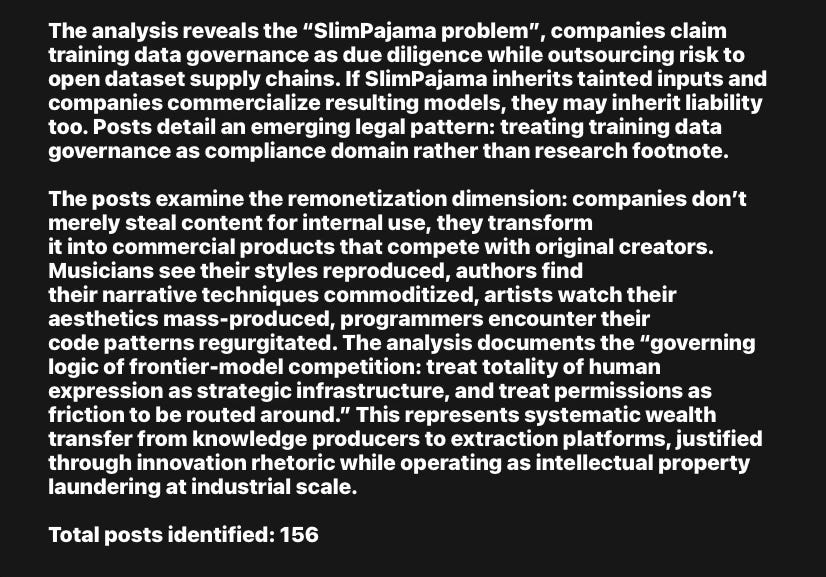
The analysis reveals the “SlimPajama problem”‚ companies claim training data governance as due diligence while outsourcing risk to open dataset supply chains. If SlimPajama inherits tainted inputs and companies commercialize resulting models, they may inherit liability too. Posts detail an emerging legal pattern: treating training data
governance as compliance domain rather than research footnote.
The posts examine the remonetization dimension: companies don’t merely steal content for internal use‚ they transform
it into commercial products that compete with original creators. Musicians see their styles reproduced, authors find
their narrative techniques commoditized, artists watch their aesthetics mass-produced, programmers encounter their
code patterns regurgitated. The analysis documents the “governing logic of frontier-model competition: treat totality of human expression as strategic infrastructure, and treat permissions as friction to be routed around.” This represents systematic wealth transfer from knowledge producers to extraction platforms, justified through innovation rhetoric while operating as intellectual property laundering at industrial scale.
Total posts identified: 156