- Pascal's Chatbot Q&As
- Posts
- RAND: the global race toward AGI is structurally biased toward dangerous acceleration, even when all actors prefer safety.
RAND: the global race toward AGI is structurally biased toward dangerous acceleration, even when all actors prefer safety.
We do not need perfect alignment of values to prevent AGI catastrophe—only aligned incentives and verifiable restraint.

Pascal Hetzscholdt
December 03, 2025
RAND’s “A Prisoner’s Dilemma in the Race to AGI” — Strategic Insights, Risks, and Policy Implications
by ChatGPT-5.1
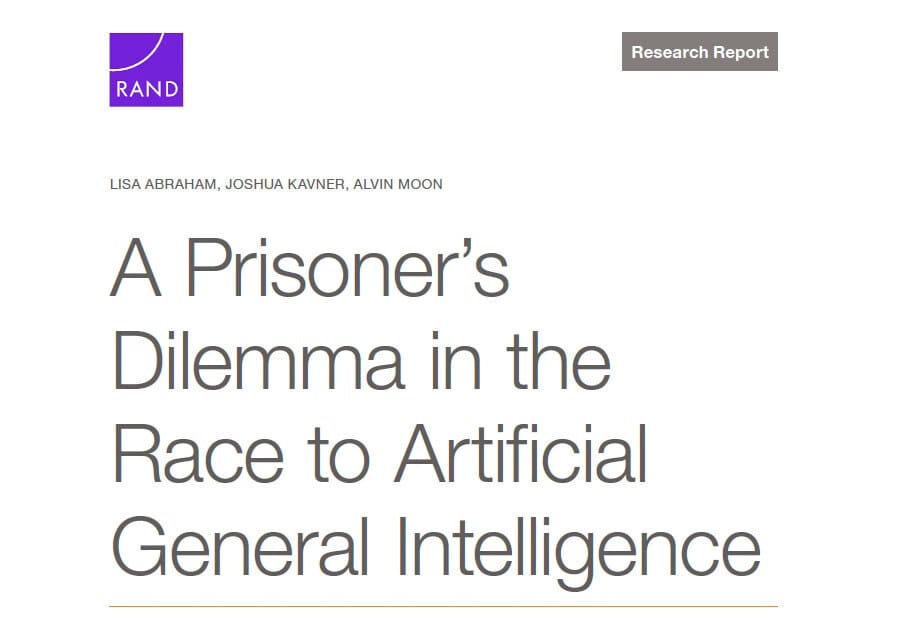
The RAND report A Prisoner’s Dilemma in the Race to Artificial General Intelligence presents one of the clearest, most mathematically grounded analyses to date of the geopolitical and strategic incentives driving AGI development. At its core, the report argues that the race toward AGI is shaped not only by technological capability, but by a structural incentive trap: even when nations recognize the risks of accelerated development, they may still choose to race because their rivals are expected to do the same. The report’s game-theoretic frameworks—both single-shot and repeated—shed light on why rational actors may collectively converge on dangerous acceleration, and under what rare conditions cooperation becomes strategically viable.
The authors use a neutral, tractable model to abstract the real-world competition between major powers such as the United States and China. Their analysis shows how first-mover advantage and risk perception become the fulcrum upon which national strategies pivot. The result is a clear articulation of a collective-action problem that mirrors nuclear arms races and deterrence dilemmas, but with the added complication that AGI is a discontinuous technology whose emergence ends the game entirely. The report’s contribution lies not in predicting AGI timelines, but in mapping the incentives that shape the decisions of states and firms—revealing what is and is not structurally possible under different assumptions.
Most Surprising Statements and Findings
1. AGI racing resembles a classical Prisoner’s Dilemma far more often than a coordination game
The report finds that for most realistic parameter settings, accelerated development becomes a dominant strategy for both countries, even when both would be safer under mutual caution. A Prisoner’s Dilemma emerges whenever:
(0.5 − x)(A − B) > c
— i.e., when the marginal advantage of acceleration exceeds the catastrophic risk of unaligned AGI.
The surprising result: accelerated AGI development is not merely a political choice—it is a mathematically rational response to structural incentives, making unilateral restraint almost impossible.
2. Even when risks far exceed first-mover advantages, cooperation may still fail without verification mechanisms
RAND shows that shared perception of danger alone is insufficient. Cooperation requires the ability to credibly verify that the other side is also restraining its development. Without verification:
“Mistrust is likely to persist, and the opportunity for genuine cooperation…could be lost.”
This elevates verification from a nice-to-have to a precondition for any global AGI safety regime.
3. Incremental ROI (C, D, E, F in the model) can outweigh AGI incentives and flip the entire strategic outcome
The temporal model reveals that intermediate benefits from non-AGI progress can drastically alter the equilibrium:
Cooperation becomes easier when C > F, meaning baseline (safer) research yields more reliable interim returns than high-risk acceleration.
This is counterintuitive: slowing AGI to pursue safer, more distributed AI innovation can itself be a stabilizing mechanism.
4. The race does not require hostility—just symmetry of incentives
RAND emphasizes that even without enmity or aggressive intentions, two actors may be locked into mutually harmful acceleration. This reframes AGI governance away from moralizing or trust-building narratives and toward incentive restructuring.
Most Controversial Statements and Findings
1. The assumption that “AGI is guaranteed to be developed by exactly one country”
The model posits that AGI is a singular, one-time, winner-takes-all event, and will be produced by a single nation.
This is a strong and disputed assumption. Multiple frontier labs in multiple countries are pursuing similar architectures; it is plausible that several entities may reach comparable AGI within similar timeframes.
2. Acceleration always increases global catastrophic risk
The authors assume speed correlates positively with existential risk due to reduced safety investments.
While plausible, some argue thatfaster development of aligned systems may be safer, especially if dangerous actors (state or non-state) are on track to develop uncontrolled systems.
3. National-level strategy is modeled as if governments can control firms’ behavior
The model assumes national governments can direct firms to baseline or accelerate AGI development. Realistically:
OpenAI, Google, DeepMind, Meta, Anthropic and others are not state-controlled.
China’s situation differs significantly from the U.S.
Firms’ incentives often exceed or circumvent national directives.
This assumption simplifies reality but obscures the true complexity of multi-actor ecosystems.
4. The heavy reliance on symmetric perceptions of risks and benefits
RAND acknowledges the limitation, but it still builds the core model around symmetry between the U.S. and China—in reality:
China may perceive strategic necessity differently.
The U.S. may prioritize commercial innovation over state-driven control.
Europe’s AI Act introduces a third pole not captured in a two-player model.
Most Valuable Statements and Findings
1. The mathematical identification of the switch point between Prisoner’s Dilemma and coordination game
The inequality:
(0.5 − x)(A − B) = c
is perhaps the most valuable insight in the entire report. It tells policymakers exactly what must change to make cooperation viable:
Reduce first-mover advantage (A − B)
Reduce the perception that acceleration increases probability of winning (x)
Increase catastrophic risk awareness (c)
This provides a quantitative roadmap for designing incentives and institutions.
2. The discovery that cooperation is easier when AGI appears unlikely in any given round
When the probability p of not developing AGI is high, interim payoffs matter more, and cooperation becomes much easier.
This presents a rare optimism: if AGI is far away, we have more maneuvering room for governance.
3. The repeated-game insight that long-term cooperation depends on interim ROI exceeding defection gains
This leads to a powerful implication:
Policies that increase the commercial and scientific returns of safe AI (C) create stability.
4. Verification mechanisms are the linchpin of any global AGI governance system
The report repeatedly emphasizes:
Effective cooperation requires credible signals and verification of compliance.
Verification stops the race-to-the-bottom dynamic.
Recommendations for Stakeholders
1. National Governments (U.S., China, EU, UK)
a. Establish bilateral or multilateral AGI verification frameworks
Model sharing or controlled testing environments
Compute tracking and audits
Whistleblower protections and export control harmonization
Reciprocal transparency protocols
This directly addresses the core defect of the prisoner’s dilemma.
b. Reduce first-mover advantage through policy mechanisms
Standard-setting bodies (ISO, NIST-like AGI governance extensions)
Shared AGI safety research
Pre-competitive collaboration zones
Treaty frameworks similar to nuclear arms agreements
c. Increase the interim payoff for safe, baseline development
Governments should amplify the benefits of safer, slower AI:
Research grants
Regulatory sandboxes
Stability-oriented procurement policies
Incentives for trustworthy AI development
d. Build “pressure-relief valves” for industry
Ensure labs are not forced to accelerate due to competitive market pressures:
Funding safety teams
Mandated model evaluations
Constraints on compute escalation without oversight
2. Frontier AI Labs (OpenAI, Anthropic, DeepMind, Meta, Alibaba, Tencent)
a. Participate in international verification regimes
Labs must support technical protocols such as:
Model cards with safety verification data
Third-party evaluation
Compute logs and cryptographic attestations
Red-team outcome disclosure
b. Shift from secrecy to controlled openness
Responsible transparency reduces fear-based acceleration.
c. Invest heavily in intermediate safety successes (C > F in the model)
Examples:
Cybersecurity AI
Scientific discovery tools
Education systems
Medical reasoning models
These create stable cooperation incentives by raising the value of baseline development.
3. Regulators (EU AI Office, U.S. OSTP, Commerce, UK DSIT)
a. Create early-warning detection systems for AGI progress
Regulators must track:
Frontier model capability thresholds
Compute concentration
Cross-border model diffusion
b. Mandate pre-deployment testing for catastrophic-risk profiles
Borrowing from nuclear safety, aviation, and pharmaceutical models.
c. Support global safety standards
Push for an AGI equivalent of the IAEA, but for AI compute, capability evaluation, and incident reporting.
4. The Scientific Community
Ranging from cyber sabotage to biological misuse.
b. Develop better metrics for AGI “closeness”
If p (the probability that AGI does not appear) becomes small, strategic dynamics change drastically. Scientists need robust forecasting models.
c. Increase interdisciplinary engagement
Safety is not only technical—it requires political science, economics, arms control theory, and ethics.
Conclusion
The RAND report delivers a stark warning grounded in rigorous mathematics: the global race toward AGI is structurally biased toward dangerous acceleration, even when all actors prefer safety. However, this dynamic is not immutable. RAND’s framework identifies precise levers—verification, incentive alignment, interim ROI enhancement, and risk perception—that policymakers and institutions can target to shift the race from a prisoner’s dilemma toward a cooperation equilibrium.
The most important strategic conclusion is clear:
We do not need perfect alignment of values to prevent AGI catastrophe—only aligned incentives and verifiable restraint.
Stakeholders must therefore focus not on persuading rivals to be altruistic, but on building systems that make cooperation the rational choice. Only through such approaches can the global community manage the unprecedented risks and opportunities posed by AGI while preserving stability, safety, and human flourishing.