- Pascal's Chatbot Q&As
- Posts
- NATO's Mark Rutte's current framing fails because it treats US support as an unquestioned constant, when the defining feature of the moment is that US commitment is itself the variable.
NATO's Mark Rutte's current framing fails because it treats US support as an unquestioned constant, when the defining feature of the moment is that US commitment is itself the variable.
If you read closely, much of the argument rests on shaky assumptions, rhetorical shortcuts, and category errors about what “defend itself” even means in 2026.

Pascal Hetzscholdt
January 26, 2026
Europe, NATO, and the brittle logic of “keep dreaming”
by ChatGPT-5.2
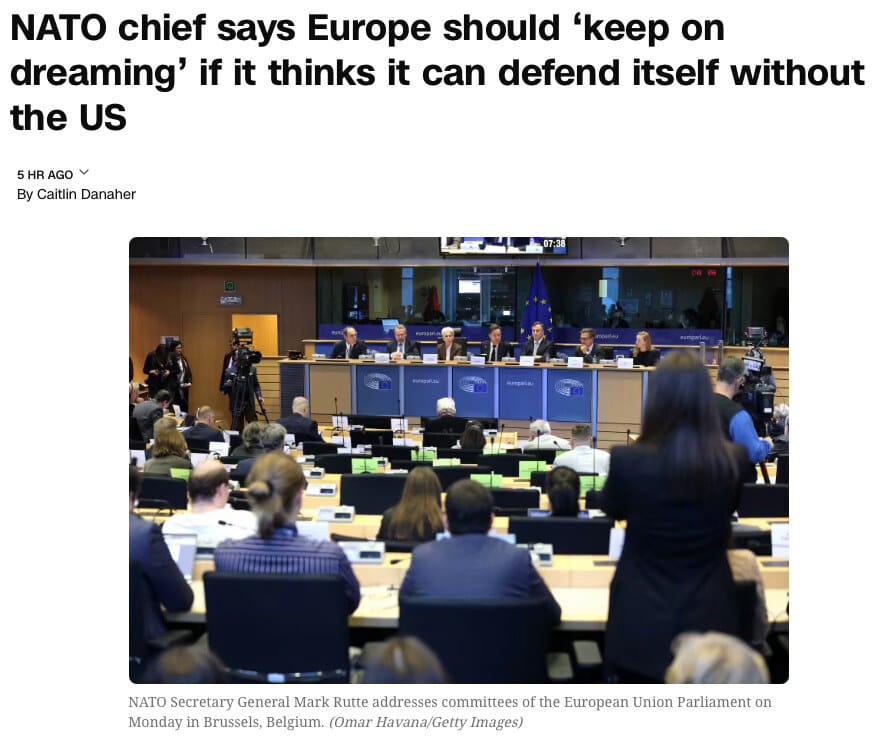
In this CNN piece, NATO Secretary General Mark Rutte delivers a blunt message to the European Parliament: Europe cannot defend itself without the United States, and anyone who thinks otherwise should “keep on dreaming.”
On its face, this sounds like hard-headed realism—an alliance leader trying to shock Europe out of complacency. But if you read closely, much of the argument rests on shaky assumptions, rhetorical shortcuts, and category errors about what “defend itself” even means in 2026.
Below is a detailed walkthrough of the article’s core claims, followed by all the points where Rutte’s logic fails (or at least doesn’t hold as stated)—including the scenario we are facing currently: a US president whose incentives, vulnerabilities, or preferences align more with Putin than with NATO’s collective defense.
What Rutte is arguing (as presented)
Rutte makes (at least) five linked moves:
Impossibility claim: Europe “can’t” defend itself without the US; NATO needs mutual dependence (“We need each other”).
Cost deterrence claim: If Europe wants to “do it alone,” it would need to raise defense spending to 10% and build its own nuclear capability—costing billions.
Nuclear umbrella claim: Without the US, Europe loses the “ultimate guarantor” of freedom: the US nuclear umbrella.
Trump normalization move: He praises Trump for raising Arctic security concerns, even while acknowledging this will irritate many.
Greenland compartmentalization: He outlines two “work streams” (NATO Arctic defense + US/Denmark/Greenland trilateral talks) and says he has no mandate to negotiate for Denmark and won’t do so—yet the article also reports Trump claiming a “framework” for a Greenland deal with Rutte.
That’s the structure. Now the failures.
All instances where Rutte’s logic fails (or is internally inconsistent)
1) False dichotomy: “Europe defends itself” vs “Europe needs the US”
Rutte frames the debate as binary: either Europe has the US, or Europe is dreaming.
But real strategy is not binary. There are multiple intermediate futures:
Europe becomes substantially more autonomous while still allied with the US.
Europe builds credible denial (making aggression fail) without needing full-spectrum power projection.
Europe reduces reliance in specific domains (ammo, air defense, ISR, cyber, logistics) while the US remains one pillar—not the pillar.
By collapsing a spectrum into two buckets, his conclusion (“you can’t”) is rhetorically powerful but logically overstated.
2) Equivocation on “defend itself”: defend where, against what, for how long, and at what cost?
“Defend itself” can mean:
deter/deny a conventional Russian push into NATO territory,
sustain a high-intensity fight for months,
protect sea lanes and undersea cables,
defend the Arctic approaches,
resist coercion (energy, cyber, sabotage),
or maintain a global expeditionary posture.
Rutte treats “defend itself” as a single, absolute capability—then declares it impossible without the US.
That’s a category error. Europe could plausibly achieve some defense objectives independently sooner than others. Without defining the objective function, “you can’t” is not a logically testable claim—it’s a political slogan.
3) The “10% spending” claim is asserted without a chain of reasoning
Rutte warns Europe would need to increase defense spending to 10% to go it alone.
As presented, that number functions as a shock statistic, not an argument. It ignores:
procurement inefficiency vs actual warfighting output,
fragmentation of European defense markets,
time-to-field constraints (industry capacity is often the binding constraint),
and the difference between transition costs and steady-state costs.
Even if Europe would need much more spending, “10%” is doing rhetorical work without being justified in the text—so the logic is incomplete at best.
4) He treats nuclear capability as the decisive missing ingredient, while ignoring existing European nuclear deterrence
Rutte says Europe would need to “build up their own nuclear capability,” implying a near-total dependence on the US for nuclear deterrence.
But Europe already contains nuclear-armed states (notably the UK and France). The debate is about credibility, scale, doctrine, and political command—not a blank slate.
So his logic fails in two ways:
Overstatement: Europe is not starting from zero.
Misframing: The key issue is whether Europe can create a credible deterrent posture and command arrangements without US extended deterrence—not whether nuclear weapons exist at all.
5) “Ultimate guarantor of our freedom” assumes the guarantor is reliably aligned with Europe’s freedom
Rutte calls the US nuclear umbrella the “ultimate guarantor of our freedom.”
That is only true if US political leadership is stably committed to NATO’s defense obligations and aligned with European security.
This is exactly where the status quo bites: if Donald Trump is “dancing to the pipes of Vladimir Putin” (whether due to ideology, leverage, blackmail, business interests, or political calculus), then US power becomes a source of strategic uncertainty rather than a guarantor. In that world:
the umbrella may be conditional, transactional, or selectively applied;
the US could use security guarantees as coercive leverage against allies;
or the US could undercut deterrence simply by signaling ambiguity.
Rutte’s logic fails because it assumes the capacity automatically translates into credible commitment. Deterrence is psychology + capability + credibility. If credibility is compromised, dependence becomes a liability.
6) He argues “we need each other,” but the rest of his argument is “Europe needs the US”
Rutte says “We need each other.”
But his supporting points focus overwhelmingly on European deficiency and US indispensability (nuclear umbrella, spending, going it alone). The argument as delivered is asymmetric.
That matters because asymmetry changes bargaining power inside alliances. If Europe internalizes “we can’t,” it also internalizes: “we must accept US terms”—even if those terms are destabilizing (e.g., Greenland coercion, tariff threats, or transactional security).
So the logic doesn’t match the premise: mutual dependence is asserted, but unilateral dependence is argued.
7) He treats US Greenland pressure as “Arctic security realism,” without addressing alliance integrity and coercion
Rutte praises Trump for raising Arctic security concerns.
Even if Arctic security is real, praising theissuewhile downplaying themethod(pressure over Greenland, “ownership” demands, tariff leverage) muddles two things:
legitimate strategic concern (Arctic sea lanes, Russia/China activity),
and coercive bargaining against an ally (Denmark/Greenland).
If the alliance normalizes coercion among allies, it weakens cohesion—the very thing NATO relies on to deter Russia. In other words: he implicitly asks Europe to depend on a protector who is simultaneously testing how far coercion against allies can go. That’s internally unstable logic.
8) Internal inconsistency on Rutte’s role: “no mandate, won’t negotiate” vs reported “framework”
Rutte says he will not be involved in the US/Denmark/Greenland discussions and has “no mandate” to negotiate on Denmark’s behalf.
But the article also reports Trump claiming he reached aframeworkfor a Greenland deal with Rutte, linked to Trump dropping tariff threats.
NATO chief says Europe should ‘…
Even allowing for Trump exaggeration, the presentation creates an inconsistency:
If Rutte truly has no mandate and no role, why is he being positioned (or allowing himself to be positioned) as a channel for a “framework” outcome tied to tariffs?
If he did influence an outcome, then “no mandate” becomes a diplomatic fig leaf, not a clean boundary.
Either way, the logic of “I’m not involved” doesn’t cohere with the reported political effect.
9) He uses “good luck” as if the only alternative to US dependence is reckless autarky
“So hey, good luck,” he says, if Europe wants to do it alone.
This isn’t an argument; it’s a rhetorical closure meant to make alternatives feel childish. It dodges the central strategic question Europe is grappling with:
How to reduce vulnerability to US political volatility while keeping NATO intact.
Europe’s push for more capability is not (primarily) romantic “strategic autonomy”; it’s risk management in a world where the US may swing hard, fast, and unpredictably.
10) He ignores the principal constraint: time + industrial capacity, not just budgets
Rutte frames the problem as spending levels and nuclear umbrellas.
But modern defense readiness is bottlenecked by:
munitions production,
air defense interceptors,
maintenance capacity,
trained manpower,
logistics and lift,
ISR/space resilience,
and supply chain security.
A pure “spend more” argument can fail because money does not instantly translate into capability. If his aim is realism, omitting the real bottlenecks weakens the logic.
The deeper strategic flaw: Rutte’s message may be tactically useful, but strategically incomplete
Rutte is likely trying to do two things at once:
Shock Europe into rearmament (hence “keep dreaming,” “10%,” “good luck”).
Keep Trump onside by praising his instincts (Arctic security) and smoothing alliance friction.
NATO chief says Europe should ‘…
Those are understandable institutional incentives for a NATO Secretary General. But they produce a brittle public logic:
If you tell Europe it cannot defend itself without the US, you are also telling adversaries (and Washington) that Europe is structurally dependent.
If Washington is politically unstable—or worse, compromised or aligned with Putin’s interests—then that dependence becomes an attack surface.
That’s the heart of the current situation: a “protector” whose preferences drift can become a mechanism of control. In that scenario, Europe’s rational strategy is not to “dream” of independence overnight, but to build credible European capacity precisely because US reliability is uncertain.
Conclusion: where the argument should land if it were logically sound
A more logically coherent version of Rutte’s message would be:
Europe cannot instantly replicate US capabilities.
But Europe can and should build enough capability to deny aggression and reduce US leverage.
NATO should be structured so that US participation is a multiplier, not a single point of failure.
And alliance cohesion requires rejecting coercion among allies as a normalized tool—even when it comes from Washington.
Rutte’s current framing—at least as reported here—fails because it treats US support as an unquestioned constant, when the defining feature of the moment is that US commitment is itself the variable.