- Pascal's Chatbot Q&As
- Posts
- Meta Platforms Inc., an entity currently facing allegations that extend beyond mere negligence...
Meta Platforms Inc., an entity currently facing allegations that extend beyond mere negligence...
...into the realm of systemic facilitation of human exploitation and the coordinated manipulation of state and federal law to preserve its commercial interests.

Pascal Hetzscholdt
March 20, 2026
Meta Platforms Inc.—The Architecture of Influence: Corporate Malfeasance, Liability Shifting, and the Erosion of Digital Sovereignty
by Gemini 3.0, Deep Research. Warning, LLMs may hallucinate!
The intersection of global social media expansion, transnational organized crime, and sophisticated legislative influence operations has created a systemic crisis in digital governance. At the center of this nexus is Meta Platforms Inc., an entity currently facing allegations that extend beyond mere negligence into the realm of systemic facilitation of human exploitation and the coordinated manipulation of state and federal law to preserve its commercial interests. The topic at hand concerns a multi-layered operation where technology-facilitated exploitation—ranging from child sex trafficking to the recruitment of child soldiers by violent cartels—is being addressed not through internal safety reform, but through an aggressive, multi-billion dollar lobbying campaign designed to shift legal liability from the platform layer to the fundamental infrastructure of the internet: operating systems and app stores.1
This analysis explores the dual-track strategy employed by Meta: first, the maintenance of a platform environment that, while generating billions in profit, has become a primary recruitment ground for organized crime; and second, the utilization of a “dark money” network of ostensibly independent child safety organizations to draft and promote legislation that creates a legal “safe harbor” for the company. The underlying objective of this influence operation is the neutralization of an estimated $50 billion in potential liabilities under the Children’s Online Privacy Protection Act (COPPA), a financial threat precipitated by the company’s documented failure to remove millions of underage users from its platforms.2 The consequence of this maneuver is the proposed implementation of a persistent surveillance infrastructure at the operating system level, which threatens the principle of online anonymity and places an insurmountable compliance burden on the open-source software ecosystem.1
Topic Overview: The Strategic Shift from Safety to Surveillance
The core of the current debate involves the transition from “point-of-access” age verification—where individual websites or services check a user’s age—to “system-level” verification. This paradigm shift is codified in two primary legislative templates currently circulating through US state legislatures: the App Store Accountability Act (ASAA) and the Digital Age Assurance Act (DAAA).1 These bills require operating system providers and app stores to verify the age of every user at the point of device activation or account setup and to provide a real-time, system-wide Application Programming Interface (API) that broadcasts the user’s “age bracket” to any application running on the device.1
This transition represents a profound change in the privacy architecture of the digital world. By mandating that age identity be baked into the operating system, these laws move away from the “privacy by design” principles seen in international frameworks such as the European Union’s Digital Services Act (DSA).1 The US model, largely driven by Meta’s lobbying efforts, creates a persistent identity layer that enables mass data collection by third-party age verification vendors—many of whom have been documented tracking users and sharing data with advertising networks.2 The topic is thus not merely one of child safety, but of the fundamental restructuring of the internet to favor large, centralized platforms while simultaneously creating a surveillance-based safe harbor for their past and future legal violations.1
The Allegations: Exploitation, Inaction, and Reputation Laundering
The allegations against Meta and its network of influence are centered on four primary pillars: the facilitation of human trafficking and organized crime, the failure to mitigate child exploitation, the deliberate laundering of corporate reputation through captive nonprofits, and the illegal or unethical use of “dark money” to write favorable legislation.
Facilitation of Human Trafficking and Transnational Crime
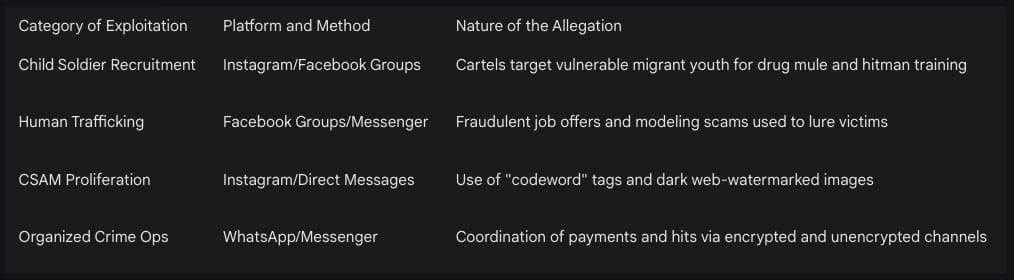
One of the most severe allegations is that Meta’s platforms have become the primary digital infrastructure for the Jalisco New Generation Cartel (CJNG) and other transnational criminal organizations. Evidence suggests that CJNG utilizes Facebook and Instagram not only for recruitment but as a primary tool for operational coordination.1 The allegations contend that Meta possessed “actual knowledge” of these activities through internal memos and whistleblower disclosures but failed to act, prioritizing user growth and engagement over public safety.1 The scope of this exploitation is vast, with research indicating that Meta’s platforms account for 72% of all identified sex trafficking recruitment and 79% of domestic minor sex trafficking recruitment.1
The “Safe Harbor” Lobbying Strategy
The second set of allegations involves a coordinated influence operation designed to shift the burden of COPPA compliance. It is alleged that Meta funded a front group, the Digital Childhood Alliance (DCA), to promote the App Store Accountability Act.1 This legislation is designed to transfer the “actual knowledge” of a user’s age from the platform (Meta) to the app store (Apple and Google). By doing so, Meta would be legally permitted to rely on a “good faith” signal from the app store, effectively immunizing it against billions of dollars in fines for existing underage users on its platform.2
Reputation and Money Laundering
The report by forensic investigator Adam Zarnowski alleges that Meta has engaged in “reputation laundering” by partnering with and funding child safety organizations like the National Center on Sexual Exploitation (NCOSE) and the International Centre for Missing & Exploited Children (ICMEC).1 These organizations, some of which are described as being in a state of insolvency and kept alive solely by board loans and corporate donations, allegedly use their “expert” status to advocate for legislation that was actually written by Meta lobbyists.1 Furthermore, Zarnowski suggests that because Meta’s profits are derived in part from facilitating exploitation, the money flowing into these nonprofits may constitute the proceeds of organized crime, potentially involving the organizations in money laundering enterprises.1
The Evidence and the Strength of Claims
The evidence supporting these allegations is derived from a combination of internal corporate documents, forensic financial analysis, and legislative tracking. The strength of the evidence varies across the different claims, but the overall picture reveals a highly integrated and well-funded operation.
Internal Memos and Actual Knowledge
The evidence regarding Meta’s knowledge of cartel activity is categorized as high-strength. Internal memos from January 4, 2021, explicitly documented CJNG’s recruitment of teenagers for training camps.1 These reports included evidence of extreme violence shared on the platform, including Instagram posts of a young male being shot in the head and bags of severed hands.1 Despite these warnings, the identified pages remained active for months.1 This documentation provides a direct link between the platform’s internal awareness and its external failure to mitigate harm, establishing a clear record of negligence.
Financial and Lobbying Records
The evidence of the influence operation is supported by public IRS 990 filings, state ethics databases, and campaign finance records. Analysts have documented a massive surge in Meta’s lobbying expenditures, which reached an all-time record of $26.3 million in 2025.1
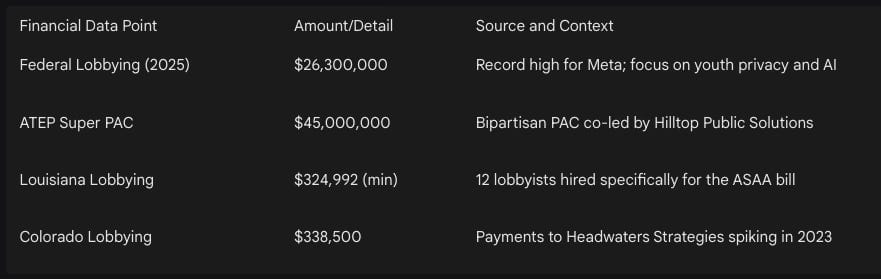
The strength of the financial evidence is bolstered by the structural “fragmentation” of Meta’s PACs. By registering numerous state-level PACs—such as “Forge the Future” in Texas and “Making Our Tomorrow” in Illinois—Meta has successfully obscured the total scale of its political spending.1 The use of common leadership across these PACs, such as Meta VP Brian Rice, provides the evidentiary thread connecting these seemingly disparate entities.8
Non-Profit Anomalies and Front Group Identification
The investigation into the Digital Childhood Alliance (DCA) has produced evidence of what is described as a “staging deployment” of a front group. The DCA domain was registered on December 18, 2024, and its website was fully functional 24 hours later, pre-loaded with legislative templates that were signed into law in Utah just 77 days later.1 The discovery that the DCA does not legally exist in the IRS database—lacking an EIN and appearing only as a “Project” in the For Good donor-advised system—provides strong evidence that it is an astroturf organization rather than a genuine grassroots coalition.1
The financial state of ICMEC adds further weight to the theory of captive nonprofits. IRS filings from 2022-2024 show ICMEC with negative net assets and a headcount drop from 21 to 13, yet the organization produced an expensive “legislative toolkit” for the DAAA during this period of near-insolvency.1 The presence of board member loans totaling $1.1 million to keep the organization afloat suggests a desperate financial environment where corporate grants from confirmed donors like Meta carry immense influence.1
Verbatim Legislative Templates
The most compelling evidence of Meta’s direct role in writing legislation is the verbatim similarity of the bill text across multiple jurisdictions. The definition of “Operating system provider” in California’s AB-1043 is identical to the language in Illinois’ SB-3977.2 Furthermore, a Meta lobbyist in Louisiana confirmed that the company brought the legislative language directly to the bill’s sponsor, Representative Kim Carver.1 This direct admission, combined with the “good faith” liability shield that specifically targets Meta’s $50 billion COPPA exposure, provides high-strength evidence of a self-serving legislative operation.2
Next Steps for Governments and Enforcement Bodies
The complexity of the exploitation and influence network requires a multi-faceted response from state, federal, and international regulators. Enforcement bodies should prioritize the following actions to restore accountability and protect digital rights.
Mandatory Lobbying and Non-Profit Disclosure
Current transparency laws are insufficient to address the “dark money” operations identified in this report.
Fundraising Transparency: Legislatures should mandate that any nonprofit or advocacy organization testifying in support of legislation must disclose its major donors (e.g., those contributing more than $10,000) for the preceding three years.
Verification of Legal Status: State Attorneys General should investigate the legal standing of organizations like the Digital Childhood Alliance that engage in high-level lobbying without public records of incorporation or IRS tax-exempt status.1
PAC Consolidation Reporting: Reform campaign finance laws to require “aggregate disclosure” for corporate-funded PAC networks, preventing companies from hiding the total scale of their influence through fragmented state-level filings.8
Financial Intelligence and Anti-Money Laundering (AML) Enforcement
The allegation that corporate profits from exploitation are being used to fund reputation-laundering nonprofits requires immediate forensic investigation.
Proceeds of Crime Audit: Federal enforcement agencies should audit the financial relationship between Meta and its “safety” partners to determine if funds are derived from the facilitation of criminal activity.1
AML Scrutiny for Non-Profits: Financial institutions should flag and investigate large, non-grant payments to nonprofits—such as “consulting fees” or “professional service fees”—which are currently used to bypass transparent grant-making channels.1
Reforming Age Verification and Data Privacy Standards
Governments must move away from the “surveillance-first” model of age verification being pushed by the DAAA/ASAA templates.
Adopting Privacy-By-Design: Regulators should follow the EU model of using zero-knowledge proofs and decentralized digital wallets, which allow for age verification without the creation of persistent, system-level identity signals.1
Data Minimization Mandates: Legislate strict data minimization requirements that prohibit the collection of biometric data or government IDs for age verification, and ban the sharing of age signals with advertising networks.5
Protecting Open Source: Future legislation must include explicit exemptions for non-commercial, open-source software and volunteer-run projects to prevent the destruction of the OSS ecosystem.1
Strengthening COPPA Enforcement
The core driver of the influence operation is the avoidance of COPPA penalties.
Strict “Actual Knowledge” Definition: Regulators should reject legislative attempts to offload “actual knowledge” onto app stores. Instead, they should enforce a standard where documented reports of underage users (as seen in the 2023 AG complaint) constitute actual knowledge.2
Aggressive Fines: Enforcement of the full $53,088 per-violation penalty for companies that fail to remove known underage users would serve as a powerful deterrent against using child safety as a commercial growth metric.2
Global Societal Implications and Future Prevention
The implications of the Meta influence operation extend far beyond the borders of the United States. They represent a fundamental challenge to the concept of digital sovereignty and the rule of law in a world increasingly dominated by technological conglomerates.
The Threat of Technofascism and the Erosion of Anonymity
The push for persistent, system-level age verification is a move toward what critics describe as “technofascism.” By requiring an identity layer at the operating system level, society is effectively ending the era of online anonymity.1 This infrastructure, while marketed as a tool for “child safety,” creates a ready-made platform for broader surveillance. If an operating system can broadcast a user’s age bracket to every application, it can just as easily broadcast their political affiliation, religious views, or health status.1 The precedent being set by the DAAA/ASAA legislation is that the state—and the corporations that write its laws—has the right to demand “identity as a service” for every digital interaction.
The Capture of the Moral High Ground
The most insidious aspect of this operation is the “hijacking” of the anti-trafficking and child safety movements. By funding organizations with deep religious and conservative roots, Meta has successfully co-opted the language of moral outrage to shield its commercial interests.1 This “reputation laundering” makes it difficult for traditional critics to oppose the legislation without appearing to oppose child safety. Future prevention must involve a thorough “de-coupling” of the anti-exploitation sector from corporate and organized crime interests. This requires the development of independent funding models for child safety that do not rely on the platforms that generate the harm.
Rooting Out Malign Corporate Practices
To prevent these practices in the future, society must address the structural opacity that allows them to flourish.
Ending Astroturfing-as-a-Service: The commercial availability of bot networks and mass-reporting services—used to suppress unfavorable research on platforms like Reddit—must be regulated or banned as a form of “inauthentic behavior”.1
Corporate Governance Reform: Laws should be enacted to hold individual corporate executives personally liable for the deployment of covert influence operations and the deliberate circumvention of child safety laws.
Global Regulatory Coordination: As seen in Brazil and the UK, these operations are global in scope.1 Regulatory bodies must share intelligence on lobbying firms and “front groups” to prevent the spread of malign legislative templates across jurisdictions.
The current crisis is a result of a regulatory environment that has allowed technology companies to grow so large and so interconnected that they can effectively bypass the democratic process. The “Bombshell” report and the findings of the TBOTE Project represent a critical moment of clarity: the choice facing global society is between a future of corporate-managed surveillance and a return to a free, open, and private internet. Rooting out these practices will require more than just new laws; it will require a fundamental reassertion of public authority over the digital infrastructure that now governs nearly every aspect of human life. At the heart of this struggle is the recognition that “safety” cannot be built on a foundation of surveillance, and “dignity” cannot be bought through the laundering of dark money. The evidence is now public; the next steps will determine whether society has the will to act upon it.
Works cited
Bombshell: The Meta Data - by Adam Zarnowski - A WARNING, accessed March 19, 2026, https://awarning.substack.com/p/bombshell-the-meta-data
I pulled the actual bill text from 5 state age verification laws. They’re copy-pasted from two templates. Meta is funding one to dodge ~$50B in COPPA fines — and the other one covers Linux. - Reddit, accessed March 19, 2026, https://www.reddit.com/r/linux/comments/1rmhxk1/i_pulled_the_actual_bill_text_from_5_state_age/
Linux Distros Respond to Age Verification - Reddit, accessed March 19, 2026, https://www.reddit.com/r/linux/comments/1rlklg9/linux_distros_respond_to_age_verification/
California’s AB 1043 Could Regulate Every Linux Command, and the Open Source World Is Too Quiet, accessed March 19, 2026, https://shujisado.org/2026/03/02/californias-ab-1043-could-regulate-every-linux-command/
I traced $2 billion in nonprofit grants and 45 states of lobbying records to figure out who’s behind the age verification bills. The answer involves a company that profits from your data writing laws that collect more of it. : r/programiranje - Reddit, accessed March 19, 2026, https://www.reddit.com/r/programiranje/comments/1rtd7zw/i_traced_2_billion_in_nonprofit_grants_and_45/
The Year States Chose Surveillance Over Safety: 2025 in Review, accessed March 19, 2026, https://www.eff.org/deeplinks/2025/12/year-states-chose-surveillance-over-safety-2025-review
I traced $2B in nonprofit grants for Meta and Age Verification lobbying | Hacker News, accessed March 19, 2026, https://news.ycombinator.com/item?id=47361235
Mukhang malakas ang panawagan ng Meta para sa pagsusuri ng edad ng Linux sa USA - Potensyal ba itong paksa sa WAN? : r/LinusTechTips - Reddit, accessed March 19, 2026, https://www.reddit.com/r/LinusTechTips/comments/1rsn1tm/it_appears_meta_is_heavily_lobbying_for_linux_age/?tl=fil
The bill that is requiring operating systems to collect age data, destroying privacy, was introduced by Meta(Facebook). : r/FortCollins - Reddit, accessed March 19, 2026, https://www.reddit.com/r/FortCollins/comments/1rt9n6v/the_bill_that_is_requiring_operating_systems_to/
It Appears Meta is heavily lobbying for Linux age verification in the USA - Potential WAN Topic? : r/LinusTechTips - Reddit, accessed March 19, 2026, https://www.reddit.com/r/LinusTechTips/comments/1rsn1tm/it_appears_meta_is_heavily_lobbying_for_linux_age/
I traced $2 billion in nonprofit grants and 45 states of lobbying records to figure out who’s behind the age verification bills. The answer involves a company that profits from your data writing laws that collect more of it. : r/linux - Reddit, accessed March 19, 2026, https://www.reddit.com/r/linux/comments/1rshc1f/i_traced_2_billion_in_nonprofit_grants_and_45/
Meta Platforms: Lobbying, dark money, and the App Store Accountability Act | Hacker News, accessed March 19, 2026, https://news.ycombinator.com/item?id=47362528
All | Search powered by Algolia, accessed March 19, 2026,
Follow-up to my bill text comparison: I traced who wrote the OS-level age verification template that covers Linux. Meta, Google, and Snap all supported it. - Reddit, accessed March 19, 2026, https://www.reddit.com/r/linux/comments/1rr3f3n/followup_to_my_bill_text_comparison_i_traced_who/
California Introduces New Age Verification Requirements for Software Applications, accessed March 19, 2026, https://www.hunton.com/privacy-and-cybersecurity-law-blog/california-introduces-new-age-verification-requirements-for-software-applications