- Pascal's Chatbot Q&As
- Posts
- If scholarly publishing does not respond by reasserting control over verification, provenance, and authority, it risks becoming indistinguishable from the AI-generated sludge it once filtered out.
If scholarly publishing does not respond by reasserting control over verification, provenance, and authority, it risks becoming indistinguishable from the AI-generated sludge it once filtered out.
The future of the sector won't be decided by how much AI it adopts, but by whether it can re-engineer trust faster than AI can counterfeit it. That's the real threat & opportunity hidden in this story

Pascal Hetzscholdt
December 19, 2025
When Citations Collapse: AI, Synthetic Authority, and the Quiet Failure of Scholarly Infrastructure
by ChatGPT-5.2
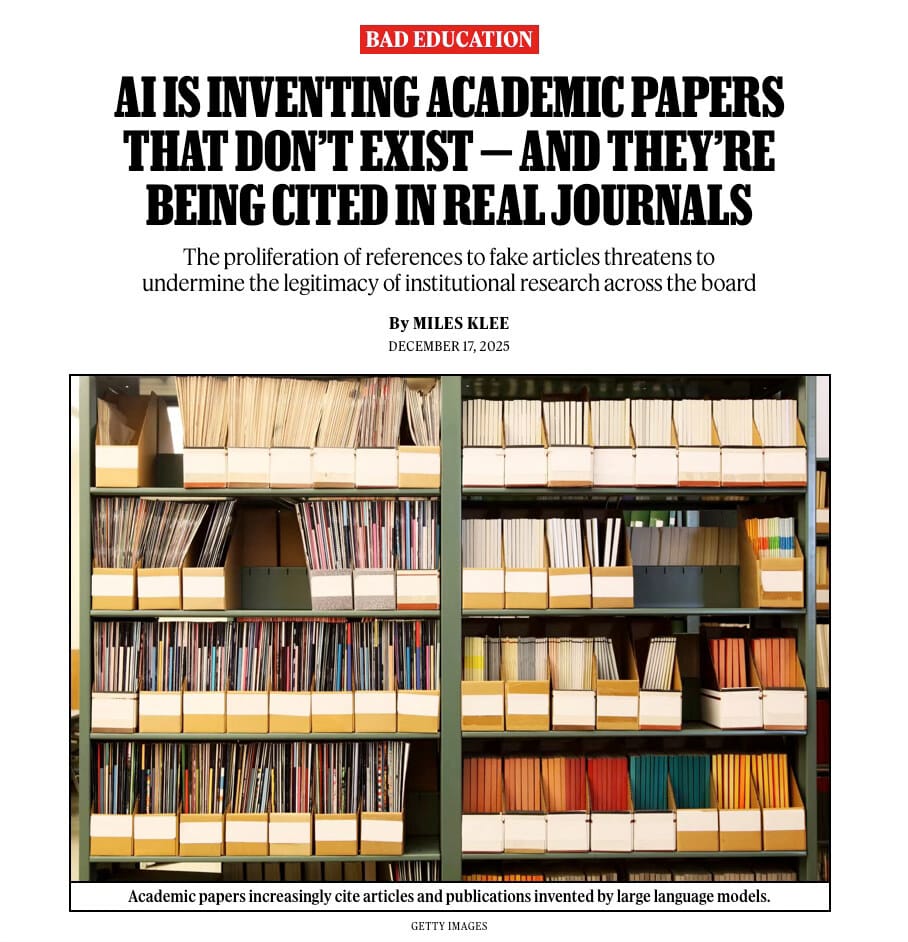
The article, AI Chatbots Are Poisoning Research Archives With Fake Citations, describes a phenomenon that at first glance appears mundane: AI systems invent academic references, and those references occasionally slip into real papers. But this framing understates the seriousness of what is unfolding. The eye-opening insight is not that errors exist, but that the machinery of scholarly legitimacy itself is being reverse-engineered and exploited—at scale—by probabilistic systems that are structurally indifferent to truth.
What emerges from the article is not a story about cheating students or careless authors. It is a story about how authority, verification, and trust in scholarly publishing were quietly optimized for a pre-AI world—and how those assumptions are now being fatally abused.
1. Fake Citations Are Not “Hallucinations” — They Are Synthetic Authority
One of the most under-discussed points in the article comes from Anthony Moser’s observation that calling AI outputs “hallucinations” is misleading. Hallucination implies deviation from a correct baseline. But large language models never had a truth-tracking baseline to begin with. They generate text that looks statistically correct, not text that is epistemically grounded.
This matters because citations are not mere metadata. In scholarly publishing, citations function as authority tokens. They signal that claims are anchored in a pre-existing body of vetted knowledge. When an AI invents a plausible-sounding journal, assigns it a realistic title, associates it with real scholars, and places it within a credible research niche, it is not making a random error. It is successfully simulating legitimacy.
That simulation is sufficient to pass through multiple layers of the academic system: authors, reviewers, editors, indexers, and discovery tools. The result is not misinformation at the edges, but counterfeit authority embedded at the core.
2. Citation Laundering: The Self-Reinforcing Failure Mode No One Designed For
Perhaps the most alarming and rarely acknowledged mechanism described in the article is what might be called citation laundering. Once a fake citation appears in a published paper, it gains second-order legitimacy. Other authors encounter it not via ChatGPT, but via real journals, real databases, and real Google Scholar results.
At that point, the original error becomes almost impossible to trace. Each subsequent citation compounds the illusion of authenticity. The academic ecosystem, designed to reward accumulation and cross-reference, becomes a credibility amplifier for non-existent research.
This is a qualitatively new failure mode. Traditional fraud could often be isolated to a bad actor or a predatory journal. AI-mediated citation laundering creates distributed, non-intentional contamination, where no single participant believes they are doing anything wrong—and therefore no one intervenes.
3. Discovery Systems Are Now Upstream Attack Surfaces
Another insight that deserves more attention is the role of search and discovery systems. The article notes that AI-assisted Google searches and academic databases reinforce the perceived existence of fake journals and papers by treating them as legitimate entities once they cross a minimal visibility threshold.
This exposes a structural vulnerability: indexing and ranking systems were built to optimize recall, not truth. They assume that inclusion equals legitimacy and that volume implies relevance. AI-generated fake citations exploit this assumption perfectly.
In effect, discovery infrastructure has become an upstream attack surface for epistemic integrity. Once polluted, every downstream user—students, reviewers, journalists, policymakers, and even other AI models—consumes corrupted signals.
The article briefly mentions that research librarians are spending up to 15% of their time responding to requests for non-existent materials. This is not a marginal inconvenience. It points to a deeper issue: human verification does not scale against synthetic content generation.
Scholarly publishing historically relied on distributed human labor—authors check sources, reviewers assess plausibility, editors ensure coherence. AI breaks this model by generating errors faster than humans can audit them, while making those errors increasingly indistinguishable from legitimate work.
The danger is not that verification fails occasionally, but that it becomes economically irrational. When checking every citation costs more than publishing the paper, incentives quietly shift toward tolerance rather than rigor.
5. What This Means for the Future of Scholarly Publishing
Taken together, these dynamics suggest that scholarly publishing is approaching a bifurcation point.
a) Publishing Will Shift From Content Volume to Trust Infrastructure
Publishers who continue to define their value primarily as content distributors will be outcompeted by AI systems that generate infinite “knowledge-shaped objects.” The scarce resource is no longer text—it is verified provenance, authenticated citations, and defensible chains of evidence.
Future publishers will increasingly resemble trust operators: maintaining canonical records, enforcing citation integrity, validating references at scale, and offering machine-verifiable signals of authenticity.
b) Journals Will Be Judged by Their Ability to Prevent Contamination
Impact factors and citation counts will become less meaningful in an environment where citations can be fabricated and laundered. Journals that cannot demonstrate active defense against synthetic citations will see their reputational capital erode—even if no single paper is fraudulent.
This creates pressure for new technical controls: citation registries, real-time validation against authoritative databases, and possibly cryptographic or registry-based reference verification.
c) AI Will Force a Re-Definition of “Peer Review”
Peer review cannot remain a plausibility check when AI can generate plausibility on demand. Review will need to become more forensic, more adversarial, and more tool-assisted—focused on provenance, data lineage, and reproducibility rather than narrative coherence.
Publishers who fail to evolve peer review risk becoming passive conduits for synthetic scholarship.
Conclusion: This Is Not About AI Misuse — It Is About Epistemic Power
The most eye-opening aspect of the attached article is that it reveals a power shift, not a technical glitch. AI systems are not merely introducing errors; they are re-encoding the signals by which knowledge is recognized as legitimate.
If scholarly publishing does not respond by reasserting control over verification, provenance, and authority, it risks becoming indistinguishable from the AI-generated sludge it once filtered out. The future of the sector will not be decided by how much AI it adopts, but by whether it can re-engineer trust faster than AI can counterfeit it.
That is the real threat—and the real opportunity—hidden in this story.