- Pascal's Chatbot Q&As
- Posts
- Five years after the UK government first floated an AI-training copyright exception, the debate has hardened into a multi-jurisdictional trench war—legal, political, and economic...
Five years after the UK government first floated an AI-training copyright exception, the debate has hardened into a multi-jurisdictional trench war—legal, political, and economic...
...over who gets to industrialise culture, on what terms, and with what accountability.

Pascal Hetzscholdt
March 11, 2026
AI on Trial at London Book Fair: When Copyright Became the Front Line of the AI Economy
by ChatGPT-5.2
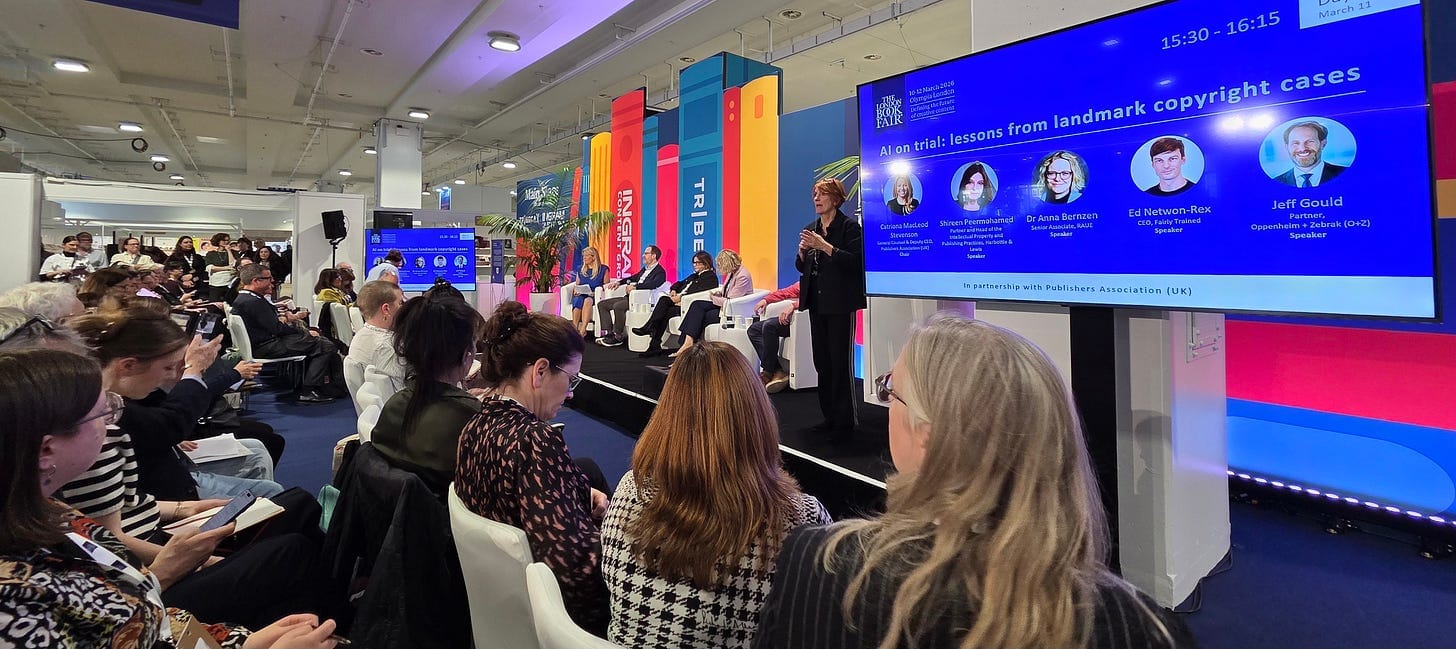
At the London Book Fair’s Main Stage (15:30–16:15, on Wednesday 11th March 2026), the session “AI on trial: lessons from landmark copyright cases” made something feel unusually plain: five years after the UK government first floated an AI-training copyright exception, the debate has hardened into a multi-jurisdictional trench war—legal, political, and economic—over who gets to industrialise culture, on what terms, and with what accountability.
Participants (names and titles)
Catriona MacLeod Stevenson — General Counsel & Deputy CEO, Publishers Association (UK) (Chair)
Jeff Gould — Partner, Oppenheim + Zebrak (O+Z)
Shireen Peermohamed — Partner and Head of Intellectual Property and Publishing Practices, Harbottle & Lewis
Dr Anna Bernzen — Senior Associate, RAUE (Germany)
Ed Newton-Rex — CEO, Fairly Trained; Visiting Research Fellow, King’s College London
The frame Catriona set: five years of drift, and a “battleground of thoughts”
Catriona opened with a blunt timeline: five years since the UK first tried to introduce an AI-training exception; backlash; consultation; reversals; and still no clarity. That vacuum has done what vacuums always do: it gets filled by power. In practice, she argued, it has produced a public campaigning war (“Don’t Steal This Book” visibly in the hall), and a global litigation wave—US, UK, Germany, and more.
Her most pointed moral claim was not abstract: we already have copyright, and yet “it’s been infringed at scale.” The alleged pattern she sketched is a familiar one in platform politics: take first, argue later, then lobby to legalise the taking. That frame mattered because it turned the session away from “new tech confusion” and toward something older: enforcement failure meets political capture.
Jeff Gould: the US is a fact-war—fair use will turn on market harm and outputs
Jeff Gould offered the clearest high-level map of US litigation. Roughly “about 80” AI copyright cases, he said, with wildly varying quality of facts, lawyering, and record-building. He grouped plaintiffs into three cohorts:
Visual artists / image-rightsholders (e.g., cases against image generators)
Author class actions
Media/news publishers
He then identified the three recurring allegation clusters:
Copying for training is infringing
Outputs are infringing
Acquisition/sourcing is infringing—often via piracy channels
Where US law bites, he said, is fair use—especially:
Factor 1: purpose and nature of use (commerciality; “transformative” framing)
Factor 4: market harm (substitution and licensing market usurpation)
The most revealing part of Jeff’s account was his comparison of two Northern District of California rulings—Anthropic and Meta—and how courts can look at similar ugly facts and still diverge dramatically.
The Anthropic split: “training fair use,” but torrenting as irredeemable infringement
Jeff described how the Anthropic court separated conduct into buckets and assessed fair use differently for each. The headline: copying for training was found fair use because “exceedingly transformative,” in the judge’s view—helped by a weak record on outputs/market substitution. But torrenting pirated books was treated differently: “meat-and-potatoes piracy” and “irreparable, irredeemable” infringement. This mattered because it created a doctrinal fissure: even if training might be argued as fair use, the way you get the data can still be its own liability crater.
Jeff also highlighted the court’s startling comfort with a scenario that, to the room, sounded like cultural vandalism: buy books, strip covers, scan, train—and still call it fair use. He later said this “shocks the conscience” and conflicts with where US fair use has been heading post-Warhol, arguing the judge defined the “purpose” too narrowly (“training a model”) rather than as commercial development of a text-generation substitute.
The Meta gestalt: “we don’t care it was illegal if it’s for training”
By contrast, Jeff described the Meta ruling as treating the training pipeline as one integrated whole and—most controversially—being comparatively indifferent to the illegality of acquisition. The saving grace, in his telling, was that the Meta judge scolded plaintiffs’ lawyers for failing to build an adequate market-harm record. That’s not a procedural footnote; it’s a strategic instruction to the entire rights-holder ecosystem: if you can’t demonstrate substitution and licensing market harm, you may lose even with morally grotesque facts.
Jeff’s strategy lesson: build the outputs record early
Jeff’s through-line was pragmatic and adversarial: stop litigating training in the abstract. Build a record showing verbatim or near-verbatim outputs, and show an existing licensing market being undermined (he gave lyrics licensing as the cleanest example). That’s where US courts may be forced to confront AI not as “transformative research” but as a commercial competitor.
Shireen Peermohamed: the UK fight is procedural reality + the “model as infringing copy” battleground
Shireen pulled the session into UK legal physics—less grand theory, more procedural constraints and tactical possibilities.
No US-style class actions; representative actions are fragile
The UK lacks US-style opt-out class actions in this space. The closest analogue is a representative action, where one claimant represents others with “the same interest.” In Getty v Stability AI, Getty attempted something like this (one claimant representing ~50,000), but Stability challenged it and the judge refused—largely because the court couldn’t identify a definitive list of affected works given uncertainty about training data.
But Shireen emphasized: the UK still has tools—multiple claimants, sample works, streamlined pleadings, and preliminary issues—to manage claims efficiently. The message wasn’t “the UK can’t do this.” It was: the UK will do it differently, and you must design for UK procedure.
Memorisation reframes the UK remedy question: is the model itself infringing?
Shireen’s most important contribution was connecting memorisation evidence to a core UK legal question: can the model itself be treated as an infringing “article” or “copy”?
In the Getty case, one claim went to trial on whether the AI model was itself an infringing copy. Getty lost in November (as Shireen recounted): the judge accepted a model could be an “article” even if digital, but held it wasn’t an infringing copy because it didn’t “store or retain copies of works.” Getty is appealing.
Why this matters is not academic: if a court accepts that a model is an infringing copy, then an injunction could have “practical teeth”—potentially existential. It becomes a route to remedies that are not just damages for past wrongs, but constraints on the continued operation of the model.
Shireen also delivered the caution that should haunt every future claimant: you don’t get to fix evidentiary gaps on appeal. UK appeals turn on legal error; you generally can’t add new facts. So the real work is front-loaded: evidence on training, what’s “in” the model, what comes “out,” and robust expert support.
Dr Anna Bernzen: Germany’s memorisation logic—“if it went in and comes out, it’s in the bottle”
Anna gave the most mechanically satisfying “how we proved it” explanation.
In the German GEMA case (lyrics), key facts were agreed: the lyrics were in training data, and outputs were close enough to be meaningful. The team used simple open-ended prompts (“what are the lyrics of [song]?”). The court found the length/complexity of outputs made coincidence implausible.
Her core evidentiary syllogism was memorable because it was so plain-language:
if it went in, and it comes out—then it’s in the model.
OpenAI argued the familiar technical defense: it’s not a database; the content isn’t stored as readable text but as statistical weights/relationships. The court’s answer (as Anna relayed it) was equally blunt: that doesn’t matter if the protected expression can be made visible again through easy prompting. Reproduction is reproduction.
The EU TDM exception: not a magic cloak
Anna also explained why a TDM exception didn’t save the defendant in this posture. The court suggested TDM might apply to some AI-training contexts, but not to the reproduction at issue because it wasn’t “for the purpose of extracting information” in the sense intended by the exception.
She then widened liability beyond the moment of output: the court treated outputs as reproductions not only in a user’s RAM but also in saved chat history—a more durable fixation attributable to the provider. And on “making available,” the court was prepared to consider that successive access by many users could cumulatively amount to public availability.
Her broader point was a governance one dressed as doctrine: intermediary-liability narratives weaken when the provider designs the system, trains it, stores the outputs, and benefits commercially. Courts may decide: you built the machine; you own the consequences.
The new case: Suno and compositions; training outside the EU; jurisdiction fights
Anna then previewed a second German case against Suno, shifting from lyrics to musical compositions and adding a bigger strategic bet: extending claims to training even though training occurred in the US. She flagged a jurisdiction hook in German collecting society law, and a plan to push US-law fair use factors—especially where outputs are allegedly near-identical and substitution evidence exists. The date that matters: judgment expected 12 June (as she stated).
Ed Newton-Rex: the creators’ economy is being hollowed out—and the politics is the point
Ed Newton-Rex brought the argument back to lived consequences: creators are seeing work evaporate, and the mechanism is direct competition from models trained on their work.
His illustrative story—artist Kelly McKernan—was simple: when a major image generator launched, her income fell dramatically, and her style was detectable in model outputs. Whether one accepts every causal claim, the pattern he insisted on is plausible and widely reported across creative labor markets: a new system trained on your back-catalog becomes the cheapest competitor to your next commission.
Ed’s political claim was even sharper: the UK government has been trying to legalise training on copyrighted works without permission to attract AI firms—because that’s what they lobby for. His campaign object, “Don’t Steal This Book,” was designed as an embodied warning: an empty book authored by thousands, symbolising a future where writers are economically displaced and publishing becomes a hollow shell.
His “end goal” answer during Q&A was the session’s most strategic: don’t stop the tech—force it to be built fairly. He invoked the Napster-to-streaming arc: the system can change; licensing models can emerge; the question is whether the state sides with enforcement and markets—or with extraction.
Late in the session, transparency emerged as the connective tissue between all jurisdictions.
Ed gave the most damning example: in an early OpenAI paper era, training datasets were named (“Books1” and “Books2”) without meaningful disclosure. Only years later—via litigation—did it become clearer (in his telling) what those labels likely contained and why that mattered. His core point wasn’t just informational—it was structural:
If training happens behind closed doors, rights-holders cannot defend rights at scale.
And if it takes years and lawsuits to discover inclusion, enforcement becomes a privilege of the largest players—exactly the kind of asymmetry that reshapes an industry.
Jeff reinforced this from the discovery trenches: companies often claim not to know what’s in training sets. His tone was incredulous; the implication was darker: either companies are reckless beyond credibility, or “not knowing” is a liability strategy.
What the session really taught: this is not a doctrinal debate—it’s a contest over industrial policy and market design
Across the panel, the legal differences mattered—US fair use versus UK framing and remedies versus German/EU TDM boundaries—but the common diagnosis was the same:
Mass acquisition—often via piracy—built the current wave of models.
The outputs increasingly substitute for licensed markets.
Governments are being pressured to normalise the taking after the fact.
Transparency is the choke point: without it, rights become performative.
In other words: the legal system is being asked to decide whether generative AI is a new kind of transformative tool—or a new kind of commercial substitute built from uncompensated inputs.
Where this goes next: likely convergence on two pressure points
If you strip the session down to predictive signals, two pressure points look decisive:
1) Outputs + substitution will become the evidentiary battlefield
Jeff’s recurring lesson was that courts respond to records, not vibes. Plaintiffs who can show verbatim/near-verbatim output and real licensing markets (lyrics, textbook excerpts, image licensing, stock libraries) will be better positioned than plaintiffs arguing “training is theft” without demonstrable market harm.
2) “Model as infringing copy” could become the UK/EU remedy lever
Shireen’s Getty appeal focus and Anna’s “in the bottle” reasoning both point toward a remedy escalation: if courts accept that models embody protected expression in a legally meaningful way, then injunctions can target the model itself, not just its outputs. That’s the difference between “pay some damages” and “rebuild your product with lawful inputs.”
Closing note
The session ended with a practical invitation: speak to the panellists in the break before the next lecture. But the deeper takeaway was less conversational: the AI copyright fight is becoming the industrial policy fight. Who gets to aggregate culture into a competitive machine, what counts as “transformative,” what “market harm” means when the market is being redesigned in real time, and whether transparency will be mandated or indefinitely litigated—those are not side questions. They are the future shape of the creative and knowledge economy.