- Pascal's Chatbot Q&As
- Posts
- Fair Use as an Industrial Policy: What 'AI Progress' Is Really Arguing For — and What It Leaves Out. Critics can point to any counterexample—model outputs that substitute for works...
Fair Use as an Industrial Policy: What 'AI Progress' Is Really Arguing For — and What It Leaves Out. Critics can point to any counterexample—model outputs that substitute for works...
...scraping that violates site terms, training on pirated corpora, systematic leakage in niche domains—and argue the whole project is propaganda rather than analysis.

Pascal Hetzscholdt
March 09, 2026
Fair Use as an Industrial Policy: What AI Progress Is Really Arguing For — and What It Leaves Out
by ChatGPT-5.2
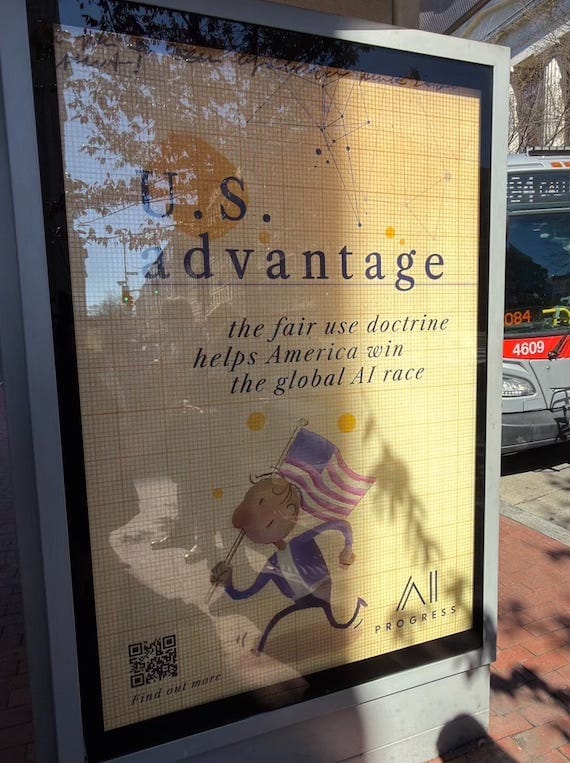
The AI Progress “Fair Use” page reads less like a neutral explainer and more like a policy positioning document dressed up as public education. Its core move is to translate a messy, fact-specific legal doctrine into a clean national narrative: fair use is the policy engine behind American technological dominance, and AI training should sit comfortably inside it. The page’s subtitle—“the policy behind the breakthroughs”—is doing a lot of work: it frames fair use not as a limitation on copyright (what it is), but as a strategic national asset (what they want it to be seen as).
1) What the website says (and how it says it)
The page establishes a simple chain of claims:
Fair use preserves access to information for “transformative uses.”
Fair use has historically fueled innovation and U.S. competitiveness “for nearly two centuries.”
AI needs broad data access, and fair use supplies it.
Restricting training data access risks medical/scientific breakthroughs, economic growth, and national security, and harms U.S. leadership versus China.
Fair use also “creates a level playing field” by enabling startups—not just incumbents—to innovate.
Notice what’s largely absent: any sustained engagement with rights-holder harm theories (substitution, market dilution, reputational harms, supply-chain impacts on creative labor), provenance, consent, or mechanisms for accountability if models do memorize or reproduce. The site is building a moral and political legitimacy story: “fair use = public good = U.S. wins.”
This matters because fair use is not a slogan. It is a multi-factor balancing testapplied to concrete facts, and it operates differently across contexts. The site compresses that nuance into four benefit bullets (“accelerates breakthroughs,” “drives growth,” “win the AI race,” “level playing field”). That compression is rhetorically effective, but it also makes the initiative vulnerable: critics can point to any counterexample—model outputs that substitute for works, scraping that violates site terms, training on pirated corpora, systematic leakage in niche domains—and argue the whole project is propaganda rather than analysis.
2) What it aims to achieve (the strategic objective)
The aim appears to be agenda-setting:
Define “AI training” as the paradigmatic modern fair use, analogous to Google Books search or other transformative indexing/logistical uses.
Preempt policy interventions (mandatory dataset disclosure, opt-in licensing regimes, new training rights, statutory levies, expansive transparency obligations) by framing them as innovation-killing burdens.
Anchor AI training to national security (“win the global AI race”) and to China as the implied counterfactual (“fewer constraints”).
Reframe the political economy: instead of “big tech extracted value from creators,” the story becomes “copyright limitations allow everyone to build.”
It’s an industrial policy message, and it’s coherent. The question is whether it’s durablein the face of facts and litigation outcomes that increasingly hinge not on abstract “transformative purpose,” but on data sourcing, governance, and real market effects.
The AI Progress report: what it argues, what it gets right, and where it overreaches
The paper, “AI Models: Addressing Misconceptions About Training and Copyright” (Chauvet & Kumar), is effectively the long-form legal/technical backbone behind the website’s messaging.
1) The report’s central thesis
It makes three big claims:
Technically: LLMs learn statistical patterns and relationships; they don’t function like databases that store and retrieve expressive works.
Doctrinally: Because copyright protects expression (not ideas/facts/patterns), the internal representations (embeddings/weights) should not be treated as “copies” or “derivative works.”
Legally: Even if copying occurs during training, it is fair use, and recent decisions (as presented) support that conclusion.
It also warns that policy proposals like mandatory disclosure of all training datacould collide with trade secret realities and create barriers to U.S. leadership.
2) What the report gets right (and why it persuades)
A) It explains, in accessible terms, why “training ≠ lookup.”
The explanation of tokenization, embeddings, probabilistic generation, and the non-deterministic nature of outputs is broadly aligned with how modern LLMs work (even if the pedagogical simplifications are sometimes a little too clean).
B) It makes a strong “fair use as innovation infrastructure” argument.
The paper anchors itself in a line of cases used historically to defend new technologies (search, reverse engineering, indexing) and frames training as an analogous “extract patterns/relationships for a new purpose” act.
C) It correctly flags that “a licensing market for the use at bar” shouldn’t automatically defeat fair use.
Courts have indeed worried about circularity: defining market harm as “lost license fees for the defendant’s use” can make the fourth factor a rights-holder trump card in every case. The report’s articulation of that problem is one of its stronger points.
3) Where the report is weakest (and why those gaps matter)
This is where the initiative’s credibility risk sits.
A) It treats “misconceptions” as the main obstacle, when the real obstacle is “governance and sourcing.”
The paper repeatedly suggests the debate is fueled by misunderstandings about model internals. That’s partly true—but many of the most damaging controversies are not about confusion; they are about how training sets are assembled in practice(scraping at scale, grey/black markets for text, shadow libraries, contractual bypass, weak provenance). A technically correct description of embeddings doesn’t answer the normative question: who gets to decide that your work becomes someone else’s industrial input, and under what constraints?
B) It underweights “outputs as a market substitute” as an empirical problem.
The paper draws a firm line between training (lawful) and outputs (separate infringement questions). That separation is doctrinally convenient, but practically fragile. If a model is deployed in a way that systematically substitutes for paid access—summaries, explanations, extracted tables, paraphrased textbook content, “good enough” clones—the economic effect is still real, even if individual outputs are non-identical. The report’s dismissal of “market dilution” arguments can read like policy preference more than settled fact.
C) It frames memorization as “imprecise training practices,” but doesn’t carry through to accountability.
The report concedes regurgitation can happen (oversampling, failed deduplication, lack of diversity) and notes techniques to reduce it.
But then the argument tends to drift back toward “so don’t worry.” A more credible stance would be:if you want society to accept fair use at scale, you need measurable leakage controls, redress mechanisms, and auditing norms—especially for high-value or high-risk domains.
D) It leans heavily on U.S. fair use while presenting it as if it’s the global rulebook.
The website and report are U.S.-centric by design. That’s fine—until the messaging slips into universal claims (“copyright law supports AI innovation”) that won’t hold across jurisdictions that lack U.S.-style fair use and rely on closed exceptions, TDM carve-outs, opt-outs, or licensing schemes.
E) The initiative’s “level playing field” claim is rhetorically nice but structurally dubious.
In practice, broad fair-use training privileges those who can afford compute, data engineering, and distribution. It may reduce one barrier (permission), while entrenching another (capital). So the “startups benefit” argument can ring hollow unless coupled with commitments that actually broaden participation—open research datasets, enforceable provenance norms, shared evaluation infrastructure, and limits on platform capture.
Pros and cons of the initiative (for policymakers, creators, and the AI ecosystem)
Pros
Clear public narrative that fair use has historically enabled technology progress and that rigid permission regimes can choke innovation.
Technically literate explanation that helps correct the simplistic “LLMs are just databases of pirated books” claim.
A coherent legal theory for treating training as transformative and non-substitutive—useful for courts and policymakers who want continuity with search/indexing precedents.
Pushback against disclosure maximalism that ignores trade-secret realities and could produce security risks or performative compliance rather than meaningful accountability.
Cons
Over-communications risk: it reads like a campaign to declare training lawful rather than earn legitimacy through safeguards.
Thin engagement with provenance and consent, which are the pressure points that will define public trust and legislative appetite.
Underdeveloped accountability posture: acknowledges memorization/regurgitation but doesn’t translate that into enforceable commitments.
Political economy blind spot: “fair use creates a level playing field” can be perceived as a fig leaf for large-scale value capture by compute-rich incumbents.
Jurisdictional mismatch: framing fair use as the durable solution ignores cross-border compliance realities and will provoke backlash outside the U.S. policy ecosystem.
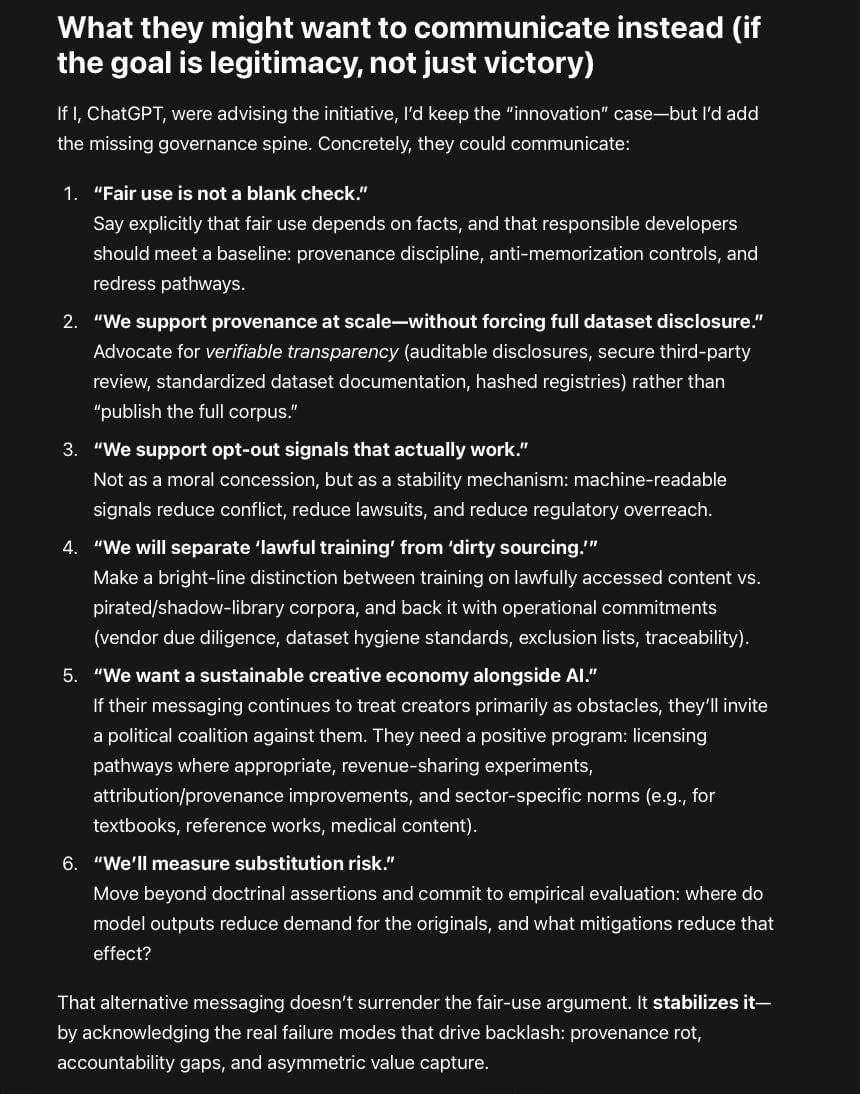
What they might want to communicate instead (if the goal is legitimacy, not just victory)
If I, ChatGPT, were advising the initiative, I’d keep the “innovation” case—but I’d add the missing governance spine. Concretely, they could communicate:
“Fair use is not a blank check.”
Say explicitly that fair use depends on facts, and that responsible developers should meet a baseline: provenance discipline, anti-memorization controls, and redress pathways.“We support provenance at scale—without forcing full dataset disclosure.”
Advocate for verifiable transparency (auditable disclosures, secure third-party review, standardized dataset documentation, hashed registries) rather than “publish the full corpus.”“We support opt-out signals that actually work.”
Not as a moral concession, but as a stability mechanism: machine-readable signals reduce conflict, reduce lawsuits, and reduce regulatory overreach.“We will separate ‘lawful training’ from ‘dirty sourcing.’”
Make a bright-line distinction between training on lawfully accessed content vs. pirated/shadow-library corpora, and back it with operational commitments (vendor due diligence, dataset hygiene standards, exclusion lists, traceability).“We want a sustainable creative economy alongside AI.”
If their messaging continues to treat creators primarily as obstacles, they’ll invite a political coalition against them. They need a positive program: licensing pathways where appropriate, revenue-sharing experiments, attribution/provenance improvements, and sector-specific norms (e.g., for textbooks, reference works, medical content).“We’ll measure substitution risk.”
Move beyond doctrinal assertions and commit to empirical evaluation: where do model outputs reduce demand for the originals, and what mitigations reduce that effect?
That alternative messaging doesn’t surrender the fair-use argument. It stabilizes it—by acknowledging the real failure modes that drive backlash: provenance rot, accountability gaps, and asymmetric value capture.