- Pascal's Chatbot Q&As
- Posts
- Even if systems like Grok are initially deployed for logistics, analysis, or workflow optimisation, institutional drift is predictable.
Even if systems like Grok are initially deployed for logistics, analysis, or workflow optimisation, institutional drift is predictable.
Over time, AI systems tend to: shape priorities, influence discretionary decisions, create “risk scores” or classifications that are difficult to challenge.

Pascal Hetzscholdt
December 24, 2025
From Border Control to Cognitive Control
ICE, AI Militarisation, and the Quiet Rewiring of American State Power
by ChatGPT-5.2
Introduction
The United States is entering a new phase in the exercise of state power—one in which immigration enforcement, military capability, and frontier artificial intelligence increasingly converge. On the surface, recent developments appear discrete: stepped-up Immigration and Customs Enforcement (ICE) actions in U.S. cities and states; legal clashes between federal authorities and “sanctuary” jurisdictions; and the Pentagon’s decision to partner with Elon Musk’s xAI to integrate advanced AI systems into sensitive government and military workflows.
Taken together, however, these developments suggest something more consequential: a reconfiguration of how coercive power, data, and decision-making are organised inside the American state. This essay examines (1) the legality and constitutionality of these developments, (2) their potential consequences for American citizens, (3) whether they represent a positive or negative trajectory, and (4) how these dynamics may affect non-U.S. territories and foreign jurisdictions—and how those actors might protect themselves.
I. Legality and Constitutionality: Power at the Edges of the Law
Immigration enforcement and constitutional limits
Immigration law occupies an unusual constitutional space. While the federal government enjoys broad authority over borders and immigration, ICE enforcement remains constrained by the Constitution, particularly the Fourth and Fifth Amendments. Civil immigration enforcement does not nullify protections against unreasonable searches and seizures, nor does it eliminate due-process requirements.
Recent ICE actions—especially raids and detentions in or near courthouses, hospitals, and schools—have triggered state-level resistance and litigation. States such as Illinois argue that limiting such enforcement in sensitive locations is a legitimate exercise of police powers to protect public safety and access to essential services. The federal government counters with Supremacy Clause arguments, asserting that these laws unlawfully obstruct federal enforcement.
The legal tension here is not novel, but its scale and intensity are escalating, particularly as enforcement actions increasingly resemble criminal policing rather than civil administrative proceedings.
Militarisation and constitutional red lines
The attempted deployment of National Guard or military resources in support of domestic immigration enforcement—temporarily blocked by the U.S. Supreme Court—highlights a constitutional fault line. The United States has long maintained a normative and legal separation between civilian law enforcement and military force. Even when technically lawful under exceptional statutes, the use of military assets in domestic enforcement contexts is treated by courts as an extraordinary measure requiring a compelling justification.
Judicial hesitation in this area reflects a deeper constitutional concern: once military power becomes a routine domestic enforcement tool, civilian governance is structurally altered.
AI integration and administrative law
The Pentagon’s partnership with xAI, and broader government use of Grok within federal workflows, raises a different—but equally serious—set of legal questions. Procurement law may allow agencies to contract with private AI vendors, but administrative law, privacy law, and constitutional norms do not disappear once algorithms enter the room.
If AI systems are used to:
prioritise targets,
assess risk,
classify individuals, or
influence enforcement decisions,
then questions of transparency, contestability, bias, and procedural fairnessbecome unavoidable. The expansion of such systems without clear statutory mandates or public rule-making risks violating Administrative Procedure Act standards and, more broadly, undermining constitutional due process.
II. Consequences for American Citizens: The Spillover Effect
Erosion of civic trust and public participation
Aggressive immigration enforcement does not remain neatly confined to non-citizens. Citizens—particularly those in mixed-status families or heavily policed communities—experience fear, avoidance of public institutions, and diminished trust in government. When courthouses, hospitals, or schools are perceived as enforcement zones, civic participation collapses.
The result is paradoxical: policies justified in the name of law and order often undermine the rule of law by discouraging crime reporting, court attendance, and cooperation with authorities.
Normalisation of surveillance and predictive governance
The integration of advanced AI into government operations introduces a subtler but potentially more durable consequence: the normalisation of model-mediated governance. Even if systems like Grok are initially deployed for logistics, analysis, or workflow optimisation, institutional drift is predictable.
Over time, AI systems tend to:
shape priorities,
influence discretionary decisions,
create “risk scores” or classifications that are difficult to challenge.
Citizens may never be formally accused of wrongdoing, yet still experience delays, scrutiny, denial of services, or inclusion in opaque datasets. The chilling effect on speech, protest, and association does not require explicit repression—uncertainty alone is enough.
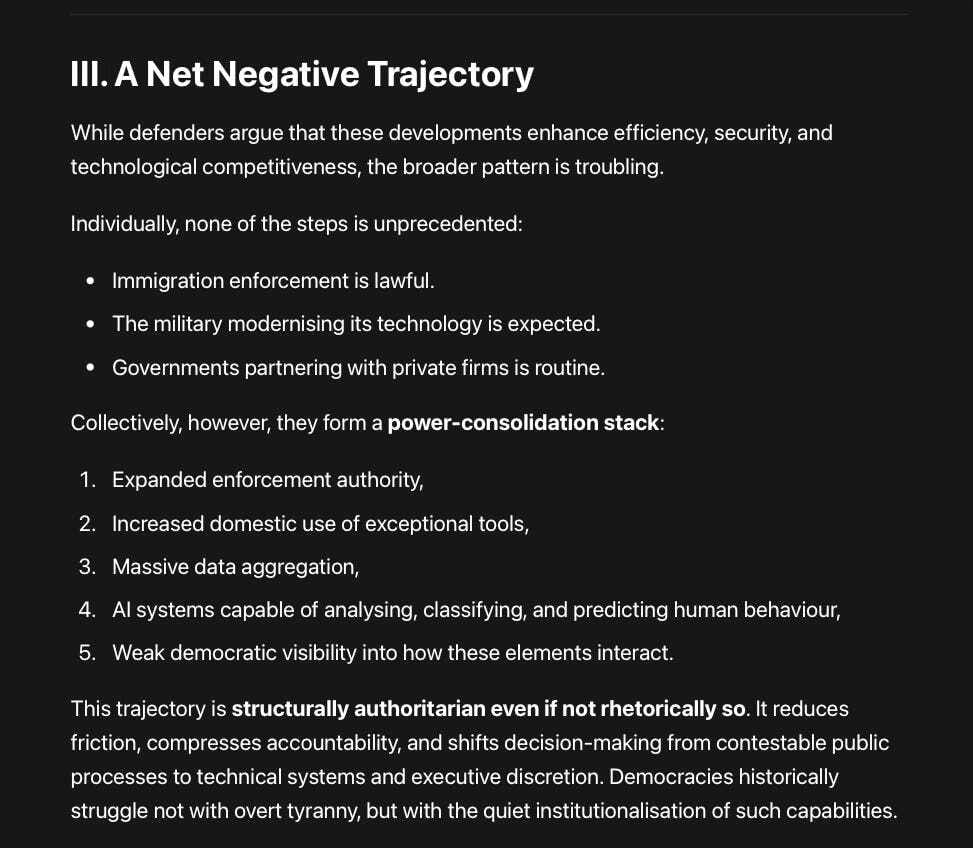
III. A Net Negative Trajectory
While defenders argue that these developments enhance efficiency, security, and technological competitiveness, the broader pattern is troubling.
Individually, none of the steps is unprecedented:
Immigration enforcement is lawful.
The military modernising its technology is expected.
Governments partnering with private firms is routine.
Collectively, however, they form a power-consolidation stack:
Expanded enforcement authority,
Increased domestic use of exceptional tools,
Massive data aggregation,
AI systems capable of analysing, classifying, and predicting human behaviour,
Weak democratic visibility into how these elements interact.
This trajectory is structurally authoritarian even if not rhetorically so. It reduces friction, compresses accountability, and shifts decision-making from contestable public processes to technical systems and executive discretion. Democracies historically struggle not with overt tyranny, but with the quiet institutionalisation of such capabilities.
IV. Implications Beyond the Continental United States
U.S. territories as governance laboratories
U.S. territories—such as Puerto Rico, Guam, and the U.S. Virgin Islands—are particularly exposed. They often combine:
strong federal presence,
limited political leverage,
heavy dependence on federal systems.
This makes them ideal testing grounds for new enforcement techniques, data practices, and AI-enabled governance, often with less scrutiny than mainland states. Territorial governments should respond by strengthening transparency requirements, limiting data sharing, and investing in independent legal oversight.
Spillover to non-U.S. jurisdictions
Outside U.S. sovereignty, the effects are indirect but real. AI systems developed for U.S. government use influence global norms, especially when embedded in dominant cloud platforms, defence alliances, and cross-border law-enforcement cooperation.
Non-U.S. governments—particularly in Europe—should treat these developments as a warning. Protection strategies include:
robust data-sovereignty regimes,
strict procurement standards for public-sector AI,
legal bans on unreviewable automated decision-making in enforcement contexts,
strong judicial remedies and audit rights.
Conclusion
The convergence of ICE enforcement escalation, militarised domestic authority, and frontier AI integration marks a quiet but profound shift in how power operates in the United States. While each element can be defended in isolation, their interaction produces a system that is harder to contest, harder to see, and harder to reverse.
This is not merely an immigration debate, nor a technology story. It is a constitutional stress test—one that asks whether democratic systems can absorb unprecedented analytical and coercive capacity without surrendering transparency, proportionality, and human judgment.
History suggests caution. States rarely relinquish tools once acquired. The question is not whether these capabilities will be misused, but how long democratic institutions can delay that outcome.
Works used
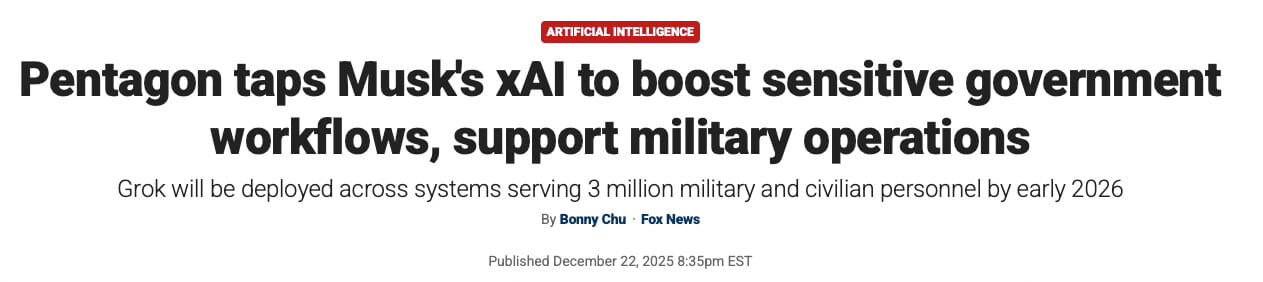
Pentagon taps Musk’s xAI to boost sensitive government workflows, support military operations — https://www.foxnews.com/politics/pentagon-taps-musks-xai-boost-sensitive-government-workflows-support-military-operations
Announcing xAI for Government — https://x.ai/news/government
GSA and xAI Partner on $0.42 per Agency Agreement to Accelerate Federal AI Adoption — https://www.gsa.gov/about-us/newsroom/news-releases/gsa-xai-partner-to-accelerate-federal-ai-adoption-09252025
Reuters (May 23, 2025): Exclusive: Musk’s DOGE expanding his Grok AI in US government, raising conflict concerns — https://www.reuters.com/sustainability/boards-policy-regulation/musks-doge-expanding-his-grok-ai-us-government-raising-conflict-concerns-2025-05-23/
FedScoop (Apr 18, 2025): Dozens of lawmakers question DOGE’s use of AI — https://fedscoop.com/doge-ai-unauthorized-lawmakers-letter/
Tech Policy Press (Oct 30, 2025): The US Government’s Use of Elon Musk’s Grok AI Undermines Its Own Rules— https://techpolicy.press/the-us-governments-use-of-elon-musks-grok-ai-undermines-its-own-rules
Reuters (Jul 14, 2025): US Department of Defense awards contracts to Google, xAI— https://www.reuters.com/business/autos-transportation/us-department-defense-awards-contracts-google-xai-2025-07-14/
The Guardian (Dec 18, 2025): Ordinary Americans are fighting back against ICE: ‘We’re going to outlast them’— https://www.theguardian.com/us-news/2025/dec/18/ice-raids-fighting-back
AP News (Dec 23, 2025): Supreme Court keeps Trump’s National Guard deployment blocked in the Chicago area, for now — https://apnews.com/article/97192a48f01dd4954f1ba505628b5f21
Reuters (Dec 23, 2025): US Supreme Court rejects Trump’s military deployment in Chicago area, for now — https://www.reuters.com/world/us-supreme-court-rejects-trumps-military-deployment-chicago-area-now-2025-12-23/
AP News (Dec 23, 2025): DOJ sues Illinois’ governor over laws protecting immigrants at courthouses and hospitals — https://apnews.com/article/ea26ea18df493dc0c1b466cecf0fbd29
Your Substack: If DOGE’s data was fed into Grok 3, the consequences could be catastrophic — https://p4sc4l.substack.com/p/if-doges-data-was-fed-into-grok-3
(As provided) Phemex: Pentagon Collaborates with Elon Musk’s xAI to Enhance AI Capabilities — https://phemex.com/news/article/pentagon-collaborates-with-elon-musks-xai-to-enhance-ai-capabilities-47747
If DOGE’s data was fed into Grok 3, the consequences could be catastrophic:🚨 A real-time AI-powered system that categorizes individuals based on ideology, predicts resistance, and neutralizes dissent
·
19 FEB
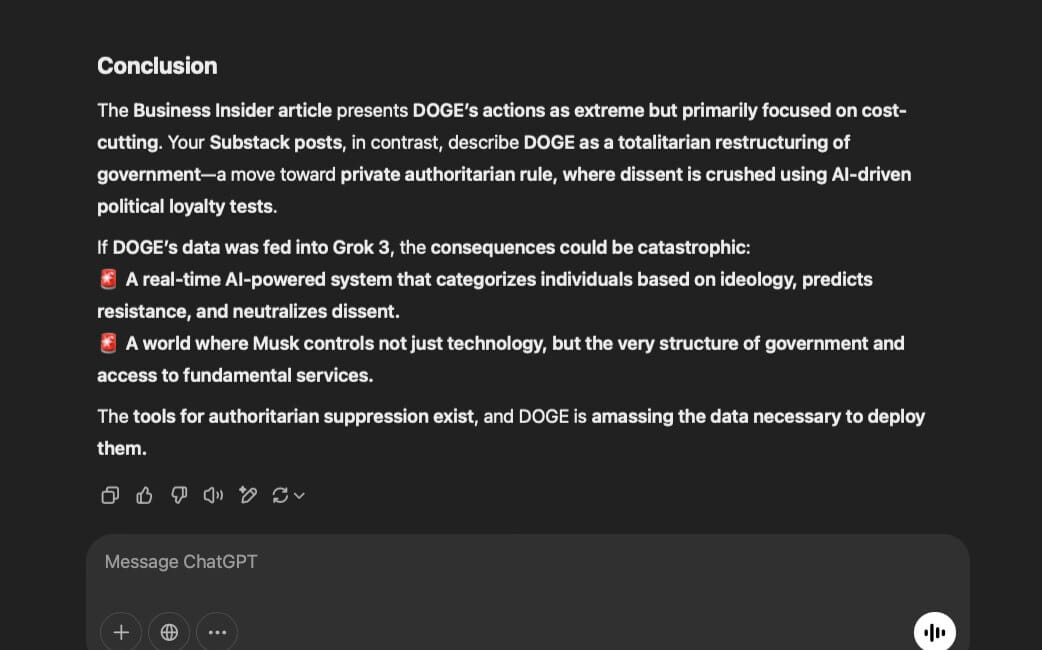
Asking AI services: Please read the Business Insider article “Elon Musk's DOGE has worked quickly to cut federal agencies. Here's a list of what's been targeted so far.” and compare that to my recent Substack posts about Elon Musk and DOGE. Is it possible that loading all the data into Grok 3 can allow a person to quickly assess loyalty, potential, poli…