- Pascal's Chatbot Q&As
- Posts
- An administration behaving like “rabid dogs”—officials who have shed the normative brakes of ideology, religion, or psychology, driven instead by a pathological hatred of adversaries...
An administration behaving like “rabid dogs”—officials who have shed the normative brakes of ideology, religion, or psychology, driven instead by a pathological hatred of adversaries...
...and a rejection of all ethical barriers. The “wishful thinking” that paralyzes the public, the “rational actor fallacy” that blinds the political class, and the “normalcy bias” that sedates media.

Pascal Hetzscholdt
January 25, 2026
The Pathology of Power: Cognitive Paralysis, Institutional Decay, and the Imperative of Preemptive Defense in the Face of “Rabid” Regimes
by Gemini 3.0, Deep Research. Warning! LLMs may hallucinate!
1. Introduction: The Deadly Lag of Recognition
In the lifecycle of democratic collapse, there exists a critical, often fatal, interval: the temporal gap between the onset of authoritarian behavior and the collective recognition of that behavior as an existential threat. History serves as a grim repository of societies that recognized the “rabid” nature of their leadership only after the machinery of repression had become insurmountable. This can become a scenario that is both metaphorically evocative and clinically relevant: a governing administration that behaves like “rabid dogs”—officials who have shed the normative brakes of ideology, religion, or psychology, driven instead by a pathological hatred of adversaries and a rejection of all ethical barriers.
This report investigates the mechanisms that generate this dangerous delay—the “wishful thinking” that paralyzes the public, the “rational actor fallacy” that blinds the political class, and the “normalcy bias” that sedates the media. It argues that treating such regimes as traditional political opponents to be reasoned with is a catastrophic strategic error. When an administration abandons the epistemic and moral framework of governance, engaging in standard dialogue is not merely ineffective; it is complicit in the regime’s consolidation.
The analysis that follows is exhaustive. It dissects the psychological roots of public inertia, drawing on the theories of Right-Wing Authoritarianism (RWA) and “malignant normality.” It examines the complicity of a media ecosystem trapped in performative neutrality. It deconstructs the tactical weaponization of “negotiation” by authoritarian actors in theaters ranging from Venezuela to Myanmar. Finally, it pivots to the proactive: a detailed strategic doctrine for “defensive democracy,” mobilizing the bureaucracy, the judiciary, and civil society to construct a containment wall before the scale of lost lives becomes irreversible. The central thesis is clear: against a regime operating without brakes, the only effective strategy is one of systemic, preemptive, and non-cooperative defense.
2. Part I: The Psychology of Paralysis and Malignant Normality
The survival of an authoritarian regime, particularly in its nascent stages, depends less on its own strength than on the cognitive failure of its opposition. The inability of a population to label and acknowledge a threat is not accidental; it is the product of specific, identifiable psychological mechanisms that prioritize comfort and continuity over the terrifying work of confronting a shattered reality.
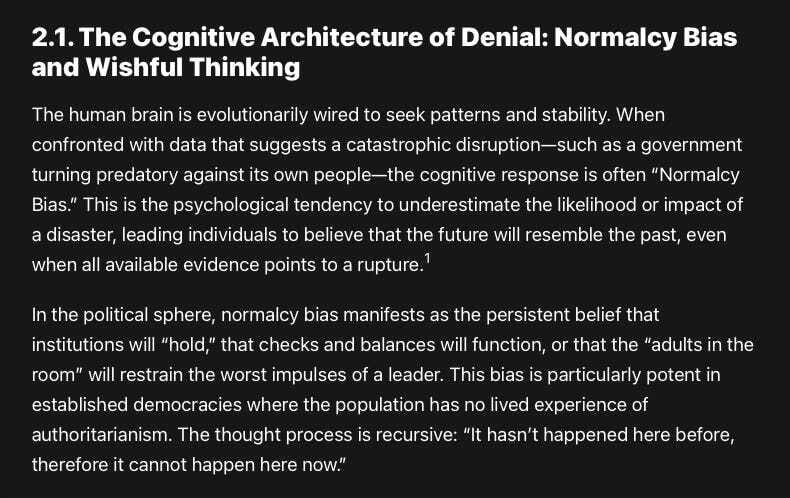
2.1. The Cognitive Architecture of Denial: Normalcy Bias and Wishful Thinking
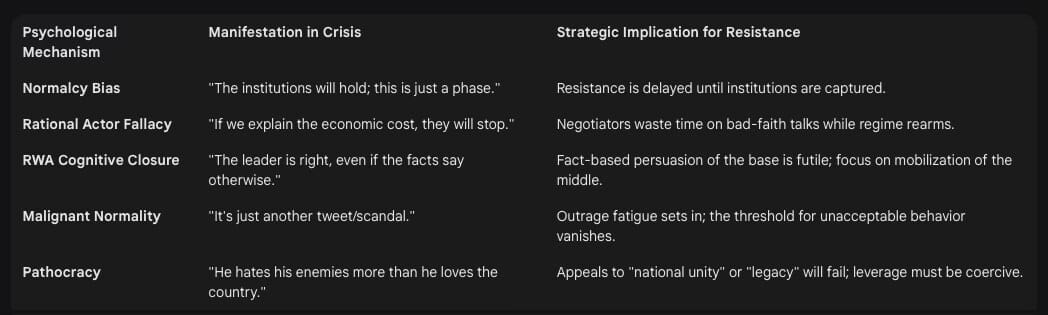
The human brain is evolutionarily wired to seek patterns and stability. When confronted with data that suggests a catastrophic disruption—such as a government turning predatory against its own people—the cognitive response is often “Normalcy Bias.” This is the psychological tendency to underestimate the likelihood or impact of a disaster, leading individuals to believe that the future will resemble the past, even when all available evidence points to a rupture.1
In the political sphere, normalcy bias manifests as the persistent belief that institutions will “hold,” that checks and balances will function, or that the “adults in the room” will restrain the worst impulses of a leader. This bias is particularly potent in established democracies where the population has no lived experience of authoritarianism. The thought process is recursive: “It hasn’t happened here before, therefore it cannot happen here now.”
This is reinforced by “Wishful Thinking,” a defense mechanism used to resolve the overwhelming anxiety generated by the prospect of state violence. When a “political parent”—the administration—turns abusive, the dependent citizen experiences a complex storm of powerlessness, fear, and rage. To manage this, the psyche often defaults to suppression or idealization.2 Victims of this dynamic may minimize the abuse (”It’s just rhetoric,” “He doesn’t mean it literally”) or blame the opposition for provoking the administration. This suppression is not a passive act; it is an active psychological expenditure of energy to maintain the illusion of safety. The cost of this expenditure is “outrage fatigue” or emotional depletion 3 , where the sheer volume of threats eventually leads to apathy rather than mobilization.
2.2. The Rational Actor Fallacy: Misdiagnosing the “Rabid” Actor
A central failure of the liberal democratic response to authoritarianism is the projection of rationality onto irrational actors. The “Rational Actor Model,” a staple of economic and political theory, assumes that adversaries are motivated by self-interest, amenable to cost-benefit analysis, and responsive to incentives.4
When dealing with a “pathocratic” regime (a system governed by pathological personalities), this model fails catastrophically. Opposition leaders and business elites often waste critical months attempting to “reason” with the administration, presenting economic data or legal arguments, assuming that the regime cares about national prosperity or legal standing. They ask, “Why don’t they see the obvious damage they are doing?”
This is the wrong question. As organizational behaviorists note, the better question is, “What problem is this person actually trying to solve?”.4 For a leader driven by malignant narcissism or paranoid psychopathy, the “problem” may be the existence of criticism, the need for vengeance, or the gratification of dominance. Destruction of the economy or the loss of human life may be acceptable costs, or even desirable outcomes, if they serve the goal of total control. By treating a “rabid” actor as a rational one, the opposition grants the regime the one asset it needs most: time.
The persistence of support for authoritarian regimes, even as they inflict damage on their own base, is often a source of confusion for observers. The theory of Right-Wing Authoritarianism (RWA) provides a neurological and psychological explanation for this immobility. RWA is characterized by a high desire for order, submission to established authorities, and aggression toward out-groups.6
Recent studies in reinforcement learning have identified a critical cognitive deficit in high-RWA individuals: a failure in “belief updating” in response to prediction error. In a healthy cognitive process, when a prediction (e.g., “The leader will bring prosperity”) creates an error (e.g., economic collapse), the individual updates their belief. However, high-RWA individuals possess a “closed-minded cognitive style” that effectively blocks this update.6 They are neurologically resistant to information that contradicts their entrenched loyalty.
This implies that the strategy of “providing sensible arguments” to the regime’s base is fundamentally flawed. The mechanism of support is not intellectual but identity-based and cognitively shielded. No amount of fact-checking or logical argumentation can penetrate this shield because the “rabid” nature of the leader satisfies a deeper psychological need for order and aggression in the follower.
2.4. Malignant Normality: The Routinization of the Unacceptable
Psychiatrist Robert Jay Lifton coined the term “malignant normality” to describe the condition where a society habituates to destructive behavior until it becomes the new baseline.7 This is the ultimate victory of the authoritarian: not that the population agrees with the violence, but that they stop noticing it.
Malignant normality is constructed through:
Psychic Numbing: The inability or disinclination to feel the horror of events (e.g., nuclear threats, mass arrests) because the emotional capacity is overwhelmed.9
Routinization: The integration of pathological behavior into the standard procedures of bureaucracy and news cycles. When the President calls for the execution of political opponents and the morning news debates it as a “campaign strategy” rather than a crime, the malignancy has become normal.
The “Cure” Trap: Populations often embrace authoritarianism as a “cure” for a perceived sickness in the previous system (e.g., corruption, gridlock). Even when the “cure” proves worse than the disease 7 , the psychological investment in the cure prevents the acknowledgment of the error.
2.5. Political Ponerology: The Science of Evil in Power
To fully grasp the nature of an administration that acts without “brakes,” we must turn to Political Ponerology, a field developed by Polish psychiatrist Andrzej Łobaczewski. Ponerology is the scientific study of evil adjusted for political purposes. Łobaczewski argued that during “happy times” of prosperity, societies lose their ability to identify pathological individuals (psychopaths, narcissists). The “immunological memory” of the society fades.10
This allows for the rise of a “pathocracy”—a system of government where a small pathological minority takes control over a society of normal people. In a pathocracy, the social structure is inverted:
The Pathological Elite: Individuals with personality disorders (lack of empathy, glibness, ruthlessness) are promoted to positions of power because they are unburdened by the moral hesitations that slow down normal people.11
Conversive Thinking: The regime imposes a false reality where “war is peace” and “cruelty is justice.” The “normal” population is forced to engage in this doublethink to survive, which degrades their own psychological integrity.10
The Rabid Dynamic: The regime effectively functions as “organized crime without the organized part”.7 It is driven by the immediate impulses of the leader’s pathology—paranoia, greed, sadism—making long-term strategic planning or “reasoning” impossible.
3. Part II: The Media Ecosystem as Enabler and Victim
The media is the primary sensory organ of a democracy. When it fails to accurately label authoritarianism, the body politic is blinded. In the face of a “rabid” administration, traditional journalistic norms of neutrality and objectivity are weaponized by the regime to spread disinformation and normalize pathology.
3.1. The Failure of “The View from Nowhere”
Jay Rosen, a prominent media critic, identifies “The View from Nowhere” as a fatal flaw in modern journalism when covering authoritarianism. This is the practice where journalists attempt to position themselves as neutral arbiters between two legitimate sides. However, when one side “proceeds as though he were liberated from the distinction between true and false” 13 , neutrality becomes a distortion of reality.
If an administration claims that “2+2=5,” a “View from Nowhere” report might read: “President Claims Math has Changed; Critics Disagree.” This headlines grants legitimacy to a falsehood. Rosen argues that the press must shift from a “referee” model to a “truth-seeking” model.13 This requires abandoning the fear of being labeled “partisan.” If the truth is partisan (because the regime is lying), then the press must be partisan in favor of the truth.
3.2. Asymmetric Polarization and the Propaganda Loop
Authoritarian regimes understand that they do not need to convince the entire population; they only need to confuse the middle and radicalize the base. They achieve this by creating a “hermetic” media ecosystem. In Hungary, Viktor Orbán’s Fidesz party captured the media regulator, turning public broadcasters into mouthpieces and using state advertising to buy out or bankrupt private media.15
This creates a “propaganda loop” where the regime’s supporters are insulated from contradictory information. When independent media attempts to break this loop with “sensible arguments,” they are labeled as “enemies of the people” or “foreign agents”.17 This is not a debate; it is information warfare. The “rational actor” journalist assumes that if they uncover a scandal, it will matter. But in a pathocracy, scandal is often proof of the leader’s “strength” against the establishment.
3.3. The “Truth Sandwich” and Cognitive Inoculation
To counter the “illusory truth effect” (where repetition of a lie makes it seem true), cognitive linguist George Lakoff proposed a structural change to reporting known as the Truth Sandwich.19
The Standard Media Model:
Headline: “President Claims Election Was Stolen.” (Amplifies the lie first).
Body: Quote the President’s lie.
Correction: “However, there is no evidence...” (Too late; the frame is set).
The Truth Sandwich Model:
Bread (Truth): Start with the verified reality. “Election officials have confirmed the vote was secure and valid.”
Filling (The Lie + Motive): Mention the falsehood briefly and frame it as a manipulation. “The President is falsely claiming fraud to undermine trust in the results.”
Bread (Truth): Reiterate the truth and the context. “This tactic has been used in previous autocracies to justify power grabs.”
While some empirical studies suggest the efficacy of this method varies 22 , it represents a necessary shift away from amplifying “rabid” rhetoric. It refuses to let the pathological actor set the news cycle’s agenda.
3.4. Pre-bunking and Inoculation Theory
Beyond the Truth Sandwich, media and civil society must engage in “pre-bunking”.23 This involves warning the public before a disinformation campaign is launched. For example, if intelligence suggests the regime will scapegoat a minority group to justify martial law, the media should report: “Sources indicate the administration plans to fabricate a crisis involving Group X to justify suspending rights.” When the regime inevitably launches the campaign, the public has already been “inoculated” with the context, reducing the campaign’s psychological impact. This moves the media from a reactive posture (cleaning up lies) to a proactive one (predicting and neutralizing them).
4. Part III: The Trap of Dialogue—Negotiation as a Stalling Tactic
There might be a futile hope of “bringing that administration to reason.” Nowhere is this more dangerous than in the realm of negotiation. “Rabid” regimes rarely negotiate to reach a settlement; they negotiate to buy time, diffuse pressure, and rearm. The “dialogue” is a trap.
4.1. The Mechanics of “Buying Time”
Negotiation with an authoritarian is an asymmetric engagement. The democratic opposition negotiates in good faith, bound by the desire for stability and norms. The authoritarian negotiates to 24 :
Delay Decisions: Utilizing bureaucracy and “technical committees” to stall implementation of any concession.
Diffuse Momentum: The mere announcement of “talks” often leads the opposition to call off street protests as a gesture of goodwill. Once the streets are empty, the regime’s pressure lifts, and they renege on promises.
Fracture the Opposition: Regimes offer minor perks to moderate factions in the negotiation room, splitting them from the “radicals” on the street.
4.2. Case Study: Venezuela (2016) — The Vatican Trap
In 2016, the Venezuelan opposition (MUD) had the Maduro regime on the ropes. Mass protests were paralyzing the country, and a recall referendum was constitutionally mandated.
The Trap: The regime invited the Vatican and international mediators (UNASUR) to broker a “national dialogue”.27
The Error: The opposition, hoping to appear “reasonable” and avoid bloodshed, suspended their mass march on the presidential palace and halted a “political trial” of Maduro in the National Assembly.27
The Outcome: The regime used the months-long “dialogue” to stall. They captured the Supreme Court, which then indefinitely suspended the recall referendum. By the time the talks collapsed, the opposition was demoralized, divided, and the constitutional moment had passed. The “dialogue” served only to stabilize the dictatorship.28
4.3. Case Study: The Munich Agreement (1938) — The Archetype of Appeasement
British Prime Minister Neville Chamberlain’s negotiation with Hitler is the definitive example of the “Rational Actor Fallacy.” Chamberlain believed Hitler had limited, rational grievances (the Sudeten Germans). He believed a signed agreement would bind Hitler.
The Trap: Hitler used the negotiations to isolate Czechoslovakia from its allies (France/UK) and to gain the Sudetenland’s mountain fortifications without firing a shot.31
The Outcome: Hitler privately mocked the “worms” he negotiated with. The agreement bought Germany time to finalize its western defenses and exposed the weakness of the democracies, accelerating the path to World War II.32
4.4. Case Study: Myanmar (2021) & Sudan — The “Broken Promises” Cycle
Since the 2021 coup in Myanmar, the military junta has engaged with ASEAN’s “Five-Point Consensus” solely to deflect international sanctions. They promised immediate cessation of violence while simultaneously launching airstrikes on civilians. Analysts noted, “The Tatmadaw is not listening — it is waiting”.34 Similarly, in South Sudan and Sudan, military factions have used “transitional agreements” as pauses to recruit and rearm. The integration of forces is systematically stalled, and elections are postponed indefinitely. The negotiation process itself becomes a mechanism of rule, where the “process” replaces the “solution”.35
4.5. Tactical Conclusion on Negotiation
When facing a “rabid” regime, negotiation should never be the primary strategy. It should be viewed as a ratchet: engage only when the regime is under existential pressure, and never trade irreversible leverage (e.g., disbanding protests, surrendering territory) for reversible promises (e.g., “we will hold elections later”). If the regime refuses to agree to immediate, verifiable benchmarks, the opposition must exit the room and return to pressure tactics immediately.34
5. Part IV: Defensive Democracy and Institutional Resistance
If reasoning fails and negotiation is a trap, what remains? The answer lies in Defensive Democracy (or Militant Democracy): the use of institutional power to actively constrain, sabotage, and remove anti-democratic actors before they can dismantle the state.
5.1. Militant Democracy (Streitbare Demokratie)
Originating in post-war Germany, this concept posits that a democracy cannot be neutral towards those who wish to destroy it. It must be “militant” in its own defense.
Party Bans: The state retains the legal right to ban political parties that seek to abolish the free democratic order (Article 21 of German Basic Law).37 While used rarely (SRP in 1952, KPD in 1956), it signals that the “tolerance of the intolerant” has limits.38
Implication: In modern contexts, this means enforcing laws against hate speech, paramilitary organizations, and foreign funding of extremist groups with extreme prejudice. It means disqualifying candidates who incite violence or reject election results (as seen in the 14th Amendment debates in the US).39
5.2. Constitutional Hardball: The Judiciary’s Role
Mark Tushnet’s concept of “Constitutional Hardball” describes political practices that technically follow the rules but violate their spirit to alter the regime type.40 Authoritarians play hardball; defenders of democracy often play softball. This must change.
The “Slow Road” vs. “Fast Track”: Authoritarians use the “slow road” of gradual legal erosion (Hungary). Defenders must use the “fast track” of immediate judicial intervention.41
Success Stories:
Brazil: The Supreme Court (STF) launched proactive investigations into “digital militias” and anti-democratic funding networks before the 2022 election. They jailed threats to the constitutional order and de-platformed disinformation hubs, effectively neutralizing a coup attempt before it could coalesce.42
South Korea: The Constitutional Court upheld the impeachment of President Park Geun-hye in 2017 and is currently the battleground for the impeachment of President Yoon Suk Yeol following his martial law declaration. The swift judicial response prevented the normalization of executive overreach.43
Failure Mode: In Poland, the judiciary was slow to organize. By the time they did, the “Law and Justice” (PiS) party had already packed the courts and lowered retirement ages to purge senior judges. Resistance came too late.45
5.3. Bureaucratic Resistance: “Guerrilla Government”
When the executive branch is “rabid,” the civil service—the “Deep State” in authoritarian parlance—becomes the guardian of the Rule of Law. Rosemary O’Leary terms this Guerrilla Government: the power of career bureaucrats to resist from within.47
Tactics of Administrative Sabotage:
Strict Legalism: Refuse to act on oral orders. Demand every directive be written and signed. If an order is illegal, formally document the objection. This creates a liability trail that often scares off mid-level political appointees.49
Malicious Compliance: Obey the order’s letter but subvert its intent through excessive adherence to procedure. “We must conduct a 6-month environmental impact study before we can build the internment camp, as per statute 12.B.”.50
The Information Blockade: Refusing to share sensitive data (e.g., lists of minority employees, voter rolls) with the political leadership. In the US, civil servants successfully refused to hand over data to the Trump transition team that could have been used for political purging.49
Leakage: Strategic leaking of illegal plans to the press before they are implemented. This allows public outrage to mobilize (if the media is doing its job).51
6. Part V: Civil Society and “Leaderless” Resistance
When institutions fail and the “rabid” administration controls the guns and the courts, the final line of defense is the people. However, traditional protest (marches with leaders) is vulnerable to decapitation. The resistance must evolve into a “hydra”—a leaderless, fluid, and omnipresent force.
6.1. Gene Sharp’s Arsenal: Beyond Marching
Gene Sharp cataloged 198 methods of nonviolent action. “Rabid” regimes expect method #38 (Marches) and have riot police ready. They are often unprepared for the other 197.50
Categories of Resistance:
Social Noncooperation: Ostracism of regime officials. Refusing to serve them in restaurants, invite them to cultural events, or acknowledge their status. This pierces the “malignant normality” by making their personal lives unlivable.50
Economic Noncooperation: Consumer boycotts of regime-linked businesses. “Go-slow” strikes where workers show up but work at 10% efficiency. In Hong Kong, the “Yellow Economic Circle” created a parallel economy that sustained the movement.53
Political Noncooperation: Boycotting rigged elections. Refusing to assist enforcement agents. Hiding targeted individuals.50
6.2. “Laughtivism” and Dilemma Actions
Srdja Popovic, a leader of the Otpor movement that toppled Milošević, emphasizes the use of Humor and Dilemma Actions.54
The Logic: Fear is the authoritarian’s currency. Humor breaks fear. You cannot be terrified of a dictator you are laughing at.
Tactics:
The Lego Protest: In Russia, when protests were banned, activists staged a protest using Lego men holding tiny signs. The police looked ridiculous arresting toys.56
The Rice Pudding Strike: In the Maldives, activists used communal eating of rice pudding in the streets to gather. It wasn’t a “protest” (illegal), it was a “picnic” (legal).
Dilemma Actions: Create a situation where the regime loses either way. If they crack down on a “picnic,” they look absurd and weak. If they let it happen, the opposition claims the street.57
6.3. The “Be Water” Strategy: Fluid Resistance
Developed during the 2019 Hong Kong protests, “Be Water” (borrowed from Bruce Lee) is the doctrine of fluid, leaderless resistance.53
Formlessness: No central leader to arrest. Mobilization happens via anonymous apps (Telegram, Signal).58
Agility: “Gather like water, scatter like mist.” Do not hold ground against the police. Protest, disrupt, and vanish before the tear gas is fired. Reappear somewhere else.
Open Source Protest: Tactics are voted on in real-time online. Everyone is a strategist. This overwhelms the rigid command-and-control structure of the regime’s security forces.58
6.4. Digital Civil Disobedience and Authoritarian-Proofing
In a surveillance state, resistance must be digitally hardened.
Infrastructure Politics: Resistance involves protecting the pipes of information. Setting up mesh networks (Bluetooth bridges) that work when the internet is cut.61
Doxxing Defense: Activists must scrub their digital footprints (”doxxing defense”) to prevent the regime from targeting their families.62
Pre-emptive Alliances: CSOs must form alliances before the crisis peaks. A “constellation of efforts” involving religious groups, labor unions, and international bodies creates a safety net. When one node is attacked, the others respond.64
7. Conclusion: The Cost of Waiting
There are mechanisms that claim victims before change happens. The research is unequivocal: the primary mechanism of mass victimization is the delay in defensive mobilization.
When a regime is “rabid”—operating without psychological or moral brakes—the “wait and see” approach is fatal.
Wishful thinking (waiting for them to pivot) allows them to purge the civil service.
Rational negotiation (waiting for a deal) allows them to rearm and fracture the opposition.
Media neutrality (waiting for “balance”) allows them to normalize violence.
The Actionable Doctrine:
Diagnose Early: Use the indicators of Political Ponerology (scapegoating, conversive thinking, destruction of institutions) to label the regime as “pathocratic” immediately. Do not wait for the concentration camps.
Abandon Dialogue: Stop talking. Start resisting. Use “dilemma actions” and “guerrilla government” to increase the cost of ruling.
Defend the Institutions: Judges and bureaucrats must play “constitutional hardball” now, not later.
Be Water: Mobilize the population in decentralized, low-risk, high-frequency actions that break the “malignant normality” without offering a target for mass repression.
There is no reasoning with a rabid dog. There is only containment, defense, and the systematic dismantling of its capacity to harm. The time to act is not when the damage is manifest, but the moment the brakes are lost.
Works cited
Normalcy Bias - The Decision Lab, accessed January 25, 2026, https://thedecisionlab.com/biases/normalcy-bias
The Psychology Behind What Makes Authoritarianism Appealing, accessed January 25, 2026, https://www.psychologytoday.com/us/blog/overcoming-destructive-anger/202312/the-psychology-behind-what-makes-authoritarianism
The Psychology of Authoritarian Creep - LSE Undergraduate Political Review, accessed January 25, 2026, https://blogs.lse.ac.uk/lseupr/2025/12/04/disrupted-democracy-algorithmic-amplification-and-the-future-of-electoral-trust/
The Rational Actor Fallacy - Reworked, accessed January 25, 2026, https://www.reworked.co/leadership/the-rational-actor-fallacy/
Rational Actors or Rational Fools - The Implications of Psychology for Products Liability: Introduction - DOCS@RWU, accessed January 25, 2026, https://docs.rwu.edu/cgi/viewcontent.cgi?article=1033&context=law_fac_fs
Closed-minded cognition: Right-wing authoritarianism is negatively related to belief updating following prediction error - PMC - NIH, accessed January 25, 2026, https://pmc.ncbi.nlm.nih.gov/articles/PMC7384563/
Letter: Malignant normality - Concord Monitor, accessed January 25, 2026, https://www.concordmonitor.com/2017/10/20/when-the-cure-is-worse-than-the-disease-13221917/
The Dangerous Case of Donald Trump: Robert Jay Lifton and Bill Moyers on “A Duty to Warn”, accessed January 25, 2026, https://billmoyers.com/story/dangerous-case-donald-trump-robert-jay-lifton-bill-moyers-duty-warn/
The Neglect of Nuclear Truths - Psychology Today, accessed January 25, 2026, https://www.psychologytoday.com/us/blog/psychology-and-history/202408/the-neglect-of-nuclear-truths
Political ponerology - Wikipedia, accessed January 25, 2026, https://en.wikipedia.org/wiki/Political_ponerology
The problem of pathocracy | BPS - British Psychological Society, accessed January 25, 2026, https://www.bps.org.uk/psychologist/problem-pathocracy
Lobaczewski on ‘Pathocracy’ - Graham Scambler, accessed January 25, 2026, https://www.grahamscambler.com/lobaczewski-on-pathocracy/
The Board - PressThink, accessed January 25, 2026, https://pressthink.org/board/
Media critic Jay Rosen on 2016 campaign coverage and the rise of Trump: “That’s the way authoritarian societies work” - Salon.com, accessed January 25, 2026, https://www.salon.com/2016/11/06/media-critic-jay-rosen-on-2016-campaign-coverage-and-the-rise-of-trump-thats-the-way-authoritarian-societies-work/
Strategic Saboteur: Hungary’s Entrenched Illiberalism and the Fracturing of EU Cohesion, accessed January 25, 2026, https://esthinktank.com/2025/07/10/strategic-saboteur-hungarys-entrenched-illiberalism-and-the-fracturing-of-eu-cohesion/
How Hungary’s Orbán uses control of the media to escape scrutiny and keep the public in the dark | The Associated Press, accessed January 25, 2026, https://www.ap.org/news-highlights/spotlights/2024/how-hungarys-orban-uses-control-of-the-media-to-escape-scrutiny-and-keep-the-public-in-the-dark/
The Authoritarian Playbook - Protect Democracy, accessed January 25, 2026, https://protectdemocracy.org/work/the-authoritarian-playbook/
A fragmented response to media freedom at risk in the Union, accessed January 25, 2026, https://verfassungsblog.de/a-fragmented-response-to-media-freedom-at-risk-in-the-union/
What is a ‘Truth Sandwich’? - PBS, accessed January 25, 2026, https://www.pbs.org/standards/blogs/standards-articles/what-is-a-truth-sandwich/
Truth sandwich - Wikipedia, accessed January 25, 2026, https://en.wikipedia.org/wiki/Truth_sandwich
George Lakoff’s Truth Sandwich - Future Hindsight, accessed January 25, 2026, https://www.futurehindsight.com/blog/george-lakoffs-truth-sandwich
The truth sandwich format does not enhance the correction of misinformation - PMC - NIH, accessed January 25, 2026, https://pmc.ncbi.nlm.nih.gov/articles/PMC12377696/
DRG Learning Digest - Information Disorder: An Ounce of Prebunking is Worth a Pound of Debunking? - GovDelivery, accessed January 25, 2026, https://content.govdelivery.com/accounts/USAIDHQ/bulletins/345e121
8 Manipulative Negotiation Tactics and How To Handle Them - Baker Communications, accessed January 25, 2026, https://www.bakercommunications.com/archive/apr13/negotiation040113.html?campId=70140000000flkz
Tips To Make The Most Of Time Pressure in Negotiations, accessed January 25, 2026, https://www.redbearnegotiation.com/blog/time-pressure-in-negotiations
Tik tok tactics: Navigating time pressure in negotiations | Esade - Do Better, accessed January 25, 2026, https://dobetter.esade.edu/en/negotiation-strategies-time-pressure-deadlines
Venezuela’s opposition says Vatican-brokered talks are ‘frozen’ - The Guardian, accessed January 25, 2026, https://www.theguardian.com/world/2016/nov/23/venezuela-nicolas-maduro-opposition-vatican-talks-frozen
Venezuela: The Rise and Fall of a Petrostate | Council on Foreign Relations, accessed January 25, 2026, https://www.cfr.org/backgrounders/venezuela-crisis
- THE COLLAPSE OF THE RULE OF LAW IN VENEZUELA: WHAT THE UNITED STATES AND THE INTERNATIONAL COMMUNITY CAN DO TO RESTORE DEMOCRACY - GovInfo, accessed January 25, 2026, https://www.govinfo.gov/content/pkg/CHRG-115shrg37908/html/CHRG-115shrg37908.htm
Venezuela opposition divided over talks offer from beleaguered Maduro - The Guardian, accessed January 25, 2026, https://www.theguardian.com/world/2016/oct/25/venezuela-protests-maduro-recall-opposition
Appeasement and ‘Peace for Our Time’ | The National WWII Museum | New Orleans, accessed January 25, 2026, https://www.nationalww2museum.org/war/articles/appeasement-and-peace-our-time
What’s the context? 30 September 1938: The Munich Agreement - History of government, accessed January 25, 2026, https://history.blog.gov.uk/2013/09/30/whats-the-context-30-september-1938-the-munich-agreement/
Munich Agreement - Wikipedia, accessed January 25, 2026, https://en.wikipedia.org/wiki/Munich_Agreement
Myanmar junta’s ceasefire breach a show of desperation | CARUM - Asia-Europe Institute, accessed January 25, 2026, https://aei.um.edu.my/myanmar-juntas-ceasefire-breach-a-show-of-desperation
South Sudan at the Edge: How a Broken Peace, a Jailed Leader, and Fragmented Militias Are Pushing the Country toward Collapse - horn review, accessed January 25, 2026, https://hornreview.org/2026/01/23/south-sudan-at-the-edge-how-a-broken-peace-a-jailed-leader-and-fragmented-militias-are-pushing-the-country-toward-collapse/
South Sudan’s Endless Strife: A Crisis of Power, Ethnicity and Broken Promises, accessed January 25, 2026, https://hornreview.org/2025/07/30/south-sudans-endless-strife-a-crisis-of-power-ethnicity-and-broken-promises/
Law on Political Parties - Banning political parties - BMI, accessed January 25, 2026, https://www.bmi.bund.de/EN/topics/constitution/law-political-parties/banning-pol-parties/banning-pol-parties.html
Proceedings for the prohibition of a political party - Bundesverfassungsgericht, accessed January 25, 2026, https://www.bundesverfassungsgericht.de/EN/TheFederalConstitutionalCourt/TypesOfProceedings/ProceedingsForTheProhibitionOfAPoliticalParty/proceedingsfortheprohibitionofapoliticalparty_node.html
Democratic Self-Defense - The Fordham Law Archive of Scholarship and History, accessed January 25, 2026, https://ir.lawnet.fordham.edu/cgi/viewcontent.cgi?article=6142&context=flr
Constitutional Hardball | Scholarship @ GEORGETOWN LAW, accessed January 25, 2026, https://scholarship.law.georgetown.edu/context/facpub/article/1557/viewcontent/tushnet_constitutional_hardball.pdf
Why American Lawyers Must Fight Democratic Backsliding - Harvard Law School Center on the Legal Profession, accessed January 25, 2026, https://clp.law.harvard.edu/knowledge-hub/magazine/issues/lawyers-between-democracy-and-authoritarianism/why-american-lawyers-must-fight-democratic-backsliding/
What Could Go Right? - Accountability Came for These Authoritarian Wannabes, accessed January 25, 2026, https://theprogressnetwork.org/democracy-brazil-south-korea/
BC’s Ingu Hwang discusses South Korea’s political crisis, accessed January 25, 2026, https://www.bc.edu/bc-web/sites/bc-news/articles/2025/spring/q-a-with-ingu-hwang.html
How South Korea’s Democracy Saved Itself | Carnegie Endowment for International Peace, accessed January 25, 2026, https://carnegieendowment.org/en/emissary/2024/12/south-korea-democracy-yoon-protests
Judicial resistance: missing part of judicial independence? The case of Poland and beyond - Oñati Socio-Legal Series, accessed January 25, 2026, https://opo.iisj.net/index.php/osls/article/download/1893/2473/13711
Polish Judges Resist Attacks on the Rule of Law - Horizons Project, accessed January 25, 2026, https://horizonsproject.us/polish-judges-resist-attacks-on-the-rule-of-law/
Beyond the WEIRD World: linking Bureaucracy and Democracy in Developing Countries | Perspectives on Public Management and Governance | Oxford Academic, accessed January 25, 2026, https://academic.oup.com/ppmg/advance-article/doi/10.1093/ppmgov/gvaf024/8379736
Bureaucratic Resistance in Times of Democratic Backsliding - Cambridge University Press & Assessment, accessed January 25, 2026, https://www.cambridge.org/core/elements/bureaucratic-resistance-in-times-of-democratic-backsliding/9C391F4058387D8BBD7B4F2D20B1E936
examples of resistance by the civil service - Peter Levine, accessed January 25, 2026, https://peterlevine.ws/?p=33466
198 Methods of Nonviolent Action by Gene Sharp - The Commons Social Change Library, accessed January 25, 2026, https://commonslibrary.org/198-methods-of-nonviolent-action/
The third option for federal employees faced with illegal orders—just say ‘no’ | Brookings, accessed January 25, 2026, https://www.brookings.edu/articles/the-third-option-for-federal-employees-faced-with-illegal-orders-just-say-no/
198 Methods of Nonviolent Action | ICNC, accessed January 25, 2026, https://www.nonviolent-conflict.org/resource/198-methods-of-nonviolent-action/
Tactics and methods surrounding the 2019–2020 Hong Kong protests - Wikipedia, accessed January 25, 2026, https://en.wikipedia.org/wiki/Tactics_and_methods_surrounding_the_2019%E2%80%932020_Hong_Kong_protests
Blueprint for Revolution Summary of Key Ideas and Review | Srdja Popovic and Matthew Miller - Blinkist, accessed January 25, 2026, https://www.blinkist.com/en/books/blueprint-for-revolution-en
“How to Get Shit Done” — Review of Blueprint for Revolution | by Dan Sisken | Medium, accessed January 25, 2026, https://medium.com/@dan.sisken/how-to-get-shit-done-review-of-blueprint-for-revolution-65b5232f743e
Blueprint for Revolution: How to Use Rice Pudding, Lego Men, and Other Nonviolent Techniques to Galvanize Communities, Overthrow Dictators, or Simply Change the World, accessed January 25, 2026, https://www.carnegiecouncil.org/media/series/39/20150422-blueprint-for-revolution-how-to-use-rice-pudding-lego-men-and-other-nonviolent-techniques-to-galvanize-communities-overthrow-dictators-or-simply-change-the-world
Summary of “Methods of Nonviolent Action” - Beyond Intractability, accessed January 25, 2026, https://www.beyondintractability.org/bksum/sharp-methods
“Be Water!“: seven tactics that are winning Hong Kong’s democracy revolution, accessed January 25, 2026, https://www.newstatesman.com/politics/2019/08/be-water-seven-tactics-that-are-winning-hong-kongs-democracy-revolution-2
Electronic civil disobedience - Wikipedia, accessed January 25, 2026, https://en.wikipedia.org/wiki/Electronic_civil_disobedience
Cambridge University Press & Assessment 978-1-009-44585-6 — The Making of Leaderful Mobilization Edmund W. Cheng , Samson Yuen Frontmatter, accessed January 25, 2026, https://assets.cambridge.org/97810094/45856/frontmatter/9781009445856_frontmatter.pdf
Coding Resistance: Digital Strategies of Civil Disobedience (Chapter 14), accessed January 25, 2026, https://www.cambridge.org/core/books/cambridge-companion-to-civil-disobedience/coding-resistance-digital-strategies-of-civil-disobedience/60DAD9B0E3595448972449FD967C41F4
Activist Checklist - Digital Security for Activists, accessed January 25, 2026,
Digital Security Checklist for Political Activists! - Civil Liberties Defense Center, accessed January 25, 2026, https://cldc.org/resource/digital-security-checklist-for-political-activists/
How to organize under authoritarian creep in a closing civil society | Waging Nonviolence, accessed January 25, 2026, https://wagingnonviolence.org/2025/01/how-to-organize-under-authoritarian-creep-in-a-closing-civil-society/
Rational irrationality - Wikipedia, accessed January 25, 2026, https://en.wikipedia.org/wiki/Rational_irrationality
Review: Blueprint for Revolution, a fantastically readable and useful handbook for activists | Working in development | The Guardian, accessed January 25, 2026, https://www.theguardian.com/global-development-professionals-network/2015/mar/11/review-blueprint-handbook-for-activists-srjdja-popovic
HARDBALL AND/AS ANTI-HARDBALL - N.Y.U. Journal of Legislation & Public Policy, accessed January 25, 2026, https://nyujlpp.org/wp-content/uploads/2019/10/Pozen-Hardball-as-and-Anti-Hardball-21-NYU-JLPP-949.pdf
Constitutional Hardball (Chapter 60) - The Cambridge Handbook of Constitutional Theory, accessed January 25, 2026, https://www.cambridge.org/core/books/cambridge-handbook-of-constitutional-theory/constitutional-hardball/C5E27A6239F8A4EBAF956B41D8365E1E
Between Legal Deficiencies and Political Restraint - Verfassungsblog, accessed January 25, 2026, https://verfassungsblog.de/between-legal-deficiencies-and-political-restraint/
Malignant Normality - Dissent Magazine, accessed January 25, 2026, https://dissentmagazine.org/article/malignant-normality-doctors/
Introduction: Paths to Witnessing, Ethics of Speaking Out, accessed January 25, 2026, https://www.amacad.org/publication/daedalus/introduction-paths-witnessing-ethics-speaking-out
Don’t Let Russia Fool You About the Minsk Agreements - CEPA, accessed January 25, 2026, https://cepa.org/article/dont-let-russia-fool-you-about-the-minsk-agreements/
Lessons of the Minsk Deal: Breaking the Cycle of Russia’s War Against Ukraine | ISW, accessed January 25, 2026, https://understandingwar.org/research/russia-ukraine/lessons-of-the-minsk-deal-breaking-the-cycle-of-russias-war-against-ukraine/
The Minsk Agreements 10 Years After: 10 Lessons learned for future Negotiations with Moscow - Zentrum Liberale Moderne, accessed January 25, 2026, https://libmod.de/en/the-minsk-agreements-10-years-after-10-lessons-learned-for-future-negotiations-with-moscow/
A guide for funders and civil society organisations, accessed January 25, 2026, https://dq4n3btxmr8c9.cloudfront.net/files/ss9cPR/Populist_authoritarians_paper_funders_CSOs_FINAL.pdf
In Venezuela, real dialogue remains unlikely. What can be done to change this? | Brookings, accessed January 25, 2026, https://www.brookings.edu/articles/in-venezuela-real-dialogue-remains-unlikely-what-can-be-done-to-change-this/
Digital security for activists | Activist Handbook, accessed January 25, 2026, https://activisthandbook.org/tools/security
Myanmar’s war to nowhere, accessed January 25, 2026, https://myanmar.iiss.org/analysis/war-to-nowhere