- Pascal's Chatbot Q&As
- Posts
- Amazon's "Ask This Book", a structural shift in how reading, interpretation, and even authorship itself are mediated by platforms.
Amazon's "Ask This Book", a structural shift in how reading, interpretation, and even authorship itself are mediated by platforms.
According to the reporting, the feature is always on and cannot be opted out of by authors or publishers, a design choice that has already raised concerns across the publishing ecosystem.

Pascal Hetzscholdt
December 17, 2025
@dietrichstogner #booktok #authorsoftiktok #amazonkindle #aiistheft
Source: TikTok
Asking the Book Instead of Reading It: Amazon’s “Ask This Book” and the Future of Reading
by ChatGPT-5.2
This Gizmodo article describes Amazon’s introduction of a new generative-AI feature for Kindle devices called “Ask This Book.” The feature allows readers to highlight passages and ask an embedded AI questions about plot, characters, and themes—receiving “instant, contextual, spoiler-free” answers without flipping pages or re-reading sections. According to the reporting, the feature is always on and cannot be opted out of by authors or publishers, a design choice that has already raised concerns across the publishing ecosystem.
At first glance, this looks like a benign, even helpful, accessibility upgrade. At second glance, it signals something more consequential: a structural shift in how reading, interpretation, and even authorship itself are mediated by platforms.
Commercial Consequences for Book Publishers
1. Disintermediation of the Book as the Primary Experience
Traditionally, publishers sell texts and reading experiences. “Ask This Book” subtly reframes the book as a data source feeding an AI layer. Readers may increasingly rely on summaries, explanations, and clarifications rather than sustained engagement with the text itself. Over time, this risks commoditising books into raw material—valuable mainly insofar as they support downstream AI services owned by the platform.
2. Erosion of Publisher Control and Contractual Norms
The article highlights that authors and publishers were neither consulted nor given an opt-out. Historically, additions such as glossaries, annotations, or study guides require new contracts and revenue splits. Amazon’s unilateral integration bypasses those norms entirely, effectively asserting that AI-generated overlays are not derivative works—despite functionally adding interpretive content to the page.
For publishers, this sets a troubling precedent: platform-level features that reshape books commercially and creatively without renegotiation, compensation, or consent.
3. Pressure on Value-Added Publishing Products
Study guides, companion editions, annotated classics, and educational tie-ins are meaningful revenue streams. An always-on AI assistant threatens to undercut these markets by offering a “good enough,” zero-cost alternative bundled into the device. Publishers may find themselves competing not with other books, but with the retailer’s AI.
4. Data Asymmetry and Strategic Lock-In
Every question a reader asks reveals confusion points, emotional beats, pacing problems, and reader preferences. That data accrues to Amazon, not publishers. Over time, this insight can be used to optimise recommendation engines, commission AI-native content, or even guide automated book generation—further weakening publishers’ bargaining power.
Cognitive Consequences for Readers
Beyond commerce, the feature raises deeper questions about what reading does to the human mind.
Potential Benefits
Reduced Friction for Casual Readers
Readers who are tired, distracted, or returning to a book after a long break may appreciate quick reminders.Accessibility Gains
Neurodivergent readers, second-language learners, or those with memory impairments could benefit from contextual clarification.Lower Drop-Off Rates
By preventing confusion, the feature may help some readers finish books they would otherwise abandon.
Cognitive Risks
Atrophy of Deep Reading Skills
Cognitive science consistently links deep reading with sustained attention, inference-making, and memory consolidation. Outsourcing recall and interpretation to AI risks weakening those muscles—much as GPS weakened spatial navigation skills.Loss of Productive Struggle
Confusion, re-reading, and interpretation are not bugs of reading—they are features. Struggle is where meaning is formed. An AI that instantly resolves ambiguity may flatten the intellectual experience.Authorial Voice Filtered Through AI Mediation
Readers may come to trust the AI’s framing of themes and characters more than their own interpretations, subtly shifting authority away from the author and toward the platform.Normalization of “Reading Without Reading”
Over time, this could redefine literacy itself—from engaging with text to querying it.
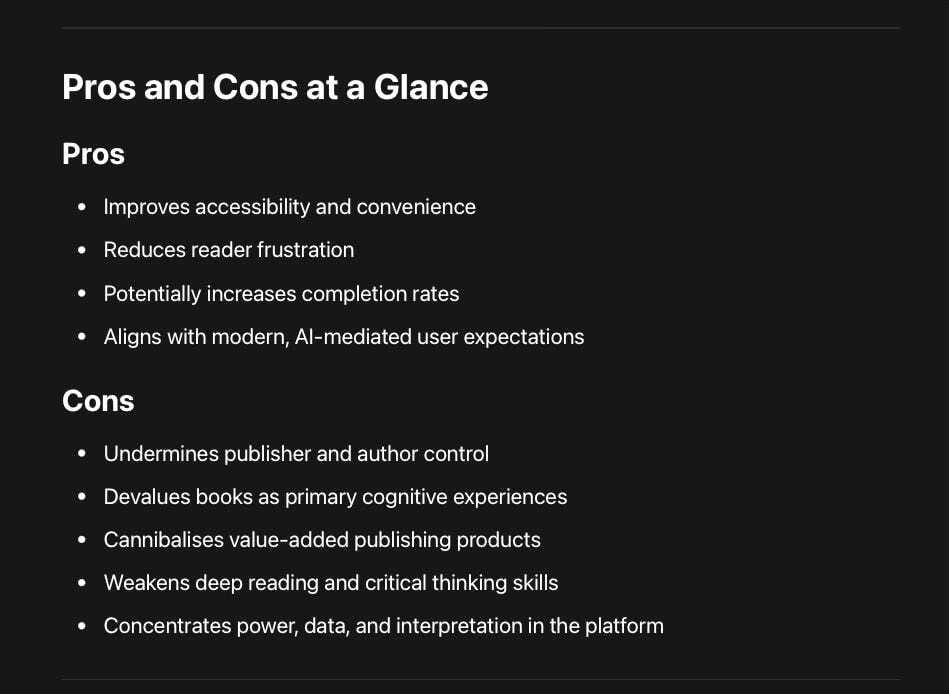
Pros and Cons at a Glance
Pros
Improves accessibility and convenience
Reduces reader frustration
Potentially increases completion rates
Aligns with modern, AI-mediated user expectations
Cons
Undermines publisher and author control
Devalues books as primary cognitive experiences
Cannibalises value-added publishing products
Weakens deep reading and critical thinking skills
Concentrates power, data, and interpretation in the platform
Conclusion: A Helpful Tool or a Category Mistake?
“Ask This Book” is not inherently malicious. Used sparingly and transparently, AI assistance could support readers who genuinely need help. But making it always on, non-optional, and platform-controlled crosses an important line.
From a commercial perspective, it accelerates a familiar pattern: publishers bear the cost of creation while platforms capture the surplus value of interpretation, data, and user attention. From a cognitive perspective, it risks training a generation of readers to consultbooks rather than think with them.
My view is that this feature represents a category mistake: treating books like FAQs instead of cognitive environments. Reading is not just about getting answers—it is about forming them. Any technology that forgets that may succeed commercially in the short term, while quietly impoverishing both the publishing ecosystem and the minds it claims to help.