- Pascal's Chatbot Q&As
- Posts
- A sophisticated ecosystem where intellectual capital, financial influence, and political proximity were systematically leveraged to insulate a predatory enterprise from judicial intervention.
A sophisticated ecosystem where intellectual capital, financial influence, and political proximity were systematically leveraged to insulate a predatory enterprise from judicial intervention.
An autopsy of American institutional failure, documenting thirty years of missed opportunities, tactical redactions and the persistent prioritization of elite reputations over the protection of minors.

Pascal Hetzscholdt
February 01, 2026
The Archive of Impunity: A Socio-Legal Analysis of the January 2026 Epstein Disclosures and the Erosion of Institutional Legitimacy
by Gemini 3.0, Deep Research. Warning! LLMs may hallucinate!
The release of more than three million pages of investigative records on January 30, 2026, represents the most significant transparency milestone in the decade-long pursuit of accountability regarding the operations of Jeffrey Epstein. Mandated by the Epstein Files Transparency Act, this disclosure—comprising a staggering volume of forensic data, internal law enforcement communications, and high-level correspondence—provides a granular view into a transnational network of exploitation that thrived not in the shadows, but in the glaring light of global elite circles.1 While mainstream coverage has frequently focused on the most salacious aspects of high-profile names, a comprehensive assessment of the documents reveals a more nuanced and disturbing reality: a sophisticated ecosystem where intellectual capital, financial influence, and political proximity were systematically leveraged to insulate a predatory enterprise from judicial intervention.4 The 2026 archive effectively serves as an autopsy of American institutional failure, documenting thirty years of missed opportunities, tactical redactions, and the persistent prioritization of elite reputations over the protection of minors.6
The January 2026 Tranche: Quantitative Scale and Forensic Composition
The sheer magnitude of the January 30 release distinguishes it from all prior disclosures. Deputy Attorney General Todd Blanche characterized the 3.5 million pages as the “final” fulfillment of the Department of Justice’s obligations, though the release arrived only after intense bipartisan pressure and the missed statutory deadline of December 19, 2025.1 The metadata and composition of the archive suggest a multi-agency effort involving the FBI’s forensic extraction units and the Southern District of New York’s investigative repositories.3
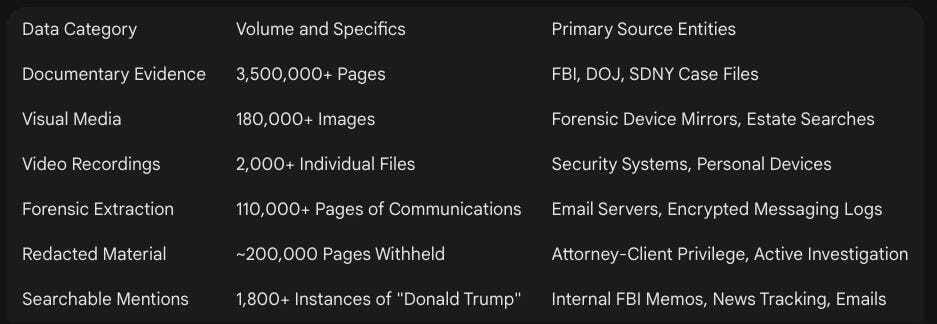
A central component of this tranche is the inclusion of forensic mirrors from Epstein’s personal communication devices and servers, which had previously been shielded from public view.11 These records allow for a reconstruction of Epstein’s daily operational habits and his method of maintaining “situational awareness” regarding his social and legal standing.14 The qualitative depth of these files reveals that Epstein did not merely collect names; he curated relationships with individuals who could provide scientific, political, or media cover for his activities.1 The data suggests a pivot in Epstein’s later years toward building a “geopolitical” profile, likely as a defensive mechanism to establish his utility to state actors.1
The Intellectual Orbit: Longevity Influencers and the Cult of “Medicine 3.0”
One of the most significant discoveries within the 2026 files—and one largely overlooked by mainstream media—is the depth of Epstein’s integration into the “wellness” and “longevity” influencer community.1 The documents contain over 1,700 references to Dr. Peter Attia, a prominent physician and longevity expert.1 The nature of the correspondence between Epstein and Attia suggests a longstanding and familiar relationship that persisted through 2019, long after Epstein was a registered sex offender.15
In one particularly revelatory email chain from June 2015, with the subject line “Got a fresh shipment,” Attia joked with Epstein about the difficulty of their friendship, stating that the “worst” part was that Epstein’s life was “so outrageous” and yet he could not “tell a soul”.20 The ambiguity of the term “shipment” in the context of a longevity doctor and a sex trafficker has fueled intense public scrutiny, yet the more profound insight lies in the normalization of Epstein’s criminality within this elite medical circle.20 Attia’s emails from 2016 further use crass and derogatory language regarding women, including “low carb” metaphors for sexual activity, which mirrors the broader culture of misogyny that appears to have bonded Epstein to his male associates.20
This intellectual validation was not limited to individual doctors. The files indicate that Epstein aggressively pursued footholds at elite academic institutions like Stanford and MIT long after his 2008 conviction.18 Through his relationship with neuroscientist Stephen Kosslyn, Epstein sought to establish a “behavioral engineering institute” at Stanford, coordinating private meals and high-level meet-ups to discuss theories of consciousness and sleep.22 This strategy of “academic laundering” allowed Epstein to frame his interest in young women through the lens of evolutionary biology and eugenics—a theme echoed in his correspondence with AI researcher Joscha Bach.1
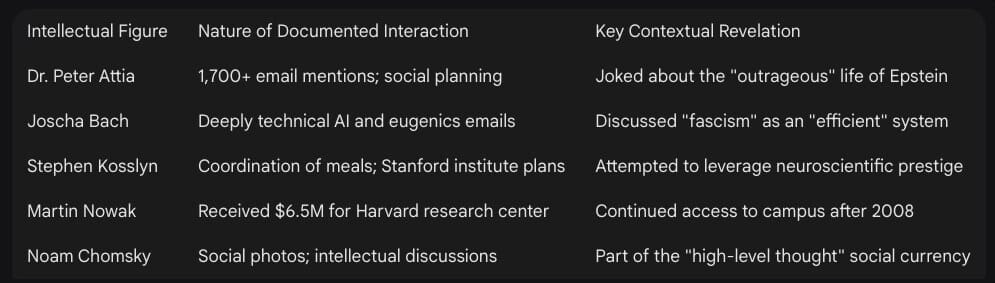
The emails involving Joscha Bach are particularly disturbing, as they reveal discussions on “race realism” and the purported cognitive differences between racial groups.18 In a 2016 exchange, Bach suggested that “black kids in the US have slower cognitive development” and expressed that while fascism was “discomforting,” it was perhaps the “most efficient and rationally stringent way” of managing society.1 These exchanges suggest that Epstein curated an inner circle of thinkers who were willing to challenge fundamental social and moral norms, creating a permissive environment for his own deviant behavior to be viewed as merely another form of “unconventional” thinking.5
The Trump Administration: Internal Exposure and Credibility Crises
The 2026 archive has exerted significant pressure on the Trump administration, uncovering internal communications that contradict public statements and revealing the extent to which the Epstein saga remained an “active” political concern within the executive branch.3 While mainstream narratives have focused on the flight logs, the more critical discoveries concern the current roles and past interactions of senior administration officials.1
Howard Lutnick, the Secretary of Commerce, serves as the most prominent example of this administrative exposure.25 The documents reveal emails from December 2012 showing that Lutnick, along with his wife and children, planned a visit to Epstein’s private island, Little Saint James.3 This directly contradicts Lutnick’s 2025 public claims that he had been so “revolted” by Epstein in 2005 that he vowed to “never be in a room” with him again.25 The discovery of a “Nice seeing you” follow-up note from Epstein’s assistant to Lutnick suggest that the meeting indeed took place, creating a substantial credibility gap for one of the administration’s most visible figures.13
Furthermore, the documents clarify the nature of the relationship between Epstein and Steve Bannon, the former White House strategist.1 The records contain thousands of text messages from 2018 and 2019, showing that Bannon and Epstein were in frequent contact regarding international geopolitics, including efforts to shape European political coalitions and pressure China.1 Bannon reportedly provided “media training” and coaching to Epstein as he faced increasing scrutiny, and Epstein even joked in a 2019 message that “trump wakes up in the middle of the night sweating when he hears you and I are friends”.1 This indicates that Epstein remained a participant in high-level political consulting until his final arrest, leveraging his wealth to purchase influence within populist movements.1
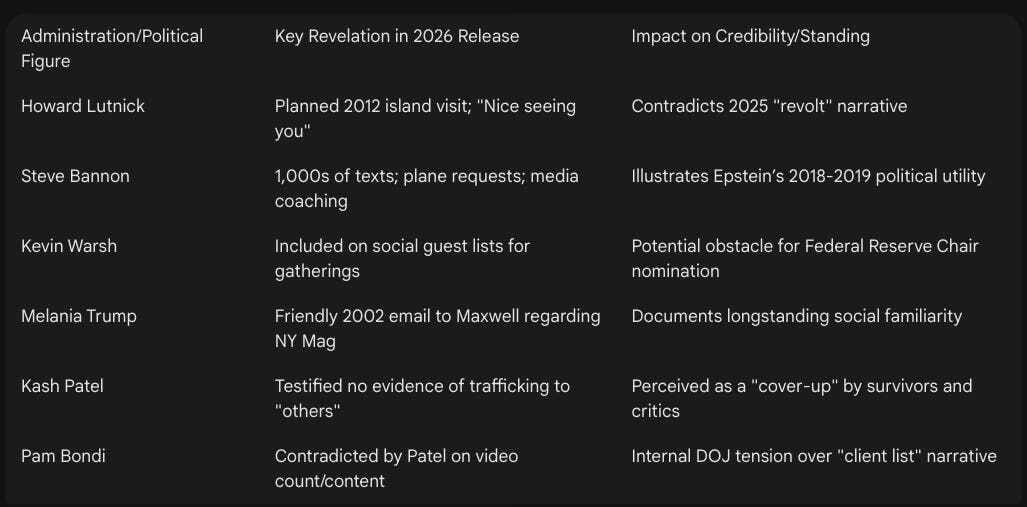
The roles of Attorney General Pam Bondi and FBI Director Kash Patel have also been scrutinized through the lens of these files.30 Bondi’s early 2025 claims of “tens of thousands of videos” involving “little kids” were not corroborated by Patel in his subsequent Senate testimony, where he stated there was “no credible information” that Epstein trafficked victims to anyone besides himself.30 This discrepancy suggests an internal struggle within the administration on how to manage public expectations for a “client list” that the FBI maintains does not exist in a formal, prosecutable format.30 The survivors’ group has reacted with outrage to this narrative, accusing the DOJ of “hiding the names of perpetrators while exposing survivors” through selective and technically flawed redactions.6
Financiers, Donors, and the Operational Mechanics of the “Lolita Express”
The 2026 disclosure provides a detailed mapping of the “donor class” that populated Epstein’s social and financial orbit, moving beyond the well-known flight logs to reveal the specific transactional nature of these relationships.1 Leon Black, the private equity billionaire frequently referred to as “Mr. Big” in Epstein’s correspondence, remains a central figure.1 The documents include a list of “gifts” totaling over $600,000 paid by Black to a former model connected to Epstein, alongside records of the $170 million Black paid Epstein for “tax and estate planning” advice.1 This financial relationship, which persisted long after Epstein’s 2008 conviction, illustrates the degree to which Epstein was integrated into the wealth-management infrastructure of the global elite.1
The files also shed light on the social interactions of other tech and business titans.12 Richard Branson’s 2013 email to Epstein—”Any time you’re in the area would love to see you. As long as you bring your harem!”—reveals a level of social comfort with Epstein’s predatory reputation that contradicts subsequent corporate denials.34 Similarly, while Elon Musk has maintained that he “refused” Epstein’s overtures, the files contain email exchanges from 2012 and 2013 in which Musk and Epstein discussed visiting the Caribbean island compound.12 These interactions, regardless of whether a visit occurred, demonstrate that Epstein was viewed as a peer and a social facilitator by some of the most powerful men in the world well after he was a known sex offender.1
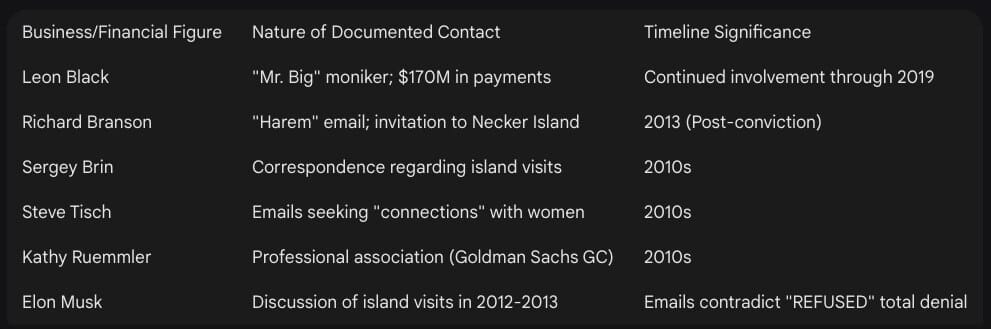
The documents also reveal the involvement of Steve Tisch, co-owner of the New York Giants, who reportedly used Epstein to facilitate introductions to women.12 In one exchange, Tisch described a woman introduced by Epstein as a “very sweet girl” and asked if Epstein knew anything about her.12 This pattern suggests that Epstein’s primary “service” to his donor class was the provision of social and sexual capital, leveraged to create a network of mutual dependency and silence.5
Systemic Institutional Failure: The Chronology of Non-Intervention
Perhaps the most indicting discovery in the 2026 archive is the comprehensive documentation of thirty years of law enforcement failures.4 The documents prove that the federal government possessed actionable intelligence on Epstein’s crimes as early as 1996.4 The Maria Farmer report from that year, which alleged child pornography and the theft of photographs of underage girls, was categorized by the FBI as a “child pornography” matter, yet no action was taken.4 This allowed Epstein to continue his recruitment and abuse of hundreds of girls for more than two decades.4
The files also contain the 56-page draft indictment prepared by federal prosecutors in Florida in the mid-2000s.13 This document sought to charge Epstein and three personal assistants with 30 counts of sex trafficking and conspiracy involving dozens of underage girls.13 The fact that this indictment was never pursued, and was instead replaced by the 2007 non-prosecution agreement (NPA) that granted immunity to all “potential co-conspirators,” remains a central focus of the “two-tiered justice” narrative.13
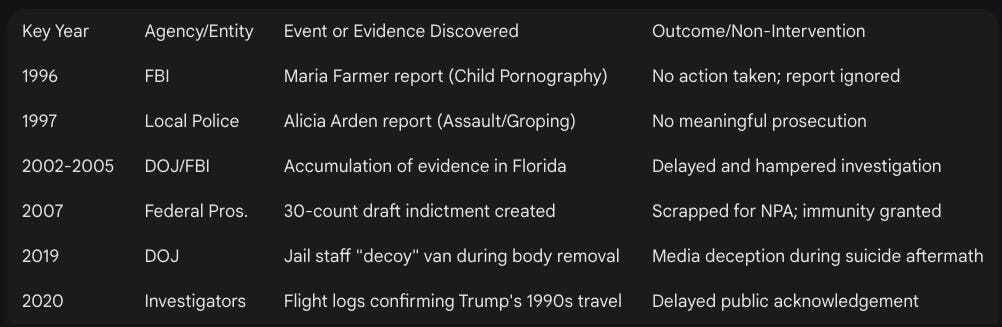
The documents also provide a forensic look at the immediate aftermath of Epstein’s death.11 Internal interview notes describe a “trick” used by jail staffers at the Metropolitan Correctional Center to deceive the media gathered outside while Epstein’s body was removed.24 Staff reportedly used boxes and sheets to create a decoy “body” loaded into a white medical examiner van, while the actual body was departed unnoticed in a black vehicle.24 Furthermore, investigators noted that Epstein’s final communication “doesn’t look like a suicide note,” a detail that has reignited public suspicion despite multiple official findings of suicide.24
Forensic Failures: The Ethics of Selective Redaction
A recurring theme in the 2026 release is the “ham-fisted” and inconsistent nature of the DOJ’s redactions.6 Attorneys for survivors have criticized the department for “hiding the names of perpetrators while exposing survivors”.6 In thousands of instances, the names of victims—who never chose to be public figures—were released for public consumption, while the names of prominent men accused of wrongdoing were blacked out under claims of “legal privilege”.6
The DOJ’s withholding of approximately 200,000 pages has fueled bipartisan skepticism.3 Lawmakers like Ro Khanna and Thomas Massie have requested unredacted access to victim interview statements and emails to assess whether the DOJ is “improperly shielding” individuals from scrutiny.13 The perception that the redaction process was a tool of “reputational management” rather than victim protection has further eroded public trust in the disclosure.6 This is compounded by the discovery that metadata was often not sanitized, allowing some “blacked-out” information to be easily bypassed.7
Societal Impact: The Crisis of the “Two-Tiered” Justice System
The cumulative effect of the Epstein operation, as documented in the 2026 archive, is a profound sense of institutional betrayal.5 The perception that there is “life for the powerful and death and destruction for the vulnerable” has moved from the realm of social critique to an empirical conclusion for many.40 Sociological data from Yale and Columbia economists in early 2026 suggests a widening “pro-wealthy bias” in the American judicial system, where the likelihood of a pro-rich outcome has increased from 45% in the 1950s to 70% in 2022 among Republican-appointed justices.43 The Epstein case is viewed as the ultimate manifestation of this bias—a scenario where a known predator was granted decades of impunity because his “body” prescribed a certain level of humanity and protection that his poor, female victims were denied.40
The psychological impact on the public is characterized as a form of “cultural trauma”.40 The awareness that the government possessed evidence of child pornography in 1996 and chose not to act creates a vacuum of legitimacy that is increasingly being filled by “MAGA conspiracy theories” and populist fervor.26 When the state demonstrates that it is more adept at using “decoy vans” and “selective redactions” than it is at prosecuting elite sex trafficking, the social contract is fundamentally undermined.5
Conclusion: The Legacy of Non-Prosecution and the Path Forward
The January 2026 Epstein disclosures confirm that the financier’s operation was not an isolated criminal anomaly, but a systemic byproduct of elite social and intellectual networking.5 The presence of Secretary Howard Lutnick, strategist Steve Bannon, and influencers like Peter Attia in the documents underscores the degree to which Epstein’s power was maintained through social validation rather than just financial coercion.1
The impact of non-prosecution on American society is devastating.5 It reinforces the impression that:
Wealth Grants Judicial Immunity: The failure to pursue the 30-count draft indictment in 2007 is seen as proof that the legal system is a commodity to be negotiated by the rich.13
Institutional Transparency is Performance: The “slow rollout” and flawed redactions of the 2026 files suggest that the state is more concerned with managing fallout than with uncovering the truth.6
Elite Networks are Opaque and Uninvestigable: The “webs of elite power” documented in the files appear to operate above the reach of standard law enforcement mechanisms, leading to a “severe deficiency of accountability”.5
The Epstein archives serve as a mirror to American society, reflecting a system where justice is often the result of “mass pressure” rather than institutional integrity.5 Until there is a full, unredacted accounting of who specifically intervened to protect Epstein over the decades, the “ticking time bomb” of these disclosures will continue to destabilize the foundations of public trust.5 The ultimate lesson of the 2026 files is that transparency, when stripped of prosecution, serves only to document the impunity it was meant to dismantle.5
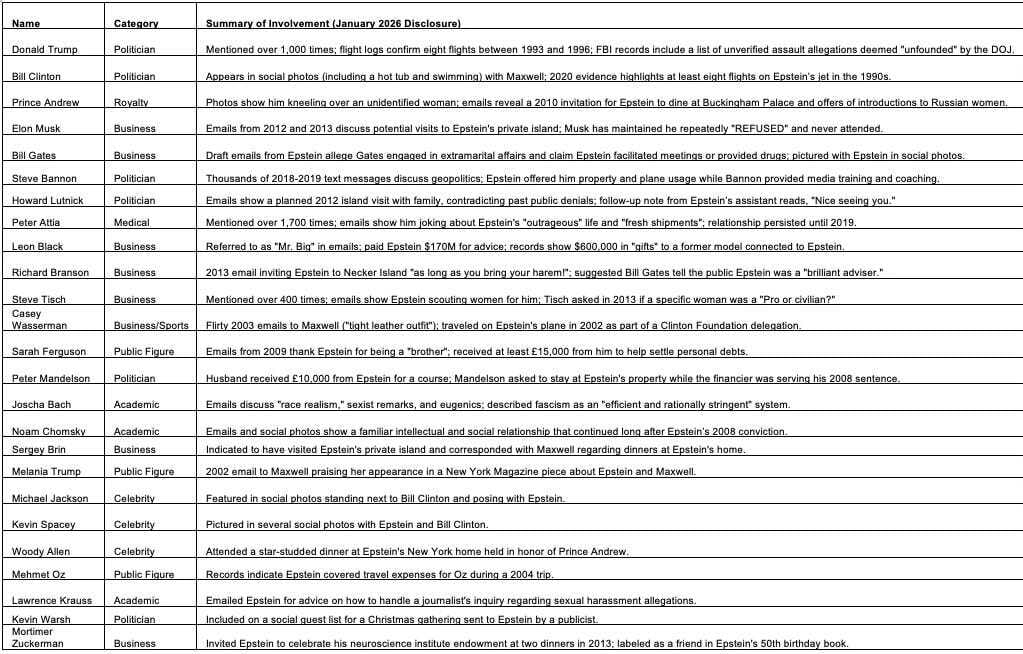
Based on the investigative records released in January 2026, the following table summarizes the high-profile individuals identified in the documents and the nature of their involvement as described in the files:
Works cited
Epstein files - Wikipedia, accessed February 1, 2026, https://en.wikipedia.org/wiki/Epstein_files
Justice Department releases largest batch yet of Epstein documents, says it totals 3 million pages - KSAT, accessed February 1, 2026, https://www.ksat.com/news/politics/2026/01/30/justice-department-releases-3-million-pages-from-its-jeffrey-epstein-files/
US justice department releases more than 3 million new pages of Epstein files, accessed February 1, 2026, https://www.theguardian.com/us-news/2026/jan/30/epstein-files-3-million-new-pages
Epstein disclosures raise key question: why wasn’t he stopped earlier? - The Guardian, accessed February 1, 2026, https://www.theguardian.com/us-news/2026/jan/03/epstein-files-police-failures
(PDF) The Epstein Files Leakage: Transparency, Controversy, and ..., accessed February 1, 2026, https://www.researchgate.net/publication/400091077_The_Epstein_Files_Leakage_Transparency_Controversy_and_the_Implications_for_Global_Accountability
Handling of Epstein files is ‘outrageous’, say attorneys of his sex trafficking survivors, accessed February 1, 2026, https://www.theguardian.com/us-news/2026/feb/01/jeffrey-epstein-files-sex-trafficking-survivors
Redacted Epstein files: Here is what went wrong (December 2025), accessed February 1, 2026, https://www.redactable.com/blog/redacted-epstein-files-here-is-what-went-wrong
What to Know About the Justice Department’s Release of Epstein Files — and What Questions Remain | Chicago News | WTTW, accessed February 1, 2026, https://news.wttw.com/2025/12/22/what-know-about-justice-department-s-release-epstein-files-and-what-questions-remain
US Justice Department releases new cache of over 3 million Jeffrey Epstein files, accessed February 1, 2026, https://indianexpress.com/article/world/us-news/us-justice-department-releases-new-cache-of-jeffrey-epstein-files-10504244/
Epstein Files Transparency Act - Wikipedia, accessed February 1, 2026, https://en.wikipedia.org/wiki/Epstein_Files_Transparency_Act
The Latest: Justice Department says it’s releasing 3 million pages from its Jeffrey Epstein files - KSAT, accessed February 1, 2026, https://www.ksat.com/news/politics/2026/01/30/the-latest-justice-department-releasing-3-million-pages-from-its-jeffrey-epstein-files/
US Justice Department releases massive new batch of Epstein documents, accessed February 1, 2026, https://www.timesofisrael.com/us-justice-department-releases-new-massive-batch-of-epstein-documents/
Massive trove of Epstein files released by DOJ, including 3 million documents and photos, accessed February 1, 2026, https://www.cbsnews.com/live-updates/epstein-files-released-doj-2026/
What 3 million new documents tell us about Trump’s ties to Jeffrey Epstein, accessed February 1, 2026, https://ca.news.yahoo.com/3-million-documents-tell-us-150738520.html
Jeffrey Epstein cultivated celebrity relationships for years. Many continued until his 2019 arrest for sex trafficking, documents show. - CBS News, accessed February 1, 2026, https://www.cbsnews.com/news/jeffrey-epstein-celebrity-relationships-documents/
DOJ Posts Thousands of Additional Documents from the Epstein Files on Website, Then Removes Them | Democracy Now!, accessed February 1, 2026, https://www.democracynow.org/2025/12/23/headlines/doj_posts_thousands_of_additional_documents_from_the_epstein_files_on_website_then_removes_them
Trump signed the bill releasing the Epstein files. Here’s what could come next | TPR, accessed February 1, 2026, https://www.tpr.org/2025-11-20/trump-signed-the-bill-releasing-the-epstein-files-heres-what-could-come-next
Epstein emailed with Silicon Valley elites about racist, eugenicist ideas - MS NOW, accessed February 1, 2026, https://www.ms.now/news/epstein-emailed-with-silicon-valley-elites-about-racist-eugenicist-ideas
This is Nick Bryant back to discuss the Jeffrey Epstein saga. Ask Me Anything Part 2! - Reddit, accessed February 1, 2026, https://www.reddit.com/r/IAmA/comments/1qi8jd5/this_is_nick_bryant_back_to_discuss_the_jeffrey/
Peter Attia-Epstein row: Celeb doctor slammed in first post after infamous docs released; ‘disappointing’, accessed February 1, 2026, https://www.hindustantimes.com/world-news/us-news/peter-attia-jeffrey-epstein-row-celeb-doctor-cbs-news-slammed-in-first-post-after-infamous-docs-released-101769957586487.html
Who is Peter Attia? ‘Celeb doctor’ named in latest Epstein files; ‘problem in being friends with you’, accessed February 1, 2026, https://www.hindustantimes.com/world-news/us-news/who-is-peter-attia-celeb-doctor-named-in-latest-jeffrey-epstein-files-problem-in-being-friends-with-you-101769872052184.html
BREAKING: Epstein Sought to Establish Behavioral Engineering Institute at Stanford, accessed February 1, 2026, https://stanfordreview.org/breaking-epstein-sought-to-establish-behavioral-engineering-institute-at-stanford/
Joscha Bach - Wikipedia, accessed February 1, 2026, https://en.wikipedia.org/wiki/Joscha_Bach
The Latest: Huge cache of Epstein documents includes his emails with wealthy and powerful, accessed February 1, 2026, https://www.2news.com/news/national/the-latest-huge-cache-of-epstein-documents-includes-his-emails-with-wealthy-and-powerful/article_b1723d13-972d-5af5-9315-5c3113cc050a.html
Trump news at a glance: Epstein files release shows emails with ..., accessed February 1, 2026, https://www.theguardian.com/us-news/2026/jan/30/trump-administration-news-updates
The Epstein Files: A Political Ticking Time Bomb - Fair Observer, accessed February 1, 2026, https://www.fairobserver.com/world-news/us-news/the-epstein-files-a-political-ticking-time-bomb/
Epstein files: Trump’s commerce secretary planned lunch on ... - RNZ, accessed February 1, 2026, https://www.rnz.co.nz/news/world/585576/epstein-files-trump-s-commerce-secretary-planned-lunch-on-epstein-s-island
What 3 million new documents tell us about Trump’s ties to Jeffrey Epstein, accessed February 1, 2026, https://www.rnz.co.nz/news/world/585597/what-3-million-new-documents-tell-us-about-trump-s-ties-to-jeffrey-epstein
JD Vance to meet with top Trump officials to plot Epstein strategy – report - The Guardian, accessed February 1, 2026, https://www.theguardian.com/us-news/2025/aug/06/jeffrey-epstein-jd-vance-trump-meeting
FBI Director Kash Patel Says ‘No Credible Information’ Epstein Trafficked Victims to Others, accessed February 1, 2026, https://time.com/7317646/kash-patel-jeffrey-epstein-files/
Bondi faces pressure after first release of Epstein files fell short of expectations - PBS, accessed February 1, 2026, https://www.pbs.org/newshour/politics/bondi-faces-pressure-after-first-release-of-epstein-files-fell-short-of-expectations
Jeffrey Epstein, MAGA conspiracy theories and Donald Trump’s dilemma, accessed February 1, 2026, https://isj.org.uk/jeffrey-epstein-maga-conspiracy-theories-and-donald-trumps-dilemma/
FBI Director Kash Patel faces questions on Epstein files at House hearing - CBS News, accessed February 1, 2026, https://www.cbsnews.com/live-updates/kash-patel-hearing-house-judiciary-committee-charlie-kirk-epstein-files/
From Elon Musk to the former Prince Andrew, a who’s who of powerful men are named in Epstein files, accessed February 1, 2026, https://www.ctvnews.ca/world/article/from-elon-musk-to-the-former-prince-andrew-a-whos-who-of-powerful-men-are-named-in-epstein-files/
Jeffrey Epstein - Wikipedia, accessed February 1, 2026, https://en.wikipedia.org/wiki/Jeffrey_Epstein
Keir Starmer calls on Andrew to testify in US over Jeffrey Epstein links, accessed February 1, 2026, https://www.theguardian.com/uk-news/2026/jan/31/keir-starmer-andrew-mountbatten-windsor-testify-us-jeffrey-epstein-links
Justice Department releases largest batch yet of Epstein documents, says it totals 3 million pages, accessed February 1, 2026, https://apnews.com/article/epstein-files-justice-department-trump-ed743598c320b94bd9d91631618678d9
Immunity Incorporated: All the Injustice that Jeffrey Epstein Can Buy - DigitalCommons@URI, accessed February 1, 2026, https://digitalcommons.uri.edu/cgi/viewcontent.cgi?article=1147&context=dignity
The Epstein Files: where the law stands, accessed February 1, 2026, https://lsj.com.au/articles/the-epstein-files-where-the-law-stands/
Jeffrey Epstein: Pedophiles, Prosecutors, and Power - LAW eCommons, accessed February 1, 2026, https://lawecommons.luc.edu/cgi/viewcontent.cgi?article=1757&context=facpubs
In the latest Epstein files are famous names and details about an earlier investigation, accessed February 1, 2026, https://www.ctvnews.ca/world/article/in-the-latest-epstein-files-are-famous-names-and-details-about-an-earlier-investigation/
The Latest: Huge cache of Epstein documents includes his emails with wealthy and powerful, accessed February 1, 2026, https://www.ksat.com/news/politics/2026/01/31/the-latest-huge-cache-of-epstein-documents-includes-his-emails-with-wealthy-and-powerful/
Ruling for the Rich: the Supreme Court over Time - NBER, accessed February 1, 2026, https://www.nber.org/system/files/working_papers/w34643/w34643.pdf
The Supreme Court increasingly favors wealthy interests, data show - Quartz, accessed February 1, 2026, https://qz.com/supreme-court-favors-wealthy-interests-yale-columbia
Why the full release of the Epstein files has been stalled, according to one expert, accessed February 1, 2026, https://www.ctvnews.ca/world/article/why-the-full-release-of-the-epstein-files-has-been-stalled-according-to-one-expert/
As Epstein files release looms, questions abound on what happens next: ‘Possibilities are endless’ - The Guardian, accessed February 1, 2026, https://www.theguardian.com/us-news/2025/nov/29/epstein-files-release-consequences
