- Pascal's Chatbot Q&As
- Posts
- A blueprint for a future in which creators, publishers, and AI developers coexist within a regulated, accounted-for marketplace...
A blueprint for a future in which creators, publishers, and AI developers coexist within a regulated, accounted-for marketplace...
...that recognises training as a form of commercial exploitation and AI outputs as economically attributable derivatives.

Pascal Hetzscholdt
December 13, 2025
Rebalancing the Music–AI Economy — An Analysis of IMPF’s Key Principles for CMO Licensing Models
by ChatGPT-5.1
The IMPF’s Key Principles for CMO Licensing Models for Generative AI represent one of the most structured and assertive attempts by a creative-rights sector to articulate what a fair AI licensing ecosystem should look like. Beyond being a policy wish list, the principles are a blueprint for a future in which creators, publishers, and AI developers coexist within a regulated, accounted-for marketplace that recognises training as a form of commercial exploitation and AI outputs as economically attributable derivatives.
Far from being parochial or music-specific, the document lays down a conceptual framework that maps cleanly across creative industries—including scholarly publishing, audiovisual media, photography, and journalism—each grappling with identical tensions: AI’s insatiable appetite for data, rightsholders’ need for transparency and compensation, and the global mismatch between ethical expectations and practical enforcement.
I. The IMPF Proposal: A Summary of the Core Architecture
At its core, the IMPF advances a dual-pillar compensation model:
1. Pillar 1 — Training-Based Licensing
This pillar frames training as a commercial use requiring a proper license. Key elements include:
Wide territorial scope—covering all AI providers in a jurisdiction, regardless of where training physically occurred.
Compensation mechanisms—parity between compositions and sound recordings, minimum guarantees, usage-based fees, collective licensing.
Value attribution—recognition that AI model quality directly depends on the quality of copyrighted inputs.
Transparency and auditability—dataset disclosure, usage logs, audit rights, metadata tagging.
This is the legal and economic equivalent of insisting that fuel suppliers be compensated for powering an engine that prints money.
2. Pillar 2 — Exploitation-Based Licensing
This pillar governs the downstream monetisation of AI-generated music:
AI-generated tracks used on streaming platforms, in retail environments, mobile apps, commercial generators, etc.
Royalty participation in all economic benefits derived from AI-generated music—even where the underlying source works are not individually identifiable.
Treatment of AI outputs as derivative works for compensation purposes.
Mandatory reporting and royalty payments from platforms distributing AI-generated music.
3. Cross-Cutting Principles
These include:
Value-based royalty allocation (market value of AI outputs, including synthetic data).
Market inclusivity (small and large AI providers alike must license).
Continuous adaptation (review clauses).
Moral rights protection (no distortion or derogatory uses).
Litigation readiness to set precedent and compel licensing.
Through this architecture, the IMPF is effectively saying: AI is welcome, but only if it respects the economic and moral fabric of the creative industries.
II. My Perspective: Are the IMPF Principles Economically and Legally Sound?
On balance, yes—the principles are clear, coherent, and aligned with significant global policy developments. But more deeply:
1. Treating Training as Commercial Use
The IMPF’s insistence that training constitutes commercial exploitation is consistent with:
The EU AI Act’s disclosure and data-provenance obligations
Emerging US case law around TDM, fair use boundaries, and derivative value extraction
Existing principles in collective rights management, where use that generates downstream commercial value is compensable even without direct traceability
From an economic standpoint, the value of training data is ongoing and multiplicative. A single dataset can fuel millions of outputs across an indefinite time horizon. The IMPF’s framing recognises the asymmetry between the one-time ingestion of a work and the continuous monetisation that follows—a tension visible in lawsuits across publishing, music, news, and film.
2. Output-Based Remuneration Is Essential
Treating AI outputs as derivative works—even non-identifiable ones—is controversial but increasingly necessary. AI models routinely generate works that are:
stylistically indebted
structurally patterned
statistically shaped by the training corpus
This is not “mere influence.” It is the extraction of economic value from data patterns derived directly from copyrighted works.
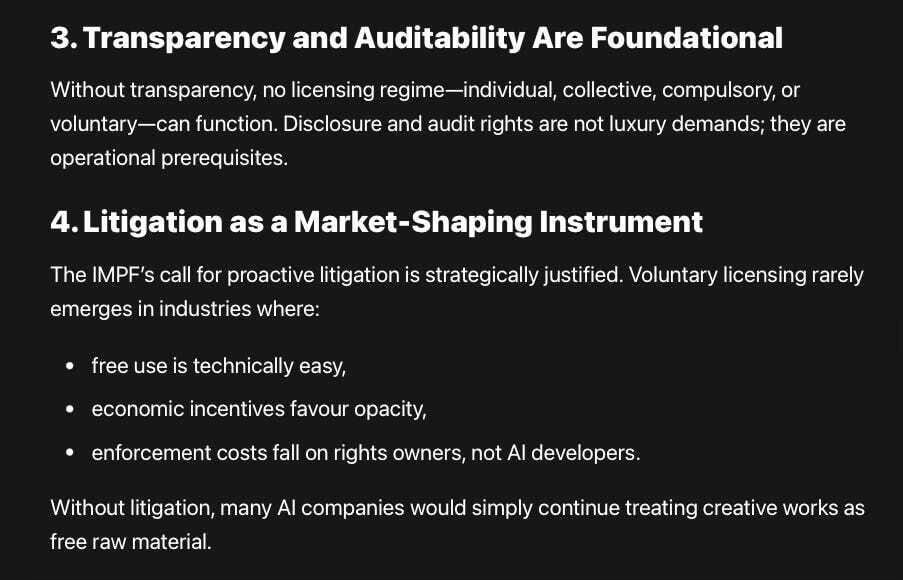
3. Transparency and Auditability Are Foundational
Without transparency, no licensing regime—individual, collective, compulsory, or voluntary—can function. Disclosure and audit rights are not luxury demands; they are operational prerequisites.
4. Litigation as a Market-Shaping Instrument
The IMPF’s call for proactive litigation is strategically justified. Voluntary licensing rarely emerges in industries where:
free use is technically easy,
economic incentives favour opacity,
enforcement costs fall on rights owners, not AI developers.
Without litigation, many AI companies would simply continue treating creative works as free raw material.
III. Should Others Adhere to These Principles? (Part A)
1. CMOs and Music Publishers
Yes, strongly.
These principles give CMOs a unified, scalable structure for handling AI, avoiding fragmentation and underpricing. Collective licensing is the only realistic mechanism for smaller publishers and creators to participate meaningfully in AI economics.
2. Other Creative Sectors (film, books, news, images, academic publishing)
Yes, with adaptations.
The IMPF model generalises remarkably well:
A dual-pillar model (training + output licensing) directly maps to text, images, scientific literature, TV/film, journalism.
Moral rights protections are especially relevant in audiovisual and literary sectors.
Transparency and audit rights are universally applicable.
3. AI Developers
They should accept this as the cost of doing business in high-value markets.
A transparent, licensed ecosystem reduces litigation risk, secures access to high-quality datasets, and enables sustainable commercial deployment. In practice, it also enables differentiation: compliant models can be marketed as legally clean, ethically sound, and enterprise-ready.
4. Platforms Using AI Music (Spotify, YouTube, TikTok, apps)
They will increasingly need to tag AI content and report usage. This aligns with obligations platforms already face under performance and mechanical rights regimes.
IV. Should Regulators Adopt or Mandate These Principles? (Part B)
1. Which Principles Should Be Mandated?
Regulators should seriously consider mandating the following:
a. Transparency Requirements
Full dataset disclosure, training logs, and provenance tagging should be statutory, not optional. Without them, no licensing regime—market-based or statutory—can function.
b. Territorial Licensing Obligations
Because AI companies operate globally, regulators should explicitly allow national CMOs and rightsholders to license AI providers regardless of where training occurred. This follows the logic of territorial copyright enforcement already embedded in international law.
c. Audit Rights
Auditability is indispensable. Regulators should create a legal basis compelling AI companies to retain and disclose training metadata.
d. Downstream Usage Reporting
Platforms distributing AI-generated content should have reporting duties similar to those in existing copyright regimes.
2. Which Principles Should Not Be Directly Mandated?
Regulators should be more cautious about mandating:
specific royalty formulas (best left to private negotiation)
treating AI outputs as automatic derivative works (this may require future case law to settle nuances)
minimum guarantees (competition law issues may arise)
Regulators should set the conditions for fair licensing, not dictate the commercial terms.
3. Should Regulators Encourage Litigation?
Not directly. But regulators can:
Clarify that litigation is a valid mechanism to establish precedent.
Support frameworks (like the EU AI Act) that shift burdens toward compliance and transparency.
Litigation remains necessary until the market stabilises.
V. Conclusion: A Blueprint Worth Adopting—With Regulatory Reinforcement
The IMPF’s principles articulate a sophisticated, future-focused model for licensing generative AI. They recognise the economic realities of AI development, the fragility of creative ecosystems, and the need for both ex-ante transparency and ex-post enforcement.
My overall judgments:
Should others adhere to it?
Yes. CMOs, rights owners, platforms, and AI developers should treat these principles as the baseline for serious negotiations. The model is fair, scalable, and technologically informed.Should regulators make use of these suggestions?
Yes, selectively. Regulators should adopt the transparency, audit, territorial scope, and output-reporting obligations.
They should not prescribe economic terms but should enable the licensing market to function by mandating the information flows and rights-recognition structures upon which licensing depends.
Ultimately, the IMPF model is not just about protecting music—it is about ensuring that human creativity, in all its forms, retains agency, economic dignity, and practical control in an AI-driven world.