- Pascal's Chatbot Q&As
- Archive
- Page -32
Archive

Platforms are functioning as invisible filters, slowing the propagation of messages that do not align with Western strategic interests or that document the humanitarian costs of the intervention.
“Algorithmic suppression” or “shadowbanning", the deliberate de-amplification of specific narratives, footage, and geopolitical discourse under the guise of safety protocols or momentum-based ranking.


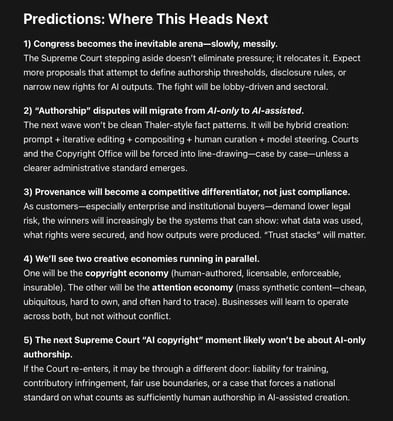
The U.S. Supreme Court’s decision to deny certiorari in Thaler v. Perlmutter lands like a deceptively quiet thud: no sweeping opinion, no doctrinal fireworks—just the sound of the status quo...
...locking into place. In the United States, a work that is truly “AI-only” (i.e., created without a direct, traditional human authorial contribution) remains outside copyright.

The transition of the global digital economy to a highly fragmented, AI-intensive, and kinetically vulnerable infrastructure marks a fundamental shift in the 2026 risk landscape.
Joint United States and Israeli military strikes against Iranian nuclear and military infrastructure triggered a retaliatory cycle that physically compromised the cloud backbone of the Middle East.
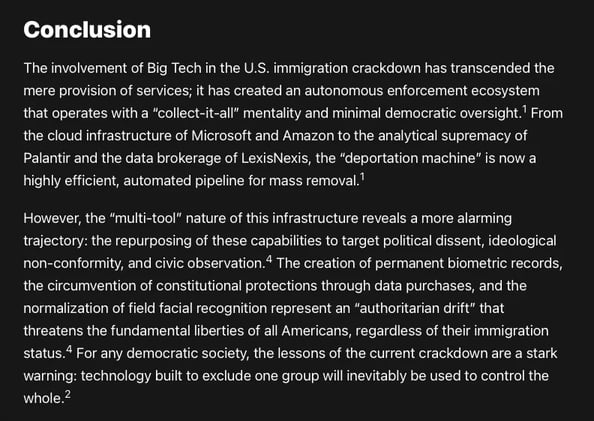
Big Tech's involvement in the U.S. immigration crackdown has created an enforcement ecosystem that operates with a “collect-it-all” mentality and minimal democratic oversight.
For any democratic society, the lessons of the current crackdown are a stark warning: technology built to exclude one group will inevitably be used to control the whole.
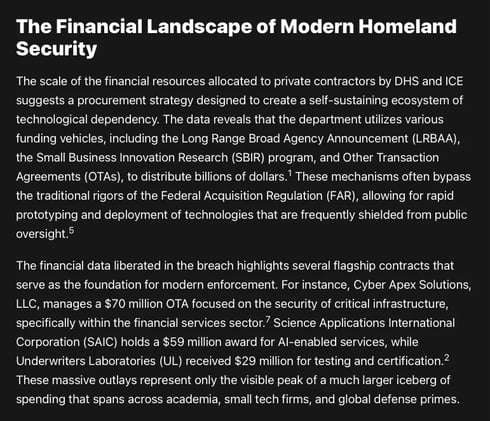
The emergence of the 2026 data breach, attributed to the hacktivist collective known as the Department of Peace, has provided an unprecedented lens into the DHS and ICE.
This breach encompasses contract data involving over 6,000 companies, revealing a sprawling infrastructure of surveillance, data analytics, and paramilitary logistics.

The US state apparatus acting less like a neutral referee of markets and more like a growth function for a particular sector. “Take our stack, because our diplomats will fight your sovereignty rules.”
“Adopt our tools, because our ‘help’ is organized around your purchase order.” That’s not development. That’s export strategy with humanitarian branding.

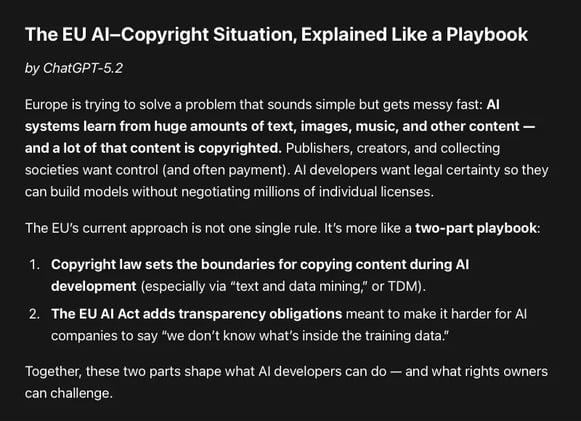
For publishers and rights owners, the EU playbook rewards those who turn rights enforcement into repeatable infrastructure (opt-out + monitoring + evidence).
For AI developers, it rewards those who treat training data and model behavior as auditable, testable, governable systems — not a black box and a shrug.

DHS has transitioned from a defensive posture, established in the wake of the September 11 attacks to protect the homeland from external threats, to an offensive domestic enforcement apparatus.
The domestic armamentarium is no longer just a set of tools; it is a fundamental reordering of the American state toward automated, high-powered internal containment.

South Korea: If the AI product competes directly with the original market (or acts like a drop-in replacement), fair use becomes much harder to defend.
Courts come down hard when the service is effectively built to replace a paid product using the same materials—like the Ross Intelligence v. Thomson Reuters/Westlaw scenario.

Europe wants more AI innovation, but only on a footing where copyright compliance, transparency, and remuneration are real—and enforceable.
The EU is trying to build infrastructure (opt-outs + transparency + licensing) that makes compliance and remuneration unavoidable rather than aspirational.