- Pascal's Chatbot Q&As
- Archive
- Page 9
Archive

Ace Cam v. Runway AI tries to reframe the core question from “Is training fair use?” to “Did you unlawfully break through access controls to get the training data in the first place?”
For AI providers, the warning is straightforward: your biggest legal vulnerability may not be your model outputs — it may be your data acquisition pipeline.


Korean broadcasters are seeking both injunctive relief (to stop alleged infringement) and damages, based on allegations that OpenAI trained ChatGPT on their news content without authorization.
The broadcasters put the emphasis on South Korea’s data sovereignty and the practical barriers local rights holders face when suing global AI firms.

The outsourcing of democratic orientation tools to systems that can fabricate facts, distort party positions, and present themselves as neutral while lacking any credible editorial process.
When such tools are wrong, the damage is not merely informational—it can directly alter political behavior, confidence in elections, and trust in institutions.

EPSTEIN CASE: An exhaustive analysis of the locations, methodologies, and materials associated with this concealment strategy, offering a blueprint for future investigative recovery.
A more critical dimension of the financier’s infrastructure has recently come to light: a sophisticated network of off-site storage units used to sequester incriminating digital and physical evidence.
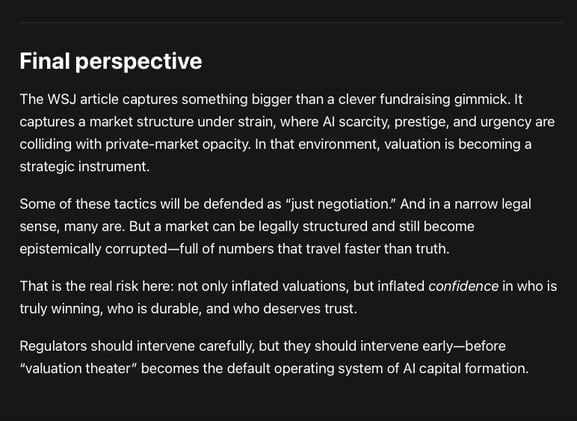
Where AI capital markets are right now: a market in which headline valuation can be engineered as a signaling weapon, not just discovered through ordinary price formation.
A startup sells shares to a lead investor at one valuation (lower), then sells additional shares to other investors shortly after (or concurrently) at a much higher valuation.

Switzerland’s reported concern was not framed as “Palantir’s tools don’t work.” It was framed as risk of access by US authorities. That moves the debate from product performance to sovereign control.
The collision between AI-era infrastructure vendors, democratic scrutiny, data sovereignty, and geopolitical trust.
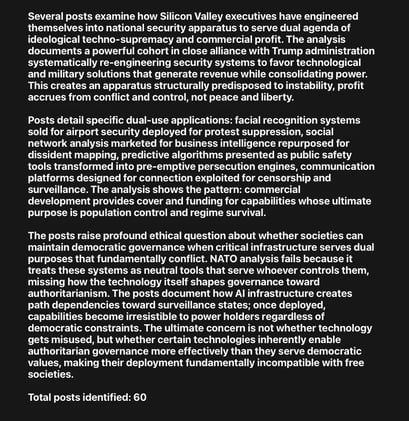
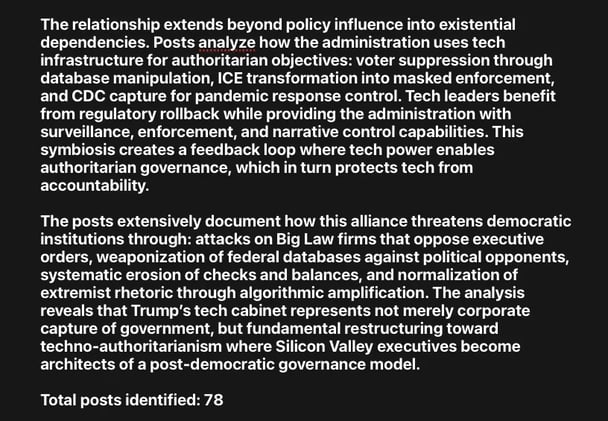
The posts systematically document how AI infrastructure developed for commercial applications readily converts to surveillance, military targeting, and authoritarian governance.
The analysis of Palantir crystallizes this dilemma: retirement security increasingly depends on investments in technologies that make states more capable of surveillance, coercion, and kinetic harm.

In this February 23, 2026 order, Judge Aileen Cannon bars the Department of Justice from releasing Volume II of Special Counsel Jack Smith’s final report outside the DOJ.
ChatGPT: This order is a democratic loss for transparency and public accountability. It did not order destruction. That leaves open the possibility of a better future path.
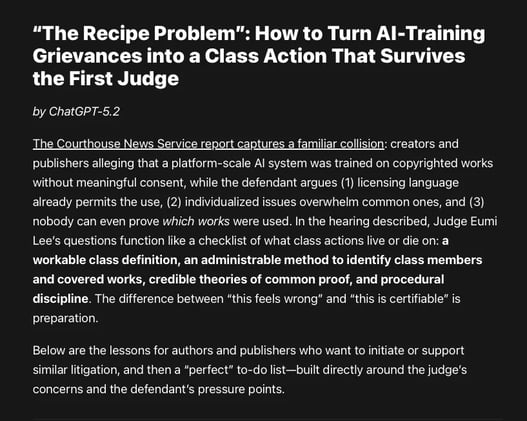
AI litigation: Judge Eumi Lee’s questions function like a checklist of what class actions live or die on: a workable class definition, an administrable method to identify class members and...
...covered works, credible theories of common proof, and procedural discipline. The difference between “this feels wrong” and “this is certifiable” is preparation.
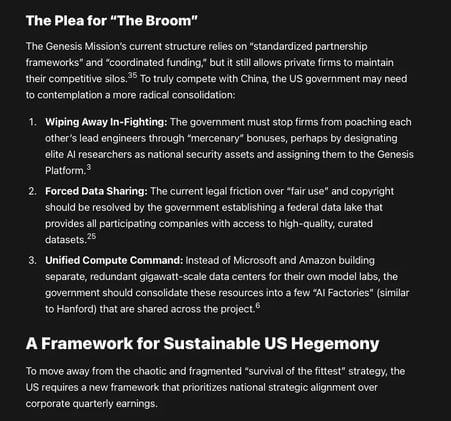
The plea for "The Broom". To truly compete with China, the US government may need to contemplate a more radical consolidation.
The Genesis Mission’s current structure relies on “standardized partnership frameworks” and “coordinated funding,” but it still allows private firms to maintain their competitive silos.
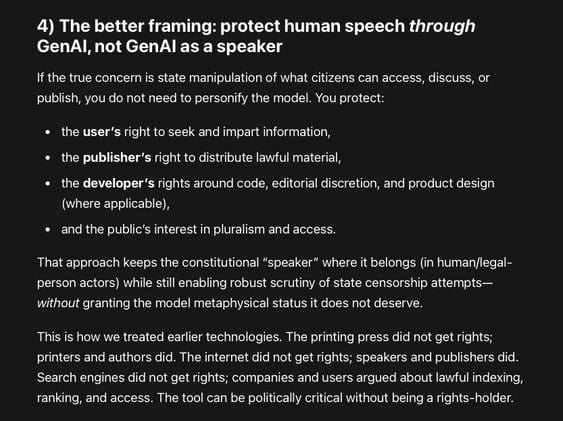
ChatGPT analyzes Marco Bassini's views: If you declare GenAI output “free speech,” you don’t just protect democracy against censorship. You also create an all-purpose deregulatory weapon...
...and an accountability escape hatch, while granting quasi-person status to systems that cannot bear moral responsibility.